Hainan to Enforce Island-Wide Ban on Fossil Fuel Vehicle Sales: Clarifying Prohibitions, Allowances, and Key Considerations for Vehicle Owners
 07/20 2026
 531
531
Author | Jiang Xu. For more financial insights, visit BT Finance and Economics Data. The main text comprises 2,994 words, with an estimated reading time of 9 minutes.
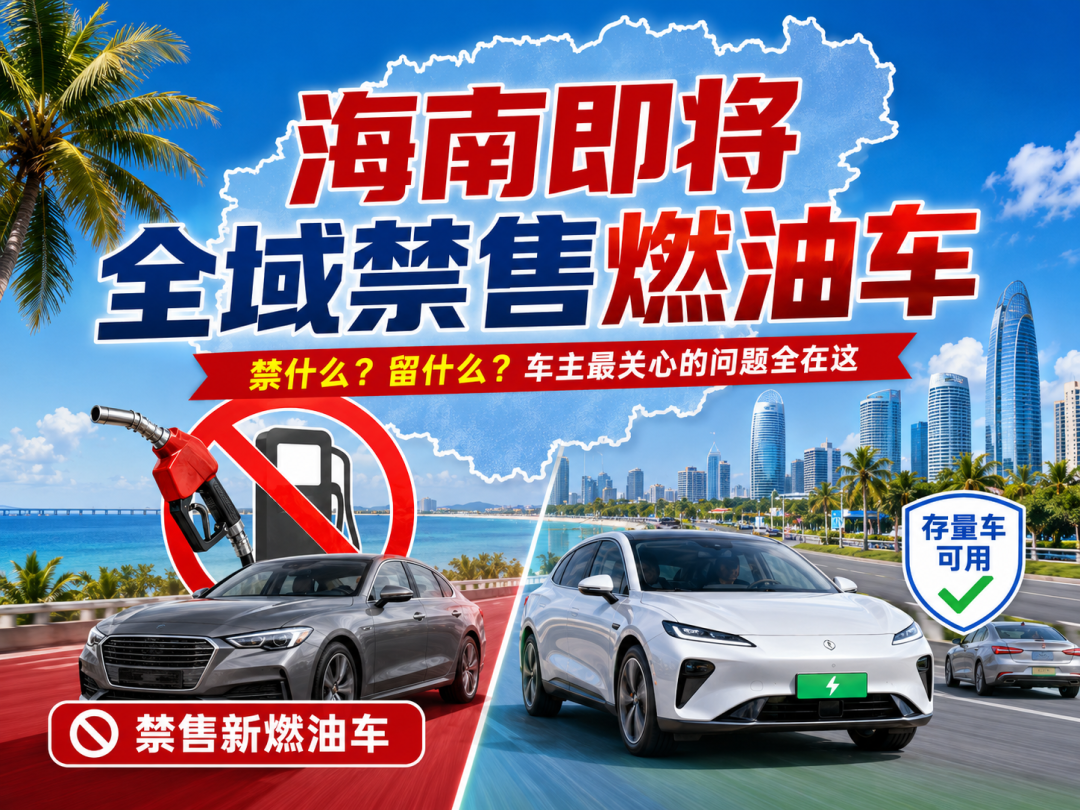
From July 13 to 14, multiple authoritative media outlets reported that the Hainan Provincial People’s Government unveiled the 15th Five-Year Plan for Hainan as a National Ecological Civilization Pilot Zone (Beautiful Hainan Construction: 15th Five-Year Plan), explicitly stating its intention to "steadily advance the prohibition on fossil fuel vehicle sales by 2030" (Sources: Xinhuanet, Sina Tech citing China News, July 13-14, 2026). This move positions Hainan as China’s inaugural province to implement an island-wide ban on fossil fuel vehicle sales, setting a precedent for nationwide green transportation transformation (Source: Xinhuanet, July 14, 2026).
Upon the news breaking, headlines such as "Fossil fuel vehicles face ban" proliferated, accompanied by widespread concern: Will I still be able to drive my gasoline car? Can gasoline vehicles from other provinces still enter Hainan? Is my province next in line? This article eschews sensationalism, focusing instead on a clear, point-by-point analysis of what the document states—and what it does not.
1
Clarifying the Scope: What’s Prohibited, What’s Allowed

The first key point is that "a ban on sales does not equate to a ban on driving." Reports indicate that the Plan clarifies that while sales will be prohibited, the operation of already registered fossil fuel vehicles will remain unaffected post-2030 (Source: Zhengguan News, July 14, 2026). In essence, the policy restricts new vehicle sales, not the use of existing ones: fossil fuel vehicles already in operation can continue to be driven, undergo annual inspections, and be transferred without mandatory early retirement.
The second key point is the "100% new and replacement vehicle" requirement. The Plan proposes that by 2030, 100% of new and replacement vehicles in public services, social operations (excluding special-purpose vehicles), and the private vehicle sector must utilize clean energy or new energy, with a vehicle-to-charger ratio below 2.5:1 (Source: Xinhuanet, July 14, 2026). Two details warrant attention: First, the exemption for "special-purpose vehicles" accommodates emergency and specialized operation vehicles. Second, the restriction targets "new and replacement" vehicles, indicating a gradual transition. Additionally, under China’s current statistical standards, plug-in hybrids and extended-range models are classified as new energy vehicles, with specific applicability subject to Hainan’s subsequent implementation rules.
The third key point is "steady advancement." The plan employs phrases like "steadily advance the 2030 ban on fossil fuel vehicle sales" rather than an immediate prohibition (Source: Xinhuanet, July 14, 2026). Supporting targets are also incremental: Hainan’s new energy vehicle ownership ratio is projected to increase from 23.75% in 2025 to 45% in 2030 (Source: Xinhuanet, July 14, 2026). The coexistence of a ban on new vehicle sales and half of existing vehicles still being fossil fuel-powered underscores the transition period’s duration.
Key Data
Policy: Hainan’s 15th Five-Year Plan for Hainan as a National Ecological Civilization Pilot Zone proposes steadily advancing the 2030 ban on fossil fuel vehicle sales. By 2030, 100% of new and replacement vehicles in public services, social operations (excluding special-purpose vehicles), and the private sector must use clean energy or new energy, with a vehicle-to-charger ratio below 2.5:1. A ban on sales ≠ a ban on driving (Sources: Xinhuanet, Zhengguan News, July 14, 2026).
Foundation: Hainan leads the nation in new energy vehicle market penetration and ranks second in ownership ratio among provincial regions. By October 2025, new energy vehicle penetration reached 67.14%, meaning roughly two out of every three newly registered vehicles are new energy. The ownership ratio was 23.75% in 2025 and is projected to rise to 45% by 2030 (Source: Xinhuanet, July 14, 2026).
2
Eight Years in the Making, Not a Sudden Shift
Tracing the timeline reveals that this is not an abrupt policy change but a path laid over eight years. In April 2018, the Guidelines of the CPC Central Committee and the State Council on Supporting Hainan in Comprehensively Deepening Reform and Opening Up first proposed "gradually banning fossil fuel vehicle sales in Hainan," marking the initial official mention of a "ban on sales" (Source: Zhengguan News, July 14, 2026). In March 2019, Hainan’s Clean Energy Vehicle Development Plan provided the nation’s first timeline: "A complete ban on fossil fuel vehicle sales across Hainan by 2030" (Source: National Business Daily, March 2019). In August 2022, Hainan’s Carbon Peak Implementation Plan reiterated a full island-wide ban on fossil fuel vehicle sales by 2030 (Source: China Energy News under People’s Daily, August 2022). This 15th Five-Year Plan advances the existing goal from "proposal" to "steady implementation."
A clear division of labor has long been established: public services aim to lead in clean energy adoption, followed by social operations, with private sectors focusing on strict incremental controls and gradual replacement of existing vehicles (Source: Hainan’s Clean Energy Vehicle Development Plan, March 2019). Buses, taxis, and sanitation vehicles lead the transition, with private cars following last—a sequence that progresses from easy to challenging.
3
Why Hainan?
Hainan’s confidence stems from three strengths. First is geography: Hainan Island spans 35,400 square kilometers with a 612.8 km ring highway. As a relatively isolated geographic unit, its size aligns well with mainstream new energy vehicle driving ranges. The Qiongzhou Strait’s natural barrier also creates a relatively closed loop for regulating new vehicle sales and registration (Sources: China Energy News under People’s Daily, August 2022; Zhengguan News, July 14, 2026). Second is climate: Tropical conditions prevent battery performance decline in cold temperatures—a significant challenge for new energy vehicle adoption in northern China (Source: Zhengguan News citing transportation analysts, July 14, 2026). Third is energy and market foundation: During the 14th Five-Year Plan period, new energy became Hainan’s largest power source, and its new energy vehicle penetration rate ranks first among provincial regions nationwide (Source: Xinhuanet, July 14, 2026).
Honesty requires acknowledging the challenges: When the first plan was released in 2019, industry experts noted that charging infrastructure, grid capacity, and energy self-sufficiency were critical hurdles for Hainan (Source: National Business Daily, March 2019). This plan’s vehicle-to-charger ratio target of below 2.5:1 directly addresses these ongoing challenges.
4
Will Your Province Follow Suit?
The question most concerning readers nationwide is: After Hainan, which province will be next? Two definitive points can be made. First, no nationwide ban timeline exists: The Ministry of Industry and Information Technology has previously stated that China’s vast regional differences in geography and climate make a unified national ban on fossil fuel vehicle sales unfeasible. Cui Dongshu, secretary-general of the China Passenger Car Association, has also repeatedly stated that an outright ban is inadvisable (Source: Public reports). Second, the industrial roadmap sets a milder benchmark: The Technology Roadmap for Energy-Saving and New Energy Vehicles proposes a directional goal for traditional pure fossil fuel vehicles to gradually exit mainstream new vehicle markets by 2035 (Source: Public materials).
The following logical deductions are offered for reader reference. The replicability of Hainan’s model is constrained by geographical conditions: The island’s closed nature resolves regulatory challenges of "local sales bans leading to cross-provincial purchases." Inland provinces cannot replicate this. A more likely path is phased implementation: First-tier cities and developed regions with high new energy penetration and infrastructure will explore staggered targets first, while other regions follow based on climate, grid, and industrial conditions. For existing vehicle owners, policies restrict new sales, not existing vehicles, so short-term panic disposals are unnecessary. However, Hainan’s pioneering implementation will accelerate nationwide consumer expectation shifts, with reduced new fossil fuel model supplies and declining secondhand residual values becoming long-term factors in purchasing decisions. All judgments are deductions; specifics depend on local official policies.
Framework for Interpreting "Sales Ban" Policies: Three Key Questions
In short, when encountering any "sales ban/driving ban" policy news, ask three questions before concluding: What is banned (new sales or existing vehicles, pure fossil fuel or hybrids)? From which year, and how long is the transition period? Who provides support (infrastructure, subsidies, existing vehicle guarantees)? After answering these, half of the anxiety from sensational headlines will dissipate.
5
What Does This Mean for You?
First, for Hainan’s vehicle owners and prospective buyers: Existing fossil fuel vehicles can be used normally—no need to panic. Those planning to buy new fossil fuel vehicles have a multi-year window to decide based on trade-in subsidies and charging conditions. Changes in secondhand fossil fuel vehicle circulation and residual values within the island are worth monitoring.
Second, for automotive industry professionals: While Hainan’s market size is limited, the policy signal will prompt automakers to further adjust product and production rhythms. Dealer transformation windows and construction orders for charging and battery-swapping networks represent visible business changes.
Third, for ordinary consumers nationwide: Hainan’s move does not immediately alter purchasing rules in your city, but it transforms "fossil fuel vehicle phase-out" from an abstract concept into a tangible example with timelines and details. When replacing your vehicle next time, include this example in your decision-making process—act rationally, not anxiously.
What are your thoughts? Welcome to share your views in the comments section.
This article is for information sharing and policy interpretation only and does not constitute investment advice, vehicle purchasing recommendations, or transaction solicitations. Policy content is based on Hainan Provincial People’s Government’s 15th Five-Year Plan for Hainan as a National Ecological Civilization Pilot Zone and subsequent official implementation rules. Data sources include Xinhuanet, Zhengguan News, China News, China Energy News under People’s Daily, and National Business Daily (March 2019–July 2026). Market risks exist; decisions require caution. Content marked as "deductions" represents logical reasoning based on public information and does not represent official positions.
This article is original to BT Finance and Economics. Unauthorized use, reproduction, dissemination, or adaptation is prohibited and may result in legal liability for infringement.
-
![]()
The Battery Swap Dream of Mr. Pleasant Goat: Pursuing IPO Despite $198 Million in Losses
-
![]()
Mercedes-Benz Advocates for Chinese Automobiles: Challenging U.S. 'Auto Exclusion of China'
-
![]()
Samsung's New Product Imitates Huawei's Wide Foldable? OPPO Joins the First Tier, Apple Awaits Supply Chain | Xinliu Observations
-
![]()
Alibaba Makes Its Premier AI Software Stack Open Source
-
The Wind Shifts: China’s Top Three Telecom Giants Embrace the ‘Token Economy’
-
The Wind Shifts: China’s Top Telecom Giants Embrace the ‘Token Economy’
-
![]()
Wang Xinling Becomes Spokesperson for a Renowned Auto Brand
-
![]()
Another High - Level Executive from XPENG Motors Is on the Verge of Leaving!