Alibaba Makes Its Premier AI Software Stack Open Source
 07/22 2026
 437
437
The Shanghai World Artificial Intelligence Conference recently came to a close. Gao Hui, Vice President of Alibaba's T-Head Semiconductor, made a significant announcement: Alibaba's self-developed AI software stack, T-Head SAIL, will be fully open-sourced.
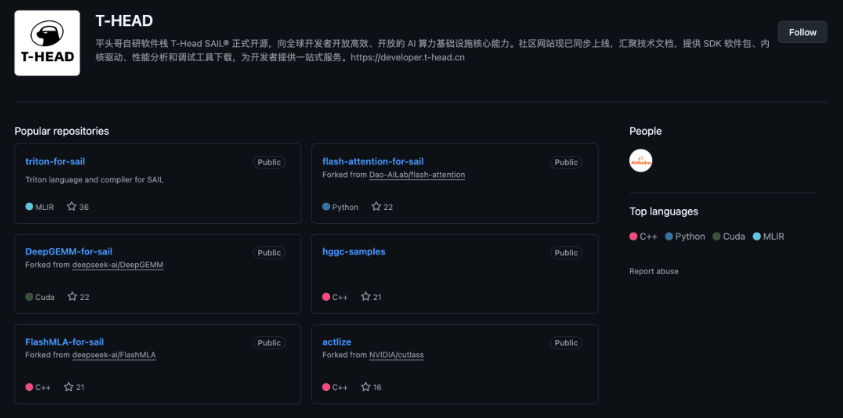
At first glance, this news may not have topped the popularity charts that day. However, from a commercial perspective, it could very well be one of the most impactful developments of the entire event.
What exactly is a software stack? Consider this analogy: if a chip is the engine of a vehicle, then the software stack is the transmission system. Developers write code using high-level frameworks like PyTorch, without directly interacting with the intricate circuitry of the underlying chip. A comprehensive software suite is required to translate this code, enable the system to recognize and utilize the chip, optimize computational speed through operator libraries, and compile the code into chip-specific instructions.
Without such a software stack, even the most advanced chip would be rendered useless, akin to a pile of sand.
The T-Head SAIL software stack acts as the "transmission" for T-Head's chips. It comprises a five-layer technology stack that encompasses everything from low-level drivers to developer tools. The chip it supports is named Zhenwu. According to Alibaba's data, as of April this year, the Zhenwu AI chip has achieved a cumulative shipment of 560,000 units, serving over 20 industries and more than 400 clients, including notable names like State Grid, the Chinese Academy of Sciences, and XPeng Motors.
According to documentation from Alibaba Cloud's help center, the SAIL SDK has undergone multiple iterations, reaching version 2.1. The earliest documentation dates back to March 2025, indicating that it has been operational in production environments for over a year.
In essence, T-Head is now making a software stack that has been validated by paying customers available to the broader public. Previously, access was limited to those who paid for it; now, developers worldwide can download and utilize it.
This move addresses a longstanding issue in the AI chip industry: while hardware can be developed, software development often lags behind.
NVIDIA's CUDA platform has spent over a decade accumulating libraries, tools, and cultivating developer habits. Switching to a different chip means incurring high costs for rewriting code and retraining teams.
On stage, Gao Hui stated that SAIL aims to reduce the adaptation time for mainstream AI inference frameworks to within seven days. It already supports over 260 frameworks, including industry standards like PyTorch, TensorFlow, and vLLM.
A more significant implication is that T-Head is not the first Chinese chip company to pursue this strategy. Huawei open-sourced the compute architecture CANN for its Ascend processors in 2025, and Moore Threads is following a similar path. Chinese AI chip companies are leveraging open-source to form a united front, challenging CUDA's dominance at the software level.
Of course, transitioning from open-source to a mature ecosystem is a time-consuming process.
CUDA's strength lies in its extensive accumulation of toolchains, tutorials, communities, and a pool of engineers. Developers choose CUDA not only for its quality but also for the support available when they encounter issues and the ease of hiring talent familiar with the platform. Such barriers cannot be overcome simply by open-sourcing a software stack.
T-Head's open-sourcing strategy unfolds in three phases: the first batch has already released the SDK, kernel drivers, and debugging tools; the second batch will open-source the communication library and v2.2 Docker source; and the third batch will make the compute acceleration library and inference engine available.
Alibaba's strategy is clear. With 560,000 chips sold, the commercial foundation is solid. The next step is to cultivate the ecosystem. Whether SAIL can evolve from a mere toolset into a foundational infrastructure depends on the number of developers who write code, submit issues, and contribute to its development in the future.
In the AI computing market, where CUDA holds sway, having an additional open-source option is undoubtedly beneficial. However, it is still a long way from becoming a viable replacement.
-
![]()
Baidu Dazi's Ambitious Overtaking with 'Product-Centric' Upgrades
-
![]()
AI PC Is Becoming Obsolete! The Rise of AC: Do Agents Really Need Their Own Computer?
-
![]()
Times Are Changing: Domestic New Energy Vehicles Are Driving Traditional Luxury Brands to the Wall, Prompting BBA to Slash Prices En Masse for Survival
-
![]()
The Myth of Musk
-
![]()
Which Type of Talents Do Automakers Prefer to Promote: Science or Liberal Arts Graduates?
-
![]()
Why has OPPO's strategy been readjusted in less than three months?
-
![]()
New Models Falter: Over 700 New Cars in the First Half of the Year Struggle, Only 4 New Models Surpass 10,000 Units in Sales, Achieving Hot Sales | Mingjing Pro
-
![]()
22 Billion Yuan in Subsidies Rolled Out! 117,000 New Energy Heavy Trucks Sold in H1, Penetration Rate Tops 33%