Toyota Accelerates Desperately While China Applies the Brakes - A Two-Way Race Begins in the Sino-Japanese Auto Industry
 08/11 2026
 566
566
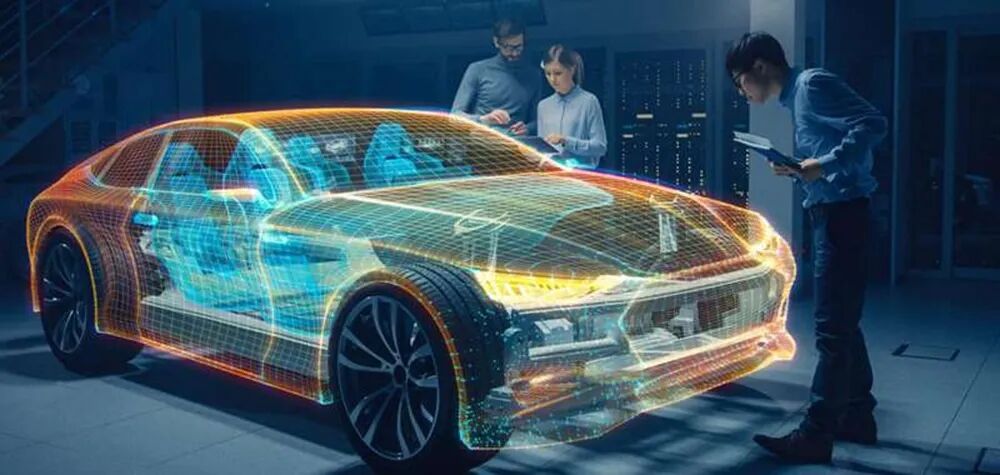
Lead
Introduction
Slow to accelerate, quick to rein in the wild.
"I think we are losing to China."
In the NHK documentary 'Inside Toyota,' aired on July 19, 2026, a Toyota development engineer faced the camera and made this blunt assessment.
After a pause, the engineer added: Chinese automakers can take a vehicle from blueprint to mass production in about two years, while Toyota still operates on a five- or even six-year rhythm. 'By the time the car is built, the market has already changed.'
At that moment, cameras were allowed into Toyota's 'top-secret' R&D base, capturing an internal meeting of the next-generation Corolla development team. This revealed the real struggles of the world's best-selling automaker in advancing its next-generation products.
The lens returns to the development site of the next-generation Corolla. This Toyota icon, with cumulative sales exceeding 57 million units, must accommodate fuel, hybrid, and electric powertrains on its latest platform, expected to serve for a decade. However, when the body team prepared to transfer the new platform blueprints to the factory for mold production, the manufacturing technology department refused them on the spot—the front longitudinal beam structure and weld spacing had not been finalized, making the cost of subsequent rework unbearable if molds were produced prematurely. The R&D side pushed for acceleration, while the manufacturing side insisted on waiting for data, leaving the progress pressure unconverted into approval.
This blueprint temporarily halted at the factory gate epitomizes Toyota's current dilemma: it wants to match China's speed but clings to verification baselines.
In the same documentary, Toyota Chairman Akio Toyoda admitted, 'There seems to be a strong sense of crisis within the company.' During an interview in the UK a month earlier, he put it more bluntly: 'Seeing everyone shift toward electrification... I feel very lonely.'
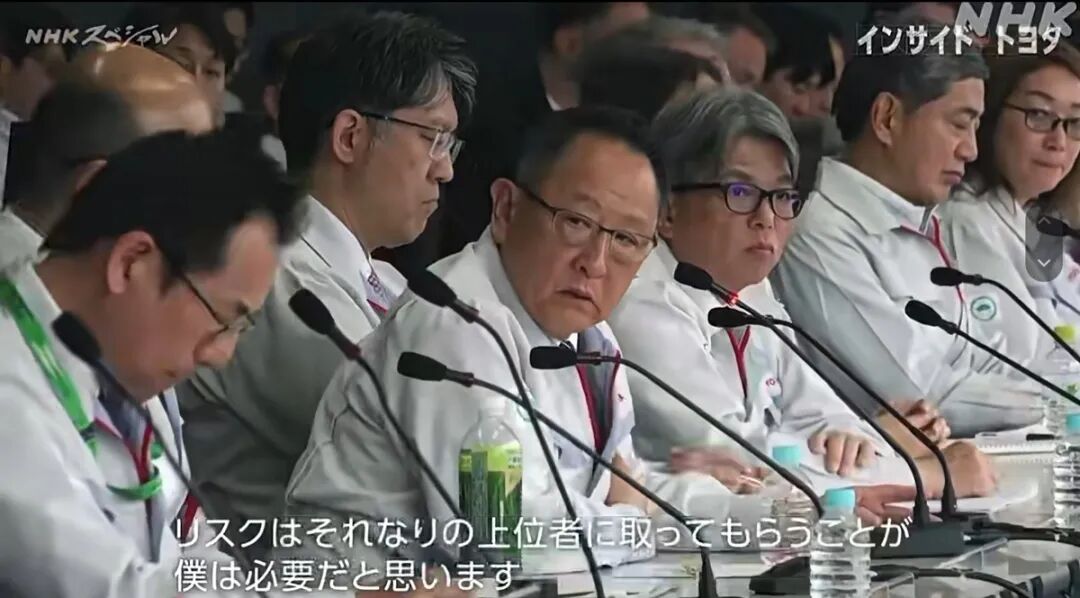
Figure 丨 Screenshot from the documentary. The subtitle means: I believe risks should be borne by corresponding senior personnel.
But while Toyota fretted over 'how to run faster,' across the sea, Chinese regulators were preparing 'speed bumps' for the industry amid concerns over rapid model turnover by domestic brands. In July 2026, the Ministry of Industry and Information Technology (MIIT) proposed raising reliability test mileage for new energy vehicles (NEVs) to 30,000 km, aligning it with internal combustion engine vehicles. Simultaneously, within a week, MIIT inspectors visited major OEM production bases twice, conducting unannounced random vehicle seizures for testing.
On one side, Toyota strives to accelerate; on the other, China moves to eliminate 'false speed.' These seemingly contradictory goals, in fact, represent a determined two-way convergence.
01 Toyota's Anxiety: How to Uphold Standards While Catching 'Chinese Speed'
Toyota's Anxiety: How to Uphold Standards While Catching 'Chinese Speed'
Since its founding, Toyota has never faced such urgency and disarray as in the past two years.
On one hand, this Japanese auto giant has topped global vehicle sales for five consecutive years since 2020, with profit margins far exceeding competitors. On the other hand, due to the rapid rise of Chinese rivals leveraging new energy and intelligent technologies, the company has been gripped by unprecedented crisis sentiment at all levels in recent years.
As a global representative of Japanese automakers, Toyota is accustomed to operating at its own fixed pace: defining the chassis framework first, then sculpting the body, ring by ring.
In the late 1980s, this Japanese giant set a record with its Lean Product Development model, compressing the development cycle of a new vehicle to under 40 months. The 2023 Crown Sport, for instance, was developed in just 21 months—less than half the industry norm of four years at the time. For years, this marked Toyota as an efficiency benchmark among traditional automakers.
However, the Corolla, as Toyota's iconic model and a global vehicle requiring coordination across 16 regional plants, has long struggled to accelerate its development cycles.
Thus, in the NHK footage, we witness the next-generation Corolla's 'unorthodox' approach—platform architecture and body development advancing in parallel.
Even before the chassis design was finalized, body development proceeded. To save time, engineers directly sliced sections from a Prius prototype and welded them onto the new Corolla platform, creating a patchwork prototype for early chassis testing.
No need to wait for final molds or styling approval; data collection began immediately. This approach, known as 'concurrent engineering' among Chinese peers, represents a silent revolution within Toyota.
But this 'silent revolution' was firmly halted by Toyota's manufacturing department, whose seasoned hands refused to budge.
The manufacturing technology department rejected the blueprints outright, citing clear reasons: the front longitudinal beam is the backbone of frontal collision safety. A few millimeters' deviation in weld spacing could downgrade offset crash results from 'excellent' to 'barely passing.'
By Toyota's strict rules, such critical safety components require extensive crash testing during the prototyping phase. Without thorough data, molds must not be produced—otherwise, billions of yen in sunk costs would be locked in, and post-launch modifications would be commercially catastrophic for a company like Toyota.
What Toyota aims to learn is not how to weld parts more cheaply but how to eliminate meaningless inefficiencies from its processes.
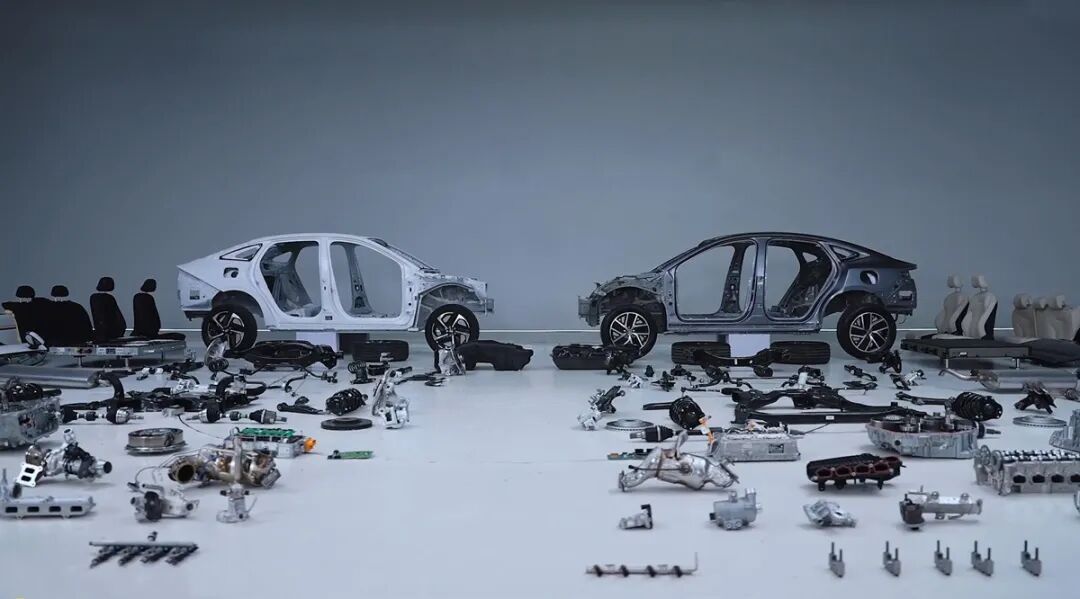
To understand how Chinese automakers achieve two-year model turnovers, Toyota engineers disassembled the Zeekr 007 and BYD Qin L. They discovered that some of the latest models' electrical/electronic architectures had skipped domain centralization, directly entering the stage of central computing combined with zonal control—reducing vehicle controllers from over 100 to just 20-plus, with full software-hardware decoupling. This means facelifts no longer require redrawing entire vehicle circuits; upper-layer applications can iterate independently, and some feature upgrades no longer depend on redeveloping underlying hardware.
However, much of the acceleration remains invisible through disassembly. In the past six to seven years, Chinese companies have shifted substantial verification and testing processes to the cloud: running 100,000 km of virtual endurance tests in a day, smoothing out potential issues through simulation before real-world validation.
What frustrates Toyota most is the decentralized decision-making. R&D centers in Shanghai and Shenzhen can finalize designs independently, with styling, chassis, and autonomous driving solutions closed-loop locally. Suppliers in the Yangtze River Delta receive updated designs overnight and deliver prototypes by dawn. This hardware-software integration, supported by highly flattened decision-making, is the knife that slashes development cycles to 24 months.
Thus, Toyoda's decisions—locating the Lexus all-electric factory in Shanghai and entrusting next-gen Corolla development to the Chinese team—essentially aim to shed Toyota's own 'any change requires cross-ocean approval' bureaucracy.
02 China Sets Rules: Nipping Risks in the Bud, Raising Baselines
While Toyota learns efficiency, Chinese regulators focus on institutionalizing 'speed.'
In January 2026, the MIIT issued Announcement No. 1, revising the 'Road Motor Vehicle Production Enterprise Access Review Requirements' and 'Road Motor Vehicle Product Access Review Requirements,' formally incorporating 'reliability verification' as a mandatory access criterion. This means 'whether to conduct reliability verification' is no longer just an internal quality management issue but a key indicator of a company's sustained manufacturing capability.
Immediately after, in July 2026, the National Technical Committee for Auto Standardization opened public consultations on three NEV homologation test procedures, proposing to unify reliability driving test mileage for battery electric (BEV), plug-in hybrid (PHEV), and fuel cell vehicles (FCV) at 30,000 km, matching internal combustion engine vehicles. BEVs must complete at least 90% of cumulative mileage under DC charging, while PHEVs require an additional 10,000 km in pure electric mode.
This effectively abolishes the long-standing '50% discount' for NEV reliability verification—the previous standard required only 15,000 km, half that of fuel vehicles.
It is crucial to clarify that these regulatory measures are not reactive fixes but proactive risk prevention, with regulators taking the initiative to apply brakes to overheating behaviors.
At another level, after four to five years of explosive NEV growth, 'equal rights for fuel and electric vehicles' are transitioning from slogans to tangible quality verification practices. The 30,000 km requirement is not mere mileage accumulation on ordinary roads; tests may cover enhanced rough roads, high-speed circuits, and other conditions. Long-term reliability issues like air suspension failures or air conditioning odors only surface under thorough verification.
More groundbreaking is the upgrade in regulatory methods. In July 2026, MIIT's Equipment Industry Department I conducted production consistency inspections at automakers twice within a week—visiting GAC Aion and XPENG on July 24, and Chery, NIO, and JAC on July 30–31.
These inspections broke from the conventional model of advance notice and enterprise-submitted samples. Instead, randomly selected vehicles were seized directly from sales inventory, with core components like batteries sealed and sent for testing simultaneously. This eliminated opportunities for enterprises to adjust parameters or optimize prototypes before inspection. Automakers found non-compliant with national standards or production consistency requirements face public notifications, suspension of relevant product announcements, and bans on new product applications.
From establishing standards beforehand to strengthening mid-process verification and enforcing strict post-event accountability, a full lifecycle regulatory framework is taking shape.
It must be emphasized that these measures do not assume widespread corner-cutting in the industry but reflect regulators' proactive risk prevention during rapid industrial iteration. As industry commentators note, in the software-defined vehicle era, many automakers use computer-aided design, virtual simulation, and digital twins to replace traditional testing phases, significantly shortening R&D cycles—a testament to China's automotive supply chain strengths.
However, moving too fast risks embedding hidden dangers and breaching safety baselines. BMW's recent 'mouth-blown wind tunnel' ad mocked precisely the kind of negligence that skips essential physical testing. Regulators aim to lock in irreducable verification steps via standards, enabling technically capable enterprises to innovate with confidence while exposing those seeking shortcuts.
From this perspective, regulators and Toyota's manufacturing department share a unified stance—albeit with different priorities. Toyota seeks speed within quality control, while China ensures quality amid accelerated development.
For decades, Toyota relied on people: the expertise and conscience of veteran engineers, coupled with Japan's traditional departmental silos.
In essence, this is 'buck-passing quality control'—if our department doesn't sign off, the blame won't fall on us. While bureaucratic, this approach inadvertently maintained a final safety net. Chinese enterprises, by tearing down departmental walls, streamlined decision-making and accelerated speeds but occasionally risked collective oversight, such as quietly reducing verification mileage.
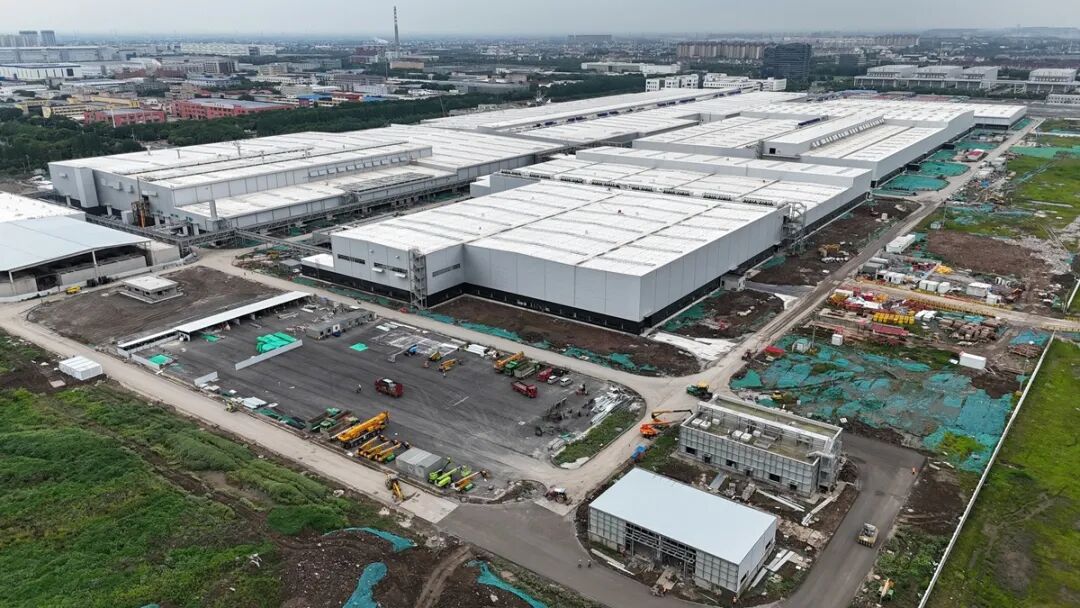
Figure 丨 Toyota's hope—the Lexus wholly-owned factory in Jinshan, Shanghai
Now, debates are moot. China's 30,000 km standard is non-negotiable; no team can unilaterally lower it. Toyota, by relocating R&D centers to Shanghai, no longer needs to fly blueprints to Tokyo for approval.
One has dismantled walls and installed a shared lock; the other retains walls but opens a ventilated window.
This is industrial collaboration in its purest form: you address your slowness, I rein in my wildness, both converging on a narrow path—vehicles must outpace product launches and warranty periods.
There are no mythical cars, only honesty in self-improvement. For four decades, Toyota taught the world about durability; in the next decade, the true test will be who can permanently fuse quality with iteration.
Editor-in-Chief: Li Sijia Editor: He Zengrong

THE END
-
How Far Have Domestic GPUs Progressed Behind Book Losses?
-
![]()
Taobao Flash Sale Restructures: After a Year of 90 Billion Yuan in Losses in the Food Delivery Battle, Even Alibaba Can’t Sustain the Fight
-
![]()
Valued at 7 Billion! Turing Quantum Races to Become the First Photonic Quantum Computing Company to Go Public
-
![]()
Revenue Sees Slight Rise, Net Profit Soars Twofold: Wavelength Opto-Electronic's 'Optics+' Strategy Yields Initial Fruits
-
![]()
Expected loss widens to HK$12.1 million! Ever Smart Eyewear issues profit warning
-
After 'No Right to Recall,' Can GAC Still Spin a Compelling Robot Tale?
-
![]()
Baidu's Critical Moment in AI Transformation: After Losing the Main Apple Partnership, What's Next for Ping Xiaoli's Strategy?
-
![]()
Voice Input: Opening the AI Gateway?