Latest US Consumer Car Purchase Report: Seats and Driving Assistance Top Picks, Auto Parking Makes Debut on List
 08/19 2026
 359
359
Recently, AutoPacific, a U.S. automotive market research and consulting firm, released its 2026 Future Vehicle Planner report. This annual survey, conducted for five consecutive years, covers over 160 automotive features and configurations. Through questionnaires, it collected data from over 19,000 licensed U.S. drivers planning to purchase a new vehicle within the next three years, regarding their vehicle preferences and views on new technologies, autonomous driving, electric vehicles, etc.
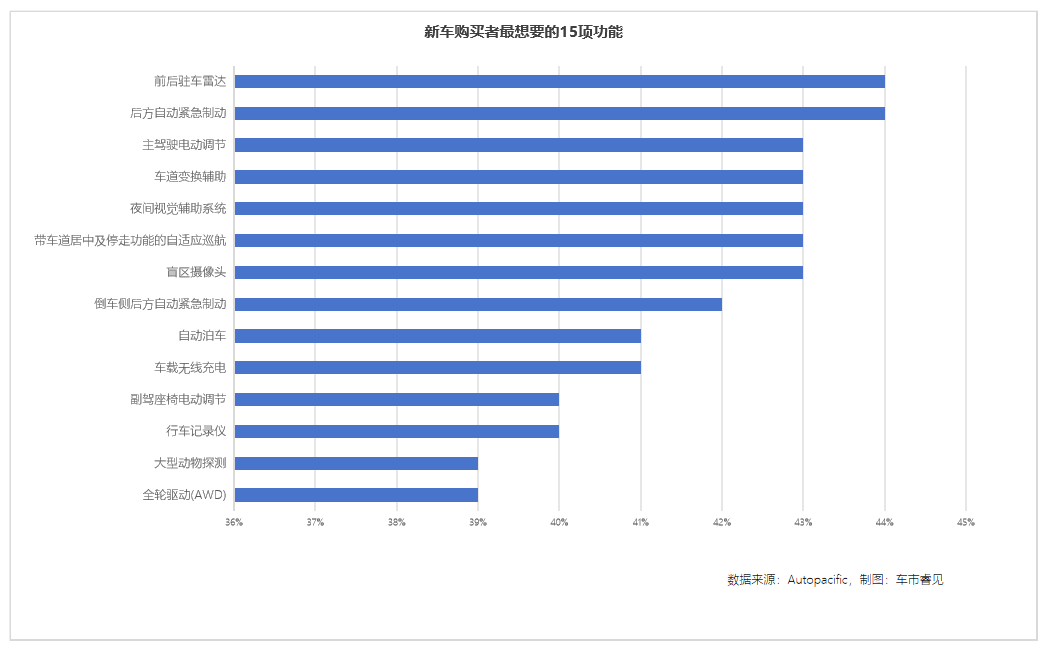
The study shows that seat-related features, safety configurations, and driving assistance systems rank at the top of the "most desired features" list for new car buyers. Among the top 15 features, six are the same as the 2025 list, while the remaining nine are newly added or have reappeared after being on the list in previous years. Notably, a brand-new feature—Auto Park—made its debut in the top 15 for the first time.
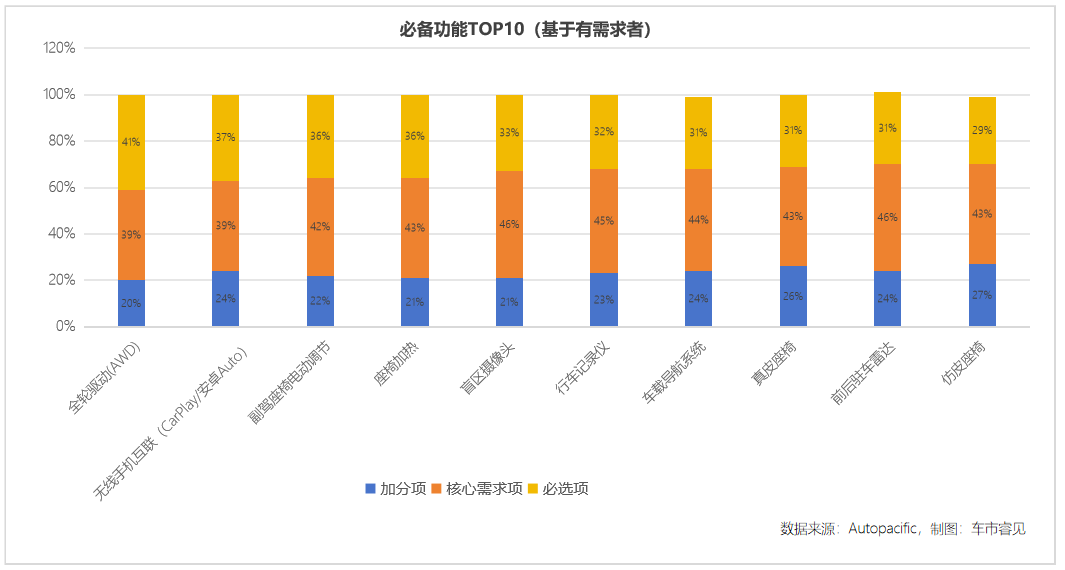
▍"Must-Have Features" Ranking: All-Wheel Drive and Wireless Phone Connectivity Top the List
Since 2025, AutoPacific has added a "feature importance" dimension to its research, gauging whether consumers consider a feature "must-have." The 2026 "must-have features" list spans categories such as safety, convenience, and seating/comfort, with All-Wheel Drive and wireless Apple CarPlay/Android Auto ranking first and second, respectively.
▍Significant Market Segment Differences: EV/PHEV Buyers Prioritize Range
The study also conducted specialized analyses of different market segments, including EV/PHEV intenders, pickup truck intenders, and users with towing needs.
For EV and PHEV intenders, range and charging are core decision-making factors. The top "must-have feature" for this group is an extended-range battery pack, followed closely by DC ultra-fast charging.
This finding holds direct reference value for Chinese new energy vehicle manufacturers. In the North American market, driving range and charging efficiency remain the primary concerns for electric vehicle consumers.
▍Trend Insights: Growing Demand for Driving Assistance and Safety Features
The report notes that as some driving assistance and safety features become mandatory by regulations (e.g., rearview cameras, automatic emergency braking systems), consumer demand for more advanced safety systems is rising simultaneously. AutoPacific data shows a clear upward trend in demand for the following features:
Lane Change Assist
Unresponsive Driver Stop Assist
Safe Vehicle Exit Alert
Blind Spot Cameras
Adaptive Smart Headlights
Additionally, demand for features such as Remote Summon, Four-Wheel Steering, and Auto Seat Adjustment has also grown significantly.
▍Autonomous Driving: Acceptance Rises, "Once Used, Never Let Go"
As automakers progressively introduce mass-produced autonomous driving functions at various levels, consumer acceptance continues to increase.
Millennials (aged 32-49) lead in acceptance. Compared to the overall sample, this group is 6 percentage points more likely to trust "safety systems that automatically prevent accidents" and feel comfortable with "vehicles autonomously performing lane-keeping and auto-parking functions."
More critical data comes from the "experience effect": Consumers whose vehicles already feature autonomous driving technology are more likely to want it in their next new car than those without it—regardless of whether they have actually used it. Users who have personally used the function show even higher future demand.
Respondents who have used autonomous driving systems report extremely high satisfaction: 91% are satisfied with ease of use, 89% with reliability, and 87% believe it offers good value for money.
Overall, this report provides clear benchmarks for Chinese automakers' product planning in North America and globally. At the product definition level, basic configurations such as seating comfort, all-wheel drive, and wireless connectivity are not mere supporting elements but core levers for winning consumer favor.
In the safety domain, advanced driving assistance systems are rapidly transitioning from "differentiating selling points" to "entry-level standards," with demand boundaries continuously expanding. Focusing on the electrification track, driving range and charging efficiency remain the primary decision variables for electric vehicle consumers, far outweighing marketing highlights like smart cockpits.
On the critical front of autonomous driving, it is a feature highly dependent on "firsthand experience." Once users actually use it, significant stickiness and repurchase inclination emerge. Therefore, enhancing real-world usability and interaction friendliness holds far more meaning than merely listing the function on a spec sheet.
Typesetting 丨 Zheng Li
Source 丨 Autopacific
Image Source 丨 Qianku.com
-
![]()
Surpassing the 'Storage Storm': Xiaomi’s Pivotal Moment
-
![]()
2026 China Auto Market: A 'Major Reshuffle' — Small Cars Decline, Large Cars Flourish, Is the Era of Fuel Vehicles Over?
-
![]()
Non-Recurring Items-Adjusted Net Profit Soars by 72.59%! Dongtianwei Records 502 Million Yuan in Revenue
-
![]()
Securing 2 Billion Yuan in Financing and Supplying Inno-Light: This Optical Device Company Launches Its IPO!
-
![]()
Farewell to 'Card Stacking': 2026 Marks China's Computing Power Shift to 'Token Value Output' Era
-
![]()
Xiaomi Weathers Storage Price Surge, Q2 2026 Revenue Tops 100 Billion Yuan Again
-
![]()
Geely Bids Farewell to the 'Li Shufu Era': A Historic Power Transition in China's Auto Industry | Auto Circle
-
![]()
Baidu Prepares for Inclusion in Southbound Trading: Wall Street Reassesses the Value of 'AI ETF'