Hesai: How Much Longer Will the Price Decline and Earnings Struggle Last?
 08/20 2026
 526
526
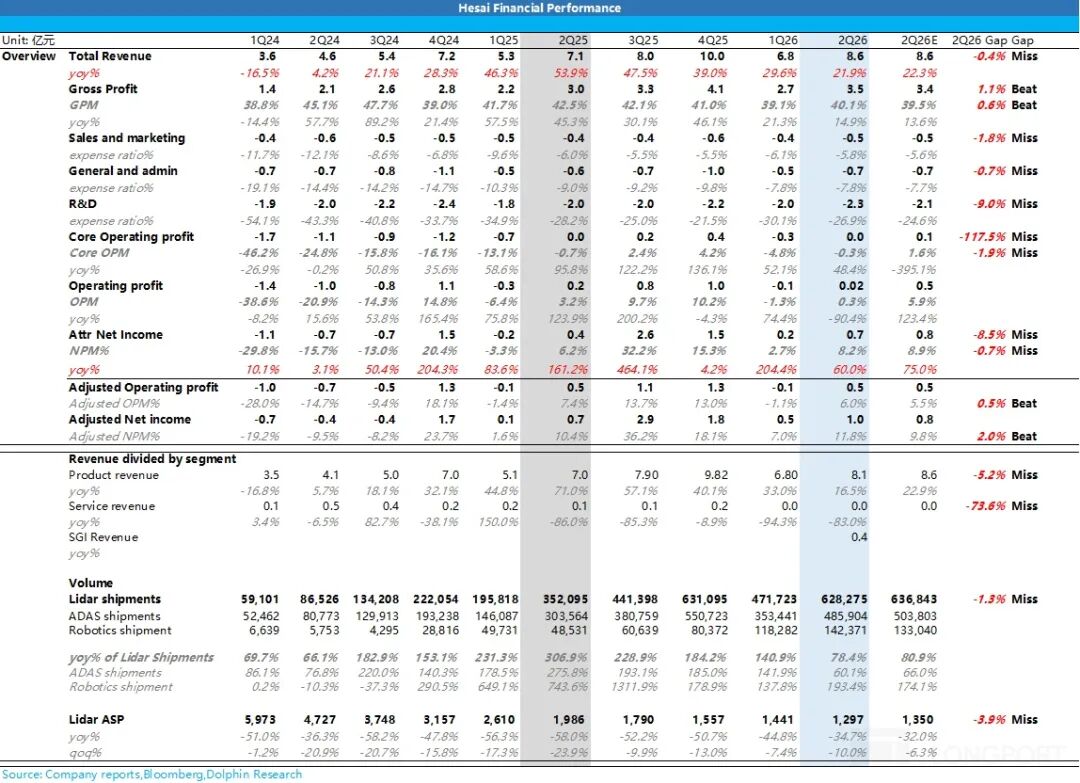
Overall, Hesai delivered performance largely in line with expectations, but the Q2 results still highlighted a core issue—the "price decline" of LiDAR remains excessively steep. Key details include:
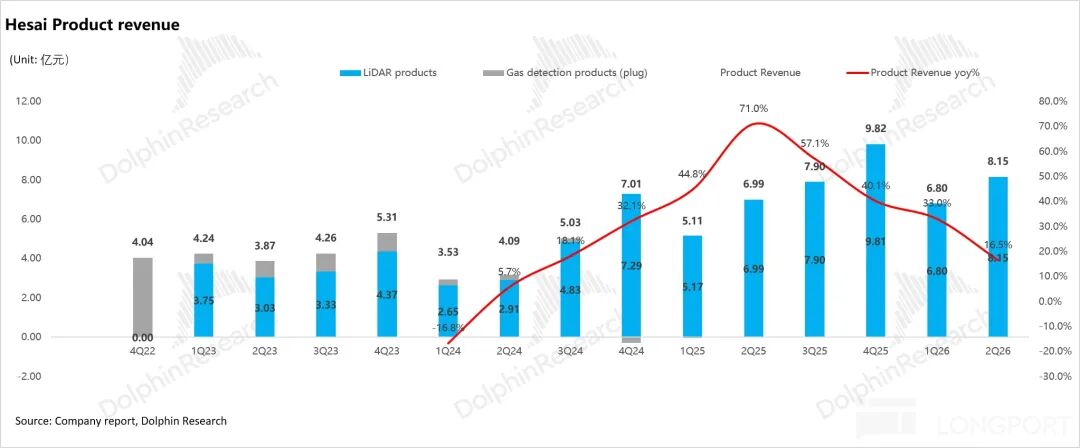
① Total revenue met expectations, but core LiDAR revenue fell short: Q2 total revenue reached RMB 860 million, up 22% YoY, positioned at the lower end of Hesai's Q2 2026 revenue guidance range of RMB 850-900 million. The new SGI business (currently comprising Kosmo and actuator modules) contributed RMB 40 million this quarter. Excluding this, core LiDAR revenue was approximately RMB 810 million, with YoY growth slowing to ~16.5%, also below market expectations.
② LiDAR shipment volume and unit prices missed expectations:
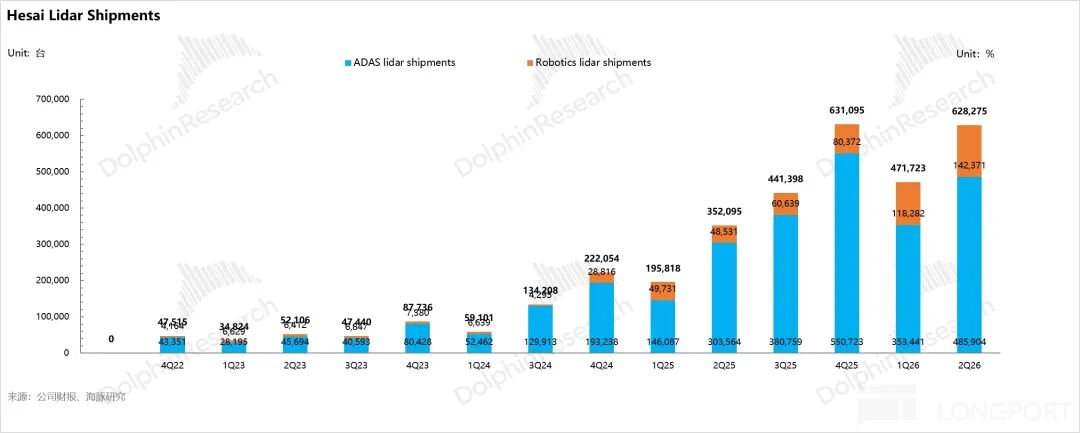
- Shipment volume: 628,000 units shipped in Q2 2026, below the company's guidance of 650,000 units and market expectations of 637,000 units. This was primarily due to slower-than-expected growth in ADAS passenger vehicle radar sales: ADAS LiDAR shipments reached 486,000 units, falling short of the market expectation of 504,000 units, likely due to pressure on NEV market sales growth amid phasing-out purchase tax incentives and lower-than-expected sales growth from major clients Xiaomi and Li Auto.
- Robot radar shipments reached 142,000 units this quarter, exceeding expectations of 133,000 units, driven by shipments of the JT128 model for humanoid and quadruped robots (collaborations with over 50 embodied AI companies) and higher-than-expected shipments of the JT16 lawnmower radar.
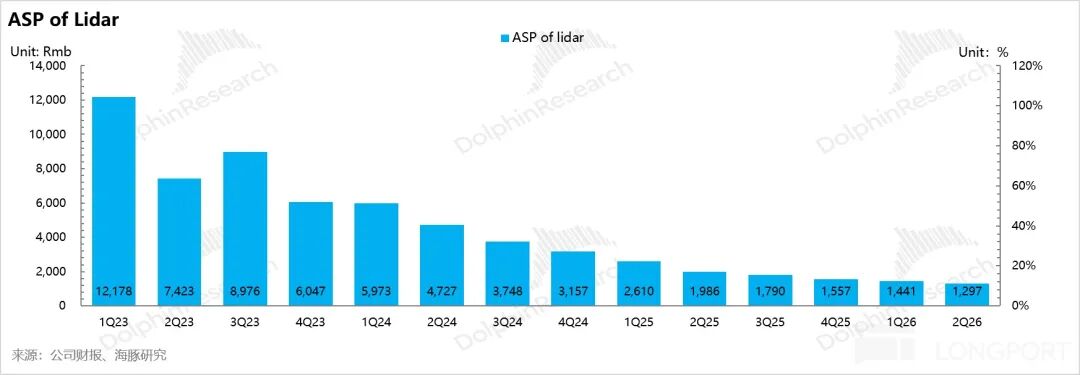
- Unit price: The average selling price (ASP) of LiDAR in Q2 2026 was just RMB 1,297, down 35% YoY and below the market expectation of RMB 1,350. Key factors include:
a. Intensified industry competition: As competitors (e.g., RoboSense's EMX series) narrow the product performance gap with Hesai, the market leader has proactively reduced its pricing premium (previously 10-20% higher than peers) to maintain market share.
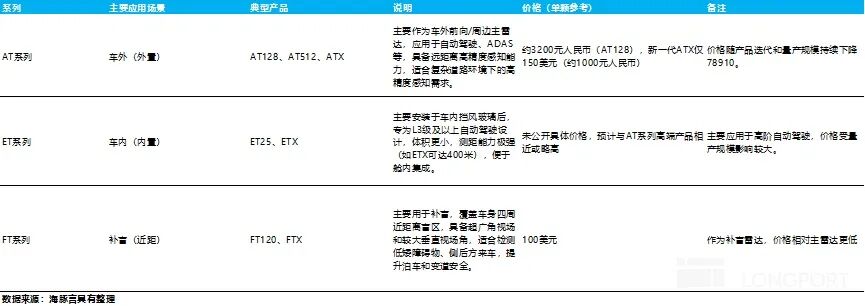
b. The ATX model's exclusive versions for high-volume clients like BYD and Geely are priced at just ~RMB 800. As their shipment share increases, the overall ASP of the ATX product line is further dragged down.
c. The FTX blind-spot radar's ASP guidance is only ~$100. As its shipment share rises, it structurally weighs down the overall ASP.
③ Gross margin held steady at 40%: Q2 2026 gross margin was 40.1%, slightly above market expectations of 39.5% and up 1 percentage point QoQ. Despite the rapid decline in LiDAR ASPs, the company maintained its critical 40% gross margin threshold, benefiting from:
- Scale effects driven by QoQ growth in shipment volume.
- Cost reductions from localized and highly integrated main control chips, as well as self-developed SPAD integration technology.
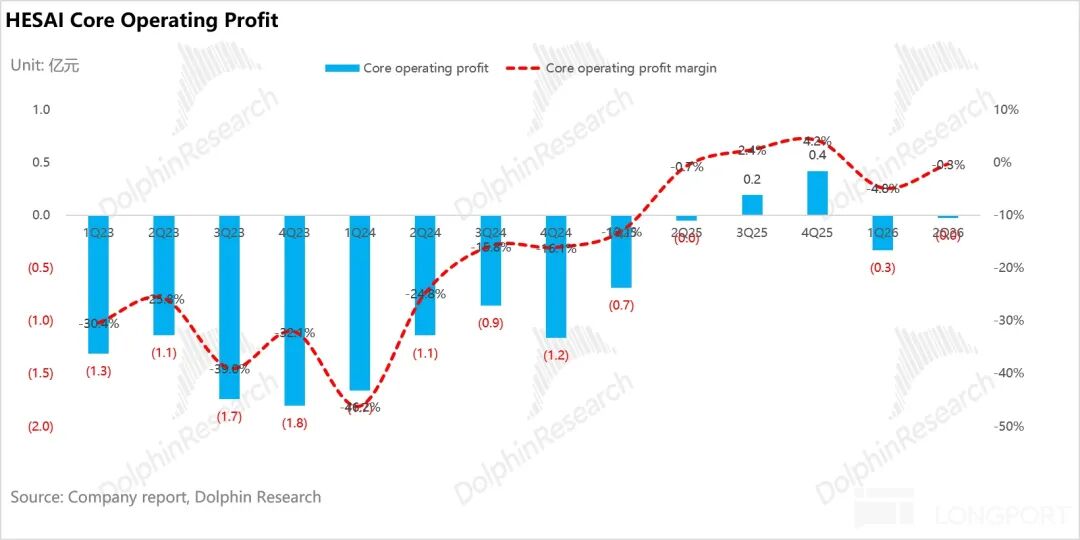
④ Operating profit missed expectations, primarily due to rising operating expenses: Q2 2026 operating profit was just RMB 2 million, below market expectations of RMB 50 million, mainly due to a 16% YoY increase in R&D expenses. This quarter's R&D spending reached RMB 230 million, driven by increased investment in SGI's new business (management previously forecasted ~RMB 200 million in proactive investment for 2026).
Dolphin Research's Core View:
Overall, Hesai delivered Q2 results largely in line with expectations: revenue slightly exceeded forecasts due to contributions from SGI's new Spatial General Intelligence (SGI) business; gross margin held steady at the critical 40% threshold driven by scale effects and cost reductions; operating profit fell short due to increased R&D investment in SGI's new business.
However, the results once again underscored Hesai's core challenge—excessive ASP declines: LiDAR unit prices fell below RMB 1,300 this quarter, down 35% YoY. Beyond natural price reductions from cost improvements, the primary driver was intensified industry competition, as the company Resolute choice (firmly chose) a "volume-over-price" strategy to defend market share and scale, proactively reducing pricing premiums to counter technological advancements from competitors like RoboSense's EMX (which accelerated shipments from Q4 2025).
2026 will remain a "volume-over-price" year of intense competition for Hesai. High-priced products like the ETX (L3-core radar) will only enter mass production by year-end, with competition primarily centered around low-priced L2 passenger vehicle radars (ATX/FTX). Meanwhile, downstream NEV clients face slowing sales growth after phasing-out purchase tax incentives, while rising upstream commodity prices (aluminum, iron, batteries, storage) erode gross margins, heightening their price sensitivity toward upstream components.
Currently, especially for 2026, the company is navigating an inevitable transition period to overcome pricing wars and secure its position in the next-generation universal sensor ecosystem:
① Full-year shipment volume will maintain high growth, but ASPs will shrink more than expected due to intensified competition:
a. Shipment volume to sustain high growth: The company raised its 2026 shipment guidance from 2-3 million units to 3-3.5 million units, representing 85%-116% YoY growth, and maintained this target this quarter. To meet surging demand, annual production capacity is set to double from 2 million units in 2025 to over 4 million units in 2026. ADAS business shipments will nearly double, while robotics shipments will more than double:
- ADAS business: Expected to ship 2.5-3 million units (~200,000-300,000 FTX blind-spot radars, with the remainder being ATX series models priced at ~RMB 1,000), up 81%-117% YoY. Key drivers include:
① ATX penetration into L2+ mass-market segments: LiDAR is now an optional feature in some models priced at RMB 80,000-100,000.
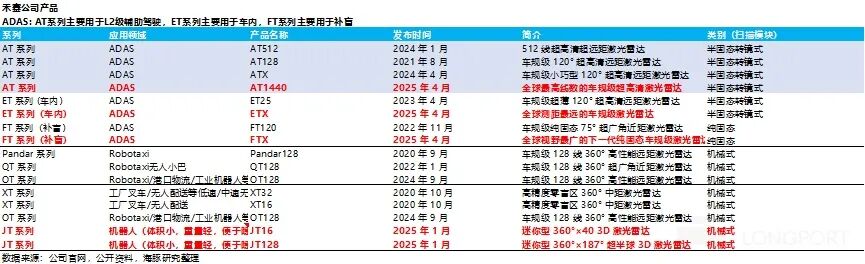
② L3 advanced autonomous driving driving a doubling of per-vehicle radar load, though volume ramp-up may only occur by late 2026 or even 2027. After L3 regulations formally take effect in 2027, per-vehicle solutions will upgrade from L2's single main radar to "1 main radar (ATX/ETX) + multiple blind-spot radars (FTX)," jumping per-vehicle value from ~$200 to $500-$1,000, with higher customer price tolerance. The ETX has already secured a mass-production project with Great Wall Motors, with SOP expected by late 2026 and detection range double that of the ATX.
③ Accelerated shipments of blind-spot FTX radars: The Li Auto L8 and L9, each equipped with 4 Hesai LiDARs, are already in mass production. The newly launched Li Auto L6 (~RMB 250,000) offers an optional four-LiDAR configuration, marking the entry of high-end features into mainstream price bands.
Breaking down ADAS clients for 2026, Dolphin Research expects core sales to primarily come from major orders with Xiaomi (~460,000-500,000 units expected in 2026, with RoboSense introduced as a secondary supplier), Leapmotor (~600,000 units, nearly exclusive supply), Li Auto (~400,000 units, exclusive supply), BYD (~300,000-350,000 units, accounting for ~50% of supply), Geely (~500,000 units), and Great Wall Motors (~200,000 units).
- Robotics business: Hesai guides shipments exceeding 500,000 units, up 109% YoY. The product mix will still focus on the ~RMB 1,000 JT series (~450,000 units), primarily supplying lawnmower robots from brands like Dreame and Mova. Additionally, Hesai has collaborated with over 50 embodied AI companies, with recent orders from Unitree, Robbyant, Galbot, Galaxea, and Dexmal. The JT128 radar, exclusive to humanoid robots, is expected to drive shipments beyond expectations, with some high-performance warehousing and logistics scenarios deploying up to 15 JT128 units per device. The JT128's ASP is higher than the JT16 used in lawnmowers.
Dolphin Research forecasts Hesai's total LiDAR shipments to reach 3.3 million units in 2026, comprising:
- 2.62 million ADAS LiDAR units, up 90% YoY, positioned at the lower end of guidance, primarily due to slowing NEV sales growth and Xiaomi's adoption of RoboSense as a secondary supplier.
- 677,000 robotics LiDAR units, up 183% YoY, significantly exceeding the 500,000-unit guidance, driven by potential JT128 shipment surges.
b. However, ASPs will continue to decline: As competitors (e.g., RoboSense's EMX series) narrow the product performance gap with Hesai and achieved large-scale shipments in Q4 2025 (RoboSense shifted from early MEMS technology to rotating mirrors, eliminating the technological generation gap with Hesai), industry price competition has intensified. Hesai, as the market leader, has proactively sacrificed its past 10-20% pricing premium over peers to maintain market share.
Specific manifestations include:
a. While the 2026 ASP for the standard ATX model is expected to remain at $150, the exclusive version for high-volume clients like BYD and Geely is priced at just ~RMB 800. As its shipment share increases, the overall ASP of the ATX product line will be further dragged down.
b. The FTX blind-spot radar's ASP guidance is only ~$100.
c. The high-value ETX model will only enter mass production by late 2026.
Thus, Hesai's blended LiDAR ASP will continue to deflate in 2026. Based on previous company guidance (revenue RMB 4.2-4.6 billion, shipments 3-3.5 million units), the corresponding blended ASP was ~RMB 1,300-1,380. However, Q2 LiDAR ASP already declined to RMB 1,297, exceeding Dolphin Research's deflation expectations.
As a result, Dolphin Research expects Hesai's overall ASP to decline 31% YoY to RMB 1,268 in 2026, especially given Q2's continued ASP underperformance.
c. SGI's new business accelerates revenue contribution:
SGI's new business primarily falls into two categories:
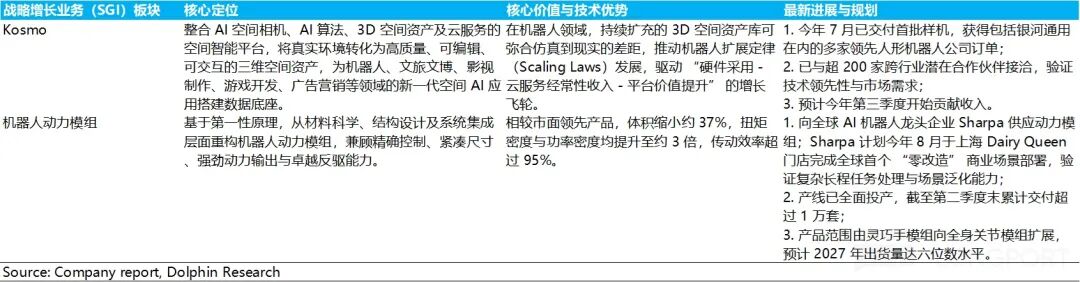
① Kosmo (Spatial General Intelligence Platform): Integrates AI spatial cameras, AI algorithms, 3D spatial assets, and cloud services into a unified system for capturing, reconstructing, and understanding the physical world. Commercial progress includes securing orders from multiple leading humanoid robot companies, including Galbot, within 7 days of prototype release in July. Since its April preview, over 200 potential partners have engaged, with scenarios extending to cultural tourism, film, gaming, and advertising.
② Actuator modules: Starting with the most challenging dexterous hands in humanoid robots, the approach validates architectures in the highest-difficulty scenarios before expanding to other body parts. Full-body module SOP is expected in H2 2026, extending to shoulder and wrist joints.
Shipment volume: Over 10,000 modules shipped by the end of Q2, with a near-term ramp-up to ~10,000 units per month and a projected six-digit shipment volume in 2027.
Clients: Supplies AI robotics company Sharpa (founded by the same entrepreneur as Hesai, an independent external entity), which has been adopted by NVIDIA's GROOT platform.
Thus, with accelerated new business expansion, Hesai raised its SGI revenue guidance: 2026 revenue increased from RMB 100 million to RMB 200-300 million (with Q3 2026 contributing nearly RMB 100 million), while 2027 revenue remains at the previously raised RMB 700 million (~$100 million).
Dolphin Research forecasts Hesai's total revenue to reach RMB 4.48 billion in 2026, up 48% YoY. This includes RMB 4.18 billion from LiDAR (up just 40% YoY, primarily dragged down by excessive ASP deflation), RMB 250 million from SGI's new business, and ~RMB 50 million from other revenues. The overall revenue expectation aligns with the midpoint of the company's RMB 4.2-4.6 billion guidance.
c. Despite sustained ASP declines, Hesai still expects its overall gross margin to remain resilient in 2026, primarily due to:
a. Localized and highly integrated main control chips (self-developed FMC500 SOC based on RISC-V architecture, integrating MCU, FPGA, and ADC into a single-chip solution that significantly reduces core chip costs accounting for 40% of BOM).
b. Self-developed SPAD integration technology (mass production in 2026).
c. Extreme scale effects (3-3.5 million units amortizing fixed costs) and highly automated manufacturing.
While ASP deflation remains substantial, scale effects and cost reductions enable management to maintain its 2026 full-year gross margin guidance of 40%, down 1.8 percentage points YoY.
d. On the expense side:
The company expects total operating expenses to rise ~15% YoY, primarily driven by ~RMB 200 million in proactive investment for robotics-related new businesses (frontier products dubbed the "eyes" and "muscles" of physical AI). This investment, independent of external entity Sharpa, represents Hesai's strategic layout (layout) for a second growth curve. In the short term, these RMB 200 million in incremental expenses will suppress 2026 profit release. Excluding new business spending, core operating expenses for the main business are expected to remain flat or decline by a low single-digit percentage, reflecting robust overall cost control.
Based on current stock prices, Dolphin Research expects 2026 revenue to reach RMB 4.48 billion (+48% YoY) and net profit to hit RMB 520 million (at the lower end of the company's RMB 500-700 million guidance), up 19.4% YoY. In the short term, 2027 earnings growth remains critical for digesting current valuations.
In particular, considering: ① Competition in 2026 will still revolve around low-cost L2+ LiDAR, with competing technological approaches largely on par, and market share facing continuous competitive pressure; ② High-priced products ETX and overseas high-gross-margin orders will only contribute to sales volume by the end of the year or even in 2027; ③ The robotics business remains a long-term option and has not yet been fully priced by the market. Therefore, Dolphin Research believes that Hesai's upward potential in the short term (2026) is relatively limited.
Looking ahead to the medium and long term, we believe that while Hesai faces significant competitive pressure and gross margin constraints in the short term, the LiDAR industry possesses strong attributes akin to "Moore's Law" (exponential increase in point cloud density, exponential decrease in cost) and relatively high barriers (ecosystem binding and scale effects). As the industry leader under the dual logic of "penetration rate increase in intelligent driving (ADAS as the core market)" and "second-curve expansion into the robotics sector (high elasticity in the pan- robotics market)", Hesai will still be a strongly determined long-term beneficiary:
① Short-term market share is expected to face pressure, but with a comprehensive technological layout, medium- and long-term market share is expected to remain stable
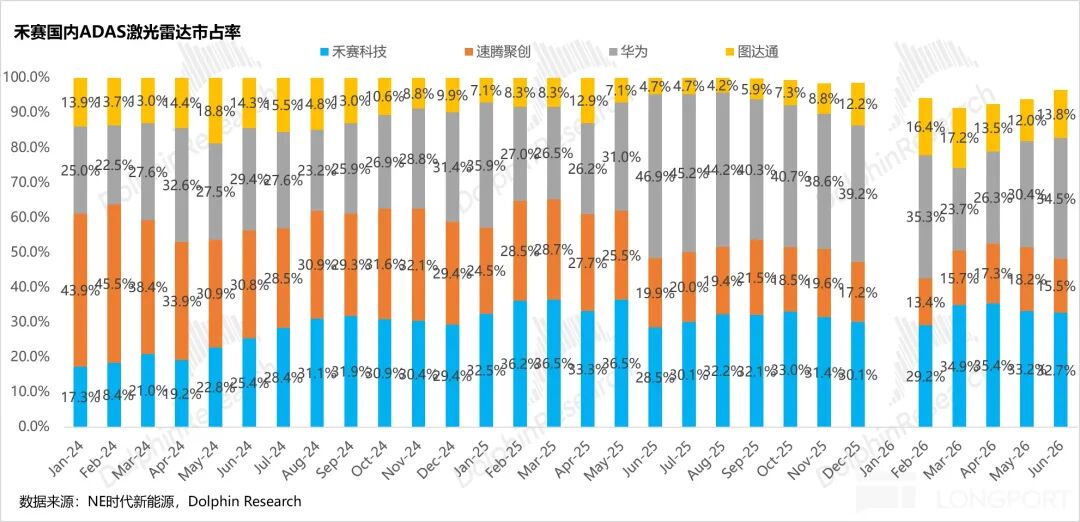
From a market share perspective, although Hesai's market share has fluctuated since the second half of last year due to the impact of Huawei's blind-spot radar shipments, Huawei's LiDAR is primarily shipped in the form of integrated hardware and software at higher prices, mainly serving the ecosystem of Smart Selection vehicles and HI mode. Therefore, in the independent third-party Tier 1 market, the actual competition remains concentrated among Hesai, RoboSense, and Innovusion.
Currently, Hesai still maintains its position as the market leader with strong shipments of its low-cost ATX. However, due to the accelerated mass production and shipments of RoboSense's EMX starting from the fourth quarter of last year, Hesai's short-term market share is expected to face continued erosion pressure in 2026.
However, Hesai has made greater investments and more comprehensive preparations in next-generation LiDAR technology routes (such as FMCW and visual-LiDAR fusion Limera). FMCW is seen as a key technology to address complex scenarios in autonomous driving (such as high dynamics and high-reflective interference). Management believes that the company is expected to be the first to achieve automotive-grade mass production in the next 2-3 years, thereby unlocking a new round of gross margin premiums. Therefore, its medium- and long-term market share is expected to remain relatively stable.
② L3 advanced intelligent driving drives exponential growth in per-vehicle adoption
As mentioned earlier, the demand for LiDAR at the L3 level will upgrade from a single ATX to "1 main radar (ATX/ETX) + multiple blind-spot radars (FTX)", driving the per-vehicle value from approximately $200 to $500-$1,000. Hesai's high-end ETX LiDAR will begin mass production from the end of 2026 to 2027, directly benefiting from this upgrade trend.
③ Overseas markets enter a breakthrough period, empowered by the NVIDIA ecosystem
Hesai has completed the development of long-range radar C samples for a leading European automaker, with overseas mass production expected to commence by the end of 2026. Meanwhile, Hesai has been selected by NVIDIA as a partner for the NVIDIA Drive Hyperion platform (meaning that when overseas OEMs adopt NVIDIA's solutions, Hesai has priority for recommendation). This full-stack platform significantly enhances the integration efficiency and scalability of Hesai's products, aiding its rapid expansion among overseas OEMs.
Considering that overseas customers have low price sensitivity and a preference for high-end products, overseas expansion will become an important tool to hedge against the decline in domestic ASP.
Therefore, Dolphin Research expects that driven by the L3 upgrade and the contribution of high-priced overseas LiDAR revenue, Hesai's profit elasticity is expected to be released starting from the end of 2026 or 2027.
④ The robotics sector becomes the second growth curve
Hesai adopts a dual-track layout of "in-house + external" for its robotics business:
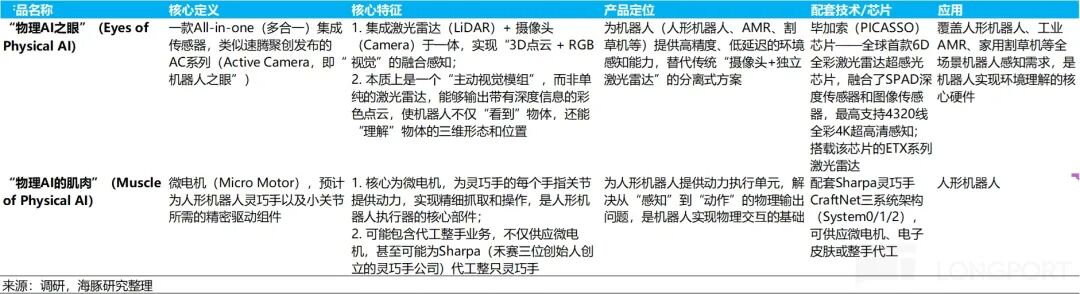
In-house: Following the logic of general-purpose sensors, it has launched the "Eye of Physical AI" (fully integrated sensors) and the "Muscle of Physical AI" (micro-motors), aiming to achieve a 50-50 revenue split with LiDAR within five years;
External (Sharpa): Through Sharpa, a dexterous hand company invested in by the founder, it is deploying core actuators for humanoid robots. In the future, Hesai can supply micro-motors or manufacture entire hands for Sharpa, with higher per-unit value.
Hesai expects revenue from new SGI businesses in 2027 to reach RMB 700 million, an 180% year-on-year increase compared to RMB 250 million in 2026, continuing to grow significantly.
⑤ 2027 will be a critical turning point for Hesai's price deflation to shift from "rapid decline" to "steady annual reduction":
Dolphin Research expects that the comprehensive ASP decline for LiDAR will narrow to approximately 10% in 2027 (a significant narrowing from approximately 31% in 2026), with further narrowing to 5-10% annually thereafter. The core reason is that Hesai's ASP decline of over 50% in the past two years was largely driven by technological cost reductions from in-house chip development, and this round of technological dividends has largely been exhausted.
Meanwhile, starting from 2026, the proportion of Hesai's high-end products will increase, offsetting the ASP decline of low-end ADAS products in terms of product mix. As the industry evolves from L2 to L3/L4, the per-vehicle LiDAR value will multiply—approximately $200 at the L2 stage (usually 1 ATX), approximately $350 for entry-level L3 (1 ATX + 2 FTX blind-spot radars), and up to $500-$1,000 for advanced L3 configurations (equipped with high-end ETX radars and multiple FTXs, etc.).
The ETX series (equipped with Picasso 6D full-color SPAD-SoC, up to 4,320 channels, and a 600-meter detection range) is expected to enter SOP in the second half of 2026 and achieve global scale deployment in 2027-2028, becoming the flagship configuration for high-end models.
Robotics LiDAR provides higher ASP support: Its gross margin is generally 5-10 percentage points higher than that of automotive ADAS, with a much higher average price than ADAS products. Moreover, Hesai is already the global leader in robotics LiDAR revenue. As the proportion of robotics business shipments continues to increase, it will provide structural support for the comprehensive ASP.
More fundamentally, LiDAR is transforming from an "emerging tech product" into a standardized automotive component, and its pricing model will also transition from "rapid decline to capture penetration" to the traditional automotive component's annual reduction model (usually around 5-10% annually).
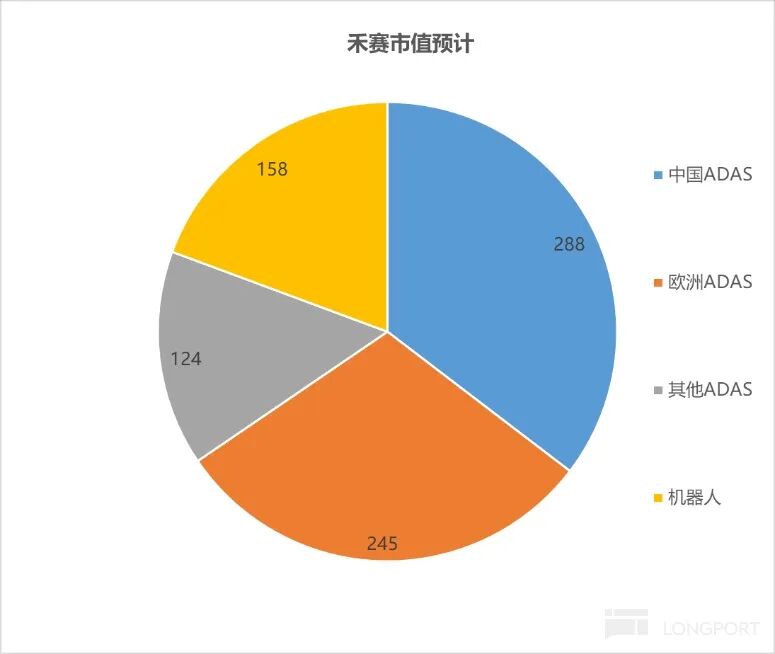
The following are detailed company charts:
- END -
// Reprint Authorization
This article is an original piece by Dolphin Research. If you wish to reprint it, please obtain authorization.
// Disclaimer and General Disclosure
This report is for general comprehensive data purposes only, intended for general reading and data reference by users of Dolphin Research and its affiliated institutions. It does not take into account the specific investment objectives, investment product preferences, risk tolerance, financial status, or special needs of any person receiving this report. Investors must consult with independent professional advisors before making investment decisions based on this report. Any person making investment decisions using or referring to the content or information mentioned in this report must bear their own risks. Dolphin Research shall not be liable for any direct or indirect responsibilities or losses that may arise from the use of the data contained in this report. The information and data contained in this report are based on publicly available materials and are for reference purposes only. Dolphin Research strives to ensure but does not guarantee the reliability, accuracy, and completeness of the relevant information and data.
The information or viewpoints mentioned in this report shall not, under any jurisdiction, be regarded or treated as an offer to sell securities or an invitation to buy or sell securities, nor shall they constitute recommendations, inquiries, or endorsements of relevant securities or related financial instruments. The information, tools, and materials contained in this report are not intended for or proposed to be distributed to jurisdictions where the distribution, publication, provision, or use of such information, tools, and materials contradicts applicable laws or regulations, or to citizens or residents of jurisdictions where Dolphin Research and/or its subsidiaries or affiliated companies are required to comply with any registration or licensing requirements in such jurisdictions.
This report only reflects the personal viewpoints, insights, and analytical methods of the relevant creators and does not represent the stance of Dolphin Research and/or its affiliated institutions.
This report is produced by Dolphin Research, and the copyright is solely owned by Dolphin Research. Without the prior written consent of Dolphin Research, no institution or individual may (i) make, copy, reproduce, duplicate, forward, or create any form of copies or reproductions in any way, and/or (ii) directly or indirectly redistribute or transfer them to other unauthorized persons. Dolphin Research reserves all relevant rights.
-
![]()
Why Does Dongfeng Peugeot Citroen Opt for a Fresh Start Rather Than Share Reform?
-
![]()
Hesai: How Much Longer Will the Price Decline and Earnings Struggle Last?
-
![]()
Is August Truly Not the Ideal Month to Purchase a Car?
-
![]()
2026 Chengdu Auto Show Preview: Emerging Forces, Top Five Chinese Brands in Showdown, Joint Ventures Speed Up Localization Efforts
-
Has Xiaomi Weathered Its Toughest Phase as Single-Quarter Revenue Again Tops 100 Billion Yuan?
-
![]()
14.6 Billion Yuan in Asset Impairment Losses: What’s Ailing Geely Holding Group, and How Will Li Shufu Navigate the Crisis?
-
![]()
Baidu’s WorkBuddy: Beyond Task Completion, Toward Trusted Automation
-
![]()
Bu Yizhou from Junyuan Capital: The Allure of Commercial Space Investment Transcends Mere Rocket Recovery Success