AITO Takes a Bold Leap, Forms Joint Venture with BMW and Mercedes-Benz
 08/24 2026
 418
418
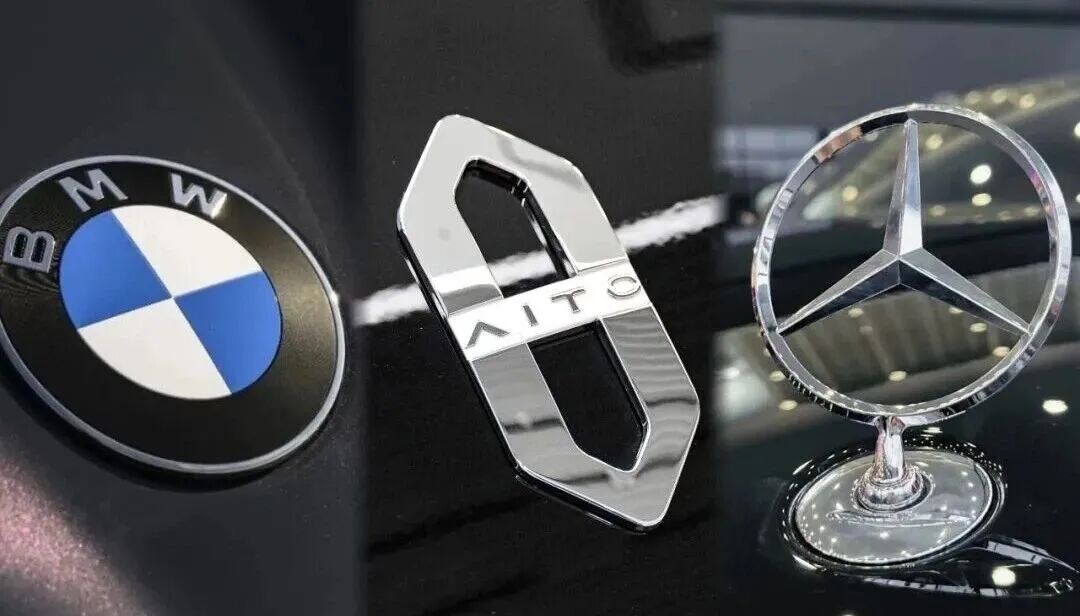
On August 19th, the new energy sector witnessed a seismic shift, catching many off guard.
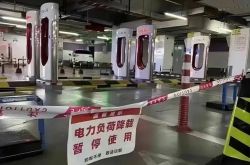
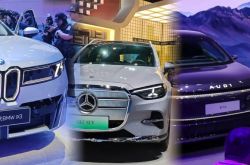
The European Commission gave its official blessing, approving a joint venture between Mercedes-Benz China, BMW Brilliance, and Seres (AITO's parent company) to take a controlling stake in Beijing Yianqi New Energy Technology Co., Ltd., a high-end ultra-fast charging enterprise.
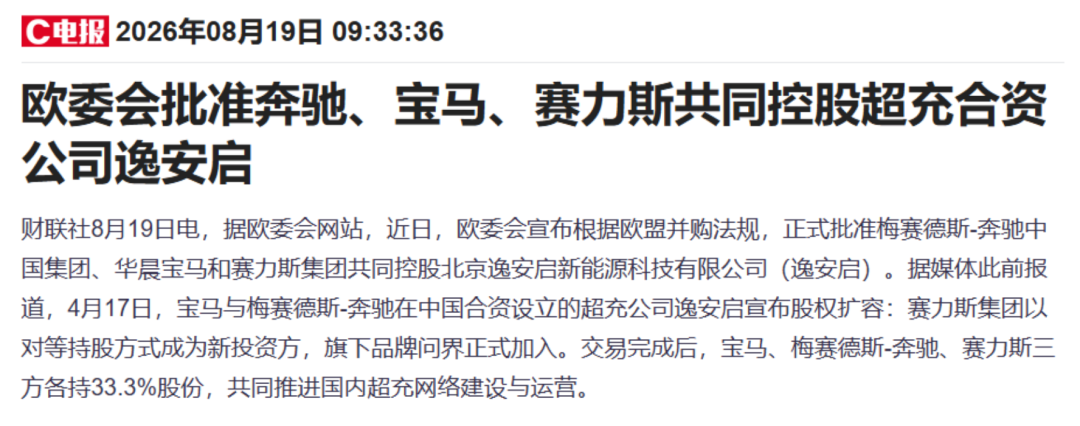 Image Source: Cailian Press
In layman's terms: AITO has entered the fray directly, partnering with BMW and Mercedes-Benz to establish a company dedicated to high-end ultra-fast charging solutions.
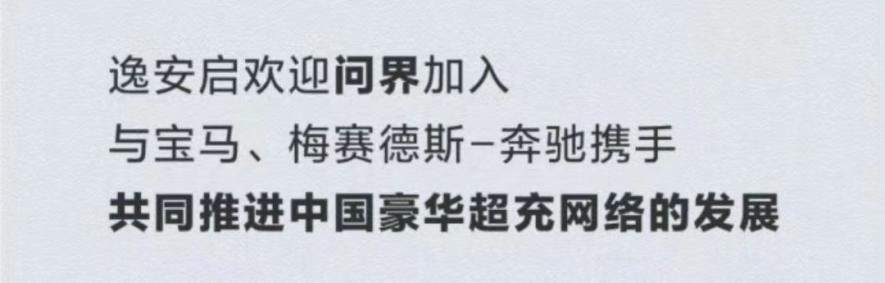
Image Source: Weibo
This collaboration, four months in the making, has finally come to fruition. The most notable aspect is the equity distribution, with each of the three companies holding roughly 33.3%, sharing equity equally without any single party holding a majority stake.
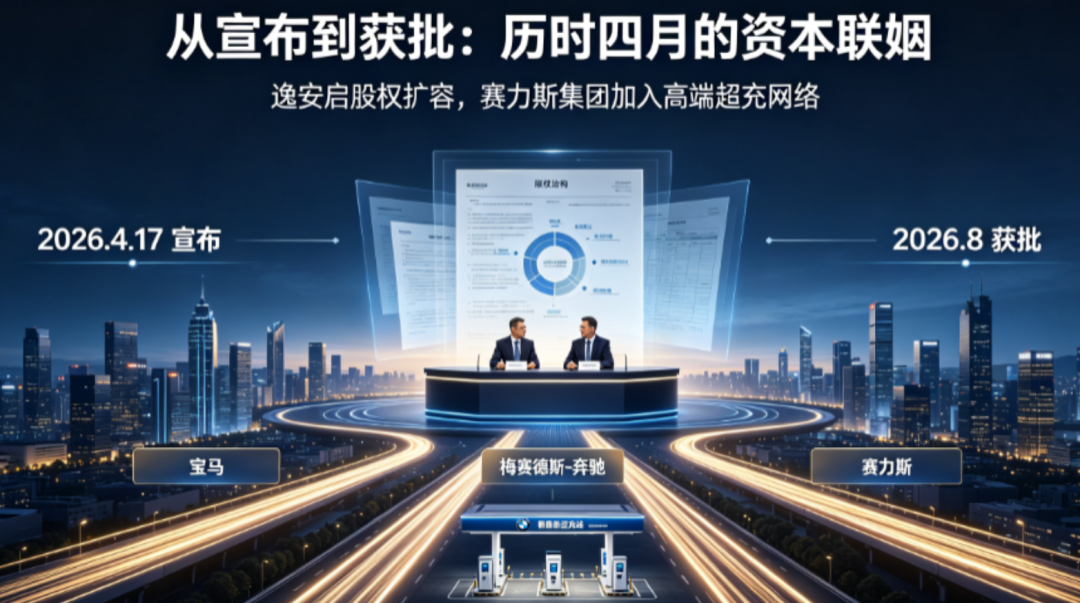 Image Source: Auto Talks
In the highly stratified and exclusive luxury automotive circle, such an egalitarian cooperative approach is rare, signaling a genuine and long-term commitment to this partnership.
Many may be unfamiliar with Yianqi, but it is no newcomer.
Founded in 2024 by BMW and Mercedes-Benz, each holding a 50% stake, Yianqi serves as a dedicated platform for the German luxury duo to deeply cultivate China's high-end ultra-fast charging market, exclusively catering to luxury new energy vehicle owners.
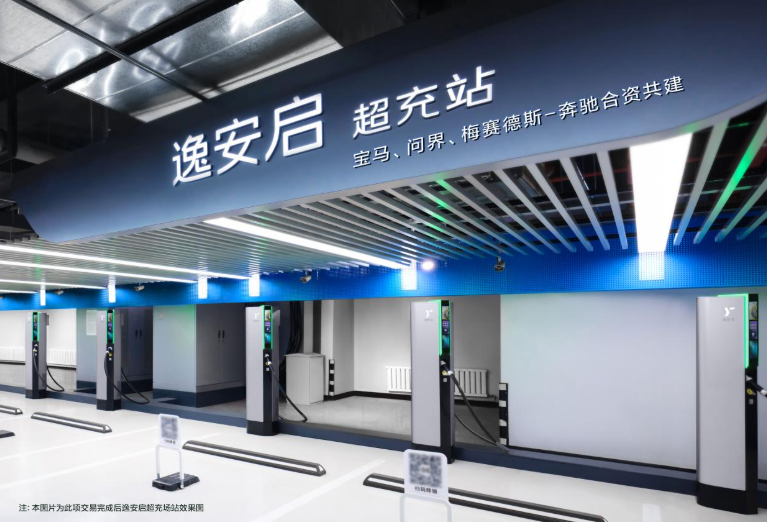
Image Source: Xinhua Net
Until April 17th of this year, this exclusive luxury circle remained unbroken. Yianqi officially announced an expansion and equity increase, with Seres making a strong entrance, officially joining the high-end ultra-fast charging core track with AITO, as personally announced by Kang Bo, Vice President of Seres.
The landscape of China's high-end energy replenishment sector has been completely rewritten, transitioning from a duopoly to a tripartite equal partnership.
Ultra-Fast Charging Capabilities at Their Peak, Emphasizing High-End Efficiency
The fact that BMW and Mercedes-Benz actively sought an equal partnership with AITO speaks volumes about Yianqi's strength.
While ordinary charging stations are ubiquitous, their quality varies greatly, with slow charging speeds and frequent malfunctions being common issues. Yianqi, on the other hand, follows a purely high-end and refined route, being extremely selective in its locations, establishing itself only in the core business districts, transportation hubs, and commercial areas of first-tier and emerging first-tier cities. It precisely targets the daily travel, commuting, and shopping scenarios of high-end vehicle owners, avoiding unpopular and inefficient sites altogether.
Its hardware configuration sets a new industry standard, uniformly equipped with second-generation liquid-cooled ultra-fast charging stations across its network, boasting impressive parameters: a maximum power of 800 kilowatts and an ultra-high current of 800 amperes.
The practical effects are striking: ordinary models can replenish 370 kilometers of range in just 10 minutes, while mainstream 800V high-voltage new vehicles can charge up to 80% in around 13 minutes. Compared to the sluggish charging speeds of ordinary stations, this efficiency is a game-changer, perfectly addressing the pain point of 'time-consuming charging' for high-end vehicle owners.
After two years of deep cultivation and layout, Yianqi's network scale is already considerable. As of May 2026, its stations cover 22 provinces and 38 cities nationwide, with over 510 charging stations and more than 2,800 charging points deployed. According to official plans, by the end of 2027, it will cover over 40 cities, with the number of ultra-fast charging stations surging to 7,000, and subsequent expansion will only accelerate.
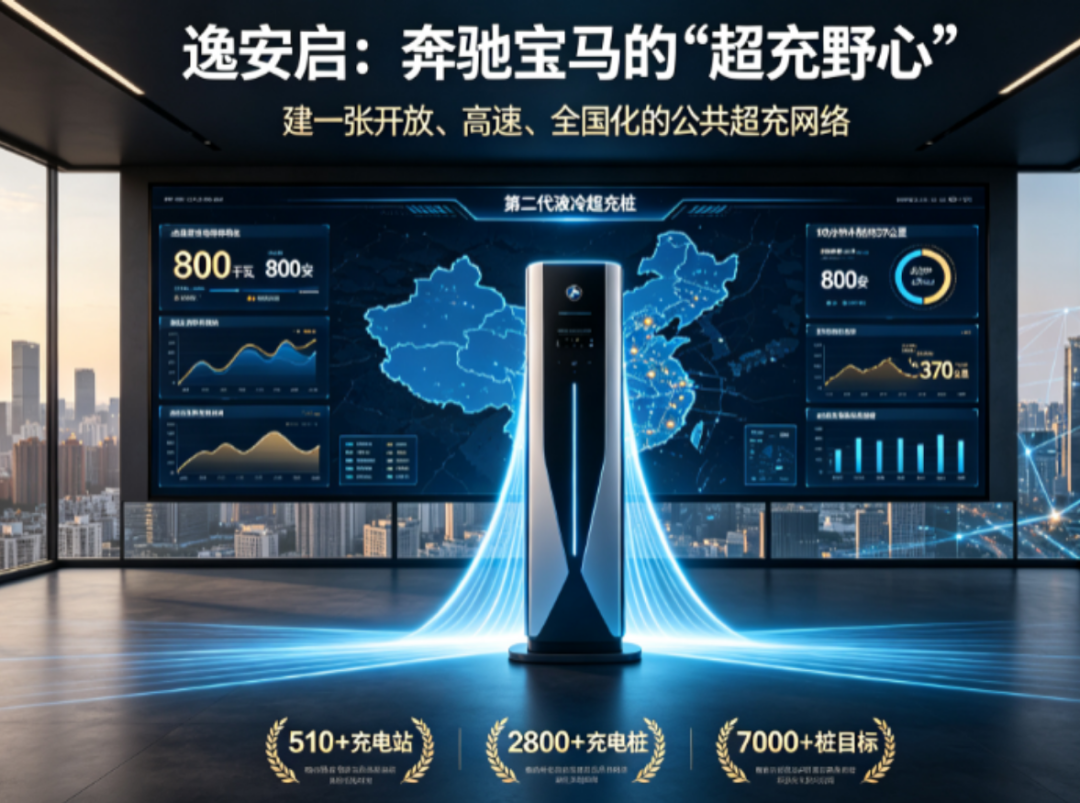 Image Source: Auto Talks
What's most appealing is that Yianqi does not engage in brand monopolies or luxury privileges. Its charging stations are open to all new energy vehicle owners, regardless of brand. At the same time, it offers exclusive VIP privileges for BMW, Mercedes-Benz, and AITO owners, including reserved charging, priority charging power, and dedicated maintenance, balancing public utility and high-end differentiated service experiences.
Tripartite Win-Win Cooperation, Each Filling Their Gaps
Many wonder: Why are the once-arrogant BBA (BMW, Benz, Audi, though Audi is not involved here, the term is used colloquially to refer to German luxury brands) willing to actively bring the domestic high-end brand AITO into the fold?
In fact, this is not a simple cross-border collaboration but an extremely shrewd and mutually beneficial commercial cooperation. The three automakers, appearing to be a cross-border alliance, are actually all reaping substantial benefits and filling their respective gaps, with no redundant party.
For Seres and AITO, this entry directly addresses their biggest brand shortcoming.
Objectively speaking, AITO's model quality, intelligent cockpit, and autonomous driving are all top-tier in the domestic high-end sector. However, a consistent point of criticism from owners is that while the cars are luxurious and priced at a premium, their exclusive energy replenishment facilities fall short, lacking the service ambiance expected of a luxury brand.
After partnering with Yianqi, this issue is directly resolved. AITO gains seamless access to a luxury ultra-fast charging ecosystem on par with BBA, completing its upgrade from a 'high-end good car' to a 'high-end complete travel ecosystem'.
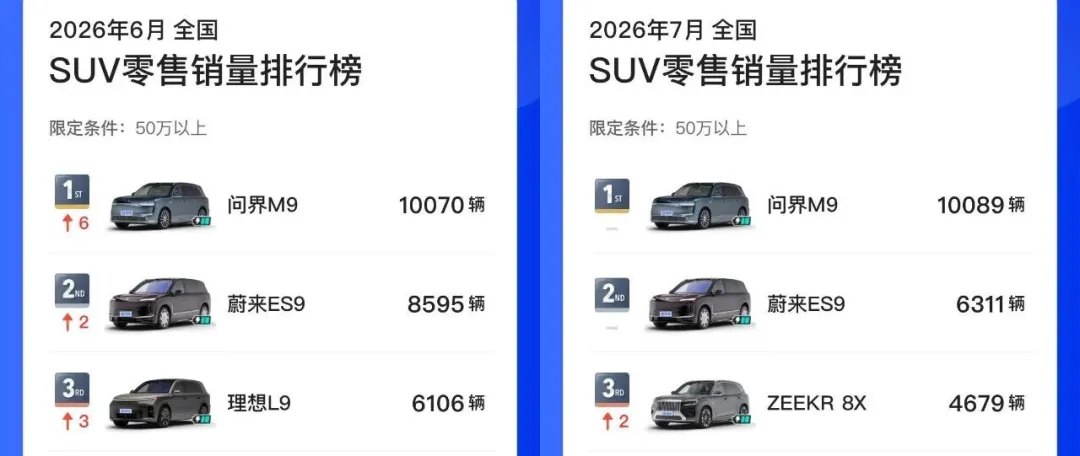 Image Source: Yiche APP
Currently, AITO's high-end market position is rock-solid, with stable annual deliveries of 420,000 units and an average transaction price per vehicle exceeding 390,000 yuan. Especially its flagship model M9, which nearly monopolizes the high-end price segment above 500,000 yuan. According to Yu Chengdong, for every 10 new energy vehicles sold in this price range, 7 are AITO M9s, accumulating a massive user base of high-net-worth individuals.
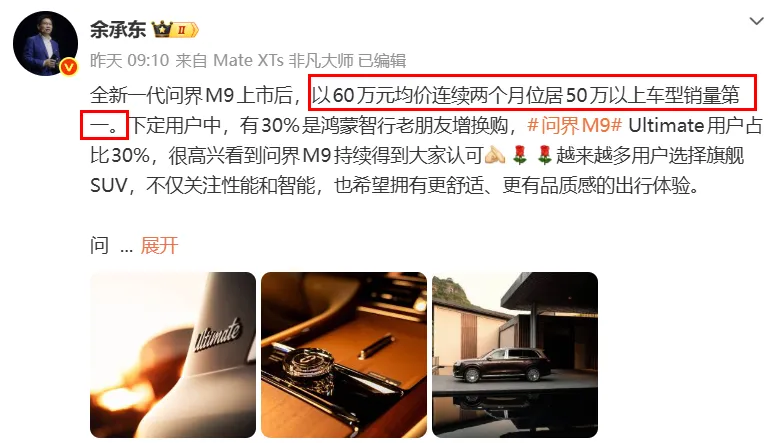 Image Source: Weibo
A noteworthy background is that AITO itself is not lacking in charging network resources. The energy replenishment layout within the Hongmeng Zhixing (HarmonyOS Intelligent Mobility) ecosystem is quite substantial. According to public data from February 2026, Hongmeng Zhixing's charging services cover over 350 cities, 2,700 counties and cities nationwide, and have access to more than 5,000 highway service areas.
Over 120,000 fast-charging stations have been launched, including over 7,000 ultra-fast charging stations, with charging speeds reaching 'one kilometer per second'. Against this backdrop, AITO's decision to join Yianqi and co-build a charging network with BMW and Mercedes-Benz on an equity basis itself constitutes a brand-level endorsement. 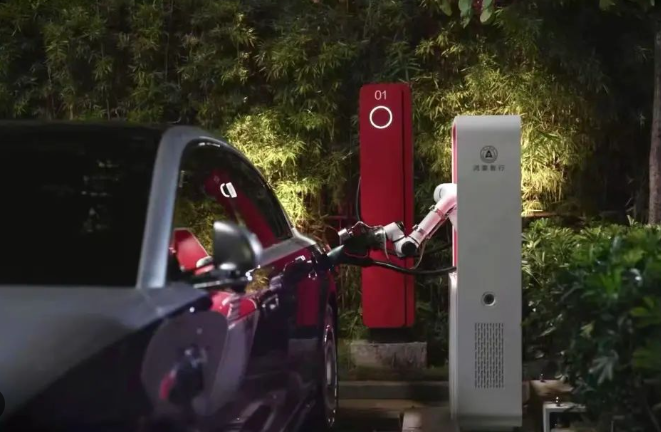
Image Source: 36Kr
More crucially, this group of high-end users who pursue quality and are picky about experiences highly overlaps with BMW and Mercedes-Benz owners. After integrating into the Yianqi system, AITO owners completely shed the stereotype of 'subpar domestic high-end supporting facilities' and genuinely enjoy the energy replenishment services of first-tier luxury brands. At the same time, this independent layout also reflects Seres' ambition to grow independently and reduce reliance on a single partnership.
In contrast, BMW and Mercedes-Benz are the most needy parties in this cooperation.
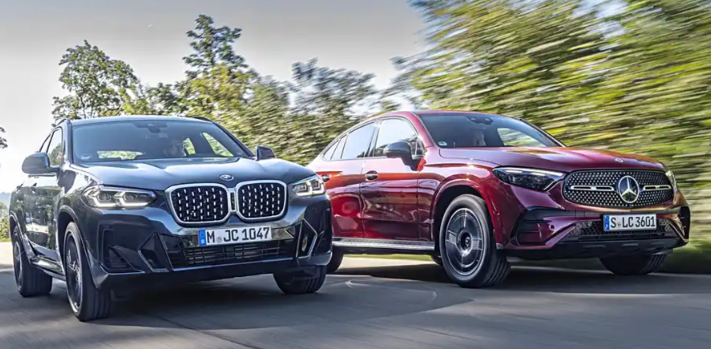
Image Source: Yicai
The electrification journey of these two German luxury brands in recent years has been tumultuous. Sales data doesn't lie: BMW's electric vehicle sales in China have declined by 12.5%, while Mercedes-Benz has plummeted by 19%. Their flagship EQ electric series, despite significant terminal price reductions, still fails to gain market acceptance, leaving their electrification transformation at a complete standstill.
Even more vexing is that ultra-fast charging is a notoriously capital-intensive and heavy-asset sector. Building stations, equipment upgrades, and daily maintenance all require massive investments with extremely long payback periods. Relying solely on their limited number of electric vehicle owners, many charging stations remain idle and underutilized, leading to increasing losses the more they operate. Shouldering this heavy asset burden alone is simply unrealistic.
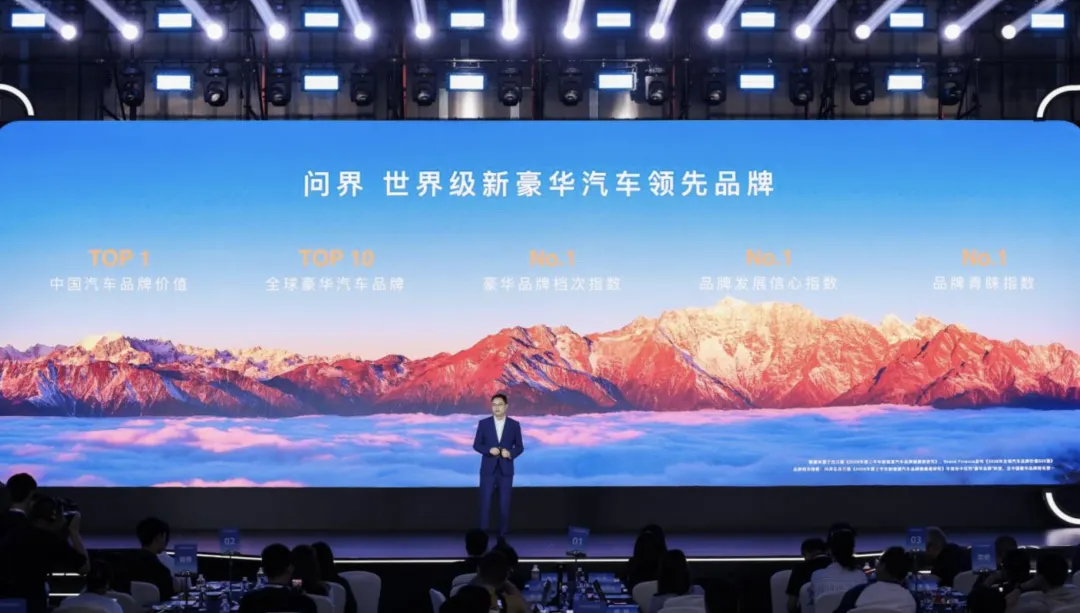 Image Source: Weibo
AITO's annual high-end delivery volume of 420,000 units, however, brings a steady stream of high-quality charging traffic to Yianqi, directly revitalizing all station resources, significantly boosting equipment utilization rates, and helping BBA stem their loss-making trend. At the same time, the three parties sharing costs and risks greatly alleviates the financial pressure on these two luxury automakers. Coupled with Seres' localized operation and digital management experience in the domestic market, it precisely fills the gap of foreign brands' inability to adapt to local conditions.
Short-Term Financial Pressure, Long-Term Cash Flow Confidence
Coincidentally, on the same day this heavyweight cooperation was finalized, August 19th, Seres also released its 2026 semi-annual report, with an overall trend summarizable as: short-term losses, long-term confidence.
The financial data is clear: Seres' revenue in the first half of the year was 57.493 billion yuan, down 7.87% year-on-year; its Non-GAAP net profit (non-recurring profit and loss adjusted net profit) was a loss of 2.379 billion yuan.
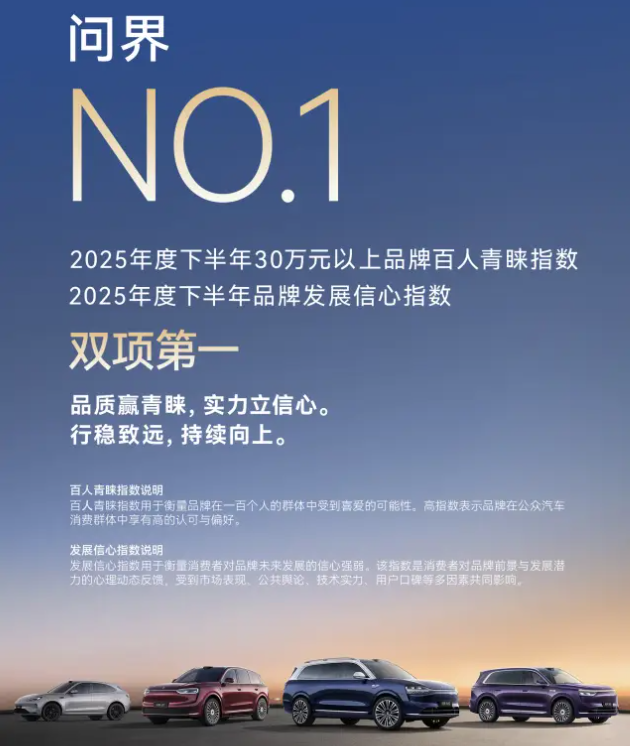 Image Source: Weibo
However, knowledgeable car enthusiasts and investors understand that this is not poor management but a common occurrence during the expansion phase of new energy vehicle companies. At this stage, Seres is investing heavily in R&D, new model iterations, and ecological layout, which represents a very normal strategic loss.
There's no need to worry about Seres; the company holds a massive 73.15 billion yuan in cash reserves, with a highly robust cash flow. This sufficient capital can steadily support subsequent ultra-fast charging layouts, new vehicle R&D, and technological iterations, providing a solid safety net for the long-term cooperation among the three parties. Meanwhile, the AITO M6 sold over 40,000 units in just 97 days after its launch, showcasing explosive new product potential and significant room for subsequent performance recovery.
Industry Landscape Transformed, High-End New Energy Enters Co-Construction Era
From BMW and Mercedes-Benz jointly establishing Yianqi in 2024 to Seres officially announcing its entry in April this year, and now to the official approval of this cooperation after four months, this cross-border alliance has directly overturned the outdated rules of China's high-end ultra-fast charging sector.
The competition in the new energy vehicle sector has already changed.
The era of simply comparing range, screens, and configurations is over. A high-end, efficient, and stable energy replenishment network has become the true core defensive moat for top automakers.
The model of a single brand going it alone and burning money to build its own network is both costly and inefficient, having long fallen behind the industry's development pace.
This new combination of German luxury giants and a domestic high-end leader sets an example for the entire automotive industry: setting aside head-to-head competition and choosing open co-construction, traffic interconnection, and resource sharing. Each party leverages its strengths and fills its gaps, maximizing the value of the high-end ultra-fast charging network and achieving genuine multi-win outcomes.
In the short term, this is a precisely complementary commercial cooperation that perfectly addresses the practical development pain points of the three automakers; in the long term, it is a significant signal of reshuffling in the new energy industry landscape.
In the future high-end new energy sector, going it alone will be completely outdated, and co-construction and collaborative development will inevitably become the mainstream industry trend.
-
![]()
Can Domestic Autos Still Hold Their Own Against Joint Venture Brands?
-
![]()
Domestic Cars Priced Above 300,000 Yuan Are Gaining Ground in Chengdu
-
![]()
BBA Takes a Leap of Faith: No Sales, No Tomorrow
-
![]()
Chengdu Unfaded: BYD and Geely Vie for Championship While the Weak Exit
-
![]()
3X Salary Poaching, 40 Executives Depart: Autonomous Driving Talent is Batch-Producing Embodied AI Leaders
-
![]()
Apple’s Foldable iPhone and Huawei’s Straightened Pura X: Two Paths, One Vision
-
![]()
Dong Yuhui Departs with Traffic, Yet East Buy Crafts a Profit-Generating Engine
-
![]()
Did Alibaba Say AI Investments Would Pay Off in Three Years, Then Turn Around and Ask Shareholders for HK$80 Billion to 'Tide Over'?