BREAKING NEWS! Goertek Unveiled at CES 2026: A Comprehensive Guide to All-Scenario AI Glasses and XR Optical Solutions
 01/09 2026
 873
873
Tri-core architecture AR glasses, EMG wristbands, variable focus liquid crystal lenses...
Text/VR Gyroscope Ran Qixing
On January 6, 2026, the International Consumer Electronics Show (CES), the largest and most influential event of its kind globally, officially opened in Las Vegas, USA. As a representative enterprise in the XR technology industry chain, Goertek brought an 'XR New Year Package' to this year's CES: from the Rubis full-color display multimodal AR glasses with myoelectric interaction and a 'tri-core' architecture, to the stylish and lightweight Spinel AI glasses and MR reference designs, as well as various combinations of AR optical, VR optical, and sensing solutions. These exhibits comprehensively demonstrated the integrated strength of Chinese intelligent manufacturing in the consumer electronics sector.
01 Innovative Products Powered by 'Tri-Core' Architecture and EMG Interaction: Rubis Full-Color Etched Waveguide AR Glasses Make Their Debut
The slow emergence of consumer-grade AI+AR glasses primarily stems from the challenge of balancing display performance, computing power consumption, and interaction experience. Goertek's exhibit at this event, the Rubis full-color display multimodal AR glasses, offers a systematic solution to achieve multi-dimensional performance balance.
In terms of core near-eye display optics, Rubis employs Goertek Optical's self-developed full-color etched waveguide display module. This full-color vertical display solution provides better adaptability to user scenarios, ensuring clear presentation of content such as shooting previews, AI information prompts, and translations while minimizing obstruction of the real-world view and eliminating the sense of isolation for the wearer.
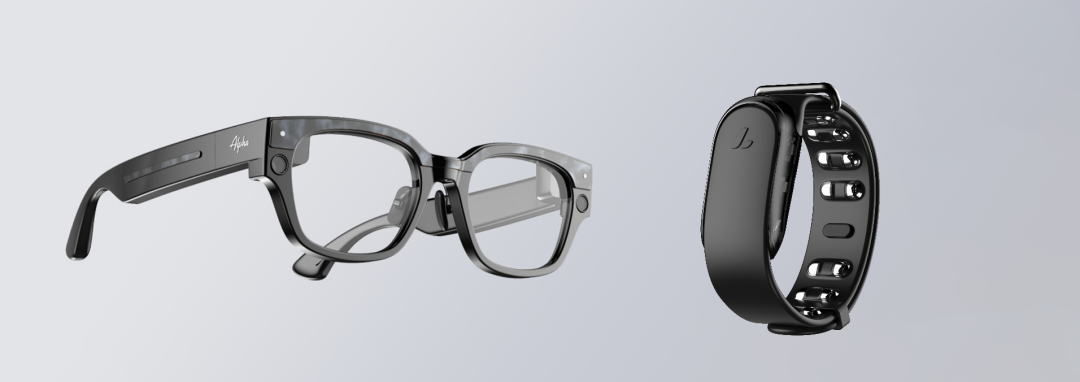
Unlike traditional solutions that rely on a single SoC, the Rubis AR glasses adopt an MCU+ISP+NPU tri-core heterogeneous system. This architecture establishes a complex processing pathway through heterogeneous communication, connecting the camera, ISP, NPU, and display. It not only achieves ultra-low power consumption through distributed computing but also allows the glasses to run lightweight object detection models using the NPU under extremely low power conditions, laying the technical foundation for 'AI Always-On.'
In terms of design, the Rubis AR glasses incorporate decorative plate elements into a classic frame shape, paired with a modular nose pad design, balancing personalization and comfort.

At the interaction level, the EMG neural wristband paired with the Rubis AR glasses addresses the interaction shortcoming (weakness) of AR glasses. According to reports, this neural wristband adopts a newly self-developed solution, achieving a gesture recognition accuracy rate exceeding 90%. Users can easily operate the AR glasses through high-sensitivity sensors with minimal finger movements, resolving the inconvenience of touch-based interaction in AR glasses.
02 Lightweight AI Glasses and Sub-100g MR Designs: Focusing on Lightweight Product Solutions
In addition to exploring future-oriented innovative solutions like Rubis, Goertek also introduced innovative reference designs for smart glasses and MR headsets that focus on lightweight construction and smooth interaction experiences in today's hottest sectors.
(I) Spinel AI Glasses: Redefining Daily AI Wearable Experiences with Lightweight Design
The Spinel AI glasses product solution achieves an ultra-lightweight design of 35 grams, ensuring a fashionable appearance and long-lasting battery life while delivering high-definition imaging capabilities, laying the foundation for all-day wear.
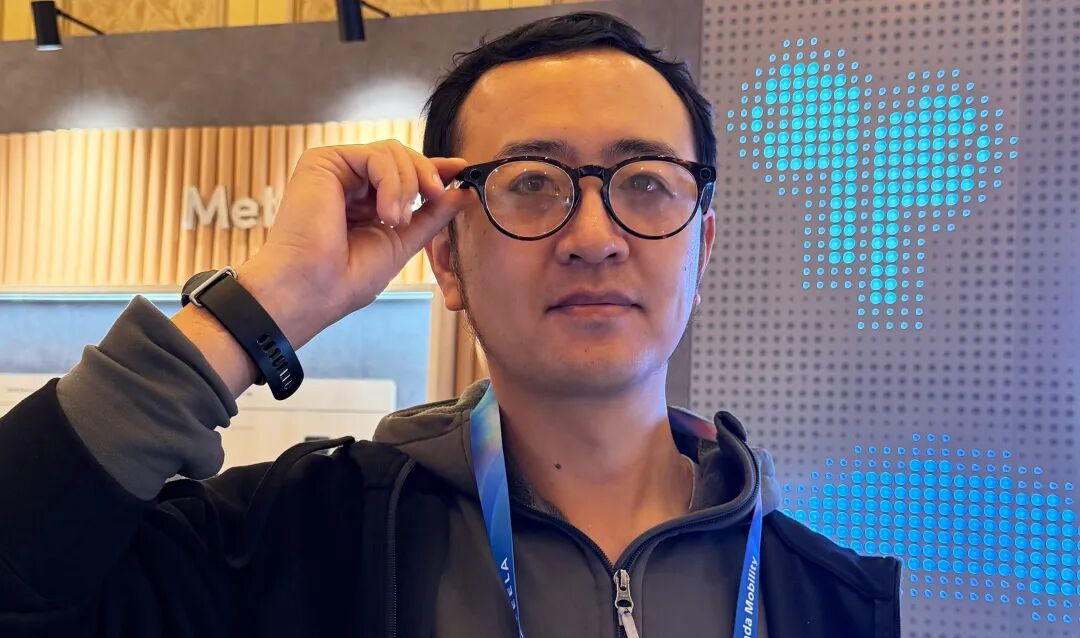
Its imaging system supports 4K (4032×3024) photo capture and 1-hour continuous 1080P/30fps video recording, equipped with EIS anti-shake and HDR functions. This capability enables the device to serve as both a life recorder and a high-quality imaging output tool, making it a practical Take photos with you (on-the-go shooting) tool.
Simultaneously, the Spinel AI glasses feature AI visual perception capabilities. Through continuous environmental capture at low resolution and low frame rates, the device operates at low power consumption, enabling a shift in interaction mode from 'responding to commands' to 'anticipating needs,' providing a technological pathway for scenario-based proactive services.
(II) Smart Add-On Accessories: Transforming Traditional Glasses into AI Glasses Instantly
Addressing the broader market of existing glasses, Goertek offered a clever solution at CES: the lightweight AI smart glasses accessory, Rox-Vision.
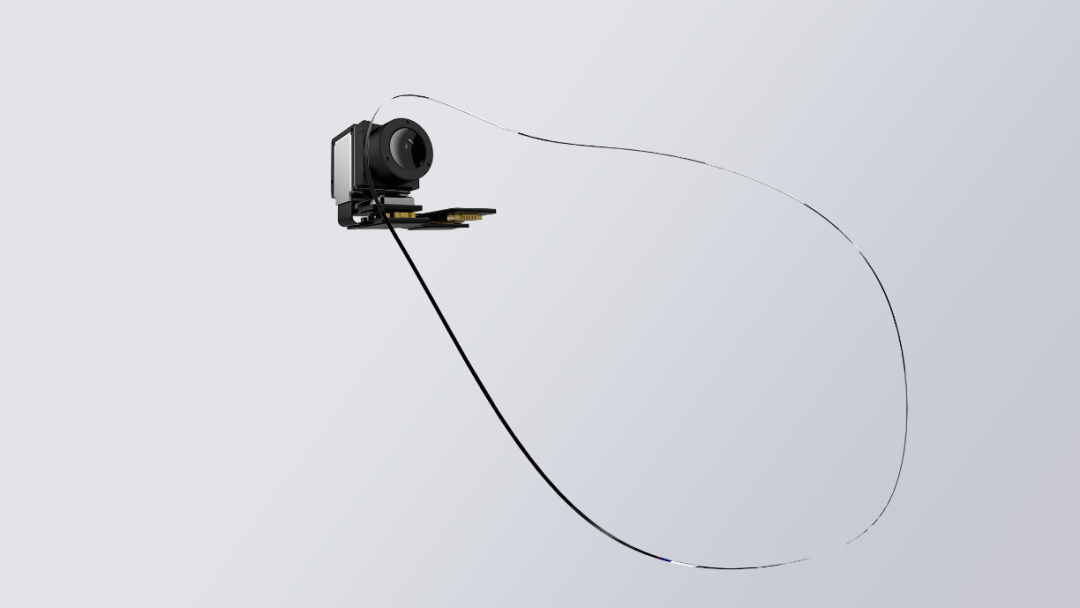
Rox-Vision breaks free from the limitations of traditional all-in-one AR glasses designs by innovatively combining an 'AI smart add-on accessory' with traditional glasses. Through a decoupled design, Goertek integrates visual capture (Camera), audio interaction (Audio), and AI processing capabilities into a single independent module.
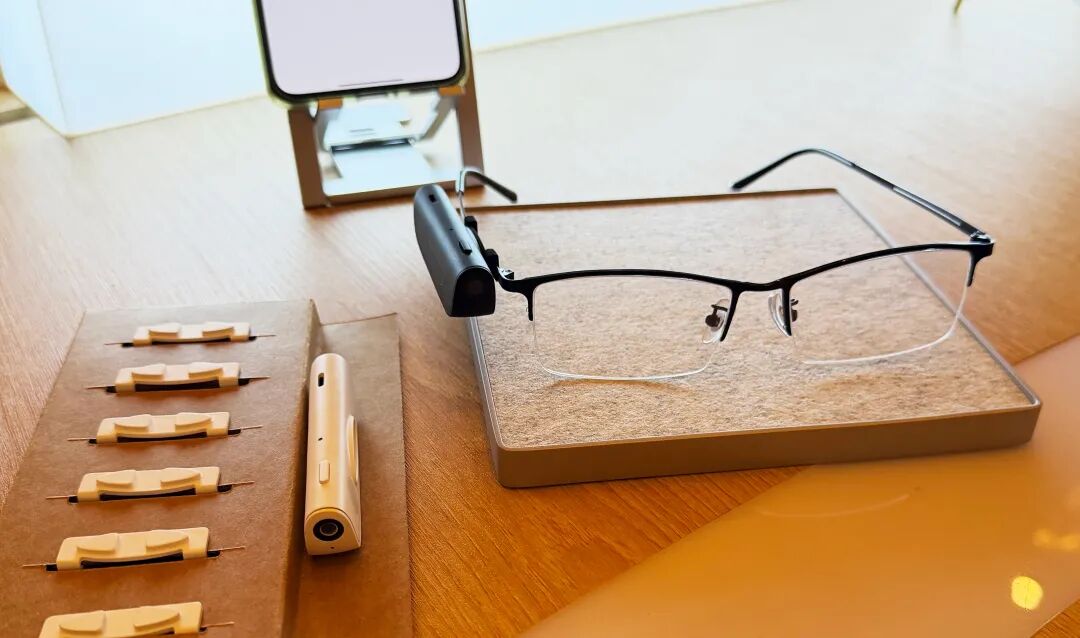
This solution retains the vision correction and decorative properties of traditional glasses while endow (imbuing) them with generative AI interaction capabilities at an extremely low cost, validating the technical feasibility of 'detachable AI assistants' in the wearables sector.
Addressing the common pain point of wear comfort in add-on devices, Rox-Vision overcomes engineering challenges by integrating high-pixel imaging modules and large-capacity batteries within a micro-cavity through optimized structural stacking and high-density PCB technology. The overall weight is strictly controlled below 15g, achieving a nearly 'weightless' wearing experience.
At the core perception layer, Rox-Vision achieves a 105° ultra-wide field of view (FOV) while minimizing module size. This ensures the completeness and immersion of first-person view (FPV) shooting footage, providing high-quality image input for AI visual recognition. In terms of audio, thanks to vertical integration capabilities, the product utilizes Goertek's self-developed customized SBS micro-speakers and MEMS acoustic sensors, ensuring a high-quality voice interaction closed loop.
(III) Sub-100g MR Headsets: Goertek Paves the Way for Lightweight Products
In the MR sector, 'weight' remains an unavoidable physical challenge, as the weight of all-in-one headsets often causes user fatigue after just half an hour of wear. Goertek Optical's newly released ultra-lightweight 4K MR reference design compresses the headset's main body weight to around 100 grams, nearly one-fifth of traditional all-in-one headsets, making 'weightless wear' a reality.
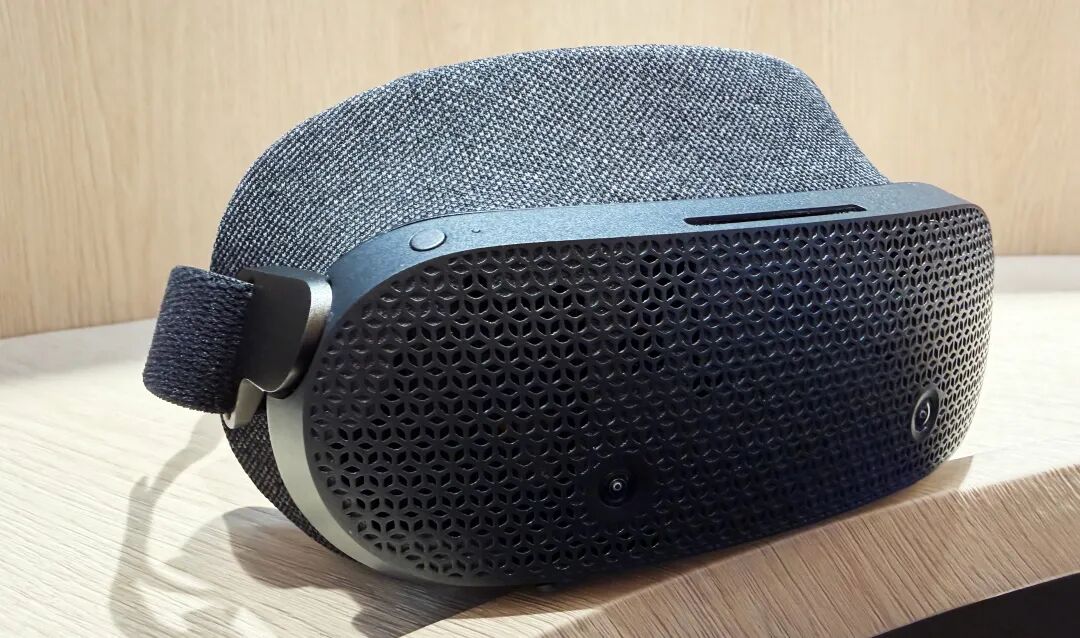
While achieving light weight, its visual configuration remains luxurious: equipped with a 1.35-inch 4K Micro-OLED display, combined with Goertek Optical's 3P Pancake module, it delivers retinal-level clarity with 38 PPD at a 100° field of view, fully integrating interaction schemes such as VST and 6DoF. This form factor better supports wear comfort for movie watching, light office work, and casual gaming, representing a definitive lightweight MR pathway.
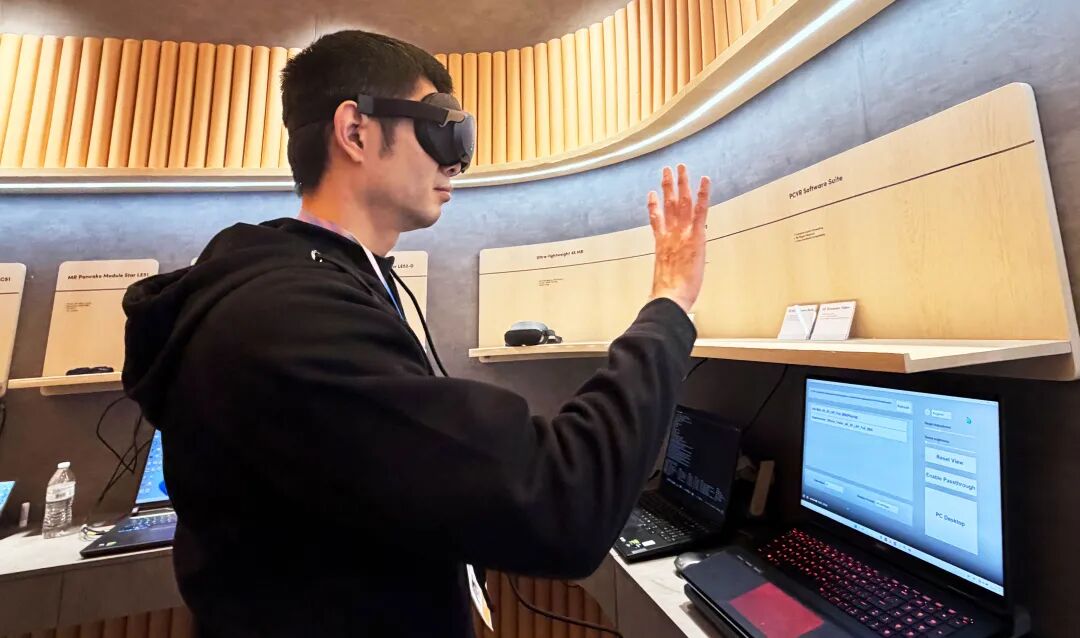
03 From AR Resin Full-Color Waveguides to 'Electronically Controlled Liquid Crystal Molecular Focusing': The Next Frontier in XR Optics
At this year's CES, Goertek also showcased optical solutions covering the full spectrum of AR and MR scenarios, with the breakthrough in electronically controlled liquid crystal molecular focusing technology standing out prominently.
In AR optics, Goertek Optical introduced the F15Pi full-color resin waveguide module, which balances 'lightweight construction' and 'high image quality.' Compared to glass, resin materials are lighter and less prone to breakage, making them safer for lightweight AR glasses applications. However, their lower refractive index often led to optical issues such as excessive rainbow patterns in past implementations.
At this year's CES, Goertek Optical optimized rainbow patterns to invisibility and increased waveguide grating transmittance to over 92% through high-refractive-index resin materials, micro-nano structure optimization, and ergonomic design. Paired with the industry's smallest high-efficiency full-color Micro-LED light engine at just 0.2cc/0.5g, it becomes one of the best optical choices for all-day wear.
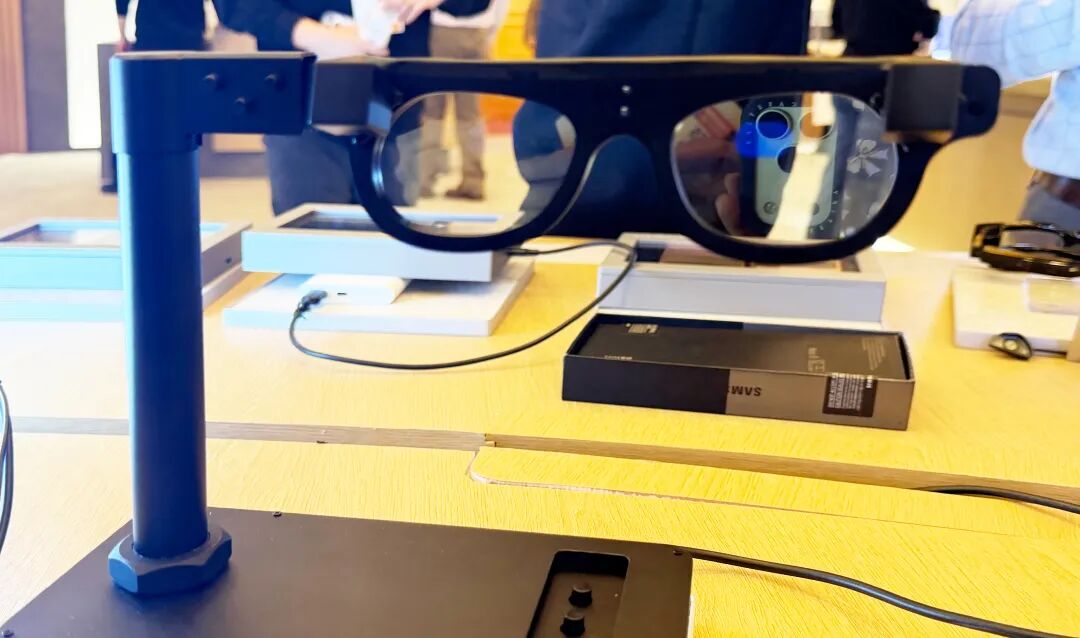
In terms of more cutting-edge optical materials and process exploration, Goertek Optical's fully laminated silicon carbide (SiC) etched waveguide module utilizes the extremely high refractive index of SiC materials to achieve a thickness of 0.65mm and a weight of 3.5g, setting a new industry record for thinness and lightness. At a 30° FOV, it delivers clear images with excellent color uniformity.
Additionally, Goertek Optical introduced the F25Ge full-color etched waveguide designed specifically for outdoor high-light scenarios, paired with a 0.2cc high-efficiency full-color Micro-LED light engine, delivering a peak in-eye brightness of 4200nits.
In the MR field, the Pancake scheme has been further miniaturized. The Xinghe LE51-D integrates diopter adjustments ranging from -700° to +200° within a mere 14mm thickness, representing a significant advantage for the vast global market of myopic users. It features a 1.03-inch Micro-OLED display achieving an 85.5° field of view. For even thinner and lighter demands, the Xinghe LE52 adopts a 0.68-inch screen with a TTL of just 13.6mm.
In terms of XR optical technology breakthroughs, Goertek also introduced electronically controlled liquid crystal molecular focusing technology at this year's CES. As is widely known, VAC (Visual Accommodation-Convergence Conflict) is a common issue in XR technology, referring to the mismatch between the focal point of light emitted by virtual objects and the actual distance the human eye needs to focus on. This discrepancy leads to uncoordinated eye functions in convergence (binocular alignment) and accommodation (lens focusing), resulting in visual fatigue, headaches, blurriness, and even motion sickness.
 Mismatch when viewing virtual objects in near-eye display systems (Source: Internet)
Electronically controlled liquid crystal molecular focusing technology enables dynamic optical adjustments and vision correction functions, addressing this long-standing industry challenge. Specifically, its variable focus liquid crystal lens employs electronically controlled driving methods to alter liquid crystal molecule arrangements by adjusting voltage, achieving a continuous diopter adjustment range of -300 to +300 degrees (for hyperopia and myopia).

Furthermore, this liquid crystal lens can be manufactured at a thickness of less than 1mm with an aperture exceeding 25mm. Its thin, lightweight, and easy-to-integrate characteristics make it applicable not only to VR and MR headsets but also embeddable into the optical pathways of AR glasses, enabling myopic users to achieve clear vision without the need for additional corrective glasses, further enhancing the wearability and convenience of XR devices.
04 Conclusion
From the heterogeneous reorganization of underlying chip architectures for AI glasses to innovations in natural interaction paradigms and the expansion of optical material boundaries, the innovative product solutions introduced by Goertek at CES 2026 address core industry demands in display performance, wear comfort, and interaction convenience. Moreover, they represent a profound reflection on the future of the XR industry chain. As the XR industry enters the next cycle of large-scale commercial deployment, this full-stack integration capability spanning from underlying technologies to complete device applications provides the industry with diversified implementation pathways and constructs a solid technological foundation.
Looking ahead, with the continuous refinement of upstream core technologies, ongoing optimization of end-product experiences, and gradual release of market demand, the XR sector is poised to embrace a more diversified development ecosystem. The implementation effectiveness and market feedback of various technological solutions will further drive the industry toward directions that better align with user needs.
-
On the Eve of Its IPO, Avatr Finds Itself Embroiled in a 'Farce of Controversy and Belittlement'
-
![]()
Yutong Optics' Japanese Subsidiary Unveiled in Tokyo, Shifting Strategic Focus to Technology-Driven Growth
-
![]()
Half-Year Revenue Outstrips Last Year’s Total! Zhongrun Optics Forecasts 80.2% H1 Revenue Growth
-
![]()
Why Does AI Competition Start with Computing Power?
-
![]()
Apple AI Finally Makes Its Debut in China, Yet iPhone's 'AI Autonomy' Faces Uncertainty
-
![]()
Apple AI and QianWen Make Up Lessons: Alibaba Has Its Own 'Doubao Phone'
-
![]()
QianWen Joins Apple, Signal for Large Models to ‘Fade into the Background’
-
![]()
The ‘Anchor’ Strategy of Google Hidden Behind the Bleeding Financial Report