87th in Ultrafast Nonlinear Optics: Soliton Self-Compression in Hollow-Core Fibers and Its Role in Water-Window Attosecond Pulse Generation
 04/13 2026
 559
559
The water-window spectral range encompasses photon energies from 280 to 530 electron volts (eV), corresponding to wavelengths between 2.34 and 4.43 nanometers (nm). This range falls within the boundary of the extreme ultraviolet and soft X-ray regions. Notably, this energy band can excite the K-shell electrons of carbon, nitrogen, and oxygen, while water absorption remains relatively low in this range. As a result, water-window X-rays possess the unique ability to "penetrate water" and directly observe molecular dynamics within biological samples. Hence, the generation of isolated attosecond pulses (IAPs) within the water-window range is regarded as an optimal light source for investigating chemical reactions and biological processes.
In the realm of attosecond science, hollow-core fibers (HCFs) represent a significant milestone. By filling these fibers with noble gases and fine-tuning the gas type and pressure, it is possible to precisely balance anomalous dispersion and self-phase modulation (SPM), thereby achieving soliton self-compression. Consequently, HCFs serve as a pivotal platform for generating single-cycle driving light and, subsequently, attosecond pulses. The research team led by Professor Wörner from ETH Zurich has achieved two groundbreaking advancements in ultrafast optics: the first direct field-resolved characterization of soliton self-compressed single-cycle pulses and their application in water-window high-order harmonic generation (HHG).
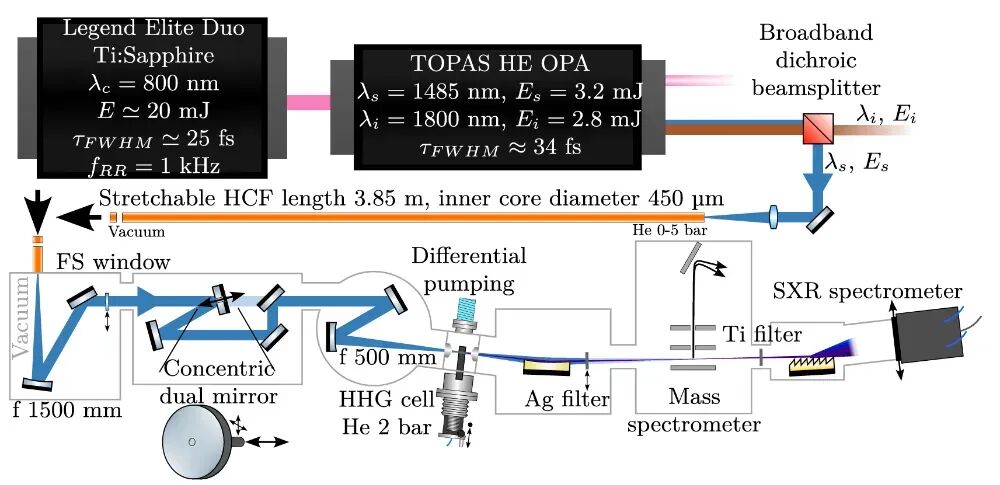
Figure 1. Experimental setup
The experimental configuration is illustrated in Figure 1. A high-power short-wave infrared optical parametric amplifier (OPA) was employed as the front-end light source, featuring a central wavelength of 1485 nm, a pulse width of 34 femtoseconds (fs), a single-pulse energy of 2.1 millijoules (mJ), and a repetition rate of 1 kilohertz (kHz). The output laser was efficiently coupled into a 3.85-meter-long HCF with an inner diameter of 450 micrometers (μm). To optimize the soliton self-compression process, the fiber was differentially filled with helium, introducing a pressure gradient along the fiber axis. This approach precisely balanced dispersion and nonlinear effects, resulting in high-quality pulse self-compression. The self-compressed laser was then split into two beams using a concentric double mirror: one beam for strong-field ionization and the other for perturbing the ionization process. These two beams (driving and probe beams) were focused by a toroidal mirror into a continuously jetted pure ethylene gas flow (plume). The pulse waveform was measured using the TIPTOE technique and reconstructed using the CRIME technique. At a pressure of 4.5 bar, the pulse was compressed to a width of 5.05 fs, equivalent to 1.1 optical cycles (i.e., a single-cycle pulse). The total energy output from the fiber was 1.175 mJ, with a contrast ratio of approximately 1:6. Subsequently, the laser pulse was focused into a 6 mm-long gas cell filled with 2 bar of helium to generate high-order harmonics. Figure 2 displays the high-order harmonic generation results obtained from 'multi-cycle' to 'single-cycle' driving light. At pressures of 4.0 and 4.5 bar, isolated attosecond pulses with pulse widths of 672 attoseconds (as) and 561 as, respectively, were generated. For nearly all carrier-envelope phases (CEPs), the high-order harmonic pulses were single isolated attosecond pulses. Double pulses only formed within a very narrow CEP offset range of approximately 135 degrees. This indicates that, due to the driving pulse reaching the single-cycle limit, stable isolated attosecond pulses can be generated even without CEP locking, significantly reducing experimental complexity and cost.
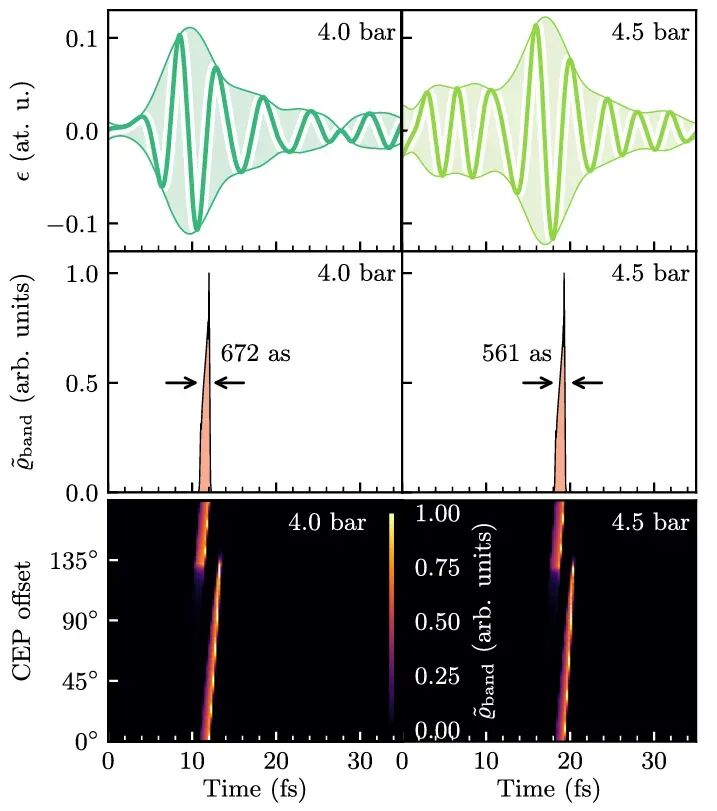
Figure 2. Experimental results of isolated attosecond pulse generation
In summary, this work comprehensively demonstrates the unique advantages of soliton self-compression in hollow-core fibers for attosecond science. Through precise control of gas dispersion and nonlinear effects, femtosecond pulses can naturally compress to the single-cycle limit during propagation, and direct field-resolved characterization of this process was achieved for the first time. Building on this foundation, single-cycle driving light was successfully utilized for high-order harmonic generation in the water-window range, yielding stable isolated attosecond pulses and significantly reducing dependence on carrier-envelope phase. This not only simplifies the experimental setup for water-window attosecond light sources but also provides a more feasible light source solution for cutting-edge research, such as the ultrafast dynamics of biomolecules and real-time imaging of chemical reactions.
Reference:
[1] Tristan Kopp, Leonardo Redaelli, Joss Wiese, et al. Field-resolved measurements of soliton self-compressed single-cycle pulses and their application to water-window high-harmonic generation. Optica 12(11), 1767-1774 (2025).
-
On the Eve of Its IPO, Avatr Finds Itself Embroiled in a 'Farce of Controversy and Belittlement'
-
![]()
Yutong Optics' Japanese Subsidiary Unveiled in Tokyo, Shifting Strategic Focus to Technology-Driven Growth
-
![]()
Half-Year Revenue Outstrips Last Year’s Total! Zhongrun Optics Forecasts 80.2% H1 Revenue Growth
-
![]()
Why Does AI Competition Start with Computing Power?
-
![]()
Apple AI Finally Makes Its Debut in China, Yet iPhone's 'AI Autonomy' Faces Uncertainty
-
![]()
Apple AI and QianWen Make Up Lessons: Alibaba Has Its Own 'Doubao Phone'
-
![]()
QianWen Joins Apple, Signal for Large Models to ‘Fade into the Background’
-
![]()
The ‘Anchor’ Strategy of Google Hidden Behind the Bleeding Financial Report