Ultrafast Nonlinear Optics Technique 88: Generation of Soft X-ray High-Order Harmonics Using 3 μm Ultrafast Lasers in Anti-Resonant Hollow-Core Fibers
 04/16 2026
 624
624

Soft X-rays, which have wavelengths ranging from 0.1 to 10 nanometers, possess strong penetration capabilities. This allows for high spatial resolution in transmission imaging. In spectroscopy, soft X-rays can be used to investigate the chemical and magnetic properties of elements. This specific spectral range is typically achieved through high-order harmonic generation (HHG) driven by mid-infrared lasers. Anti-resonant hollow-core fibers (ARHCFs) are particularly effective in generating high-order harmonics in the soft X-ray band. This is due to their ability to support long laser-gas interaction distances and exhibit low transmission losses for mid-infrared light.
This study introduces a four-stage optical parametric chirped-pulse amplification (OPCPA) system. The system utilizes an all-fiber front-end seed source and periodically poled lithium niobate (PPLN) crystals to produce mid-infrared pulses at a wavelength of 3 μm. These pulses have an energy of 775 μJ and operate at a repetition rate of 1 kHz. By focusing this mid-infrared light into an ARHCF filled with high-pressure gas, soft X-ray high-order harmonics are generated in argon (Ar)[1]. 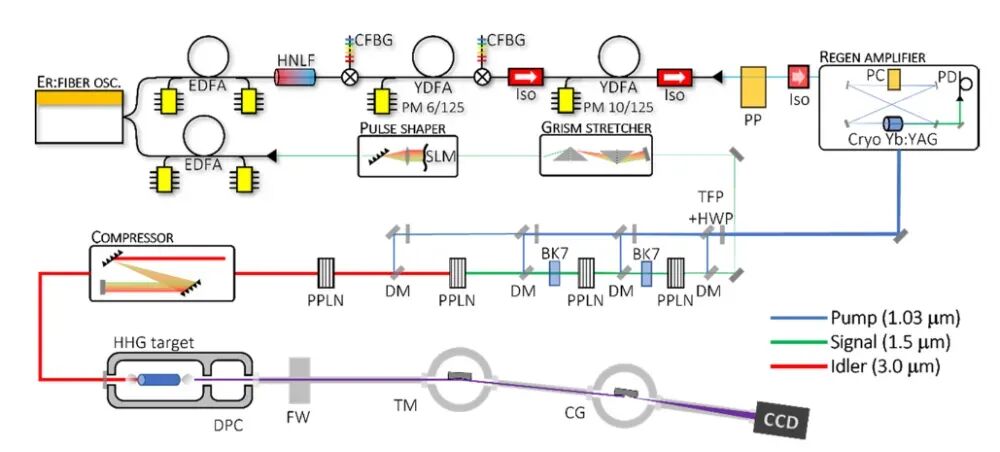 Figure 1: Schematic of the experimental setup[1]
The experimental setup is illustrated in Figure 1. The front end employs an erbium-doped fiber oscillator with a central wavelength of 1570 nm, generating 700 fs pulses with an energy of 30 pJ at a repetition rate of 100 MHz. The output from the oscillator is split into two paths, each amplified by a fiber amplifier. One path serves as the pump for the subsequent OPCPA stage, while the other functions as the signal light.
In the pump path, the light first passes through a 3.5 cm long highly nonlinear fiber, shifting its central wavelength to 1030 nm. It then undergoes two stages of chirped fiber Bragg grating (CFBG) stretching and ytterbium-doped fiber amplifier (YDFA) amplification, increasing the power to 6 W. An electro-optic modulator reduces the repetition rate to 1 kHz and the energy to 20 nJ before the light is injected into a regenerative amplifier, which further amplifies it to 20 mJ. The signal path undergoes phase control using a spatial light modulator and is stretched by a stretcher composed of four prisms and two gratings, providing the input signal for the OPCPA.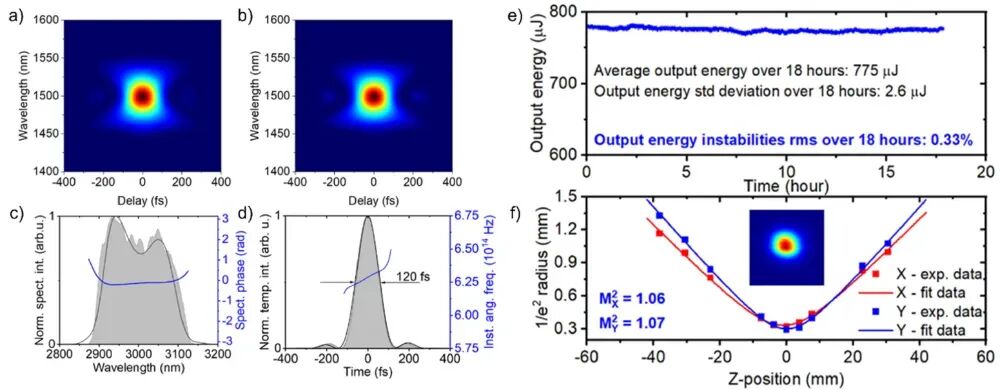 Figure 2: (a, b) Measured and reconstructed frequency-resolved optical gating (FROG) traces, (c) spectrum, (d) pulse width, (e) power stability, and (f) beam quality M2 factor of the 3 μm mid-infrared light[1]
The crystals used in the optical parametric amplification process are all 5% MgO-doped PPLN crystals. The first stage is powered by 0.2 mJ of pump energy, amplifying the signal light to 10 μJ with a spectral width of 70 nm. The first two stages utilize BK7 glass to absorb the idler light. The second and third stages employ pump energies of 1.2 mJ and 4 mJ, respectively, amplifying the 1.5 μm signal light to over 800 μJ. After the third optical parametric amplification (OPA) stage, the signal light is filtered out, and the generated idler light serves as the seed for the final OPA stage. The final stage, pumped with 10 mJ of energy, produces 1.3 mJ of 3 μm mid-infrared light with a conversion efficiency of approximately 10%. The spectral width of the mid-infrared light exceeds 200 nm and is compressed to 120 fs by a grating pair (Figure 2(c, d)), with a transmission efficiency of 64%. The compressed pulse energy is 775 μJ, exhibiting an RMS power fluctuation of 0.33% over 18 hours and an M2 factor of less than 1.1 (Figure 2(e, f)).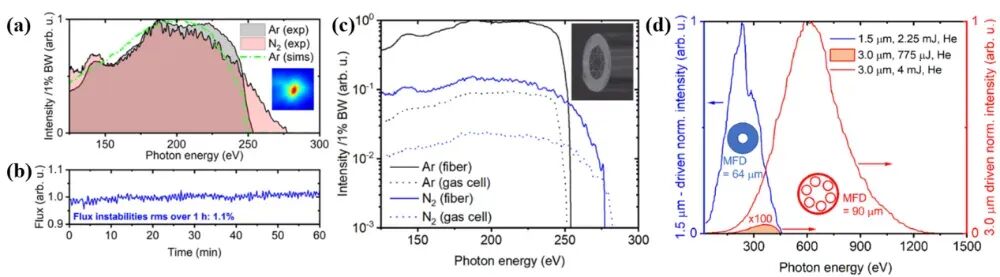 Figure 3: (a) HHG spectra generated in Ar and N2, along with simulated spectra for Ar; (b) HHG intensity stability in Ar; (c) comparison of harmonic intensities generated in ARHCF versus a gas cell for Ar and N2; (d) simulated HHG spectral intensity in He for infrared light of different wavelengths and energies[1]
The ARHCF used in the experiments is 13 mm long, supports a mode field diameter of approximately 90 μm, and can withstand pressures up to 35 bar. In the experiments, it was filled with 10 bar of Ar and N2, respectively. After the generation of high-order harmonics, the harmonics pass through two differentially pumped chambers (Figure 1 DPC) to minimize residual gas absorption of the HHG.
As depicted in Figure 3(a), the HHG spectra generated in both Ar and N2 extend to the cutoff energy region, with the experimental spectrum of Ar closely matching the simulation (Figure 3(a), green dashed line). The harmonic intensity stability over 1 hour has an RMS of 1.1% (Figure 3(b)), which is comparable to the typical stability of extreme ultraviolet high-order harmonics. This study compares the harmonic intensities generated in a 1.75 mm long gas target with those generated in an ARHCF. In the ARHCF, Ar produces a maximum photon flux of 105/s/1%BW, with a conversion efficiency from mid-infrared to >125 eV photons of 4e-10. Due to shorter interaction distances and lower pressures, the gas cell generates harmonic intensities an order of magnitude lower than the ARHCF. Owing to molecular alignment effects, N2 produces harmonic intensities approximately five times lower than Ar. This study also simulates HHG driven in He, which exhibits lower absorption. When combined with higher pulse energy and shorter pulse widths, the photon flux is expected to increase by 10,000 times (Figure 3(d)).
In summary, this study presents an OPCPA system capable of generating 3 μm mid-infrared lasers. Its exceptional long-term stability enables the generation of ultrastable soft X-ray high-order harmonics in an ARHCF. This light source provides a high-quality tool for research in soft X-ray transmission imaging and advanced spectroscopy.
References: D. Morrill, W. Hettel, D. Carlson, et al. Soft x-ray high-harmonic generation in an anti-resonant hollow core fiber driven by a 3 μm ultrafast laser[J]. APL Photon. 10, 116101 (2025).
-
On the Eve of Its IPO, Avatr Finds Itself Embroiled in a 'Farce of Controversy and Belittlement'
-
![]()
Yutong Optics' Japanese Subsidiary Unveiled in Tokyo, Shifting Strategic Focus to Technology-Driven Growth
-
![]()
Half-Year Revenue Outstrips Last Year’s Total! Zhongrun Optics Forecasts 80.2% H1 Revenue Growth
-
![]()
Why Does AI Competition Start with Computing Power?
-
![]()
Apple AI Finally Makes Its Debut in China, Yet iPhone's 'AI Autonomy' Faces Uncertainty
-
![]()
Apple AI and QianWen Make Up Lessons: Alibaba Has Its Own 'Doubao Phone'
-
![]()
QianWen Joins Apple, Signal for Large Models to ‘Fade into the Background’
-
![]()
The ‘Anchor’ Strategy of Google Hidden Behind the Bleeding Financial Report