Sunny Intelligent Technologies’ IPO: Five Crucial Queries and the Compliance Imperative for Optical Firms
 04/20 2026
 721
721
Recently, the International Department of the China Securities Regulatory Commission (CSRC) has requested supplementary materials for overseas listing filings from seven companies. Among them, Sunny Intelligent Technologies, a vehicle-mounted optics subsidiary of Sunny Optical, has been asked to clarify five key issues, including the fairness of its related-party transactions with the parent company. Here are the details:
1. Please provide a supplementary explanation regarding the reasonableness of the share purchase prices paid by new shareholders within the last 12 months, the reasons for any discrepancies in these prices, and issue a clear and definitive opinion on whether any related-party transactions or transfers of interests have occurred.
2. Please provide a supplementary explanation of the specific compliance status of regulatory procedures, such as overseas investments and foreign exchange registrations, involving the company’s overseas subsidiaries, and provide a conclusive opinion on their compliance.
3. Please provide a supplementary explanation of the specifics of the company’s large-scale model development and processing algorithms, and whether the necessary filing procedures with the competent authorities have been completed.
4. Please provide a supplementary explanation of whether the shares held by shareholders participating in the “full circulation” this time are subject to pledges, freezes, or other encumbrances.
5. Please provide a supplementary explanation of the specifics of the company’s purchases from its parent company during the reporting period, whether the pricing of these related-party transactions is fair, whether there are any related-party transactions or transfers of interests, and provide supporting evidence.
As the world’s leading supplier of vehicle-mounted lenses and camera solutions by shipment volume, Sunny Intelligent Technologies’ IPO process has garnered significant attention. The regulatory inquiry touches upon deep-seated challenges currently faced by intelligent vehicle supply chain enterprises, such as clarifying product compliance boundaries, navigating regulatory requirements in technology path selection, and balancing supply chain independence with collaboration.
Among the five questions, two are particularly noteworthy for the industry. One concerns the specifics of the company’s large-scale model development and processing algorithms, as well as whether the filing procedures with the competent authorities have been completed. Sunny Intelligent Technologies’ intelligent perception solutions are highly algorithm-driven, involving functions such as multi-sensor fusion, target detection, and path planning. These algorithms are no longer a free-for-all technical testing ground for enterprises.
The other issue pertains to the fairness of pricing in related-party transactions involving purchases from the parent company. During the reporting period, Sunny Intelligent Technologies’ purchases of core optical components from Sunny Optical Group accounted for a significant proportion. Although this proportion has been declining year by year, whether the supply chain relationship between the parent and subsidiary companies has achieved truly market-based pricing directly relates to the operating independence of Sunny Intelligent Technologies as an independently listed entity.
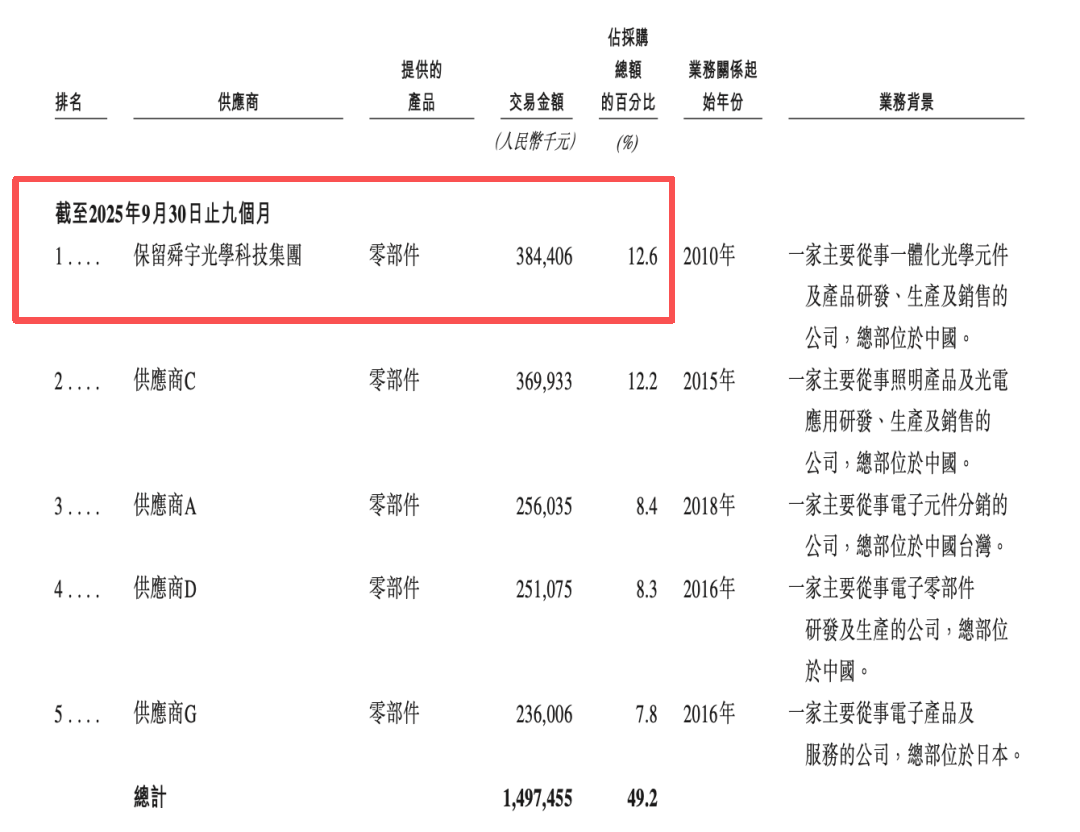
This underscores a common challenge faced by many vehicle-mounted business entities spun off from large optical groups—how to establish an independent pricing mechanism that withstands market and regulatory scrutiny while maintaining internal supply chain efficiency. If the prices of related-party purchases remain below fair market levels for an extended period, profitability may see a “correction” after listing. Conversely, if pricing has approached market levels, the sustainability of gross profit margins must be demonstrated through product competitiveness.
This also serves as a reminder to the entire industry that relying solely on internal resource synergies within the group is no longer sufficient to support an independent listing narrative. Enterprises must demonstrate to the outside world that their core products possess genuine independent bargaining power and cost control capabilities in the market.
From a broader market and product perspective, the regulatory inquiry faced by Sunny Intelligent Technologies reflects the industry’s increasing emphasis on compliance. The vehicle-mounted optics sector is currently undergoing an industrial upgrade from single lenses to system-level solutions such as LiDAR, HUD, and intelligent headlights. However, the expansion of product lines should not overshadow a core issue—all technological innovations must operate within the bounds of legality and compliance.
The regulatory focus on algorithm filings, overseas investment compliance, and the fairness of related-party transaction pricing serves as a reminder to enterprises: future competition will hinge not only on who can lead in performance parameters but also on who can first establish a compliance system covering the entire product lifecycle. For Chinese optical enterprises within the global supply chain, a lack of compliance capabilities may hinder market access, whether serving domestic OEMs or overseas clients.
As a benchmark enterprise in the vehicle-mounted optics sector, the regulatory scrutiny faced by Sunny Intelligent Technologies during its IPO process holds significant indicator value. As the intelligent vehicle industry transitions from rapid growth to high-quality development, optical enterprises must simultaneously enhance their technological innovation capabilities and compliance governance standards. Regulatory inquiries do not negate the value of enterprises but rather drive the industry to establish a healthier underlying operational logic.
For Sunny Intelligent Technologies, how it addresses these concerns with solid supplementary materials will directly influence its capital market narrative. For the optical industry, this incident provides an opportunity to calmly reflect on its development model—only by finding a sustainable balance between innovation and compliance can enterprises thrive in the long-term race of intelligent mobility.
-
On the Eve of Its IPO, Avatr Finds Itself Embroiled in a 'Farce of Controversy and Belittlement'
-
![]()
Yutong Optics' Japanese Subsidiary Unveiled in Tokyo, Shifting Strategic Focus to Technology-Driven Growth
-
![]()
Half-Year Revenue Outstrips Last Year’s Total! Zhongrun Optics Forecasts 80.2% H1 Revenue Growth
-
![]()
Why Does AI Competition Start with Computing Power?
-
![]()
Apple AI Finally Makes Its Debut in China, Yet iPhone's 'AI Autonomy' Faces Uncertainty
-
![]()
Apple AI and QianWen Make Up Lessons: Alibaba Has Its Own 'Doubao Phone'
-
![]()
QianWen Joins Apple, Signal for Large Models to ‘Fade into the Background’
-
![]()
The ‘Anchor’ Strategy of Google Hidden Behind the Bleeding Financial Report