Following Equipment Business Integration, Sugon’s Net Profit (Excluding Non-Recurring Items) Skyrockets by 222.54% in H1!
 08/26 2026
 493
493
Recently, Sugon released its semi-annual report, revealing that the company generated revenue of RMB 1.035 billion in the first half of the year, marking a year-on-year increase of 5.39%. Net profit attributable to shareholders reached RMB 49.7604 million, up by 62.29% year-on-year, while net profit excluding non-recurring gains and losses soared to RMB 41.823 million, representing a staggering 222.54% year-on-year growth.
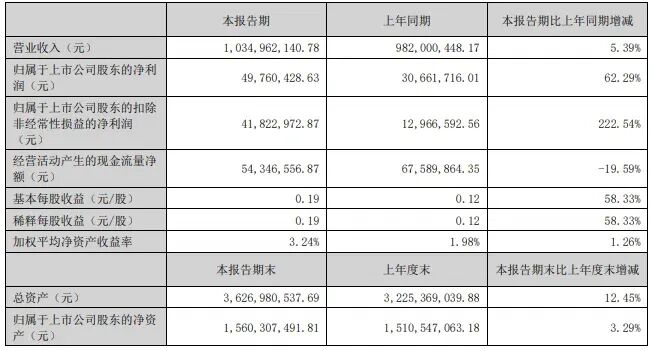
The fact that profit growth significantly outpaces revenue growth underscores a qualitative shift in the business structure—the profit-pulling effect of high-value-added semiconductor equipment is now fully evident. The driving force behind this transformation is Weipu Semiconductor.
On January 20th of this year, during a research visit by 16 institutions, including CITIC Securities and HunDun Investment, Sugon announced the completion of its acquisition of a 51% stake in Changzhou Weipu (now known as Weipu Semiconductor). This company specializes in photomask and wafer defect detection equipment and is one of the few domestic manufacturers to achieve large-scale mass production of photomask defect detection equipment. Its core technologies and components are independently developed and have been localized. According to the company, its products have been integrated into the production lines of leading clients such as SMIC, Luwei Optoelectronics, and Qingyi Optoelectronics.
In its first full half-year post-consolidation, Weipu Semiconductor delivered outstanding results: revenue reached RMB 94.2204 million, a 524.78% year-on-year increase; net profit hit RMB 50.6827 million, turning a loss into a profit and surging by 1,384.23%. The corresponding net profit margin stood at an impressive 53.8%, fully reflecting the high-value-added nature of high-end detection equipment. Its contribution to Sugon’s net profit attributable to shareholders amounted to RMB 24.7773 million, accounting for 49.79% of the total.
Additionally, the gross profit margin of the high-end intelligent equipment business soared to 77.73%, far surpassing the 23.91% of micro-nano optical products and the 16.03% of reflective materials. This directly propelled the company’s overall gross profit margin from 20.05% in the same period last year to 28.34%. Semiconductor equipment has clearly emerged as the company’s primary profit driver.
Beyond domestic market substitution, Weipu Semiconductor’s overseas breakthroughs also offer promising growth prospects. According to the company, during the reporting period, Weipu achieved its first export to a South Korean factory of a global leading enterprise and secured orders from leading clients in Taiwan, China, with shipments expected in the second half of the year. If these orders are fulfilled as planned, it will signal initial recognition of its product performance and quality by international high-end clients.
In the domestic market, Weipu’s shipments to leading wafer and mask enterprises continue to climb. Combined with Sugon’s proprietary laser direct-write lithography equipment, which forms a closed-loop “mask manufacturing + defect detection” full industry chain with Weipu’s detection equipment, lithography equipment has been clearly identified as the company’s future strategic focus.
On August 17th, the company disclosed that its actual controller, Chen Linsen, and shareholder Yu Zhangxing collectively transferred a 5% stake to the Hede Shangxuehui Growth Private Equity Fund, with the transferee voluntarily extending the lock-up period from 12 months to 18 months. This move, to some extent, reflects institutional investors’ confidence in the long-term growth potential of its semiconductor equipment business.
However, amidst the bright spots of transformation, the weaknesses of the traditional core business and the tight financial structure cannot be overlooked. Excluding consolidation effects, the company’s micro-nano optical core business revenue declined by approximately 4.93% year-on-year, with demand pressure for anti-counterfeiting films for motor vehicle certificates and cards, as well as the tobacco and alcohol packaging industry, still in a cyclical adjustment phase. In the reflective materials business, subsidiary Huari Sheng remains unprofitable, with no significant relief in overall operating pressure. Although the company has repeatedly expressed its intention to “effectively dispose of low-efficiency assets with poor profitability,” as of the semi-annual report disclosure, no substantive actions have been taken.
Overall, Sugon is undergoing a profound strategic transformation from micro-nano optics to semiconductor equipment. For Sugon, the future narrative may center on the rapid advancement of its semiconductor equipment business. However, the key variables determining the ultimate success of this transformation will be its ability to properly dispose of low-efficiency assets, manage financial risks, and consistently fulfill orders in overseas markets.
The leap from “materials” to “equipment” presents both an opportunity and a dual test of strategic resolve and execution efficiency. OFweek Optoelectronics will continue to monitor its subsequent market progress.
-
![]()
Two Major Optical Film Projects Reach Pivotal Implementation Stage! Tianlu Technology Records RMB 268 Million in H1 Revenue
-
![]()
Following Equipment Business Integration, Sugon’s Net Profit (Excluding Non-Recurring Items) Skyrockets by 222.54% in H1!
-
![]()
Insta360 Sidesteps Price Wars, Pursues New Avenues for Growth
-
![]()
Strategic Emphasis on Digital Photonics Gains Momentum! Optical Behemoth Reports RMB 12.4 Billion in H1 Revenue
-
![]()
In-depth | Li Shufu's "Turn at the Peak": Why Did Geely Choose to Change Leadership at Its Prime?
-
![]()
Has Xiaomi Weathered Its Toughest Times?", "Xiaomi, Financial Report, Chips, Automobiles, AI
-
![]()
Has Xiaomi Ridden Out the Storm?
-
![]()
Why Are Children Better at Learning Languages Than AI? MIT TR: Large Models Need to Burn Down an Entire Forest, While Kids Only Need 100 Million Words