The Pioneering Role of Unmanned Logistics Vehicles: Why the Breakthrough in Scaling Autonomous Driving Lies in 'Cargo' Rather Than 'Passengers'?
 01/04 2026
 808
808
Introduction
With autonomous Robotaxis frequently making headlines, it's easy to assume that 'passenger transport' is the ultimate goal and the core competitive arena of this technology.
However, on the journey towards large-scale commercial deployment of autonomous driving, 'cargo' scenarios are quietly taking the lead, stepping onto the fast track of rapid expansion.
This trend is not coincidental but rather an inevitable outcome of the coordinated evolution of technology, commerce, and policy.
While passenger-carrying Robotaxis are still grappling with open-road 'long-tail challenges,' exorbitant hardware costs, and ambiguous liability regulations, unmanned cargo vehicles have already found success in fertile grounds such as ports, mining areas, industrial parks, and last-mile delivery.
The shift from 'transporting goods' to 'transporting people' may seem minor, but it represents a significant leap in commercialization difficulty.
'Unmanned Vehicles Are Here' (WeChat Official Account: Unmanned Vehicles Are Here) is excited to discuss this with everyone!
(For more information, please click: 'Unmanned Vehicles Shine as Torchbearers at the National Games for the First Time! Autonomous Vehicles Take on 72 Roles: Passenger Transport, Coffee Sales, Firefighting, Archaeology, Psychological Warfare, Evolving from 'Toolbox' to 'Treasure Chest'?)
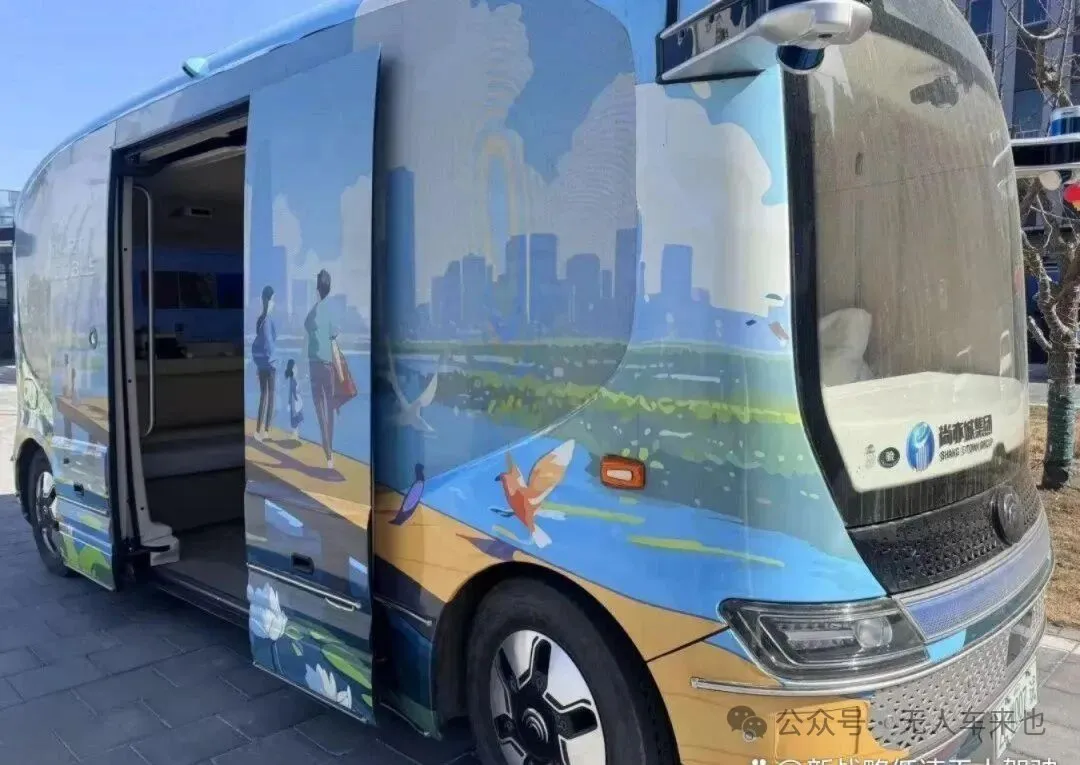
I. Advantage Differentiation: Why Are 'Cargo' Scenarios Inherently More Suitable for Deployment?
The core advantages of unmanned cargo can be distilled into two key points: relatively controllable environments and highly predictable operational paths. These factors form the bedrock for its commercial deployment.
Unlike passenger autonomous driving, which must navigate the infinitely complex urban road conditions, scenarios such as ports, mining areas, and large logistics parks are 'closed or semi-closed systems.'
In these settings, road ownership is clear, the behavior of traffic participants (primarily operational vehicles) is predictable, and infrastructure can even be modified (e.g., deploying roadside sensing equipment) to actively support the needs of autonomous vehicles.
This controllability drastically reduces the number of extreme 'Corner Cases' that technology must address, making current mature L4-level technology more than sufficient.
From a commercial perspective, cargo transport addresses a clear need for transferring production materials. Its value is measured by direct, efficient standards: whether it can replace human labor, reduce overall costs, and enhance operational efficiency and safety.
As long as a technological solution can 'win the economic calculation,' the procurement decision-making process is relatively straightforward.
In contrast, passenger services must also overcome subjective barriers such as passenger psychological trust and service experience comfort, making the commercialization path more convoluted.
II. Dual Drivers: How Do Technology and Policy Accelerate Industry Growth?
The report highlights that the industry's rapid growth is driven by the combined effects of technological maturity and policy support.
On the technology front, after years of research and development and closed testing, the reliability of autonomous driving's perception, decision-making, and control modules in specific scenarios has been thoroughly validated.
More importantly, customized technological solutions for logistics scenarios (such as heavy truck platooning and high-precision docking) are becoming increasingly mature, achieving a leap from 'usable' to 'practical and durable.'
On the policy front, clear encouraging signals have removed obstacles for industry development.
In recent years, construction guidelines and subsidy policies for smart ports, smart mines, and smart logistics parks have been introduced at both central and local levels.
(For more information, please click: '2025 Autonomous Driving Observations (5): Autonomous Driving Companies Flock to IPOs, L3 Deployment, Tenfold Growth in Unmanned Delivery Vehicles—Have Money-Burning Autonomous Vehicles Finally Turned Profitable?')
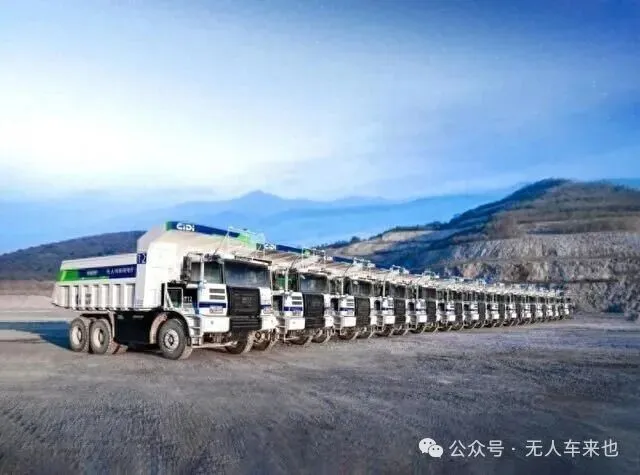
These policies not only provide financial support but, more importantly, actively open up testing and operational scenarios, clarify regulatory norms, and offer valuable 'testing grounds' for corporate innovation.
This 'scenario-driven' policy model perfectly aligns with the needs of cargo autonomous driving, forming a powerful driving force.
III. Competitive Logic: Why Can 'Scenario Deep Divers' Build Solid Barriers?
The unmanned cargo market is not a winner-takes-all arena.
Industry observers have keenly noted that leading companies are building solid competitive barriers through a deep understanding of specific scenarios and customized technological solutions, achieving a virtuous cycle of technology and market.
This means that solutions effective in ports cannot be directly replicated in mining areas; players skilled in last-mile delivery may not be able to handle mainline logistics.
Each niche scenario has its unique operational processes, industry norms, vehicle requirements, and cost structures. Successful companies are often those 'rooted' in a specific scenario, deeply bound to industry leaders, jointly refining products, and even participating in standard-setting—the 'scenario experts.'
(For more information, please click: 'China's Top Five Autonomous Driving Scenarios and Nine Leaders (With Vote): Baidu Apollo Go, Pony.ai, WeRide, Jiushi, Neolix, Westwell, QCraft, Easy Control Intelligent Driving, AutoX Intelligence—Who Do You Favor?')
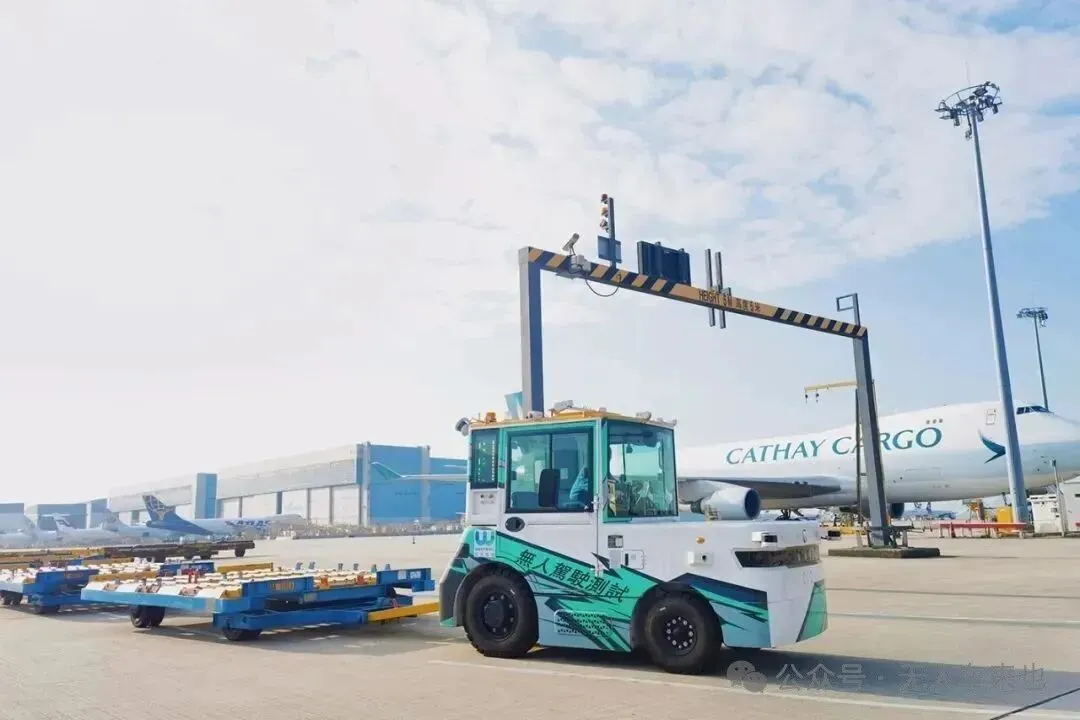
This 'deep-well' development model has fostered a diverse and healthy industrial ecosystem.
It prevents companies from engaging in homogeneous hardware parameter and algorithm arms races at an early stage, instead encouraging them to gain competitive advantages by addressing real industry pain points.
Achieving closed-loop profitability in one scenario before expanding horizontally has become a widely recognized robust growth path in the industry.
IV. Scaling Up: The Critical Point from 'Demonstration Pilots' to 'Commercial Norm'
Currently, the unmanned cargo industry is transitioning from a 'multi-point bloom' demonstration pilot phase to a replicable large-scale deployment moment.
Its hallmark is that leading companies' business models have been validated, unit economic models (Unit Economics) have proven viable, and cross-regional, multi-site replication deployments have begun.
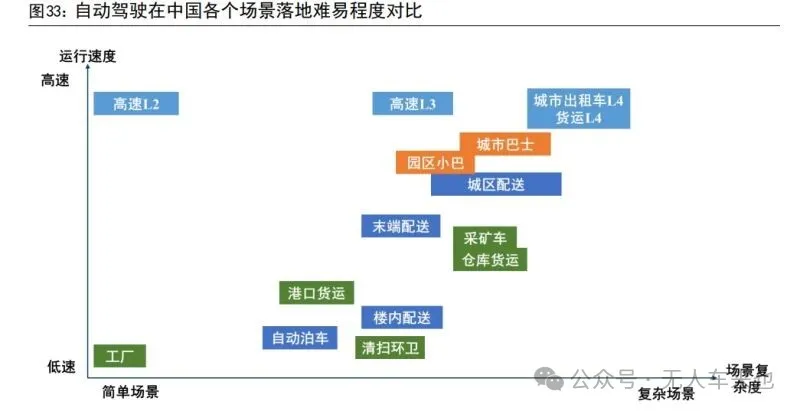
Source: Guosen Securities
Looking ahead, the scaling-up process will deepen along two main lines:
1. Horizontal scenario expansion, penetrating into more diverse fields such as manufacturing parks, airports, and agriculture from current leading scenarios;
2. Vertical technological integration, where autonomous driving will deeply fuse with IoT, 5G, and cloud computing, becoming not just a smart node in a single vehicle but a coordinated scheduling intelligent node within the entire smart logistics or smart park system.
It is foreseeable that the first and profound transformation of autonomous driving technology on socioeconomics will occur in the 'invisible' logistics and production links of our daily lives.
In conclusion, 'Unmanned Vehicles Are Here' (WeChat Official Account: Unmanned Vehicles Are Here) believes:
As unmanned trucks efficiently navigate ports and unmanned logistics vehicles deliver parcels to our doorsteps, these 'silent wheels' are driving the true arrival of the autonomous driving era in a more pragmatic and rapid manner.
For investors and industry observers, rather than solely gazing at the vast expanse of passenger-carrying Robotaxis, it may be wiser to pay more attention to the 'pioneers' who have already solidly cultivated and begun harvesting in the fertile ground of unmanned cargo.
What do you think, dear?
#UnmannedVehiclesAreHere #AutonomousDriving #SelfDriving #UnmannedVehicles
-
![]()
Net Profit Surges 13.65% Year-on-Year! Yutong Optics Reports RMB 1.782 Billion in H1 Revenue
-
![]()
Q2 Net Profit Slashes Losses by 80%! Has Costar Emerged from Its Darkest Hour?
-
AI Agents: The Paradigm Shift from 'Conversation' to 'Execution'
-
NVIDIA Takes Bold Strides to Lead in Both Hardware and Software Realms
-
![]()
It's Hard to Build Cars, Even Harder to Build Humans, and XPENG is Doing Both
-
![]()
Valuation Soars by $57 Billion: Three Entrepreneurs Born in the 1980s Forge an AI Unicorn Now Suddenly on the Market
-
![]()
How Can We Achieve the Goal of 100,000 Hydrogen Vehicles by 2030?
-
![]()
July Online Market for Consumer-Grade Sports Cameras: Robust Double-Digit Growth in Sales Volume and Value, Mid-Range Products Fuel Market Expansion