From the 2018 Scene: Autonomous Vehicles Lead the Charge, Earning Wang Junxia's Approval, to 2026: Cainiao's Autonomous Fleet Powers the Huzhou Marathon in Zhejiang: An Eight-Year Love Affair Between
 04/15 2026
 561
561
Introduction
On April 12, 2026, amidst the picturesque cherry blossoms and tea-scented air of Huzhou City, Zhejiang Province, 16,000 runners embarked on a grueling 42-kilometer marathon. Yet, the most captivating 'participants' along the route were the silent, steadfast Cainiao L4 autonomous vehicles.
These vehicles didn't vie for the track or honk their way through the crowd. Instead, they stood as stationary supply stations, precisely delivering water and energy supplements to runners' outstretched hands, marking a remarkable crossover from urban logistics to the realm of sports events.
Rewinding to November 11, 2018, at the Zhangzhou Port Steel Station in Fujian, Olympic champion Wang Junxia, known as the 'Oriental Deer,' stood at the starting line. Accompanying her was not a motorcycle or a pacer, but a blue, driverless autonomous vehicle—the self-driving bus 'Apolong.'
From Zhangzhou Port to the shores of Taihu Lake, from the pioneering 'Apolong' to Cainiao's full-fledged autonomous fleet, from leaders to service providers—this enduring 'love story' between autonomous vehicles and marathons has spanned a full eight years.
Let's delve deeper into this narrative with insights from 'Autonomous Vehicles Are Here' (WeChat Official Account: Autonomous vehicles have arrived )!
(For further reading, please click: Special 315 Report: Six Consecutive Months Zero Accidents! Jiushi and Cainiao Demonstrate 'Textbook-Level Safety' with Autonomous Vehicles in Shenzhen)
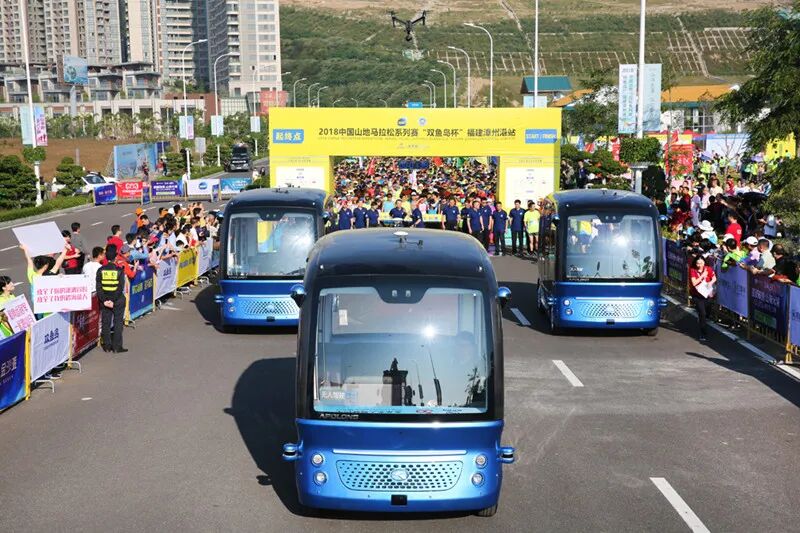
I. 2018: The Dawn of 'Apolong' and a National Milestone
Returning to the 2018 Zhangzhou Port Station, a pivotal stop in the China Mountain Marathon Series, renowned for its seaside track dubbed the 'Island Mountain Marathon.'
Olympic champion Wang Junxia remarked, 'This place is breathtaking; I never expected such beauty! It's my first time participating in a mountain marathon.'
The arrival of three 'Apolong' vehicles bestowed a unique label upon this event—the nation's first marathon led by autonomous vehicles.
Experts at the time commented, 'There's no precedent for autonomous vehicles leading marathons nationwide. Motorcycles and cars are more familiar sights. Zhangzhou Port Station's innovation will, I believe, set a trend across the country.'
World champion Zhang Linli put it succinctly, 'This innovation is not just incredibly cool; it's also environmentally friendly.'
On race day, over 4,000 runners sprinted along a course that seamlessly integrated mountains, seas, lakes, islands, ports, tunnels, reservoirs, and charming towns.
The 'Apolong' autonomous vehicle led the way at a steady 15 kilometers per hour, devoid of engine roar or exhaust fumes—just a serene shade of technological blue.
That marked the 'first love' between autonomous vehicles and marathons.
At that time, autonomous driving was still a concept tinged with science fiction, and 'Apolong's appearance seemed more like a 'tech show.'
Yet, in hindsight, that quietly leading vehicle had already laid the foundation.
II. 2026: From Pioneers to Service Providers
After 2018, the dynamic between autonomous vehicles and marathons evolved quietly.
In 2023, Cainiao made its debut as the official logistics provider for the Hangzhou Marathon.
That year's Hangzhou Marathon was unique—it took place in December, the coldest in history, with temperatures nearing zero.
The organizing committee prepared abundant supplies for runners but faced a challenge: How to efficiently manage bag storage and retrieval for 20,000 full marathon runners?
Cainiao's solution was 'smart light strips'—over 80 self-operated vehicles were transformed into 'mobile smart outlets.' Runners scanned a code to bind a light strip when storing their bags and scanned it again to illuminate the light for retrieval.
At the finish line, 20,000 light strips accurately lit up, minimizing queue times for runners.
In 2024, Cainiao's autonomous vehicles were invited back to Hangzhou, this time by special request—a Dafeng Sports representative stated that after the successful implementation the previous year, they specifically invited Cainiao to continue collaborating with the organizing committee.
Coinciding with the eve of Double 11 (November 3rd), Cainiao faced the dual pressure of ensuring express deliveries and marathon logistics, yet 20,000 light strips still accurately illuminated.
In August 2025, Cainiao's autonomous vehicles began operations in Huzhou, serving as 'little assistants' for Dingdong Maicai's delivery personnel—each morning, they loaded fresh produce from the Taihu Avenue store and autonomously drove to delivery points, where personnel completed door-to-door deliveries.
The transition from 'delivering vegetables' to 'delivering supplies' was just a marathon away.
On April 12, 2026, at the Huzhou Marathon, Cainiao's autonomous vehicles underwent a role upgrade—no longer just 'bag storage managers' but 'mobile supply stations.'
The Huzhou Marathon, a Chinese Athletic Association A1-certified event hosted by Huzhou City, Zhejiang Province, with the theme 'See Beautiful China in Huzhou,' integrates urban landscapes and ecological features. The inaugural event was held on December 3, 2023, marking its third edition this year.
The night before the race, multiple autonomous vehicles switched to silent mode, accurately identifying road markings and flexibly avoiding obstacles in low-light conditions, steadily delivering supplies to various core course points.
On race day, they transformed into 'smart supply stations,' adopting a 'precise placement, static standby' approach, allowing runners to utilize them as needed.
From pioneers in 2018 to service providers in 2026, the role of autonomous vehicles on the marathon course has evolved, yet the core remains unchanged: leveraging technology to enhance event efficiency, environmental friendliness, and enjoyment.
III. Why Marathons? The Business Logic Behind a 'Stress Test'
Why are autonomous vehicle companies flocking to marathon courses?
On the surface, it's about showcasing strength.
Marathon events feature dense crowds, complex movement patterns, and stringent timeliness requirements—if supplies lag, runners complain; if autonomous vehicles malfunction, they become the center of online scrutiny.
Daring to participate in such settings is itself a testament to technological reliability.
Deep down, it's about identifying viable scenarios.
The autonomous vehicle industry is at a critical juncture, transitioning from 'technological verification' to 'commercialization.'
Finding high-frequency, essential, and replicable application scenarios is key to survival and growth.
Marathons provide an ideal 'stress test field'—high-density crowds, complex movement patterns, rigid timeliness, and public visibility.
An industry insider bluntly stated, 'If autonomous vehicles can excel on marathon courses, they have nothing to fear on city streets.'
Another often-overlooked aspect is environmental protection.
In 2018, Wang Yongfeng mentioned that autonomous vehicles leading the race would 'benefit the natural environment.'
Today, environmental protection is a core concern for marathon events.
Jiushi's autonomous vehicles reduce carbon emissions by 300 kilograms per day, and Cainiao's autonomous vehicles are purely electric with zero emissions—under the 'dual carbon' goals, the green attributes of autonomous vehicles align perfectly with marathon events' 'correct guidance.'
IV. Future Outlook: From Courses to Streets
The significance of autonomous vehicles participating in marathons extends far beyond a single event.
In 2018, the 'Apolong' at Zhangzhou Port was tested on semi-open park roads, with the local goal of establishing a national-level demonstration zone for intelligent vehicle-road coordination and autonomous driving applications.
Eight years later, this goal is becoming a reality.
Cainiao's autonomous vehicles' role switch in the Huzhou Marathon—from logistics backbones navigating city streets to supply stations beside the course—is the best evidence of this capability.
In conclusion, 'Autonomous Vehicles Are Here' (WeChat Official Account: Autonomous vehicles have arrived ) believes:
From the 'Apolong' autonomous vehicle leading the race at Zhangzhou Port in 2018 to Cainiao's autonomous vehicle fleet serving the Huzhou Marathon in 2026;
From Wang Junxia's teammate's 'this innovation is incredibly cool' to the 'use as needed' by 16,000 runners—
The eight-year journey of autonomous vehicles and marathons is an evolutionary tale of technology moving from the laboratory to the streets.
It proves one thing: Autonomous driving is not the 'future'; it is the 'present.'
It is steadily integrating into our lives, one step at a time, in the manner of a marathon.
What are your thoughts, dear readers?
References: Reports from media outlets such as China Sports Daily, Urban Express Orange Interaction, Huzhou Public Security Official WeChat, Cainiao Official WeChat, Daily Business News, Jingchu Net, Haixia Net, Life Consumer, Huizhou Daily, etc.
#AutonomousVehiclesAreHere #AutonomousDriving #SelfDriving #AutonomousVehicles
-
![]()
Is Tencent AI Heading in the Right Direction?
-
Latest Update! Jinding Optics’ GEM IPO Review Now “Under Inquiry”
-
![]()
VOYAH’s CBO Sets Ambitious Target: Secure Top 3 Spot in Luxury BEV Market Within Two Years, Launch 4 New Models to Cover All BEV Segments
-
![]()
Sehwa Technology Invests 740 Million Yuan, Eyeing the Lucrative Optical Film Market!
-
![]()
150 Million Users, $40 Million ARR: AIShige Technology Enters the Final Round of AI Video Competition
-
![]()
StepOn Star Forays into Smartphone Manufacturing: A Rationally Sound Yet High-Risk Endeavor
-
![]()
TCL Zhonghuan: Embracing a New Story Despite Anticipated Losses
-
![]()
Forty Years On: From Volkswagen’s State-Backed Entry into China to BYD’s Hiring of a Former European Foreign Minister