Why Does Zhipu Still Need Financing?
 09/15 2026
 551
551
RMB 33.5 billion. The scale of Zhipu's latest financing round is beyond the reach of most AI companies.
However, the truly noteworthy aspect is not the number itself but the timing. Zhipu completed its Hong Kong IPO in January this year, its first placement in July, and disclosed a mid-year report in late August showing nearly 400% year-on-year revenue growth—and then it raised another round. Going public did not end its financing needs; instead, it became a springboard for more efficient fundraising.

This points to a more fundamental question: What does going public really mean for AI companies?
The Real Cost Behind a 'Beautiful' Financial Report
Zhipu's 2026 mid-year report features impressive growth metrics across the board. Revenue reached RMB 954 million, up 399.7% year-on-year, surpassing its full-year 2025 revenue in just six months. Revenue from its core MaaS open platform and API services hit RMB 825 million, up approximately 2,736% year-on-year, accounting for 86.5% of total revenue. ARR reached USD 1.6 billion by late August, growing 60% in two months.
If you only look at these numbers, you might ask: Why does a company with nearly 400% revenue growth still need to raise another RMB 33.5 billion?
The answer lies on the flip side of the same financial report. Net loss stood at RMB 2.072 billion, with R&D expenses reaching RMB 2.131 billion—more than double its revenue. Over the past three and a half years, cumulative R&D investment has been approximately RMB 4.4 billion, roughly six times its revenue during the same period, with 70% to 80% spent on computing power.
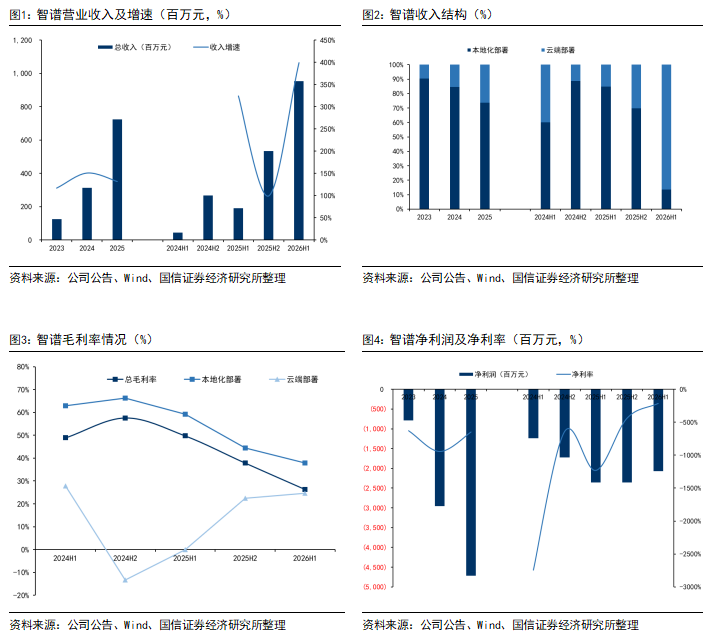
This is not unique to Zhipu. MiniMax reported an adjusted net loss of RMB 1.965 billion, nearly identical to Zhipu's RMB 1.964 billion, despite having only 80% of Zhipu's revenue scale. Both leading companies share a highly consistent financial structure: revenue is growing rapidly, but R&D spending is accelerating even faster.
Going public addresses the efficiency of capital acquisition but not the structural issue of capital consumption. As long as the gap between R&D investment and revenue remains, financing will be an ongoing necessity. In Zhipu's current financing round, approximately 60% is explicitly allocated to next-generation GLM foundation models and a 'fully self-trained system,' exploring Recursive Self-Improvement (RSI)—indicating a bet on generational leaps in model capabilities rather than short-term profitability.
Unitree's Lesson: Valuations Anchor on the 'Future,' but Markets Only Recognize the 'Present'
Shifting focus from large models to embodied AI, Unitree Technology provides a more dramatic case study.
Unitree went public on the STAR Market with a price-to-earnings ratio of 219x, compared to the industry average of just 38x. After surging on its debut, its stock price plummeted more than 55% within a month, erasing over RMB 250 billion in market value. The direct cause of the crash was simple: the stock had been overhyped. But the deeper contradiction lies in Unitree's financial fundamentals failing to support the steep market expectations.
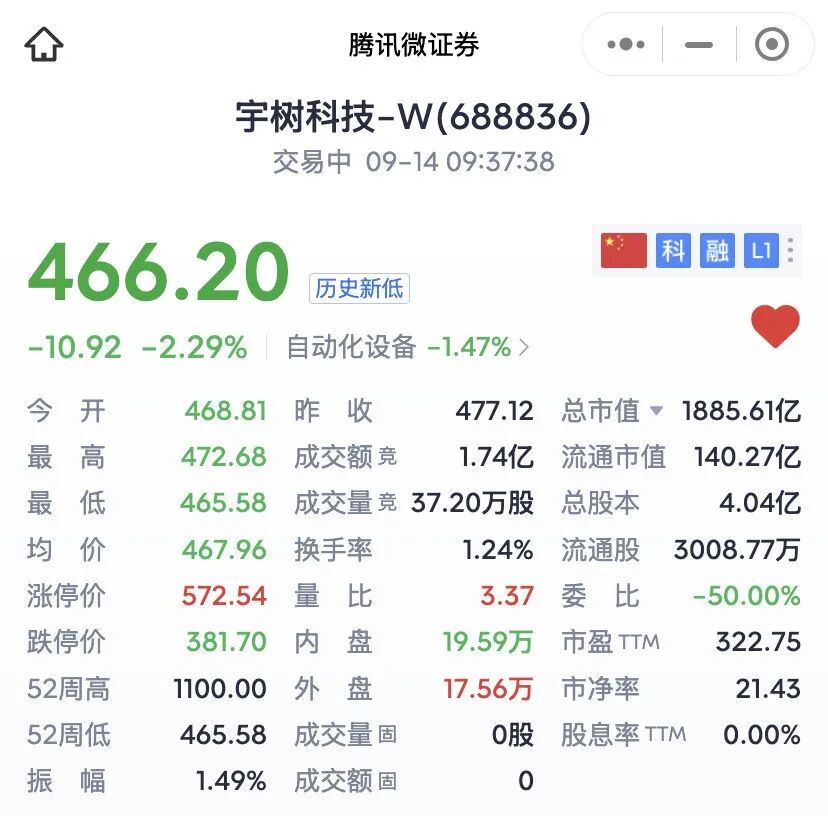
In the first half of 2026, Unitree reported RMB 1.152 billion in revenue, up 48% year-on-year, but its non-GAAP net profit fell 19% due to an RMB 82.03 million increase in R&D expenses and a 2.5x rise in sales costs. Revenue was growing, but profits were shrinking—yet the market had priced it as a growth stock. A fund manager's assessment cut to the chase: 'Unitree's hardware is decent, but its brain algorithms are weak, and its software subscription model hasn't taken off yet.'
In Unitree's IPO fundraising plan, RMB 2.022 billion out of RMB 4.2 billion was earmarked for 'intelligent robot model R&D projects,' accounting for nearly half, with 85% of total proceeds dedicated to R&D. For a hardware company, spending over half its funds on software and models highlights a broader issue: the real money-burning phase for robotics companies begins only after going public.
Embodied AI's 'R&D Imperative' Is Even More Rigid Than Large Models
While large models demand massive R&D investment, they at least follow a clear path: stack computing power, expand parameters, feed data—Scaling Law remains effective for a considerable time. Zhipu's RSI approach further suggests that models can self-train in environments built by previous generations, forming recursive improvement loops—expensive but directionally clear.
Embodied AI faces far more complex constraints. It lacks a single, large-scale text corpus to rely on; training data must be collected bit by bit from the physical world.
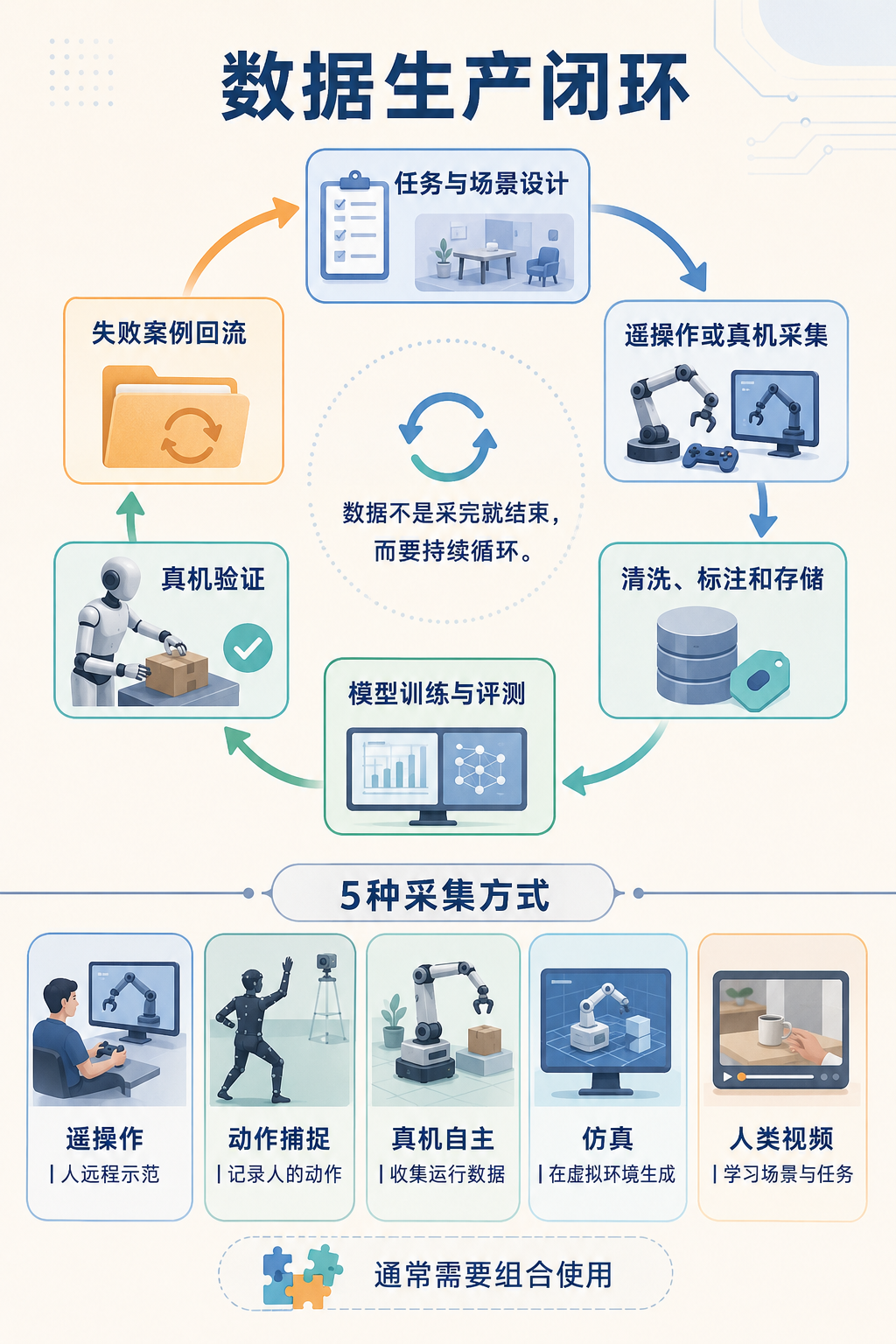
Current real-world data collection costs are prohibitive. Effective data collection via teleoperation costs approximately RMB 275 per hour at scale, and even higher during small-scale collection. Zheng Sipeng, partner at Zhizai Wujie, revealed more direct figures: 30 seconds of real-world data collection costs RMB 10–15, roughly RMB 1,000 per hour. Pre-training a model with one million hours of real-world data would require RMB 1 billion in investment—'unsustainable for large-scale model iteration.' Fang Han, chairman of Kunlun Wanwei, offered an even more extreme estimate: 10 million hours of real-world data would cost RMB 5 billion.
This is just for data collection. Training visual and world models costs even more. NVIDIA's DreamZero world action model requires eight H100 GPUs running for 25 days per training cycle, with training throughput improving nearly 4x only after system-level optimizations—even then, high costs and long durations remain major barriers to industry replication.
Critically, vertical-scenario training for embodied AI has almost no 'generalizability.' A grasping strategy trained on an industrial assembly line may fail entirely in a home kitchen. This means each vertical scenario requires independent data collection, model fine-tuning, and continuous iteration—costs cannot be amortized across users as with large models. Zhu Xing, CEO of Ant Intelligence, judges that embodied AI is still in its cold-start phase: 'Model capabilities, hardware stability, and cost constraints make many scenarios unreachable.'
Distillation techniques can partially reduce inference costs by compressing large model capabilities into lightweight 'student' models—a key deployment direction for embodied AI today. But distillation addresses deployment efficiency, not training costs. Teacher model training, data collection, and scenario validation all require sustained capital investment.
Going Public Is Not the Finish Line—It's the Start of Higher Consumption
Back to Zhipu. It has completed its IPO, its first placement, and a new RMB 33.5 billion financing round. But this does not mean it 'no longer needs money.' Sixty percent of proceeds go to R&D and infrastructure, 15% to business expansion and strategic investments, and 25% to optimizing capital structure. Over the past three years, both Zhipu and MiniMax have maintained R&D investment at roughly six times their revenue. As long as this ratio persists, financing will remain the norm.
The situation for embodied AI companies is even more severe. Large model companies at least have a clear path: improved model capabilities drive API revenue growth, as evidenced by Zhipu's 2,736% year-on-year MaaS revenue surge. Embodied AI, however, has yet to close its commercialization loop—Unitree's revenue comes primarily from robot hardware sales, with software subscriptions and services contributing negligible income. When hardware margins cannot cover ongoing model R&D costs, IPO proceeds merely buy companies a longer runway, not a finish line.
Unitree's stock crash is not an isolated incident. It reveals a structural contradiction: embodied AI's technological maturity is nowhere near the 'scalable monetization' stage achieved by large models, yet capital markets have already priced it using mature-stage valuation logic. When this mismatch corrects, the stock price retracement reflects the market's repricing of 'premature listings.'
Regulators have clearly noticed this. Reports indicate that IPO reviews for humanoid robot companies are tightening, requiring firms to demonstrate sustainable revenue and narrowing losses with concrete evidence.
For large model companies, post-IPO financing is an arms race for technological generational leadership. For embodied AI companies, it is a war of attrition for survival—every hour of data, every model iteration, and every scenario validation burns real money, while revenue returns remain far on the horizon.
The end of going public is not self-sufficiency but higher-leverage, larger-scale financing capabilities. In this sense, Zhipu's RMB 33.5 billion and Unitree's crash tell the same story.
-
![]()
Xiaomi Xuanjie O3 Debuts, Qualcomm Reveals Next-Gen Snapdragon Platform, Paving the Way for the Agentic AI Era
-
![]()
Will New Energy Vehicle Prices Climb Following the Introduction of the Battery Tax?
-
Over 4.27 Million Vehicles Recalled: The Price of Hidden Door Handles' Technological Allure
-
![]()
Audi A2 e-tron’s Hasty Production Launch: Are Luxury Brands Compelled to Build Cars as a “Quick Fix”?
-
![]()
8% Surge on the Eve of Trading Halt! FAW Acquires Stake in GAC: Is the Dynamics of South and North Toyota Set to Transform?
-
Can Apple’s Foldable Phone Outpace Huawei to Claim Second Place Worldwide in Just Over Two Months?
-
![]()
Why Does Zhipu Still Need Financing?
-
![]()
FAW’s Integration with GAC Unveiled: Will China’s Southern and Northern Toyota Joint Ventures Further Consolidate, and Will Dongfeng Press On with Integration Efforts?