Leapmotor Surges Ahead! Li Auto and HiMo Harmony Intelligent Travel See Declines, September’s New Energy Vehicle Market a Blend of Triumph and Challenge
 10/08 2026
 374
374
Written by | Guanchejun
As September draws to a close, the monthly sales figures for various new energy vehicle brands are being gradually unveiled. According to the latest statistics on emerging automotive brands from the China Automotive Data Research Institute, the market landscape can be characterized as a blend of triumph and challenge.
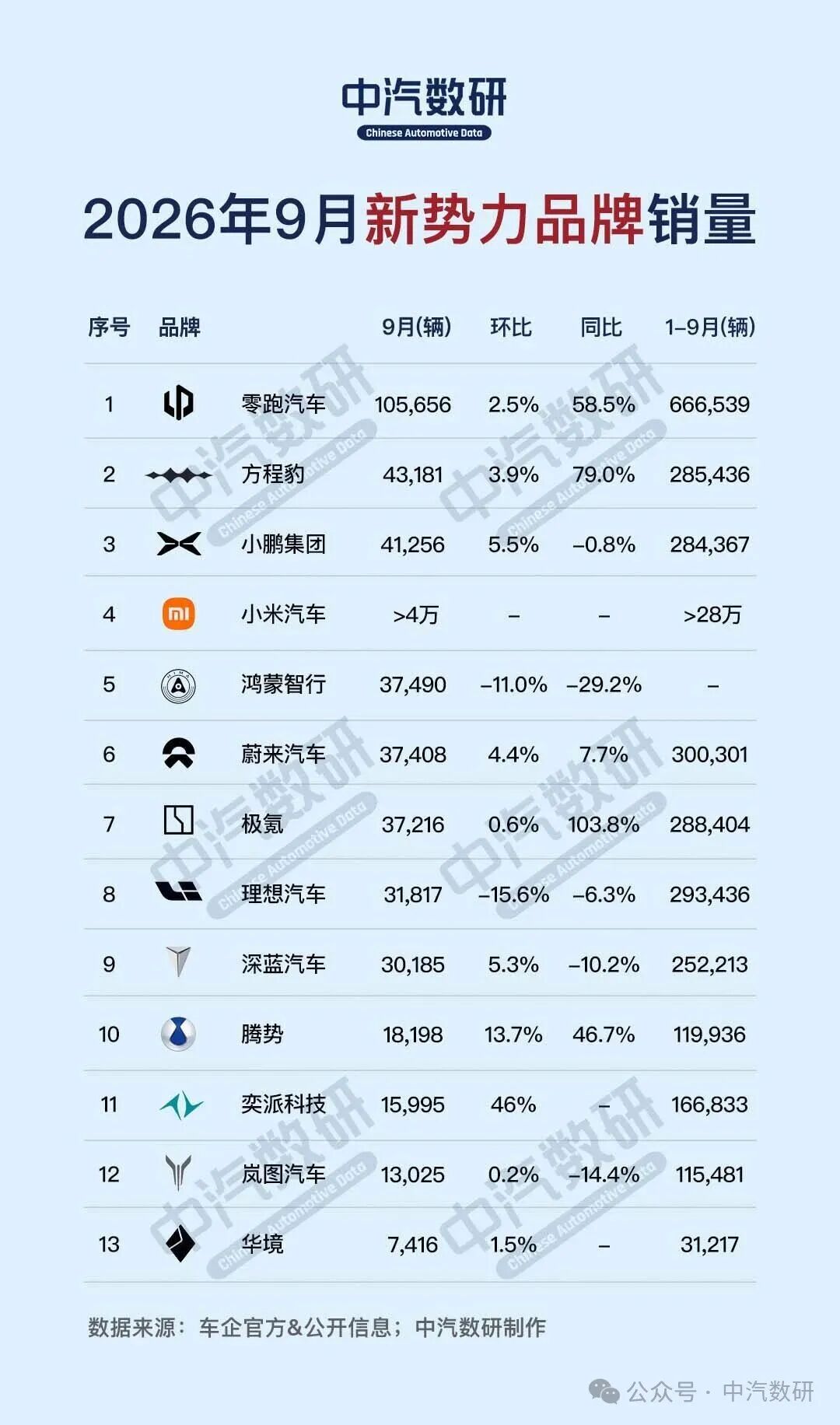
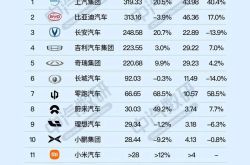
The standout performer is undoubtedly Leapmotor. In September, Leapmotor delivered 105,656 units, marking a 2.5% increase month-on-month and a remarkable 58.5% surge year-on-year. From January to September, its cumulative sales reached 666,539 units, putting it on the verge of clinching the annual sales crown among new energy vehicle contenders.
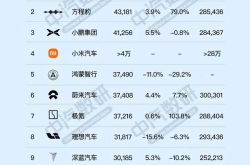
Furthermore, Guanchejun observed that Leapmotor stands alone in the leading pack as the only brand to exceed 100,000 monthly sales, extending its lead over the second-placed Fangchengbao (43,181 units) by a substantial margin of over 60,000 units.
However, high sales volumes do not necessarily translate into high profits. Li Bin acknowledged that each vehicle bears an approximate 10,000 yuan increase in costs, while Li Auto executives cautioned that the supply satisfaction rate for memory chips might dip below 50%. Faced with industry-wide chip shortages in 2026, whether Leapmotor's strategy of "trading price for volume" can withstand the pressure of rising chip prices will determine if it can transition from a sales leader to a profit leader in the same year.
The most notable setbacks were experienced by Li Auto and HiMo Harmony Intelligent Travel. Li Auto delivered 31,817 units in September, a 15.6% decrease month-on-month and a 6.3% decline year-on-year. HiMo Harmony Intelligent Travel fared slightly better but still saw a 11.0% month-on-month and 29.2% year-on-year drop, with 37,490 units delivered.
Li Auto continues to grapple with its longstanding issue: its pure electric vehicle strategy has encountered obstacles, and its "family-oriented" brand image is being challenged by competitors like Huawei and Xiaomi.
As "refrigerators, TVs, and large sofas" cease to be unique selling points, and as extended-range vehicles transition from a blue ocean to a red ocean market, Li Auto's future competitive edge remains uncertain. The company is now racing against time, and its success or failure will likely be determined within the next two years.
For HiMo Harmony Intelligent Travel, the challenge may lie in its expansive brand portfolio. The external environment has shifted; previously, a multi-brand strategy could be seen as a tool for expansion, but now, amid intense competition, it risks diluting efforts and causing internal cannibalization.
Among other brands, Zeekr delivered 37,216 units in September, a 103.8% year-on-year increase, finally offering some hope for Geely's premium brand aspirations.
NIO delivered 37,408 units, a 7.7% year-on-year rise, with its cumulative sales from January to September exceeding 300,000 units. While performing decently, NIO still faces significant pressure from losses in its capital-intensive battery swap network.
XPeng delivered 41,256 units, a slight 0.8% year-on-year decrease, with the MONA series driving sales while the main brand undergoes a transition. In Guanchejun's view, XPeng's challenge has never been technological but rather the pace at which it converts technology into sales.
Looking further ahead, Seres' September sales declined by 10.2% year-on-year, and Voyah's dropped by 14.4% year-on-year, indicating that the transformation pains for state-owned enterprise new energy brands persist.
E'pi's sales rose by 46% month-on-month, a rare bright spot within the Dongfeng system, but with a volume of 16,000 units, it is still insufficient to secure the brand's future.
Tengshi delivered 18,198 units, a 46.7% year-on-year increase, making steady progress but failing to replicate its past explosive growth.
Finally, Guanchejun noted that the sales of the top-ranked brand on this list are nearly six times those of the tenth-ranked and 14 times those of the last-ranked, fully displaying the Matthew effect in action.
In the foreseeable future, brands with monthly sales below 20,000 units will face increasing difficulties in terms of supply chain bargaining power, channel expansion, and R&D amortization.
The charts in this article, unless otherwise noted, are sourced from public disclosures through various channels. We hereby acknowledge and express our gratitude! The views expressed herein are for reference only and do not constitute investment advice.
This article is original content from Leverage Auto Observations and is prohibited from being reproduced without authorization. For reproduction, please obtain authorization. Additionally, when authorized for reproduction, please also indicate the source and author at the beginning of the article. Thank you!
-
![]()
After Testing ChatGPT dot, I Understand Why Big Companies Must Develop Personal Agents
-
![]()
SAIC Surpasses BYD! Automakers' 2026 Yearly Goals Prove to Be a Daunting Task
-
![]()
Leapmotor Surges Ahead! Li Auto and HiMo Harmony Intelligent Travel See Declines, September’s New Energy Vehicle Market a Blend of Triumph and Challenge
-
![]()
SERES and Huawei Make a Dramatic Shift! AITO Launches Ultimate Evolution Strategy
-
![]()
Changan Automobile Takes Action: What Lies Ahead for Deepal and Avatr?
-
![]()
World Model Track: Who's Consolidating, Who's Breaking Through?
-
![]()
AI Self-Generation: The Dawn of a New Era
-
![]()
Musk Changed the Name Again, But This Time It's No Simple Matter