Jia Zhangke Tunes into Hongguo: AI Buzzes, but the Masses Just Want to 'Kick Back'
 10/12 2026
 568
568

Produced by | Shitianhao Observations
Written by | Chencong
On the evening of August 6, Jia Zhangke took to Weibo, sharing that he's been hooked on Hongguo lately. 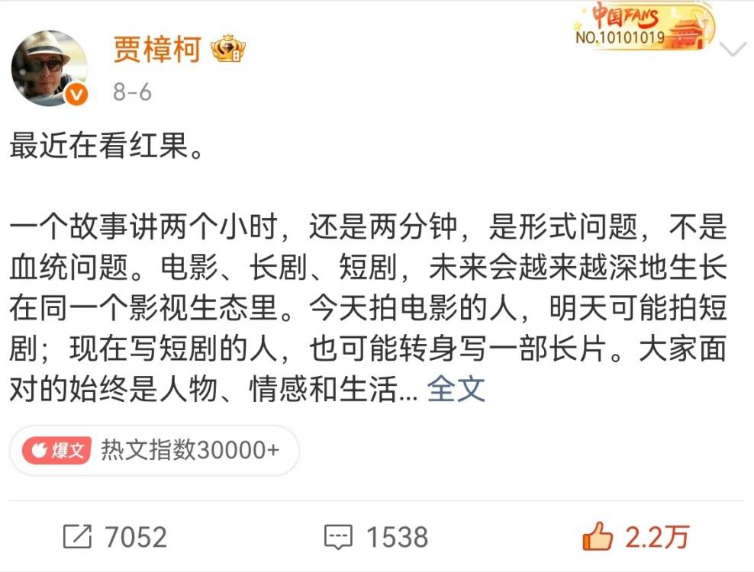
(Image credit: Weibo)
This Weibo post quickly went viral, amassing over 20,000 reposts. The director, famed for his long takes in Still Life, was now chasing free short dramas packed with conflicts every three seconds—and surprisingly, no one in the comments section found this odd. Half of the replies even mentioned their parents binge-watching even more. Hongguo, launched in April 2023 with a modest 320,000 monthly active users in its debut month, skyrocketed to 356 million users three years later, hitting 100 million daily active users by January of this year. It became ByteDance's fifth app to boast over 100 million users. According to QuestMobile, a staggering 851 million people tuned into short dramas in May 2026—that's two out of every three netizens—with 47.2% being from the post-70s and post-80s generations.
Jia Zhangke didn't 'sink' into obscurity—Hongguo has 'landed' in the mainstream. It bypassed the county towns and urban villages, swimming into everyone's evenings.
Around the same time, another scene made waves on the hot search: Mid-Autumn mooncakes weren't selling, with 'gifts for leaders' dropping to a ten-year low of 31.2%. On October 8, at Tencent, 55-year-old Pony Ma sat beside 28-year-old AI scientist Yao Shunyu. The company's Q2 capital expenditures soared to 52.8 billion yuan, up 176% year-on-year, while employee numbers grew by 4.2%, yet total compensation dipped by 0.8%.
Life goes on, money flows into computing power, and people retreat into their shells. These three trends are intertwined, painting a picture of the 'era of pure living for all'.
While AI dominates internet headlines, most ordinary people just want to 'kick back'. ('Kick back' is a Sichuan-Chongqing dialect term meaning 'to relax', now representing a lifestyle of avoiding inner friction and living in the moment.)
I. Life Gets Thinner
1. The Mooncake Ledger
The mooncake business was never really about the cakes. According to the Qince Consumer Research Institute's 2026 Mid-Autumn Consumption White Paper, only 31.2% of mooncakes were bought as gifts for leaders—a ten-year low—while personal consumption surpassed 50% for the first time. Maxim's offered 60% discounts, and Tai Pan Bakery, a 40-year veteran in ice-skin mooncakes, closed shop. Gifts no longer carry the same weight, reducing mooncakes to mere sugary snacks. Why? August's retail sales figures hold the answer: total sales grew just 0.4%, with jewelry plunging 17.5%, apparel in negative growth, while groceries, oils, and tobacco and alcohol rose. Symbols fade, necessities stay, and the middle ground evaporates first.
2. The Mortgage Ledger
The numbers are even colder. In August, new RMB loans added just 60 billion yuan, down 530 billion yuan year-on-year—a nearly 90% drop. In the first eight months, household loans shrank by 1.03 trillion yuan, compared to a 711 billion yuan increase last year—a staggering 2 trillion yuan swing. The six major banks saw personal housing loans drop by 508.6 billion yuan in H1, averaging 2.8 billion yuan in net reductions daily—70% of last year's total in just six months.
As property prices fall, household assets shrink, and deleveraging further depresses prices. The previous generation believed hard work paid off—a truth in blue-ocean times. This generation, scrambling in a red ocean, finds that promise hollow. In Xi'an, four young men turned this sentiment into performance art: they stole over 300 shared bikes, sold them as scrap for 50,000 yuan, and ended up in the red after rent, storage, and labor costs.
When even stealing fails to turn a profit, people stop struggling.
3. Pain-Relief Rhetoric
But people can't just admit 'effort is worthless'—they need a narrative to justify themselves. That narrative took shape this year: the viral concept of 'entering an era of pure living for all'. Instead of swimming against the current, floating becomes a stance. Spend only when necessary, stay home whenever possible, and treat health conservation as an aesthetic.
Add Hongguo to fill the saved evenings. 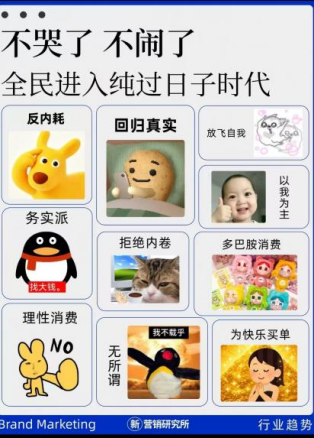
(Image credit: Marketing Research Institute)
Character Magazine collected over 200 responses, with 'sleep until naturally awake' topping the list. A 31-year-old reader, recovering at home for over 100 days, described lying on a balcony camping chair, watching wind strip leaves from trees, and feeling like they lived in a 'square fishbowl'.
This square fishbowl is home to this generation.
In the era of pure living, the core shift is from external comparison to internal contentment. People actively simplify life, rejecting consumerist coercion and the drain of ineffective social interactions.
02 Connections Are Cancelled One by One
1. Social Withdrawal
Past relationships were often forged through favors. Drafting contracts required lawyer friends, building PCs meant asking tech-savvy cousins, and moving demanded colleague help. Elders always said favors bred human connections. In the AI era, favors are 'zeroed out'—unknowns are handled via chatboxes, and help is ordered online. What once required human connections now uses AI and 'small change'. Each substitution saves time, and each save cancels a reason to reach out. Worldly wisdom didn't lose to anyone—it lost to a quiet cost-benefit analysis.
2. Cost-Effectiveness First
There's a harder reason to cancel connections: the math no longer adds up. Dating now comes with price tags, human connections became liabilities, and weddings resemble project debriefs. For the past decade, society pursued 'big results'—school, employment, homeownership, marriage—each a KPI in an endless war of attrition, where stopping meant losing. 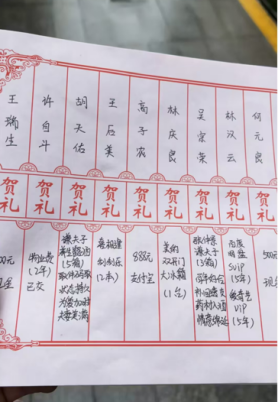
(Image credit: Xiaohongshu)
Even wedding gifts now prioritize cost-effectiveness: annual Baidu Netdisk subscriptions, phone bills, parking fees, and heating bills replace traditional cigarettes, alcohol, tea, flowers, and calligraphy.
AI arrives at this precise moment. It never pressures you to socialize, never tires of your chatter, replies instantly, and never leaves you on 'read'. It doesn't sell connections—it sells cheap substitutes.
Once accustomed to substitutes, the ability to connect with real people atrophies.
Moreover, in the AI era, people resemble isolated islands, linked only by digital data. Yet when they meet, online is preferable. The time saved could fit several short dramas.
03 Hongguo Fills All the Gaps
1. Evenings for 851 Million
Hongguo's business model is simple: users pay with time, not money.
Episode after episode, thrills are timed to the second, slicing your night into daily active users (DAUs) for capital to report. In February, Hongguo users averaged 125 minutes daily per person per month, while second-place Hippo Theater managed just 41.7 minutes. Its free users generate 29 yuan monthly in ad revenue per person—higher than iQIYI's member ARPU.
The free content isn't the product—you are.
Today's family scene no longer shows a family gathered before a TV. Instead, at 10 PM, the husband watches Hongguo in the living room, the wife scrolls another feed in the bedroom, and the child wears headphones in a third. Separated by walls, their attention is outsourced to three recommendation systems.
Deep relationships are too costly—they demand compromise, tolerance, and absorbing each other's bad moods. Short dramas are free, offering a Perfect (happy ending) every three episodes, asking nothing in return, and serving unlimited content.
Though everyone knows short dramas aren't 'good', life is too thin to hold anything else.
2. The Fading of Symbols
The other half of consumption collapses too.
Shopping used to be half function, half signal—a message sent to others. Now, with no receivers—no visits, no gatherings, no banquets—the signals go undelivered.
Restaurants display this on their doors. The 2026 Chinese Dining White Paper reveals a 48.9% closure rate in 2025, with high-end dining closures exceeding 65% in Q1 this year. National per capita dining spending is 33 yuan, down 23.6% from two years prior, with dine-in prices effectively returning to 2015 levels. August's retail sales remained positive only for 'eating'—the sole consumption that holds without signals.
AI pushes this further. Courses, plans, translations, and resumes once bought for money are now free in chatboxes. Hongguo goes further, offering infinite free emotions. Why pay for gatherings, romance, or gifts?
In the 'era of pure living', it's not that people don't want to spend—they don't need to.
3. Grids and Low Power Consumption
Piecing these together reveals a new pattern (structure).
The old pattern (structure) was a square—work tied to socializing, consumption tied to face. Neighbors, colleagues, and relatives formed a dense net, suffocating but warm. The new pattern (structure) is grids—low-cost spaces, an AI-assisted survival system, and a tailored information flow. Grids connect only minimally: chatboxes, orders, necessary collaborations.
Maintaining only essential connections isn't coldness—it's low power consumption. Extrapolating from national mental health surveys, China has ~190 million with mental disorders. This curve mirrors Hongguo's DAU growth—two waterlines of the same retreat. Japan saw this in the 1990s, which Kenichi Ohmae called a 'low-desire society'; Taiwan experienced it earlier, with youth calling it 'small certainties'.
Now it's our turn.
Circling back to August 6's Weibo: Jia Zhangko watching Hongguo feels natural because his audience already lives in grids. Three-minute dramas, abundant and satisfying, perfectly fill a night when words feel unnecessary.
'Kick back', originally a Sichuanese trait of not fighting life, isn't a sudden generational epiphany—it's what the ledger dictates. Hongguo fills the gaps, AI cancels favors, both free and undemanding. Yet the essence of being human grows precisely in gaps and favors—waiting for responses, owing human connections, and slowly growing close to someone.
These don't generate efficiency. Algorithms can't provide them.
Defending small lives isn't degeneration—it's rational self-preservation. But bills come due eventually: isolated crowds, shrinking consumption, outsourced emotions, and the inexpressible void after twenty episodes.
History's current points to AI, but it never promised efficiency equals necessity. 'Kick back' can be a pose, not a destination.
Water recedes, but life must thicken again. And the thickening parts? AI can't replace them.
END
Shi Tianhao is a columnist, co-founder of Beijing Five-Second Technology Co., Ltd., and an internet analyst with columns on multiple media platforms. He has been published in traditional outlets like Southern Metropolis Daily, Computer Application Digest, Business Review, and Communication Information News. His awards include 36Kr's 2022 High-Quality Content Award; PMCAFF's 2021/2020 Popular Author; Netease's 2021 Top 50 Creator; Baijiahao's Craftsmanship and Kunpeng Plan awards; Yiguan's 2018 Author of the Year; Geek Park's 2017 Author of the Year; 2017 Most Explosive Self-Media; and 2016 Most Explosive Self-Media. He has published over a thousand articles.
-
![]()
September 2026 Sales Review of Emerging Automakers: Leapmotor Soars to New Heights
-
![]()
September’s Centralized Feedback Highlight: Beijing Benz Faces a Surge of Complaints Over Camshaft Filter’s Vulnerability to Detachment
-
![]()
2027 Changan Qiyuan A06 Hits the Market: Worth Buying If You Can Overlook These Drawbacks
-
![]()
Analysis Report on Automobile Reputation Index for September 2026
-
![]()
Jia Zhangke Tunes into Hongguo: AI Buzzes, but the Masses Just Want to 'Kick Back'
-
![]()
Can JAC Motors Withstand Further Challenges?
-
![]()
NIO Achieves Three Consecutive Quarters of Profitability: Is Li Bin Walking on Air?
-
![]()
FAW Toyota and GAC Toyota Merge: FAW Leads the Exit! What’s the Real Value Behind the FAW-GAC Alliance?