28-Year-Old Yao Shunyu Takes Seat Beside Pony Ma as Post-90s Talent Floods into the Core Circle of the ‘AI War’
 10/13 2026
 413
413
Produced by Leadar Finance | Written by Ding Yu | Edited by Meng Shuai
Twenty-eight years ago, Pony Ma founded Tencent. Today, Yao Shunyu, aged 28, has become his key collaborator in the AI arena.
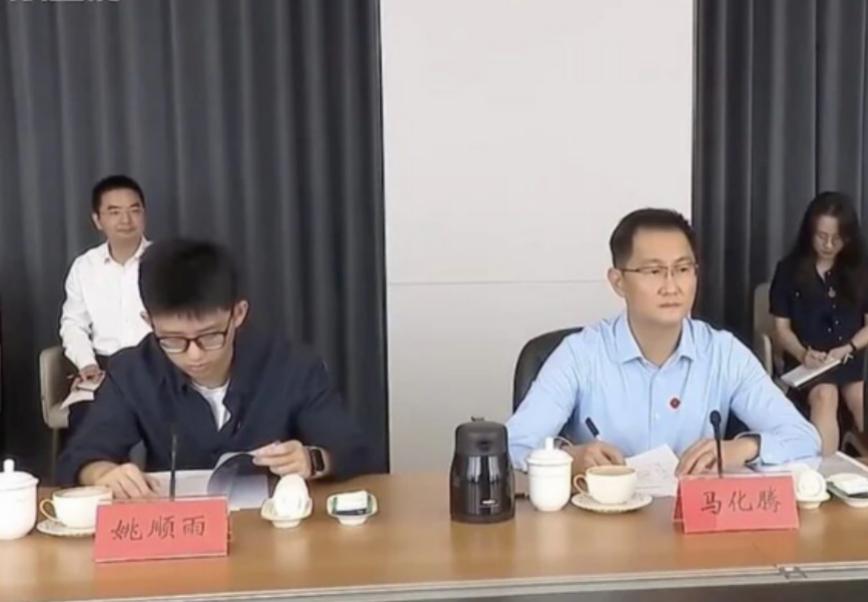
Recently, Guangdong Provincial Party Secretary Huang Kunming paid a visit to Tencent’s headquarters to inspect the progress of AI research and development. The event sparked widespread discussion after photos emerged showing Pony Ma and Tencent’s Chief AI Scientist Yao Shunyu sitting side by side during the meeting.
A top graduate from Tsinghua University’s Yao Class, Yao Shunyu previously worked at OpenAI, where he quickly rose through the ranks. Shortly after joining Tencent, he assumed a leading role in the company’s AI operations. His recruitment is seen as a significant indicator of Tencent’s full-scale commitment to AI.
In the first half of this year, Tencent’s capital expenditure soared by 81.9% year-on-year, reaching RMB 84.72 billion and surpassing the total for the entire previous year. With popular products like WorkBuddy, Tencent, which had initially lagged in the first half of the ‘AI war,’ has officially launched a counterattack in the Agent sector.
Leadar Finance has observed that the ‘cockpit’ of the ‘AI war’ is now dominated by post-90s talent. Like Yao Shunyu, numerous young tech professionals, including Luo Fuli, Chen Yusen, and Guo Daya, are being propelled into core management roles in AI businesses at major internet companies.
Post-90s founders are also making waves as leaders in prominent AI companies such as Moonshot AI, MiniMax, and Manus.
Rare Sighting: Pony Ma Appears Alongside 28-Year-Old Yao Shunyu
According to Nanfang Daily, on October 8, Guangdong Provincial Party Secretary Huang Kunming visited Shenzhen, conducting in-depth research at port hubs and platform companies.
At Tencent’s headquarters, Huang Kunming toured the exhibition hall, observed live demonstrations of core product applications, and focused on examining Tencent’s R&D innovation and industrial layout in AI. He also heard reports on the company’s recent digital technology innovations and their empowerment across multiple fields.
Video footage from "Guangdong News" revealed that at the research symposium held that day, Tencent founder, Chairman of the Board, and CEO Pony Ma made a rare public appearance.
Seated next to Pony Ma was Guo Kaitian, Tencent’s Senior Vice President and Party Secretary, on his left, and a youthful-looking young man with black-rimmed glasses on his right.
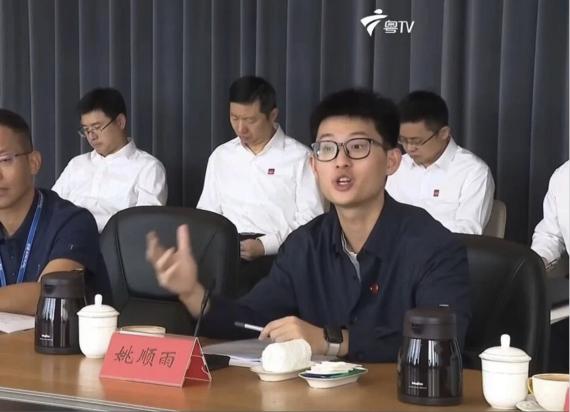
This young man was Yao Shunyu, Tencent’s Chief AI Scientist and head of the AI Infra and Large Language Model departments. During the tour, Yao Shunyu stayed close to Pony Ma.
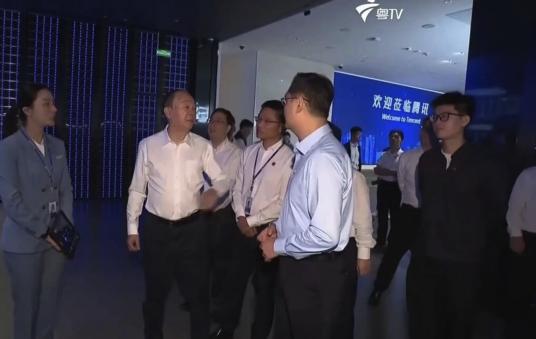
Tianyancha data shows that Pony Ma, now 54, founded Shenzhen Tencent Computer System Co., Ltd. in 1998. Coincidentally, Yao Shunyu was born in the same year—1998.
Public information indicates that Yao Shunyu graduated from Tsinghua University’s Yao Class and later pursued a Ph.D. at Princeton University in the United States.
In 2024, Yao Shunyu joined OpenAI as a research scientist, focusing on transitioning large language models from theoretical research to practical applications, particularly in AI Agent development.
Yao Shunyu led the development of OpenAI’s first released agent model and product, while also participating in the Deep Research project.
In 2025, Yao Shunyu was selected for the MIT Technology Review’s TR35 list, becoming one of the youngest recipients in China.
However, in September 2025, Yao Shunyu left OpenAI and joined Tencent. In December of the same year, Tencent announced a major organizational restructuring, appointing Yao Shunyu as Chief AI Scientist in the "CEO/President’s Office," reporting to Tencent President Martin Lau. He also concurrently served as head of the AI Infra and Large Language Model departments, reporting to Lu Shan, President of the Technology Engineering Group.
When asked about his decision to join Tencent, Yao Shunyu previously stated that in the second half of the AI race, methodologies have become highly mature, but identifying problems has become more challenging. A key reason for joining Tencent was the abundance of meaningful problems and products.
In Yao Shunyu’s view, Tencent operates primarily on trust rather than metrics, a culture he believes is crucial for building a long-term AI organization.
Tencent Ramps Up AI Layout as Capital Expenditure in the First Half Exceeds Last Year’s Total
Compared to other internet giants like Alibaba and ByteDance, Tencent initially appeared somewhat ‘hesitant’ and ‘conservative’ towards AI.
At Tencent’s shareholders’ meeting in May this year, Pony Ma addressed concerns about whether Tencent was falling behind in AI, stating, "A year ago, we thought we had boarded the ship, but later realized it was leaking. Now we feel like we’ve stepped on board but still can’t sit comfortably. We hope the ship can speed up."
The recruitment of high-level AI talents like Yao Shunyu signals that this tech giant, with a market value of nearly HK$4 trillion, is now fully committed to the AI race.
In terms of capital expenditure, Tencent invested RMB 76.76 billion in 2024, a staggering 221.3% year-on-year increase. In 2025, growth slowed significantly, with capital expenditure reaching RMB 79.19 billion.
According to Zheshang Securities, ByteDance invested heavily in AI, with capital expenditure reaching RMB 80 billion in 2024. Another report by Orient Securities in July 2025 stated that ByteDance’s capital expenditure plan for 2025 was as high as RMB 150 billion, an 88% year-on-year increase.
Alibaba’s capital expenditures for FY2025 (ending March 31, 2025) were RMB 85.97 billion, surging to RMB 126.06 billion the following year.
In September last year, Alibaba CEO Wu Yongming announced an ambitious three-year, RMB 380 billion AI infrastructure investment plan.
During an earnings call in late November of the same year, Alibaba’s management indicated that the initial RMB 380 billion plan might be conservative, as demand had already outstripped supply. They did not rule out further increasing investment if market needs remained unmet.
After rivals made substantial investments, Tencent also upped its bets. Its interim report showed that capital expenditure in the first half of this year surged by 81.9% year-on-year to RMB 84.72 billion, surpassing the total for all of last year. Capital expenditure in the second quarter alone reached RMB 52.78 billion, a 176.3% year-on-year increase.
After Yao Shunyu became Tencent’s top AI executive, Pony Ma revealed that the company was accelerating talent acquisition, restructuring R&D teams, and speeding up Co-design internally to enhance collaboration between the Hunyuan large model and Yuanbao.
Pony Ma admitted that Tencent’s foundational AI capabilities were not prominent in the early stages but have steadily improved in recent years through talent development, team management, and internal training, now gradually entering the fast lane.
He emphasized that Tencent may not be the fastest to seize opportunities but insists on taking the right path, leveraging its unique strengths steadily. "We can’t just rush in because others are doing it and try to seize their territory. We’ve tried that before and largely failed," he said.
To further concentrate resources, Tencent dissolved its nearly decade-old AI Lab in March this year, reassigning some R&D personnel to the Large Language Model department to join the Hunyuan team under Yao Shunyu’s leadership.
In July, Tencent merged its Hunyuan multimodal model department with the large language model department to form the Foundational Model department, all under Yao Shunyu’s management, further improving model R&D efficiency and exploring the intelligence limits of full-modal models.
On the marketing front, Tencent fully committed to WorkBuddy, blanketing major cities like Beijing, Shanghai, Guangzhou, and Shenzhen with advertisements. With relentless promotion, this office Agent, which received ‘green light’ treatment internally at Tencent, quickly dominated the market.
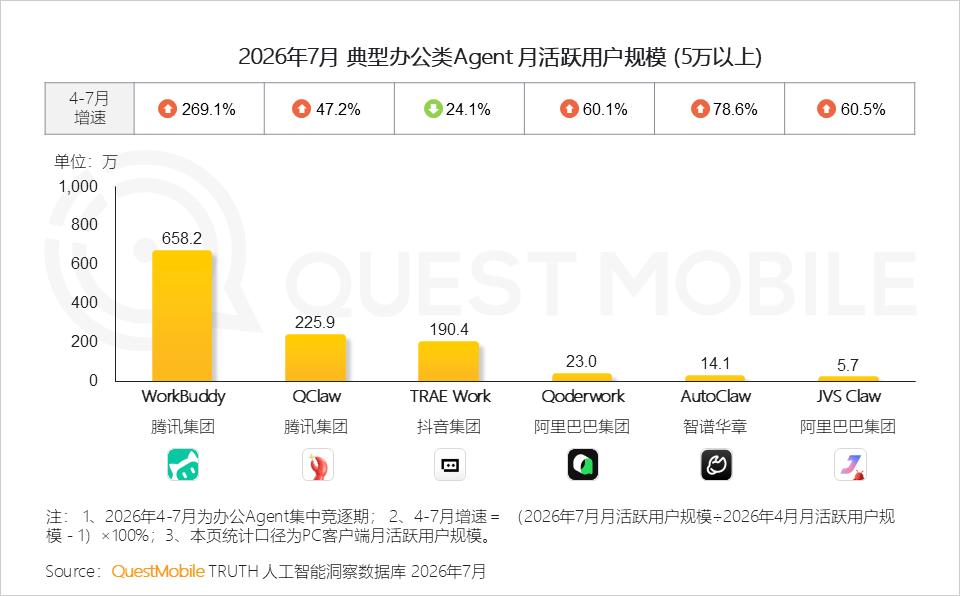
QuestMobile data shows that as of July 2026, Tencent’s WorkBuddy and QClaw had 6.582 million and 2.259 million monthly active users, respectively, far surpassing ByteDance’s TRAE Work and Alibaba’s Qoderwork.
WorkBuddy’s growth rate from April to July was as high as 269.1%, significantly outpacing competitors.
Post-90s Tech Talent Ascends to Core Positions in the ‘AI War’
Leadar Finance has noticed that amid the increasingly fierce ‘AI war,’ a group of post-90s tech leaders, including Yao Shunyu, are rapidly ascending to core positions at major tech firms.
Luo Fuli, now heading Xiaomi’s MiMo large model, is one such notable figure. Public information shows that Luo Fuli, born in 1995 in Yibin, Sichuan, graduated from Beijing Normal University for her undergraduate studies and pursued a master’s degree at Peking University.
After graduation, Luo Fuli worked at Alibaba’s DAMO Academy and DeepSeek, playing a core role in developing the MoE architecture-based large model DeepSeek-V2, earning her the nickname "AI prodigy."
In December 2024, rumors surfaced that Lei Jun had offered Luo Fuli a multi-million-dollar salary to lead Xiaomi’s large model team, sparking a Weibo hot trend.
In November the following year, Luo Fuli officially announced her joining Xiaomi via a WeChat Moments post, becoming the head of the Xiaomi MiMo large model team. A month later, at Xiaomi’s "Smart Living Ecosystem" partner conference, Luo Fuli made her first public appearance in her new role.
According to LatePost, on September 22, Xiaomi announced a promotion list internally, with Luo Fuli advancing to the highest level—Level 22—in Xiaomi’s job hierarchy.
Earlier in July, Xiaomi restructured its Xiao Ai team, splitting technical capabilities into three parts: foundational models, cloud, and edge. The foundational model capabilities were provided by Luo Fuli’s MiMo team, further expanding her business scope.
Around the same time as Luo Fuli’s promotion, on September 21, Alibaba confirmed at its Apsara Conference that Liu Dayiheng, born in 1993, would lead the Token Foundry Qwen large language model project under the ATH business group, with his main forum speech scheduled just after Alibaba Group Chairman Cai Chongxin and CEO Wu Yongming.
The next day, Chen Yusen, born in 1992, made his first public appearance as Alibaba Group Vice President and CEO of Qianwen Office. Previously, Chen Yusen had been promoted from P10 to P11 (M6), becoming Alibaba’s youngest current business unit CEO.
Turning to ByteDance, Zhou Chang, born in 1990, left Alibaba to join ByteDance’s Seed team, overseeing Seedream, Seedance, and world model businesses.
Earlier, rumors circulated that ByteDance had heavily recruited Guo Daya, a former DeepSeek researcher born in 1994.
According to LatePost, after joining ByteDance, Guo Daya led the Seed organization for large model R&D as one of the Agent leaders, holding the L8 job level.
Moreover, leading domestic AI companies also feature post-90s AI tech leaders, such as Moonshot AI founder and CEO Yang Zhilin, MiniMax co-founder, executive director, and visual model research and engineering head Zhou Yulong, and Manus founder and CEO Xiao Hong.
Which of these young AI tech stars will shine the brightest in the future? Leadar Finance will continue to follow.
-
12 weeks after Mercedes-Benz was tested for rollover
-
![]()
Math PhD Makes 141.7 Billion Through AI Stock Trading!
-
![]()
The Enigma of Zeekr's Sales: How 96% of Annual Target Was Achieved in 9 Months
-
![]()
Apple Reduces Orders! Luxshare Precision Faces a 50.3 Billion Yuan Inventory Challenge
-
![]()
From January to September, Chinese EV Brands Shine in Europe: One in Five Cars Sold, Some Brands See 20-Fold Increase | Mirror Pro
-
Transsion Holdings' Hong Kong IPO: What Makes the Business in Africa's Mobile Phone Market So Challenging?
-
![]()
Global Market Share of Pure Gasoline Vehicles Dips Below 50%: Is the Gasoline Car Era Nearing Its End?
-
![]()
The Whole Story of the 2026 'Rushed Vehicle' Controversy: From a Live Stream Joke to a Public Naming by People's Daily