Apple Reduces Orders! Luxshare Precision Faces a 50.3 Billion Yuan Inventory Challenge
 10/13 2026
 351
351
During this round of the smartphone upgrade season, not many friends around Xingkongjun have made the switch to the iPhone 18, with a select few opting for domestic brands instead.
Why is that? Well, the iPhone 18 comes with a hefty price tag.
According to reports, at Apple's behest, some suppliers have scaled back production schedules for components of the iPhone 18 Pro and Pro Max, with October volumes seeing a 15% to 20% drop from the original plans.
The reason is straightforward: escalating memory chip prices. Alongside these price hikes, there's also a shortage. Cloud service providers are ramping up their AI infrastructure procurement, prompting storage manufacturers to prioritize production capacity for HBM, server DRAM, and enterprise-grade SSDs. Consequently, production capacity for PCs and smartphones has been pushed to the back burner.
In fact, it's not just Apple; domestic smartphone makers are also struggling to maintain their pricing, with all of them raising prices.
As the overall selling prices of devices climb, consumers footing the bill for smartphones are starting to hesitate. Apple had already revised its shipment expectations downward in early September, and this time, it's simply asking suppliers to follow suit.
Supply chain production schedule data reveals that Apple has shifted some Pro orders to the Pro Max, with the total volume not necessarily decreasing but rather shifting between models. The stocking target for foldable screen models was previously set at around 10 million units, with Pro series orders hovering around 70 million units. Media reports suggest an annual iPhone production target of approximately 220 million units.
For assembly plants and component manufacturers, this shifting between models spells trouble. Each model boasts a different bill of materials, and switching production means reallocating in-transit materials and rescheduling established production capacity.
What Xingkongjun is concerned about is whether the Apple supply chain can weather the storm.
1
Luxshare Precision's Inventory Situation

What are the key metrics to watch when a major customer cuts orders?
Inventory.
Data Source: ifind
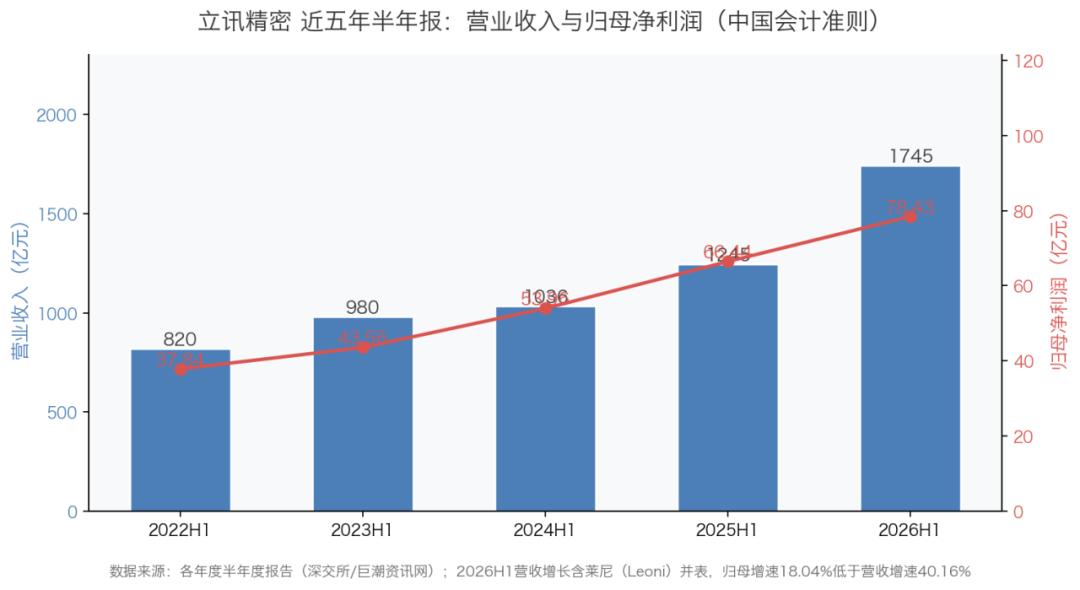
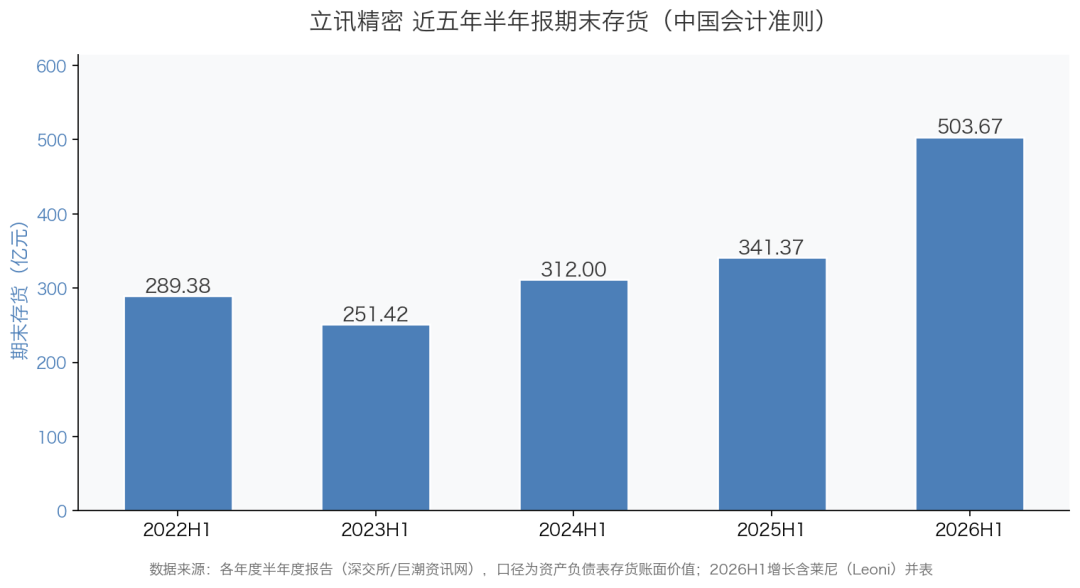
Luxshare Precision's semi-annual report reveals an 8.034 billion yuan increase in inventory.
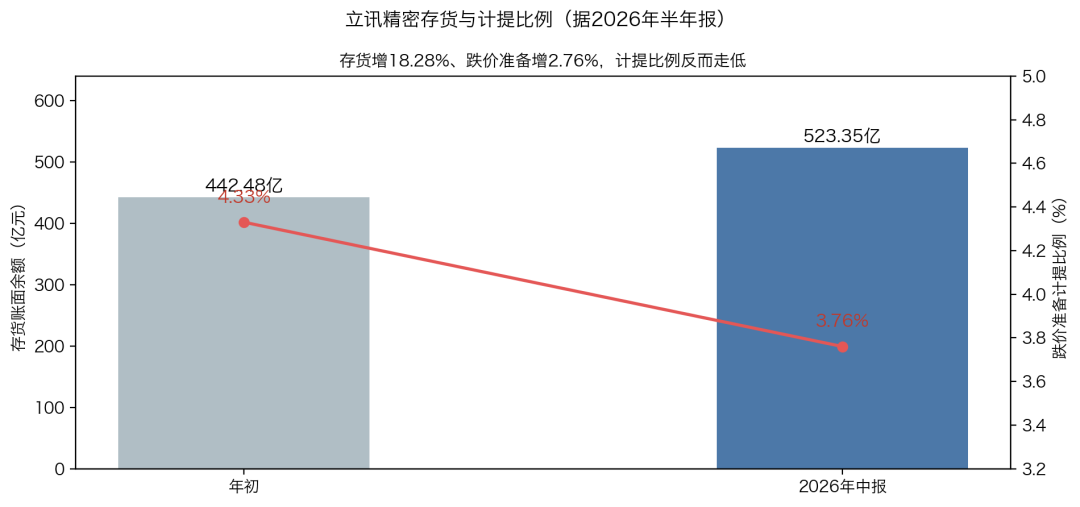
According to the report, the ending inventory book balance stood at 52.335 billion yuan, with a corresponding allowance for inventory obsolescence of 1.968 billion yuan and a book value of 50.367 billion yuan. At the beginning of the year, these figures were 44.248 billion yuan, 1.915 billion yuan, and 42.333 billion yuan, respectively.
Data Source: ifind
Raw materials surged from 14.383 billion yuan to 19.884 billion yuan, marking a 38.24% increase and accounting for 37.99% of inventory. Finished goods rose from 18.874 billion yuan to 20.987 billion yuan, an 11.19% increase, making up 40.10% of inventory. Work-in-progress increased from 8.894 billion yuan to 9.409 billion yuan, a 5.79% rise. Turnover materials decreased from 1.266 billion yuan to 967 million yuan, the only category to see a decline.
The remaining categories are smaller in amount but all trending upward. Goods in transit stood at 239 million yuan, consigned processing materials at 68 million yuan, goods shipped at 328 million yuan, and contract fulfillment costs at 455 million yuan. Goods shipped and contract fulfillment costs totaled 783 million yuan, representing items already sent to customers but not yet recognized as revenue.
Raw materials witnessed the fastest growth, aligning with Apple supply chain stocking habits.
July and August are the peak periods for mass production, with acoustic modules, connectors, structural parts, and memory materials all needing to be stocked in advance. The high proportion of finished goods indicates that finished products are also being shipped to customers and channels.
Inventory was 34.137 billion yuan in the 2025 mid-year report, 44.248 billion yuan at the end of 2025, 46.032 billion yuan at the end of Q1 2026, and 50.367 billion yuan in this year's mid-year report, a year-on-year increase of 47.54%. Looking just at the mid-year figures, inventory grew from 34.137 billion yuan to 50.367 billion yuan in one year, an increase of 16.230 billion yuan.
Part of this increase is attributable to consolidation. The inclusion of Germany's Leoni Group in the consolidated financial statements has boosted the revenue scale of the automotive electronics segment, and the accompanying inventory is also included. While external mergers and acquisitions have qualitatively increased the inventory base (the quantitative impact of consolidation has not been separately disclosed), they do not explain the 38.24% increase in raw materials.
The proportion of inventory to total assets rose from 13.81% at the beginning of the year to 14.40%, compared to 13.97% in the same period a year earlier. More telling is the ratio of inventory to revenue, with the book value of inventory accounting for 28.86% of operating revenue in the first half, compared to 27.42% in the same period last year. The growth rate of stocking is more than one percentage point faster than revenue growth.
The structure of inventory corresponds to the composition of revenue, with consumer electronics contributing 70.18% of operating revenue and thus determining the majority of the materials in the warehouse. Any change in Apple's order rhythm will first impact these several hundred billion yuan in raw materials and finished goods.
Stocking itself is not a mistake. The question is whether these goods can be sold as planned.
2
Risk of Allowance for Inventory Obsolescence
Inventory rose by 18.28%, but the allowance for inventory obsolescence only increased by 2.76%.
The allowance for inventory obsolescence of 1.968 billion yuan corresponds to an inventory balance of 52.335 billion yuan, a provision ratio of 3.76%. At the beginning of the year, this ratio was 4.33%.
Data Source: ifind
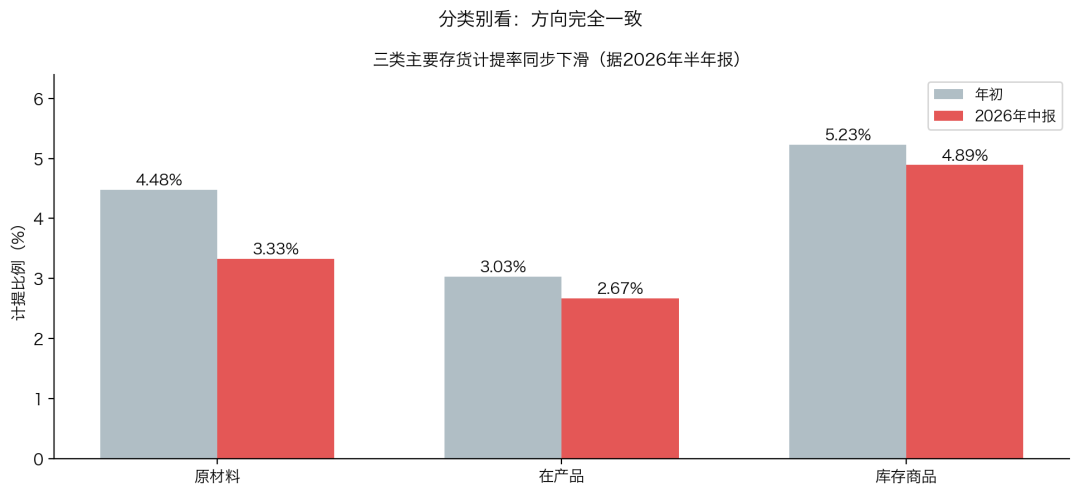
When comparing by category, among the eight subcategories, all those with significant amounts saw their provision rates decline. Raw materials fell from 4.48% to 3.33%, work-in-progress from 3.03% to 2.67%, and finished goods from 5.23% to 4.89%. The provision rates for the three main categories all declined in the same direction.
Data Source: ifind
A decline in the provision ratio is not inherently problematic. Changes in inventory structure, shorter inventory ages, and improved order visibility can all lead to this outcome.
The issue is that this decline occurred in the same half-year when inventory scale reached a record high for the same period.
Inventory balance increased by 8.087 billion yuan, while the allowance for inventory obsolescence only increased by 53 million yuan.
Let's do a simple calculation.
With an inventory balance of 52.335 billion yuan, a one-percentage-point change in the provision ratio corresponds to a reserve of 523 million yuan, equivalent to 6.7% of the first-half net profit attributable to shareholders of 7.843 billion yuan. A looser provisioning standard leads to a more relaxed income statement.
Inventory write-downs and contract fulfillment cost impairments were 574 million yuan in the first half, compared to 515 million yuan in the same period last year, a 11.36% year-on-year increase in provisions. During the same period, 452 million yuan was reversed or written off, resulting in a net increase in the allowance for inventory obsolescence of 53 million yuan.
The 452 million yuan reversed or written off is equivalent to 23.6% of the beginning allowance for inventory obsolescence. Rapid turnover means that provisioned reserves are also being quickly consumed. This figure suggests that the proportion of long-term stagnant inventory is not high.
3
Q3 and Annual Reports Outlook
Looking back at past financial reports, a pattern emerges: Luxshare Precision's asset impairment provisions are concentrated in the second half of the year.
In 2023, total asset impairment losses were 1.319 billion yuan, with 930 million yuan provisioned in the second half. In 2024, total losses were 1.245 billion yuan, with 996 million yuan provisioned in the second half. Over three years, the annual provisioning scale has consistently exceeded 1.2 billion yuan.
In both years, the second half accounted for two-thirds of the annual provisions. The reason is not hard to fathom: Q4 is the year-end inventory count window and the full quarter for new device sales, providing answers on whether products are selling or not.
In the first half of 2026, total asset impairment losses were 595 million yuan (549 million yuan in the same period last year), with inventory write-downs and contract fulfillment cost impairments at 574 million yuan, a 11.36% year-on-year increase. Following this trend, Q4 provisioning is likely to be higher than in the first half.
Inventory scale has reached a record high for the same period and is expected to rise further.
There's also a time lag to consider. The parts (component) orders reduced in October correspond to device sales that will not be settled until Q4 or even Q1 of next year. The true impact of the order cuts will not appear in the Q3 report but will be reflected in the Q4 and next year's Q1 reports.
Therefore, the key is not the provisioning ratio in the first half but the direction it takes in the Q3 and annual reports. If inventory continues to increase while the provisioning ratio continues to decline, the reported profits will look better, but the risks will simply be pushed back by one quarter.
-END-
Disclaimer: This article is based on the public company attributes of listed companies and relies primarily on information disclosed by the listed companies in accordance with their legal obligations (including but not limited to interim announcements, periodic reports, and official interaction platforms) as the core basis for analysis and research; Shiyu Xingkong strives to ensure fairness in the content and views presented in the article but does not guarantee its accuracy, completeness, or timeliness; the information in this article or the opinions expressed do not constitute any investment advice, and Shiyu Xingkong assumes no responsibility for any actions taken based on this article.
Copyright Notice: The content of this article is original to Shiyu Xingkong and may not be reproduced without authorization.
-
![]()
Math PhD Makes 141.7 Billion Through AI Stock Trading!
-
![]()
The Enigma of Zeekr's Sales: How 96% of Annual Target Was Achieved in 9 Months
-
![]()
Apple Reduces Orders! Luxshare Precision Faces a 50.3 Billion Yuan Inventory Challenge
-
![]()
From January to September, Chinese EV Brands Shine in Europe: One in Five Cars Sold, Some Brands See 20-Fold Increase | Mirror Pro
-
Transsion Holdings' Hong Kong IPO: What Makes the Business in Africa's Mobile Phone Market So Challenging?
-
![]()
Global Market Share of Pure Gasoline Vehicles Dips Below 50%: Is the Gasoline Car Era Nearing Its End?
-
![]()
The Whole Story of the 2026 'Rushed Vehicle' Controversy: From a Live Stream Joke to a Public Naming by People's Daily
-
![]()
V4 Flash Scores Impressively, But DeepSeek Hasn't Revealed All Its Cards Yet