AI Enters Memoirs: Can an Elderly Person's Life Be 'Generated' with One Click?
 10/13 2026
 358
358
By Guo Yu
Original content from Evergreen Research Society
Have you ever experienced moments like these? You come across old photos of your elderly relatives from their youth and wonder what stories lie behind them. During family gatherings at the Spring Festival, you want to chat with your elders about their past, but the conversation often fizzles out after exchanging pleasantries like 'Have you eaten?' and 'How's your health?' It's only after a loved one passes away that you suddenly realize their life's ups and downs, choices, and unspoken thoughts may never be shared with you again. As the silver economy expands from elderly care services and products into the realm of spiritual and cultural needs, 'preserving the lives of our elders' has become an increasingly common yet hidden desire among families. The advent of generative AI has slashed the cost of customized memoirs, which once cost tens of thousands of yuan, to as low as 99 yuan or even free. The dream of 'everyone having their own life biography' seems within reach. Yet, beneath the frenzy of price wars, awkward truths emerge. Many find that the final product depicts 'an elderly person's life' but not 'their own elder's life.' So, is a life story entirely written by AI still that person's life? When the cost of compiling words approaches zero, where does the true value of a memoir lie—on the page or in the process of storytelling? With these questions in mind, Evergreen Research Society conducted an in-depth study of China's AI memoir industry, aiming to dissect its business logic and uncover answers about listening and understanding hidden within the text.

Today's memoir industry presents three representative paths.
The first is the pure AI tool-based approach, the loudest and cheapest.
Outsiders might imagine it as 'input a few life details, upload old photos, and a large model expands them into tens of thousands of words in minutes, automatically adding images and printing the book.' However, after testing several free products, we found this is no longer the case. Mainstream offerings now use an 'interview-style' format: instead of making you write from scratch, AI acts as an interviewer, asking questions like 'Tell me about your parents,' 'Who cooked in your childhood home, and what did it taste like?' or 'What did you buy with your first paycheck?' You speak into your phone, it transcribes your words, and organizes them into chapters under frameworks like 'Childhood—Education—Career—Family—Retirement.' The first few chapters are free; you pay only if satisfied. This design is far smarter than crude expansion but exposes its flaws clearly. The questions, while specific, follow a pre-set life outline. Answering them feels like taking a quiz about yourself. If you express emotions beyond the outline, it responds with a templated 'You must have had it hard,' then moves to the next question. More subtly, it 'completes' your story: you say one sentence, and it crafts a lengthy, coherent, even moving narrative you never uttered. Extreme standardization brings ultra-low prices but also content homogenization, narrative templating, and the absence of real human presence. No one knows which sentences warrant follow-up or where to pause. Essentially, this remains a text production assembly line.
The second path is the traditional artisan-style approach, the industry's original form.
Senior journalists or writers independently handle projects, conducting in-depth one-on-one interviews, writing by hand, and even publishing through formal channels. Works under this model boast high quality and strong humanistic attributes. Creators forge deep emotional connections with interviewees, capturing the finest emotions and details. However, production capacity is extremely low—practitioners typically complete only 1–2 projects annually, charging tens of thousands to over a hundred thousand yuan. This model serves only a tiny, high-net-worth audience, remaining out of reach for ordinary families.
The low-cost sector competes on traffic, relying on templates for mass production but losing the soul of memoirs. The high-end sector upholds quality through artisanal service but remains distant from most people. Does this industry truly have no third path?
With this question, we recently engaged in deep discussions with the team behind 'Jixia Tanwang,' a Nanjing-based brand specializing in life stories and family memories.
Unlike low-cost tool-based or traditional artisan approaches, this company prioritizes human effort supplemented by technology. Our conversations revealed another possibility for this sector.
Of course, human-machine collaboration doesn't inherently equal high quality. Technology can enhance organization efficiency but cannot automatically yield good interviews or writing. The outcome depends on whether the team has stable professionals, fact-checking mechanisms, and privacy boundaries.

Many assume a memoir's value lies in the finished book—its binding, paper, word count, and thickness become market-default pricing metrics. Yet, what truly determines whether a book 'resembles its subject' are the invisible steps before publication.
In conversations with Xing Rui, founder of Jixia Tanwang, she shared two real client stories (de-identified per request). These stories reshaped our understanding of where a memoir's value truly lies.
The first story is about reconciliation.
A client couldn't understand why their grandmother, despite frequent visits, always felt neglected. Through deep interviews for the memoir, the family uncovered the reason. During visits, younger relatives inadvertently discussed income and expenses—topics that, in the grandmother's generation, signified 'sharing burdens,' not 'accounting.' The more they talked about money, the more she felt like a liability to be audited. This sensitive elder concluded that all concern was transactional. What began as a 'book-writing' conversation became a catalyst for bridging generational divides.
The second story is about understanding.
A client once contemplated extreme actions during their lowest point, hiding this for decades even from close family. During the memoir interview, they shared this experience for the first time with an unfamiliar interviewer. The interviewer listened without rushing to comfort or judge, merely noting details. After the memoir's completion, the client's child read it on an ordinary evening. After finishing, they sat in silence before telling the team, 'I feel you understood my father better than I do.' The family patriarch, always composed and saying 'I'm fine,' had silently endured long, unknown nights.
Other clients said the memoirs left by their elders held far more meaning than eulogies at funerals. Eulogies summarize for others; memoirs reveal genuine choices, struggles, and vulnerabilities.
The founder herself experienced this. During our interview with Xing Rui, she shared that her grandfather began writing his memoir at 90 and left scattered yet precious manuscripts after passing away at 95. Reading them for the first time, she saw him anew. She realized families lose not photos but the stories and voices behind them. If ordinary people lack time or skills to record these, could professional teams help preserve vital life experiences while memories remain fresh? This question became Jixia Tanwang's starting point.

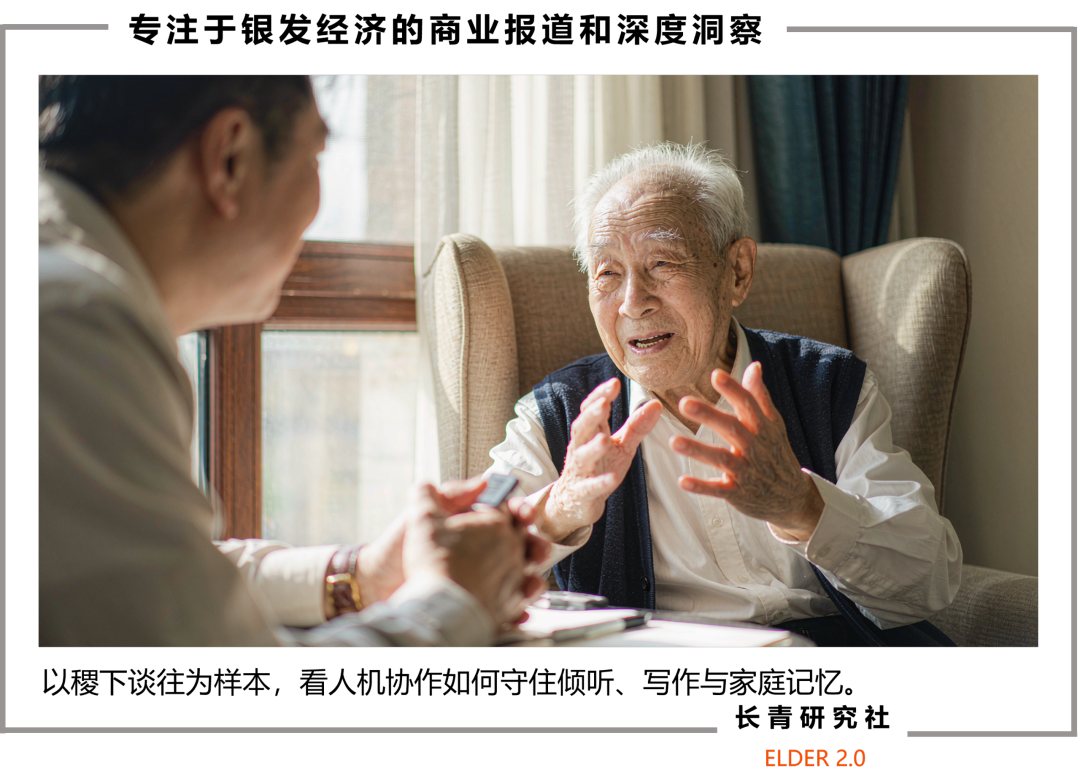
The image shows Xing Rui, founder of Jixia Tanwang, speaking.
These stories highlight AI's limitations.
This is what pure AI products currently struggle to achieve. AI can string disjointed events into stories and polish plain text beautifully, but it cannot detect emotional undertones, discern which words should be written or kept private, or use a glance or response to make storytellers lower their guard and speak openly.
Thus, a memoir's value lies not just in the finished book but in whether the person was truly heard, repeatedly confirmed, and treated with solemnity. Those hesitant pauses, tear-filled eyes when recalling the past, and lifelong secrets and regrets only emerge in face-to-face, sufficiently safe, trusting relationships.
Without this process, even thick books remain mere sheets of printed paper.

When we dissect 'how a memoir is born' into a complete production chain, the essential differences among the three player types become stark. The pure AI model prioritizes efficiency; the traditional artisan model prioritizes quality. Both are valid yet narrow. The human-machine collaboration model is seen as the industry's long-term direction precisely because it balances efficiency with quality, scale with warmth. Jixia Tanwang's workflow provides a referential professional template for the industry.
In terms of division of labor, AI serves as a tool; humans guard the core.
Writing must be overseen by professionals. 'Warmth' doesn't mean crafting golden lines for storytellers or elevating ordinary lives into legends. It means preserving a person's original tone, personality, and worldview. It avoids sentimentalizing regrets, exploiting suffering, or fabricating unconfirmed details. The final product should remain 'this person,' not a standardized story bearing their name.
The pure AI model follows a fully automated 'user input—model generation—one-click delivery' chain, with algorithms handling everything and little professional intervention. The traditional artisan model follows a 'one-on-one—fully manual' workshop chain, with humans handling everything and efficiency limited by personal capacity.
Jixia Tanwang's core logic is to set clear boundaries between technology and humans. All repetitive, mechanical tasks go to AI; all trust-, judgment-, and emotion-related core tasks remain human-led.
In Jixia Tanwang's workflow, AI handles transcription, data indexing, information comparison, and draft assistance. Establishing trust through interviews, confirming key facts, judging privacy boundaries, and final writing stay with professionals. Technology shortens organization time but not the time needed to build understanding between people. This model resolves the traditional model's inefficiency and limited capacity while avoiding the pure AI model's algorithmic overreach and factual distortions.
In terms of quality control, processes shift from personal experience to institutional standards.
The traditional artisan model relies entirely on creators' personal experience and professional ethics for quality control, while the pure AI model lacks quality control almost entirely. In the human-machine collaboration template, quality control is broken down into standardized, replicable procedures.
During deep interviews, interviewers not only collect facts but also observe emotions, judging when to probe, when to pause, and which topics to avoid. This supplements the pure AI model's 'no-interview' approach and standardizes the traditional model's 'intuition-based' methods.
In fact-checking, the Jixia Tanwang team often says, 'Our biggest fear isn't AI writing poorly but writing too smoothly, so everyone forgets to ask where each claim comes from.' Thus, they enforce a 'all narratives must have sources' rule. Names, dates, and major events must trace back to interview recordings, archival materials, or personal confirmation. AI is never allowed to invent plot details. This avoids the pure AI model's tendency toward 'imaginative creation' and transforms the traditional model's vague 'authenticity principle' into enforceable procedures.
In privacy boundaries, they've established a mature mechanism of tiered authorization and dual-version delivery, collaborating with clients to determine disclosure levels for sensitive content and distinguishing between gift editions and internal circulation versions. Respect for boundaries is an ability pure AI products completely lack, turning the traditional model's reliance on personal discretion into institutionalized service standards.
In terms of value extension, goals shift from product delivery to memory preservation.
The pure AI model aims to deliver a printed product, with the transaction ending upon receipt. The traditional artisan model aims to deliver a custom work, with the relationship terminating at final draft. In the human-machine collaboration template, delivery is just one service link .
For Jixia Tanwang, the final delivery includes not just physical books or e-books but also searchable archives and extendable family interaction spaces. A book isn't the endpoint but the starting point for family dialogue. Children can keep asking questions; elders can keep adding details. Memories can continuously grow. This model redefines the memoir's value endpoint and expands the industry's long-term service boundaries.
From an industry observation perspective, Jixia Tanwang's workflow holds sample value not because it's more expensive or slower but because it clarifies the relationship between technology and humans amid the AI wave. Technology is a tool, not a replacement; standards are a baseline, not a straitjacket. It avoids the low-price assembly line trap and the niche artisan workshop's isolation, forging a professional, replicable, and warm middle path.

Today, the industry obsesses over AI cost-cutting, price wars, and rapid scaling. It seems whoever lowers prices further wins the final battle.
Yet when AI reduces text organization costs to nearly zero, the sector's core competition shifts back to fundamental human aspects: understanding people, upholding authenticity, and building trust. Technology breaks down price barriers, but the true barriers beyond them lie entirely in 'human' factors.
The first barrier is the ability to empathize and conduct in-depth interviews. Facing a life weathered by hardships, can you make them lower their guard and be willing to share long-buried memories? Can you grasp the crucial turning points in their plain (plain) narratives and ask, 'What were you thinking at that moment?' This is a skill machines can never learn because it stems from empathy, life experience, and an understanding of human nature.
The second barrier is a reverence for truth and boundaries. AI has no sense of right or wrong; it only seeks coherence and completeness. But memoirs are written for family and left for future generations, with every word potentially becoming part of the family's collective memory. The ability to uphold the bottom line (bottom line) of 'no fabrication, no speculation, no overstepping' and to find balance between commercial efficiency and professional responsibility determines how far a brand can go.
The third barrier is the establishment of long-term trust. Writing a memoir is not a one-time transaction. From initial communication to multiple interviews, repeated revisions and confirmations, and ongoing interaction after the book's completion, the entire process can span months or even years. Clients entrust you with their most private life stories not because of flashy technology but because of your reliability, steadiness, and the sense of being 'taken seriously' that you provide.
Valuing humanity does not mean disregarding technology. This is why Jixia Talks of the Past did not follow the trend of developing a consumer-end one-click generation tool but instead independently developed a product system consisting of a B-end interview workstation and a C-end WeChat mini-program. This system enhances internal collaboration efficiency and manages AI risks without replacing human effort. The business scope has also naturally extended from personal life stories to family histories and corporate/organizational biographies. In September 2026, the 'Jixia Visits' public welfare (public welfare) project was launched, collaborating with university students to accompany empty-nesters in completing oral records.
It may seem like a slow approach, but it is a steady one. As Xing Rui said, 'The carriers of future memories may change—from books, audio, and video to digital archives and new interactive forms. But the need to 'be heard and understood' will remain constant. Jixia will adapt to new carriers but will never lose sight of the 'human' essence.'
We often say, 'Do not wait until your parents are gone to show your filial piety,' but many fail to realize that the greatest regret is not failing to buy enough gifts but missing the chance to hear their life stories in full.
Our generation grew up watching our parents' backs but rarely truly understood their youth. They once had passionate ideals, made difficult choices, and harbored hidden regrets and tenderness. They were simply accustomed to silence, and we to not asking.
The emergence of AI represents progress in the industry. It has made 'documenting lives' cheaper and simpler, enabling more families to preserve their memories. However, we must remain clear-eyed: technology can save us the time of organizing words but cannot replace the patience of sitting down and listening. It can generate coherent stories but cannot create the understanding and connection between people.
'A life should leave something behind.'
What remains should not be just a beautifully written but emotionally hollow book generated by AI.
What should remain is the light in your father's eyes when he recounts his past, the smile on your mother's face as she reminisces, and the vivid, authentic lives of those you never truly knew—their stories, full of life and truth.
And it all begins with a single act of serious listening.
-
![]()
Liang Wenfeng Pours 40 Billion Yuan Investment, Ulanqab Braces for AI Behemoths
-
![]()
AI Enters Memoirs: Can an Elderly Person's Life Be 'Generated' with One Click?
-
![]()
Coma: Why Do Points in the Peripheral Field Turn into 'Comets'?
-
![]()
When AI Starts to 'Spout Nonsense' for Brands, Who's Left Footing the Bill for Unchecked Algorithms?
-
12 weeks after Mercedes-Benz was tested for rollover
-
![]()
Math PhD Makes 141.7 Billion Through AI Stock Trading!
-
![]()
The Enigma of Zeekr's Sales: How 96% of Annual Target Was Achieved in 9 Months
-
![]()
Apple Reduces Orders! Luxshare Precision Faces a 50.3 Billion Yuan Inventory Challenge