Coma: Why Do Points in the Peripheral Field Turn into 'Comets'?
 10/13 2026
 529
529
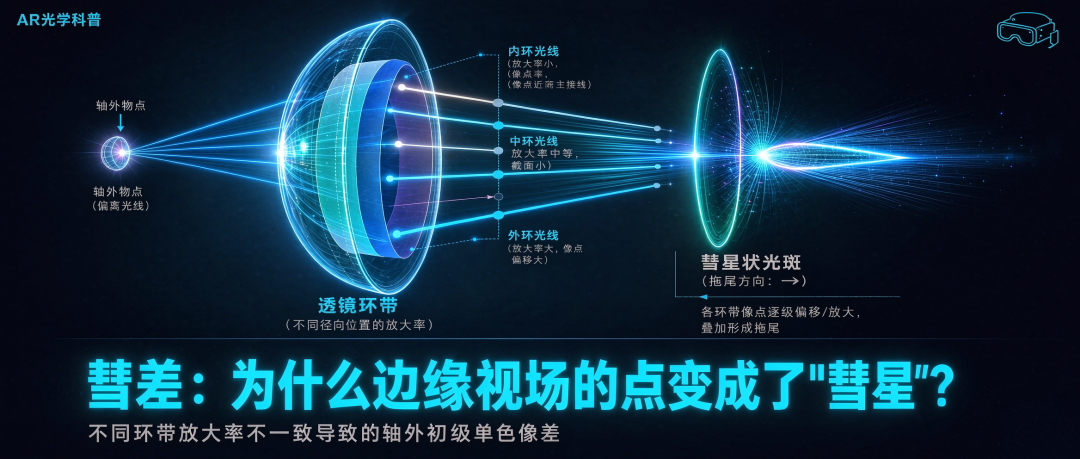
Abstract: In the peripheral field of optical systems, ideal light spots often transform into comet-shaped light spots with tails—this is known as coma.
As a typical off-axis primary monochromatic aberration, it originates from inconsistent magnification across different lens zones, causing light rays to shift in imaging position. This is a major cause of blurred and unevenly bright images at the edges of AR systems.
Imaging defects in the central field are dominated by spherical aberration. However, as the gaze shifts toward the image edges, another highly recognizable aberration emerges in the optical system: originally regular point light sources no longer form symmetric diffuse spots upon imaging but instead create trailing light spots with a sharp end and a diffuse end, resembling a comet.
This is coma, an unavoidable fundamental aberration in all wide-field optical systems.
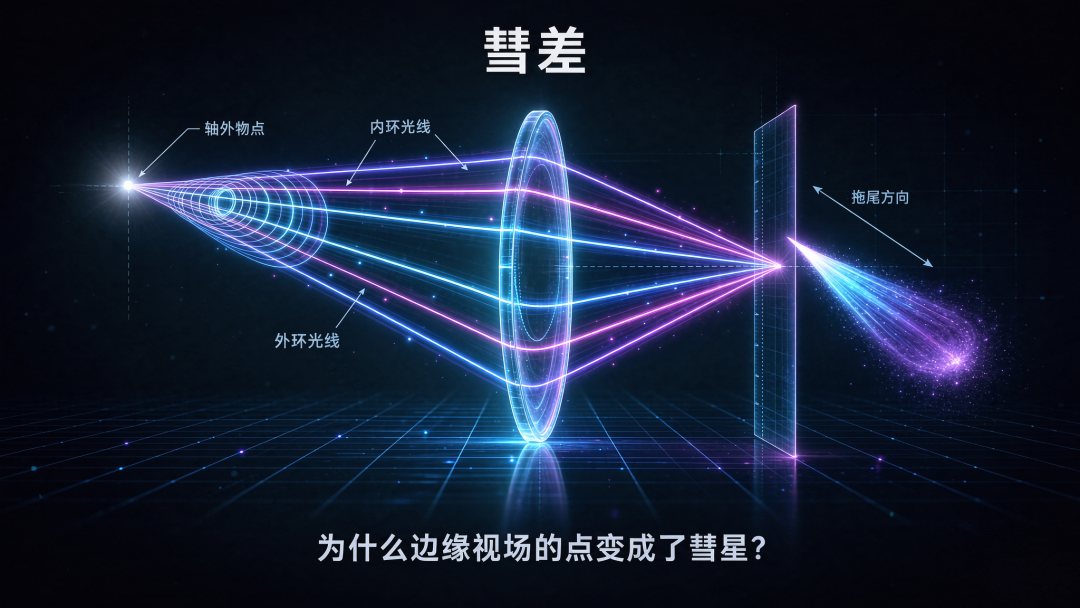
Core Understanding: Coma is a typical aberration caused by different imaging positions of off-axis object points in various aperture regions—differences in magnification of off-axis light rays across lens zones result in asymmetric 'comet'-shaped light spots on the image plane. It directly reflects the optical system's eccentric response to light rays of different apertures.
I. The Physical Nature of Coma: Zonal Magnification Differences in Off-Axis Light Rays
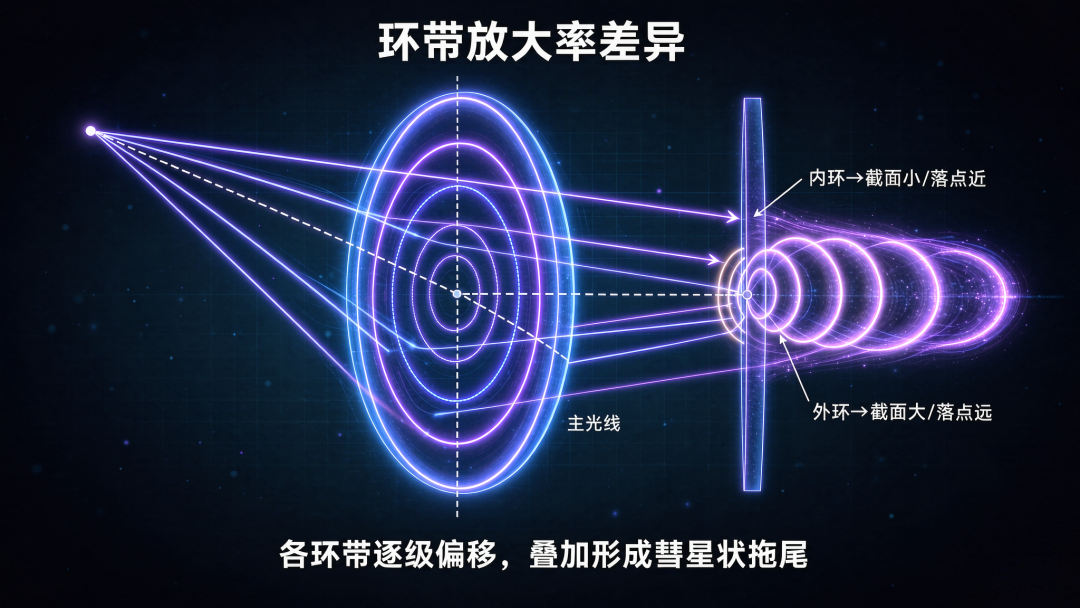
The core cause of coma lies in the inconsistent imaging magnification of off-axis light beams passing through different lens zones.
Light beams emitted from object points Deviation from the optical axis [off the optical axis] cover all zones of the lens from inside to outside. The refractive laws and imaging magnification ratios vary significantly for light rays at different radial positions.
Inner-zone light rays close to the optical axis form smaller cross-sections on the image plane and land closer to the chief ray; outer-zone marginal light rays far from the optical axis form larger cross-sections and land farther from the chief ray.
The light spots from each zone gradually increase in size and shift outward from inside to outside, After stacking [when superimposed] forming an asymmetric comet-shaped trailing light spot that completely breaks the circular symmetry of point imaging.
II. Practical Manifestations in Optical Systems: Asymmetric Degradation of Peripheral Image Quality
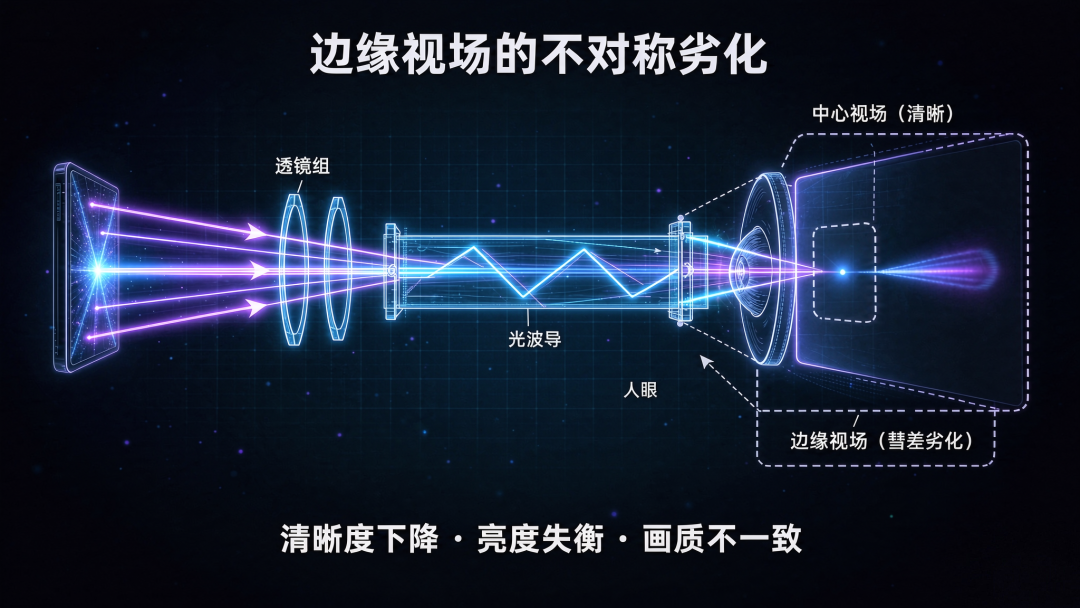
Unlike the symmetric diffuse blur caused by spherical aberration, the most intuitive feature of coma is its completely asymmetric imaging morphology: ideal point light sources ultimately image into comet-shaped light spots with a sharp end and a wide diffuse end, featuring a fixed trailing direction and highly recognizable distortion characteristics. Coma is strongly tied to the field of view and aperture size—the larger the field and aperture, the more pronounced the coma distortion.
In AR optical systems, coma primarily affects the peripheral field, causing uneven brightness distribution and significantly reduced sharpness at the screen edges, severely undermining the consistency of full-field image quality across the entire device.
III. Mainstream Correction Solutions for Coma: Symmetric Structures to Offset Eccentric Aberrations
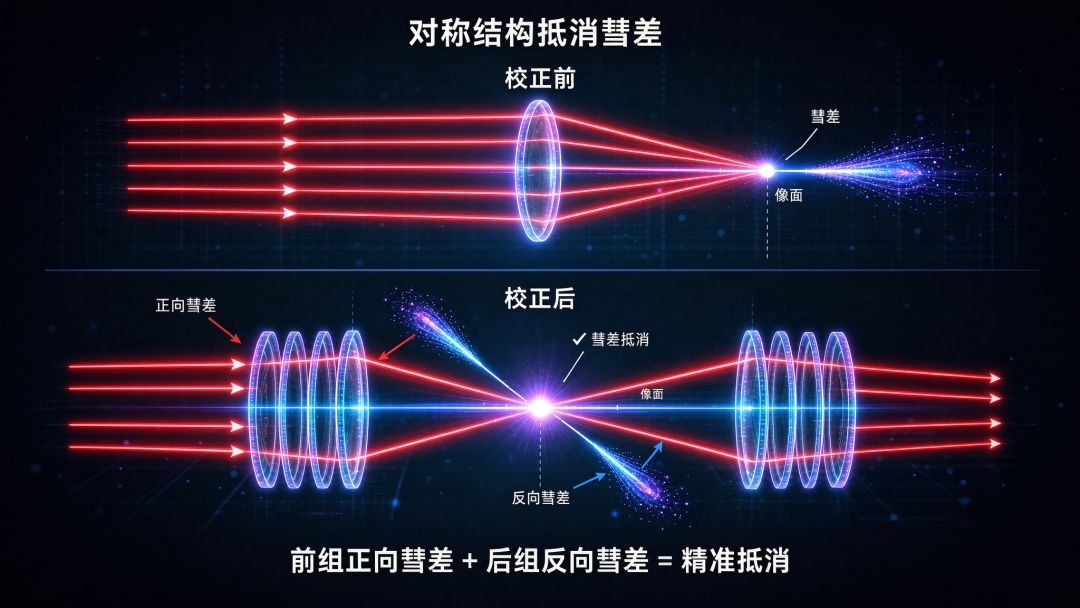
Optical path symmetric structural design represents the most core and efficient engineering method for correcting coma.
By arranging lens groups with front-back symmetric structures, the forward coma generated by the front lens group's optical path can be precisely offset by the reverse coma generated by the rear lens group, substantially suppressing residual coma and optimizing imaging accuracy at the optical structure level.
Since coma is simultaneously influenced by both aperture size and field range, optical design must balance trade-offs between light-passing capability and wide-field requirements.
In AR light engine design, coma correction accuracy directly determines imaging quality in the peripheral field and constitutes a core calibration step for achieving full-field sharpness and balanced image quality.
Conclusion: If spherical aberration causes uniform blur in the central field of optical systems, then coma is the primary culprit behind point distortion and trailing in the peripheral field.
As a primary monochromatic aberration affecting only off-axis fields, coma represents an optical defect that must be prioritized for optimization and suppression in wide-field AR optical systems.
Grasping the generation mechanisms and correction logic of coma provides clear insight into why high-end AR light engines universally adopt symmetric lens group structures—it also serves as an important theoretical foundation for calibrating full-field high-definition, low-distortion AR images.
Interactive Topic: Have you encountered typical coma phenomena such as trailing edges, asymmetric blur, or brightness shifts in AR image peripherals during optical calibration? Welcome to share your calibration insights in the comments.
— AR Andy | Focused on waveguide and AR microdisplay technologies, deeply dissecting the underlying logic of the optical industry
[Risk Disclaimer] This article provides industry-oriented optical science popularization content. The principles, phenomena, and optimization solutions discussed derive from publicly available optical theories and general optical design experience. They are intended solely for technical learning and industry exchange and do not constitute a basis for product design, process iteration, or mass production selection.
-
![]()
Liang Wenfeng Pours 40 Billion Yuan Investment, Ulanqab Braces for AI Behemoths
-
![]()
AI Enters Memoirs: Can an Elderly Person's Life Be 'Generated' with One Click?
-
![]()
Coma: Why Do Points in the Peripheral Field Turn into 'Comets'?
-
![]()
When AI Starts to 'Spout Nonsense' for Brands, Who's Left Footing the Bill for Unchecked Algorithms?
-
12 weeks after Mercedes-Benz was tested for rollover
-
![]()
Math PhD Makes 141.7 Billion Through AI Stock Trading!
-
![]()
The Enigma of Zeekr's Sales: How 96% of Annual Target Was Achieved in 9 Months
-
![]()
Apple Reduces Orders! Luxshare Precision Faces a 50.3 Billion Yuan Inventory Challenge