Invest in Unitree's 'Physical Framework' First, Then Hu Han's 'Intellectual Core': Why Liang Wenfeng Can't Afford to Delay?
 10/14 2026
 492
492

This is the 147th original article from the Thinking AI Society.
Comprising approximately 1,352 words, this article offers an estimated reading time of 4 minutes.
In May of this year, Liang Wenfeng unveiled DeepSeek's AGI roadmap during a nearly four-hour closed-door session. The roadmap outlined a sequence: language models, chain of thought reasoning, agents, continuous learning, self-iteration, culminating in embodied intelligence. He also acknowledged that prioritizing embodied intelligence would be a 'formidable challenge'.
Three months on, on October 12, Bloomberg reported that DeepSeek is set to lead the seed funding round for the robotics AI firm Winverse AI, with a multi-million dollar investment, valuing the company at around $400 million post-investment.
The envisioned final destination has been reached ahead of schedule.
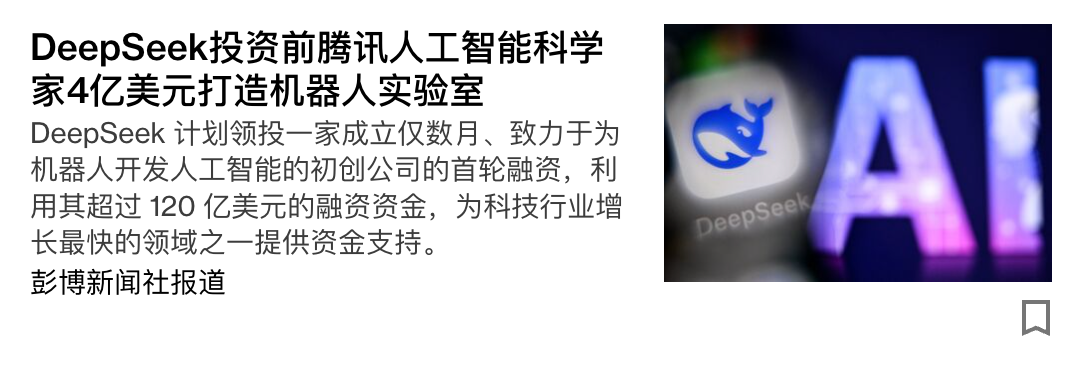
Two Investments Unveil DeepSeek's Strategic Approach
The inaugural investment occurred in August. DeepSeek invested over 140 million yuan to participate in the strategic IPO placement of Unitree Technology, acquiring over 930,000 shares with a three-year lock-up period. Based on the closing price on the first day of trading, this investment generated a paper profit exceeding 600 million yuan.
However, financial gain was not the primary focus; the crux lay in the memorandum signed by both entities: Unitree would prioritize DeepSeek for AI services, while DeepSeek would reciprocate by prioritizing Unitree for robotics solutions. One entity constructs the physical framework, the other the intellectual core, forging a robust alliance.
The second investment involves Winverse AI in this round. Established just this year, with no public products and zero revenue, why does the company command a $400 million valuation?
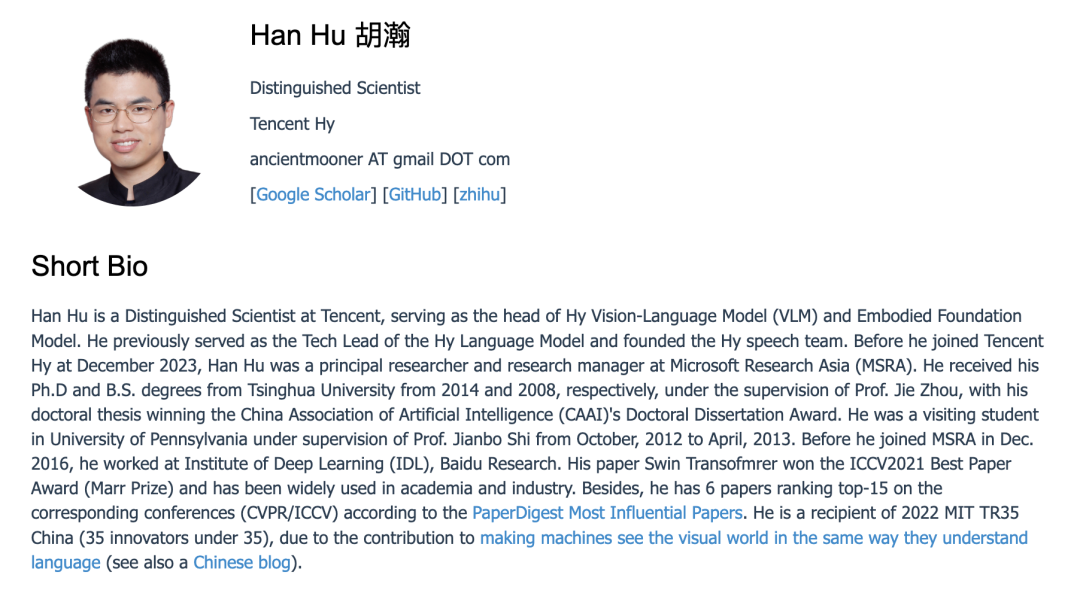
A glance at the founder provides clarity: Hu Han, a Ph.D. from Tsinghua University, former principal researcher at Microsoft Research Asia, former head of visual language models and embodied foundation models at Tencent Hunyuan, and recipient of the Best Paper Award at a premier computer vision conference—the renowned Swin Transformer stemmed from his team. Industry insiders note that this company is not strictly an embodied intelligence firm but leans more towards foundational infrastructure, such as model acceleration.
Observe how one investment targets the physical entity and real-world data, while the other focuses on the model and the 'intellectual core'. DeepSeek is not merely casting a wide net in burgeoning sectors but is strategically positioning itself at both ends of the value chain.
Incidentally, Meituan Dragonball also co-invested in Winverse, and Tencent is not only a potential investor in DeepSeek's new round of financing but also Hu Han's former employer—the talents and capital among industry leaders are already intertwined.
Why the Urgency? The Variable Known as GPT-6
Liang Wenfeng's newfound interest in robotics did not emerge spontaneously.
According to reports, he recently conceded that DeepSeek still 'has gaps in certain capability dimensions' compared to GPT-6. And GPT-6 has already ventured into the physical realm: in the publicly released RoboDojo tests in September, GPT-6 Astra directly served as a robot's action policy without specialized fine-tuning, outperforming 40 publicly available robotics policies across 42 operational tasks and 2,100 tests. On October 12 at the Industrial Expo, even Wang Xingxing predicted that GPT-7 could break through existing industry bottlenecks in embodied intelligence.
Herein lies the crux: Large models that solely consume text can comprehend that 'a cup is fragile,' but they cannot grasp the 'sensation' of the appropriate force to use when grasping a cup. The amount of force exerted in a grasp, how the cup slides, and how to recover from failure can only be learned through physical interaction. Robots are not merely new products; they are also training grounds for models to continue learning.
If other models have already commenced accumulating data and standards in action decision-making, delaying entry into the field until 'all digital intelligence is resolved' may leave no room for maneuver.
Shi Yunlei, founder of Rensen Robotics, aptly summarized it: DeepSeek values two things—learning capabilities in the physical world and new industry entry points.
Money Is Not the Primary Concern; the Focus Is on What This Money Is Investing In
Liang Wenfeng's change of heart is bolstered by a rapidly expanding funding pool.
In June, DeepSeek completed its first external funding round of over 50 billion yuan, valuing the company at nearly 400 billion yuan; in October, news emerged of a new funding round of at least 80 billion yuan, possibly approaching 100 billion yuan, targeting a valuation of about 500 billion yuan, with plans for an IPO in early 2027.
From 'absolutely refusing external financing' to securing billions in financing and making investments across the board, Liang Wenfeng's strategic shift took less than a year.
However, Winverse was only founded a few months ago, with no public products or technical roadmaps, and its $400 million valuation is almost entirely based on Hu Han himself. Some investors bluntly state that current billion-dollar valuations in embodied intelligence rely on 'market dream rates' rather than commercial fundamentals.
Experts have also cautioned that the real bottlenecks in robotics commercialization are high-quality operational data, reliable hardware, and real-world scenarios—merely embedding stronger large models into robots will not resolve all issues.
From large models to robotics, the second half of this AI race has already commenced. The first half was about whose model could answer questions; the second half is about whose model can operate stably in the real world.
Liang Wenfeng has accelerated the final destination of DeepSeek's AGI roadmap to the present, betting on precisely this.

All content is sourced from publicly available information and represents only personal opinions.
-
Aian N60 Under Sales Pressure, S600 Fails to Revive Hyper: Zhang Xiong’s Dual-Brand Strategy Falters in Early Stages
-
![]()
BYD's Da Han Redefines Flagship Standards with 1,000+ km Range and Standard Rear-Wheel Steering
-
![]()
iPhone Duo Sparks Excitement! Will Under-Display Cameras Make a Triumphant Return? RedMagic Holds Firm for Six Years
-
Xiaopeng's Global Expansion Faces Turbulence: Navigating Pre- and Post-Sales Hurdles in International Markets
-
![]()
Invest in Unitree's 'Physical Framework' First, Then Hu Han's 'Intellectual Core': Why Liang Wenfeng Can't Afford to Delay?
-
![]()
3999 Yuan! STEPX Unveils Its Pioneering AI Agent Smartphone, Bundled with a One-Year Token Subscription
-
![]()
Alibaba, ByteDance, and META Are Fully Committed! Personal Agents Are on the Rise, and Only Those with Robust Models Can Compete
-
![]()
Memory Price Hike Triggers Aftershocks: Ultra Models Axed One by One, Making Flagship Phones a Tougher Sell