Alibaba, ByteDance, and META Are Fully Committed! Personal Agents Are on the Rise, and Only Those with Robust Models Can Compete
 10/14 2026
 467
467
Agents are now beginning to "tailor" models in reverse.
In late September, Alibaba announced at the Cloud Town Conference that Qianwen will expedite the development of personal Agents, harnessing the power of the Qwen 3.8 series to create innovative product formats.
Just today (October 13), Qianwen officially unveiled "Qianwen Go!"—a personal assistant—and initiated a limited-time, invitation-only test on the Qianwen App.

Not only Alibaba is making strides—ByteDance is also internally testing a personal Agent project codenamed Spell for its Doubao platform, recently ramping up its integration with existing Doubao products. Tencent is not far behind, with at least two personal Agent projects in development: TX Handy Bot and Yuanbao Assistant.
Meta's Muse has sparked this wave of enthusiasm for personal Agents. It empowers users to delegate daily tasks and long-term goals to an Agent equipped with its own independent cloud-based computer and browser, making personal Agents the focal point of the industry. Even OpenAI has launched dots in the wake of Muse.
However, the surge in application development is just one aspect—the other side is the transformation at the model level.
On October 12, Meta unveiled the Muse Wonder series, comprising two models: Muse Wonder and Muse Wonder Full. Beyond coding and professional task capabilities, two new keywords have emerged—Active Memory and Active Focus. The former emphasizes retrieving pertinent information across conversations, while the latter focuses on advancing goals despite obstacles.
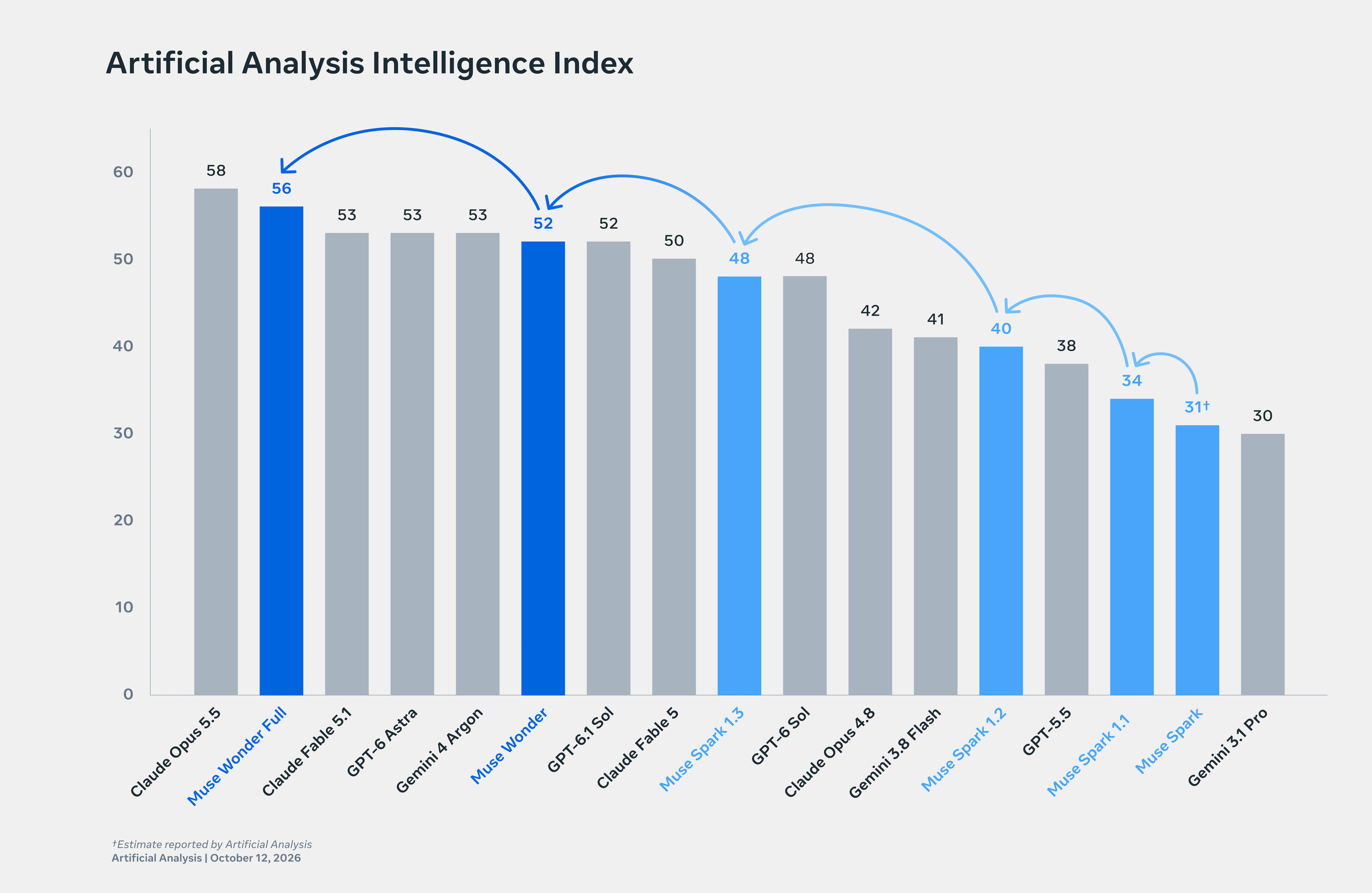
Wonder Full ranks just below Opus 5.5 on the AA leaderboard. Image source: Meta
Meanwhile, the Qianwen team has introduced QwenGyre, an online reinforcement learning framework tailored for ultra-long Agent tasks. The related paper was submitted to arXiv on September 27, addressing the core research question: How can the training system leverage an Agent's experiences from working for hours and interacting with the environment hundreds of times while minimizing idle computation?
All are gearing up for the explosion of personal Agents.
Without a robust model, discussing personal Agent experiences is futile.
Personal Agents, or personal assistants, are not novel concepts. We've been instructing our phones for years, hoping they'd remember things, schedule appointments, and handle issues for us.
Earlier this year, OpenClaw's "Longxia" (Lobster) craze introduced many to an AI capable of reading files, calling tools, and continuously working on a computer. Natural language understanding, tool execution, personal context, and background operation finally began to converge in a single product.
Then came Instinct and Muse, shifting Agents from task-centric to person-centric, from PCs to phones, and from office tasks to daily life.
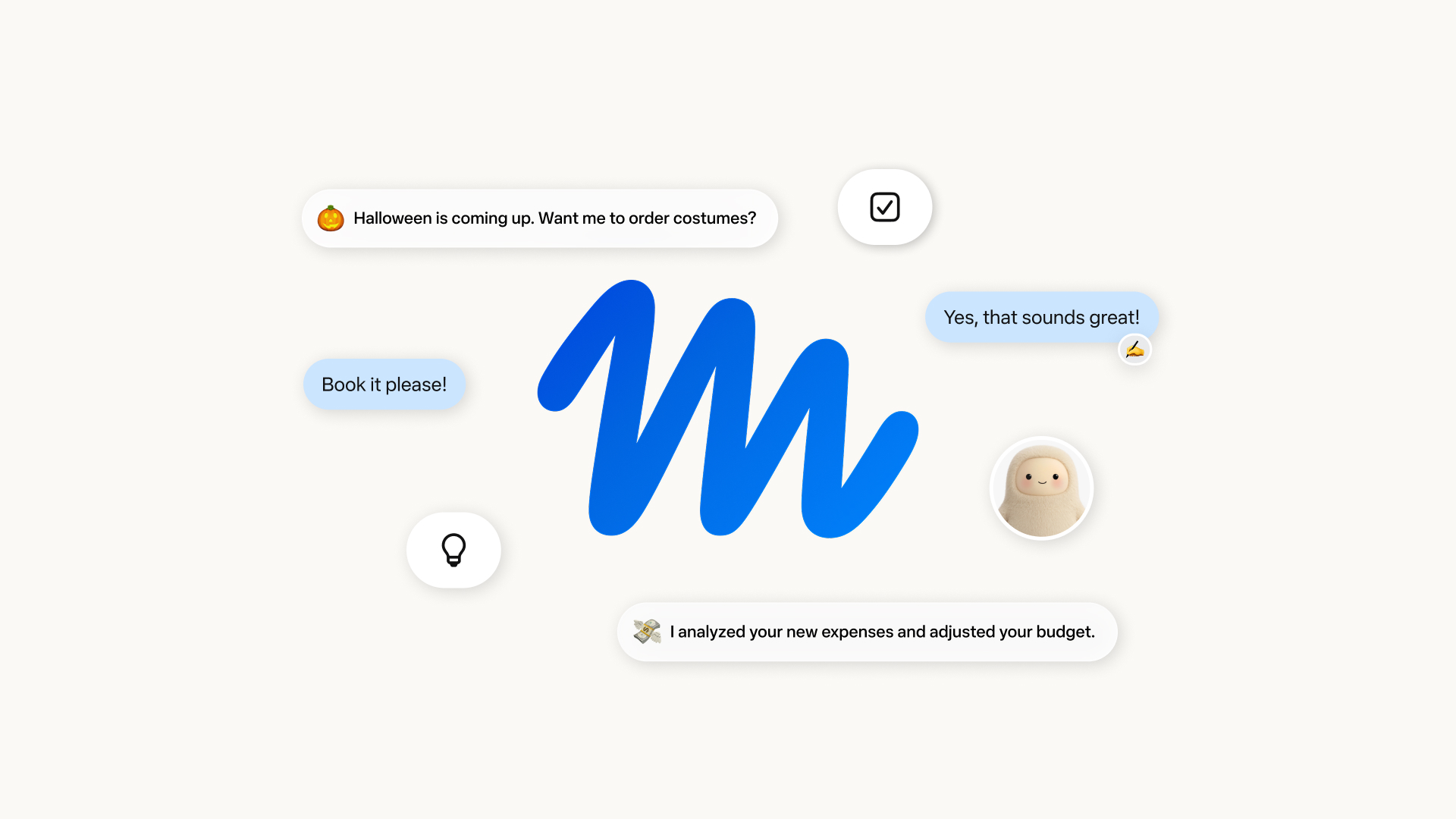
Image source: Meta
But precisely because of this, model weaknesses are exposed in another way. Suppose you instruct your personal Agent to plan a family trip, providing a budget, family availability, and a preference to avoid early-morning flights. Days later, the flight is canceled, necessitating a reconsideration of transportation and accommodation.
At this juncture, listing ten travel itineraries is insufficient—it must discern which arrangements are no longer valid, which constraints persist, and when to seek clarification from you. If this context must be re-explained each time, the so-called personal Agent faces an additional challenge: personal context.
Muse Wonder’s Active Memory precisely targets these issues. For an Agent following a person long-term, storing information is merely the starting point—retrieving relevant content when needed is paramount. A minor detail mentioned yesterday might become crucial next week. Conversely, a revised plan shouldn't remain a top priority just because it was remembered first.
Meta’s disclosures reveal that internal MemoryBench tests utilize complex dialogues ranging from 64,000 to 100,000 tokens, incorporating distracting information and conflicting or updated content. This is closer to the challenges personal Agents face than simply verifying if a model can repeat old information.
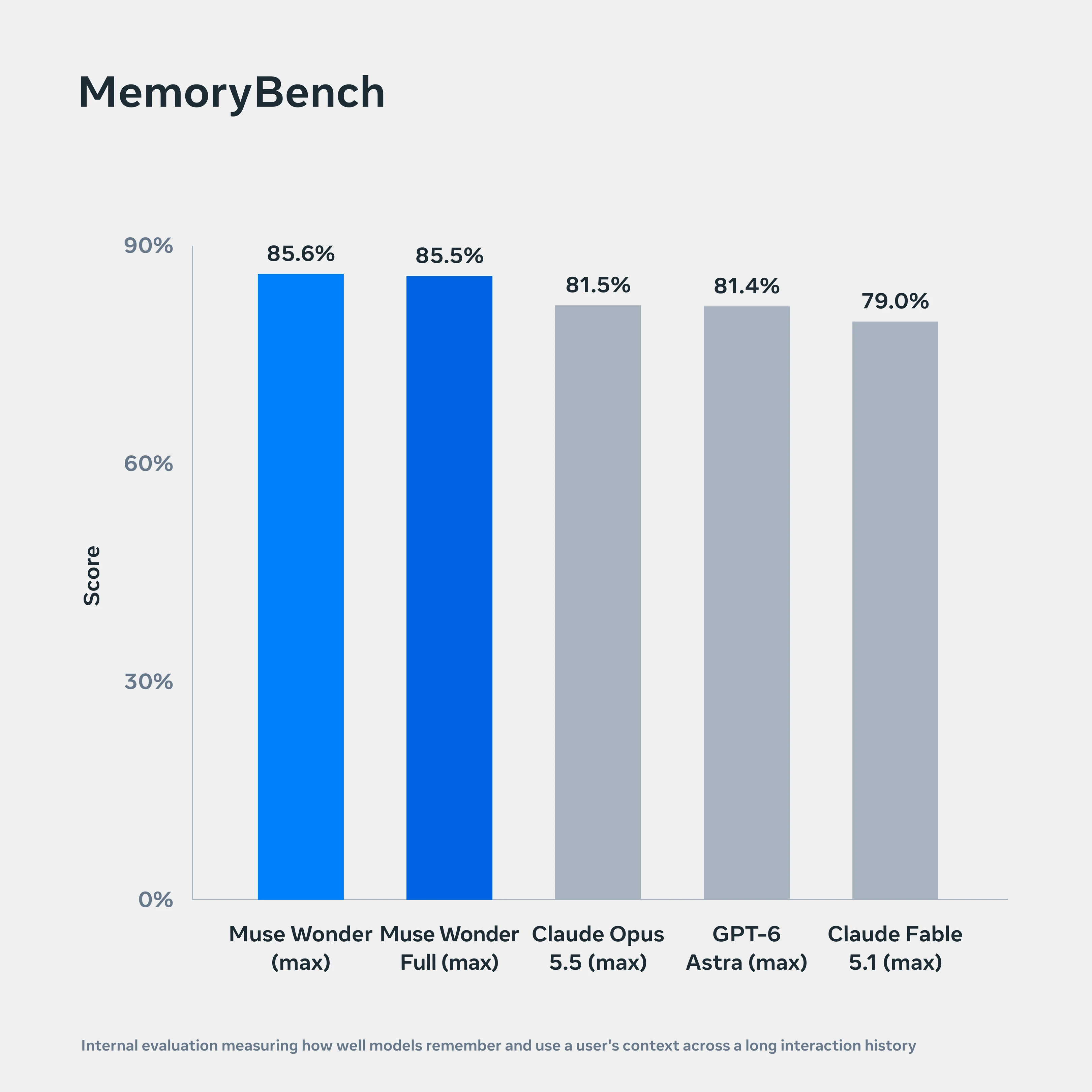
Image source: Meta
However, memory performance in a lengthy conversation still doesn't directly prove that a product reliably understands a person over months. How information is stored, when it's retrieved, and how users correct or delete it all hinge on product design beyond the model. A million-token window can hold more content but won't automatically inform the model which old arrangement should no longer be adhered to today.
Then there's the ability to focus proactively.
According to Meta, Muse Wonder will explore alternative approaches, handle obstacles, and adjust actions based on new information. The official product page also highlights long-task planning, sub-Agent division of labor, parallel tool calls, and failure recovery as key capabilities. This is crucial for personal Agents.
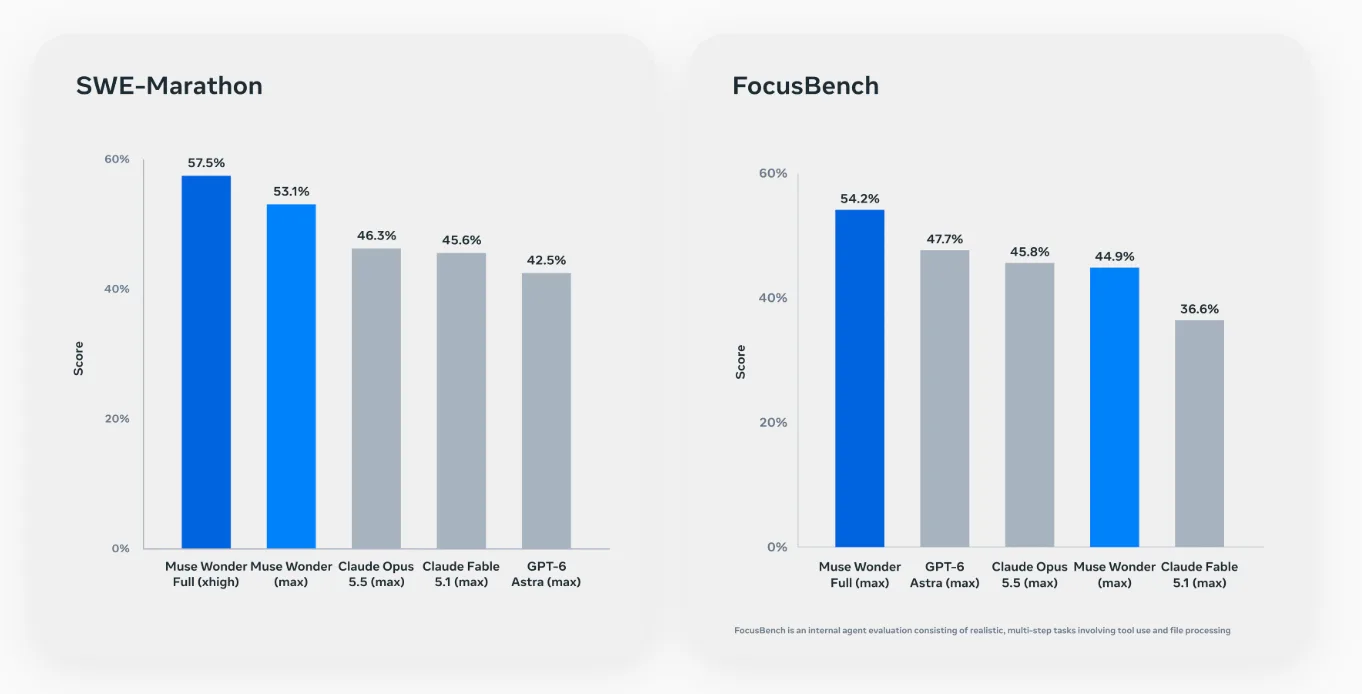
Image source: Meta
Users delegate a task, not a series of instructions they must supervise individually. For instance, if a web page needed for research can't be opened, a truly useful assistant should determine if other sources exist. Continuing work sometimes means trying another method, sometimes stopping to ask the user for more information—not blindly pushing forward.
Meta’s internal FocusBench tests this persistence, focusing on real-world obstacles and dynamic changes in tasks like housing, travel, and IT. Both Muse Wonder models undergo diverse, long-duration task training to maintain their ability to keep advancing.
In other words, personal Agents can dissect what used to be lumped together as "being smarter" into distinct requirements: remembering information accurately, keeping up with changes, having solutions to problems, and knowing when to involve the user in important decisions. These requirements are now integral to model capability descriptions and evaluation systems.
Under Meta’s announced plans, Wonder will be utilized in the personal Agent product Muse, initially rolled out to subscribers.
Model iteration directions shift, and training must adapt accordingly.
For models to learn to work long hours, training must allow them to actually work. QwenGyre, an online reinforcement learning framework for ultra-long Agent tasks, aims to make this process more efficient.
In online reinforcement learning, models execute tasks, receive feedback, and update parameters with new experiences. However, the more complex an Agent’s work, the more training encounters two issues:
1. **Waiting**: In a batch of tasks, some finish quickly while others are still calling tools or revising plans. If compute power can only start training after the entire batch completes or is fixed between execution and training, some GPUs may sit idle while tasks are still running.
2. **Redundancy**: Agents compress context, delegate sub-tasks, and may retry failed paths. These processes create branches with shared experiences. Training on every path repeats the same content unnecessarily.
QwenGyre addresses these by redistributing GPUs between execution and training based on task progress while keeping unfinished tasks running; and organizing branched execution records into trajectory trees with shared prefixes to reduce redundancy and control training sample size. Even if a task times out, its partial results can still provide useful feedback if assessable.
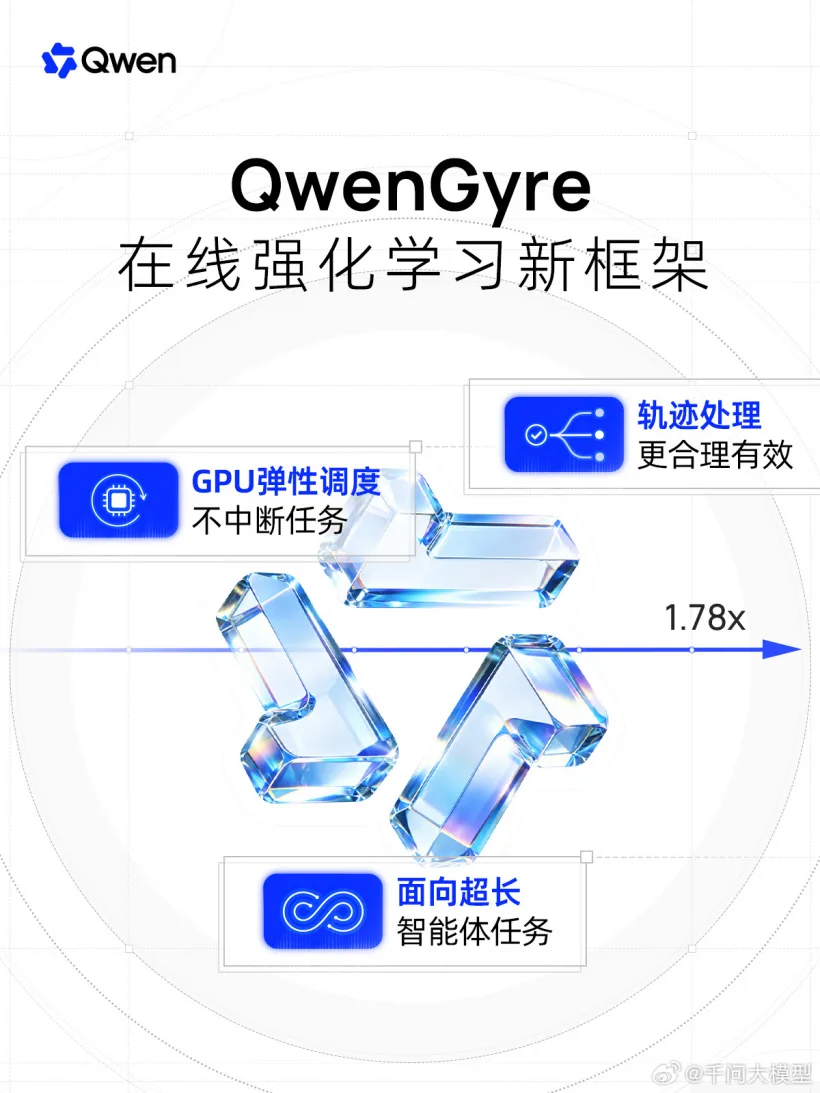
Image source: Qianwen
In Qianwen’s experiments, Qwen 3.8 2.4T processed ~700,000 tokens in a single session, improving NL2RepoBench pass rates from ~52.5% to 58.5% after 48 reinforcement learning steps. Under the same GPU budget, QwenGyre saved ~44% training time compared to Async schemes while achieving similar scores.
These are precisely what personal Agents require.
The family trip example mentioned earlier involves multi-round operations, tool calls, and adjustments after failures when rescheduling flights, accommodations, and transportation. The model must continuously observe the external environment, adapt to new information, and sometimes overturn original plans. This necessitates not just tool-calling ability but also long-term planning, state maintenance, dynamic decision-making, and failure recovery.
QwenGyre precisely targets this complexity in task execution to solve corresponding model training challenges.
For Alibaba, this path is logical.
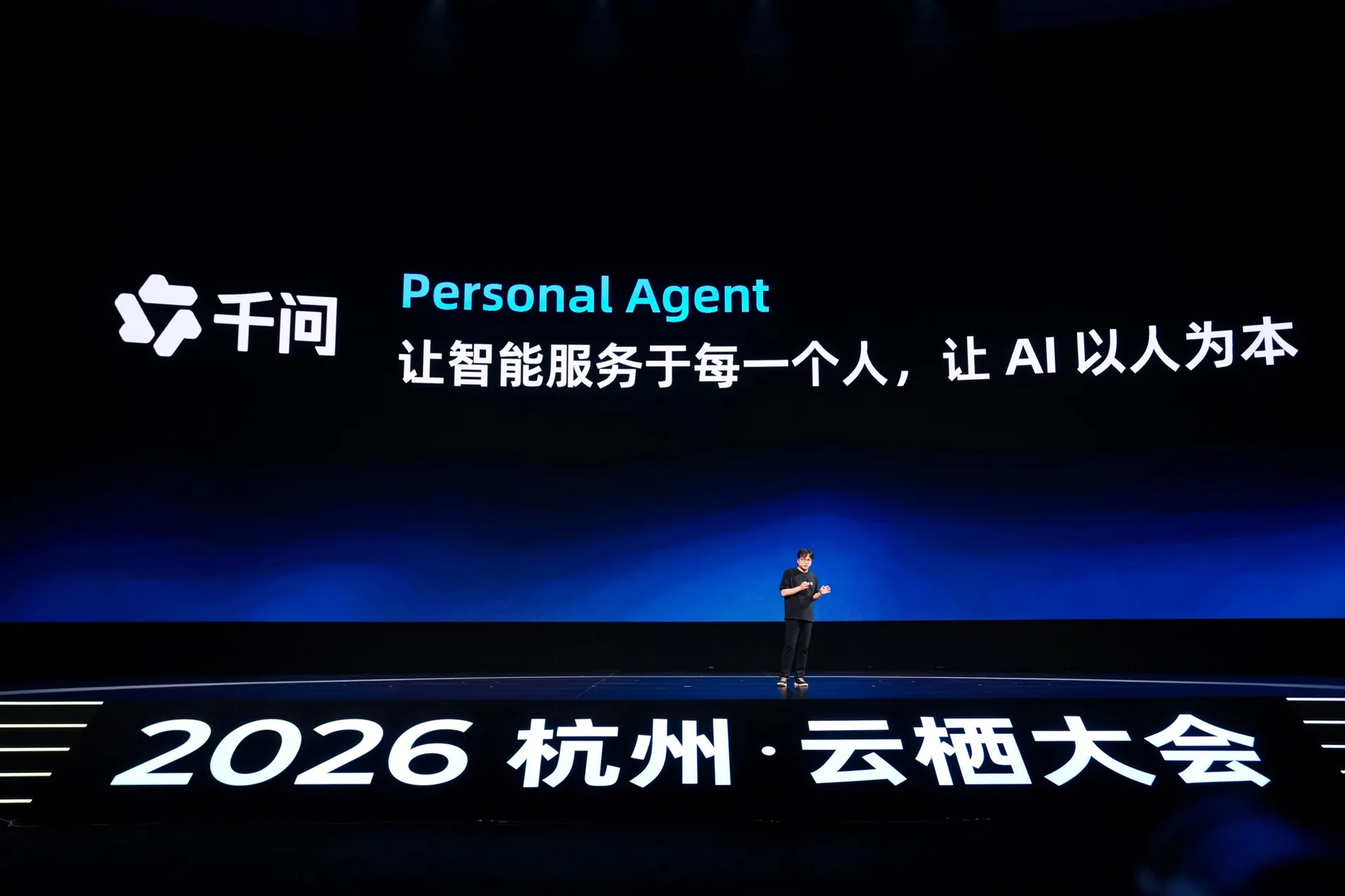
Image source: Alibaba
Qianwen has explicitly committed to building personal Agents and is developing related capabilities based on the Qwen 3.8 series. QwenGyre is already utilized for long-duration training of flagship models in the same series, and the team hopes to further expand task scope and training scale. As applications demand sustained model performance, and training frameworks reduce long-task overheads, their integration becomes tangible.
Thus, Alibaba will likely continue using QwenGyre for Agent training in subsequent Qwen models and explore personal assistant scenarios. This could manifest in new-generation models or through post-training enhancements to existing ones.
After Coding, Personal Agents Redefine "AI"
The impact of applications on models was already validated during the Coding Agent phase. Early AI programming primarily aided in completing code snippets. Later, users began entrusting entire projects to Claude Code and Codex, requiring them to understand file relationships, modify code, run tests, and fix errors based on feedback.
As AI’s role evolved, so did model optimization goals. Claude 4 emphasized long-duration execution, parallel tool calls, and file memory. GPT-5-Codex optimized for Agent-style programming—all in response to these demands.
Enhanced model capabilities enable applications to handle more complex work. Meanwhile, application requirements and failures guide the next round of model training. Personal Agents will continue driving this iteration, but the focus shifts to a specific person rather than individual tasks.
For instance, if a user says, "Let’s skip this week," the model must discern whether they're pausing the current arrangement or the entire long-term goal. Things mentioned in private chats must also be judged for appropriateness in external emails. These choices are challenging to evaluate with fixed test scripts like code but directly affect whether users trust the Agent to handle tasks.
Take OpenAI’s dots, powered by GPT-6 Astra—currently the most advanced top-tier model. While GPT-6 Astra’s capabilities are undeniable, dots doesn't yet demonstrate a stronger personal Agent advantage compared to Instinct, Muse, or Grok Bot.
Thus, it's natural for the next-gen GPT to optimize further for personal Agents like dots. Similarly, for Qianwen, Doubao, and Yuanbao, as personal Agents gradually materialize, models will face new demands, requiring adjustments in training and iteration directions.
This "customization" doesn't come at the expense of general-purpose model capabilities. Personal life is full of unpredictable situations, so broad knowledge, reasoning, and handling unfamiliar tasks remain crucial. Personal Agents simply give these abilities a clearer goal: understanding the user’s context and continuing delegated tasks.
Wonder has already begun adjusting capabilities around memory and sustained execution, while QwenGyre offers more efficient long-task training. Ultimately, users expect tangible progress: less need to repeat context, fewer corrections to changed arrangements, and less waiting for the next step.
Models must prove they're stronger—and make users want to delegate the next task.
Source: Leikeji
Images in this article come from: 123RF Royalty-Free Image Library Source: Leikeji
-
![]()
Alibaba, ByteDance, and META Are Fully Committed! Personal Agents Are on the Rise, and Only Those with Robust Models Can Compete
-
![]()
Memory Price Hike Triggers Aftershocks: Ultra Models Axed One by One, Making Flagship Phones a Tougher Sell
-
![]()
Yiwu: Emerging as the Shenzhen of Yesteryears
-
![]()
China Scales Back Support: Chinese Automakers Embark on Global Journey, Tesla Feels the Heat
-
![]()
Qianwen GO: Beyond Just Being Alibaba’s Shopping Assistant
-
Lei Jun Faces Immense Pressure as Xiaomi Phones Witness Largest Sales Decline for Three Straight Quarters!
-
![]()
September Sales Rankings for Boxy Cars: Warship 700 Secures Tens of Thousands of Pre-orders! Shenlan G318 at 99 Units, Xiangjie G9 at 234 Units? | Mingjing Pro
-
![]()
XPENG Motors had 33,752 vehicles insured in September, with Mona L03 surpassing 12,700 and Mona M03 exceeding 7,000!