ZTE: First-Half Net Profit Plummets Over 40%, Computing Business Grapples with Low-Margin Challenge
 10/15 2026
 553
553
In the first half of 2026, ZTE (000063.SZ) released a financial report that revealed a situation where revenue grew but profits failed to keep pace. The company's net profit attributable to shareholders plummeted by more than 40% year-on-year, reaching RMB 2.753 billion.
Securities Star observed that ZTE's revenue and gross margin from its operator network business both contracted, due to the continuous reduction in operators' investment in communications infrastructure. At present, ZTE is accelerating its shift towards a 'Connectivity + Computing' model. Although its government and enterprise business has witnessed rapid growth through server-based computing products, it is trapped in a low-gross-margin dilemma. This is mainly because, as a midstream integrator in the industrial chain, ZTE has limited bargaining power. Moreover, the company's inventory and accounts receivable have risen in tandem with revenue growth, adversely affecting cash flow and leaving the company in a financially strained state.
01. Operator Network Business Contracts, Gross Margins Under Pressure Domestically and Internationally
As a leading global provider of comprehensive information and communications technology solutions, ZTE offers a full spectrum of end-to-end products and solutions within the ICT industry. Based on customer segments, the company's business is divided into three major sectors: operator networks, government and enterprise business, and consumer business.
Securities Star pointed out that since 2024, ZTE's profitability has been under sustained pressure, a trend that continues to this day. The 2026 interim report indicates that ZTE achieved revenue of RMB 78.025 billion, up 9.05% year-on-year. This growth rate, however, was slower than the 14.51% increase recorded in the same period last year. Net profit attributable to shareholders was RMB 2.753 billion, down 45.57% year-on-year. Net profit excluding non-recurring items was RMB 2.221 billion, a decrease of 45.89% year-on-year.
In particular, the company's revenue in the second quarter was RMB 43.037 billion, up 11.54% year-on-year. Net profit attributable to shareholders was RMB 1.442 billion, down 44.62% year-on-year. Net profit excluding non-recurring items was RMB 1.285 billion, also down 44.62% year-on-year, marking the eighth consecutive quarter of declining net profit.
Securities Star noted that with domestic 5G network construction now in a mature phase, operators' capital expenditures are on a downward trend. ZTE's revenue from wireless and wired network products is under pressure, dragging down the overall performance of its domestic operator network business.
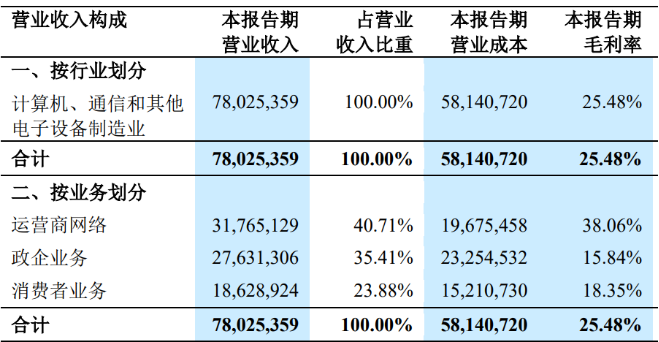
As the cornerstone of the company's revenue, the operator network business generated RMB 31.765 billion in revenue in the first half of the year, down 9.41% year-on-year, accounting for 40.71% of total revenue. At the same time, affected by changes in the product revenue mix, the gross margin of this business segment declined by 14.88 percentage points year-on-year to 38.06%.
The poor performance of the domestic operator network business also dragged down the company's overall domestic market revenue. In the first half of 2026, ZTE's domestic market revenue was RMB 50.154 billion, down 0.91% year-on-year, accounting for 64.28% of total revenue. The gross margin was 24.68%, down 9.01 percentage points year-on-year.
Faced with growth bottlenecks in the domestic market, ZTE is, on the one hand, deepening its engagement with existing customers and continuously investing in next-generation communications frontier technologies such as 6G, T-bit optical networks, and 200G PON to build technical capabilities for long-term business evolution. On the other hand, it is accelerating its expansion into overseas markets to offset the impact of the decline in the domestic operator business.
It is reported that the company is focusing on four core regions: Asia-Pacific, Europe, Latin America, and the Middle East & Africa. It is promoting 5G upgrades for local mobile networks and broadband fiber transformations, which have driven growth in its international operator network revenue. At the same time, breakthroughs have been made in international government and enterprise business as well as international home terminals, jointly driving an increase in international market revenue.
In the first half of 2026, the company's international market revenue was RMB 27.872 billion, up 33.13% year-on-year, accounting for 35.72% of total revenue. However, as the business develops rapidly, the profitability quality of overseas operations has shown signs of weakening. In the first half of 2026, the company's international market gross margin was 26.92%, down 2.53 percentage points year-on-year.
02. Limited Bargaining Power in the Computing Industrial Chain, Negative Cash Flow
Against the backdrop of declining revenue from the operator network business, ZTE is fully advancing its 'Connectivity + Computing' transformation strategy.
In the first half of 2026, computing products such as servers and storage saw increased adoption among leading customers in industries such as the internet, finance, and power. This drove a 43.51% year-on-year increase in the company's government and enterprise business to RMB 27.631 billion, with its proportion of total revenue rising from 26.91% in the same period last year to 35.41%. However, compared to the 109.93% growth rate in the same period last year, the growth rate of the government and enterprise business has significantly slowed.
At the same time, the company's consumer business revenue was RMB 18.629 billion, up 8.09% year-on-year, primarily due to growth in revenue from home terminals, mobile phones, and mobile internet products. The growth of these two major business segments has, to a certain extent, offset the impact of the decline in domestic operators' investment in communications infrastructure.
Securities Star noted that the government and enterprise business is currently trapped in a low-gross-margin dilemma. In the first half of 2026, the gross margin of the company's government and enterprise business was 15.84%, lower than the 38.06% for the operator network business and 18.35% for the consumer business.
Further research reveals that ZTE's limited bargaining power in the computing industrial chain is the primary reason for its low gross margin in the government and enterprise business. As a midstream equipment integrator, the company needs to procure core components such as chips, storage, and switches from upstream suppliers, assemble them into products like servers and intelligent computing cabinets, and then deliver them to downstream customers, earning relatively low hardware processing profits.
Some market observers also believe that ZTE faces a dual dilemma in its computing business. On the one hand, the vast majority of the costs of intelligent computing clusters are determined by core components such as GPUs and HBM, which are not controlled by ZTE, leaving limited room for cost optimization. On the other hand, capabilities such as TCO optimization and liquid cooling cost reduction have become common selling points among peers, weakening ZTE's competitive advantage. To break free from the low-gross-margin dilemma in its computing business, ZTE needs to continue investing in core technology R&D, complete the independent construction of core hardware, underlying software, and the industrial ecosystem, and reduce its reliance on external supply chains.
Notably, amid pressure on profitability, the company's R&D investment has contracted. In the first half of 2026, the company's R&D expenses declined by 13.7% year-on-year to RMB 10.93 billion.
Overall, amid declining gross margins in the operator network business and a rising proportion of low-gross-margin government and enterprise business, ZTE's gross margin performance is under pressure. In the first half of the year, the company's overall gross margin was 25.48%, down 6.97 percentage points year-on-year.
In addition to the decline in gross margin, the significant increase in credit impairment losses has further squeezed its profit margins. In the first half of 2026, due to increased provisioning for impairment of accounts receivable, the company's credit impairment losses were RMB 405 million, up 252.32% year-on-year.
Securities Star noted that as revenue has grown, ZTE's inventory and accounts receivable have also climbed. As of the end of June 2026, the company's inventory and accounts receivable were RMB 54.646 billion and RMB 30.62 billion, respectively, up 29.93% and 4.86% year-on-year. The simultaneous increase in inventory and accounts receivable has affected the company's cash flow. In the first half of 2026, the net cash flow generated from the company's operating activities was -RMB 127 million, turning negative year-on-year. (This article was first published by Securities Star, Author | Li Ruohan) - End -
-
![]()
How 79-Year-Old Lao Gan Ma Founder Tao Huabi Leveraged AI to Achieve 5.4 Billion Yuan in Revenue
-
![]()
Breaking News! Doubao Faces a Collective 'Ban' from Tencent, Alibaba, and Others for Attempting Mobile Phone Manipulation
-
![]()
How Robust Are China’s New Energy Vehicles? A Look at Eight Months of Global Market Sales
-
Competition in Ecosystems: AI’s Next Frontier
-
![]()
The cost per vehicle is 73,000 yuan higher in Europe than in China; European markets can't stop Chinese cars by any means
-
![]()
Why Has Renault, Which Doesn't Sell Cars in China, Become the Biggest Winner in Europe?
-
![]()
ZTE: First-Half Net Profit Plummets Over 40%, Computing Business Grapples with Low-Margin Challenge
-
![]()
OPPO Could Be Manus's First Domestic Partner?