How Robust Are China’s New Energy Vehicles? A Look at Eight Months of Global Market Sales
 10/15 2026
 419
419
Even for those with limited knowledge of the automotive industry, the meteoric rise of Chinese-brand new energy vehicles (NEVs) in the domestic market is undeniable. There’s no need to pore over complex sales data; a brief walk down any street reveals that 80-90% of the green-plated NEVs on the road are Chinese-made.
This trend clearly indicates that, amid the shrinking market share of traditional fuel vehicles in China, NEVs from Chinese brands have become the mainstream choice. Based on current trends, if joint-venture automakers fail to seize the final opportunity to accelerate their transition to NEVs in the domestic market in the coming years, they will inevitably face elimination. It is anticipated that in the next three to five years, more joint-venture automakers will follow in the footsteps of Skoda and Chevrolet, while Chinese auto brands will see a steady increase in their domestic market share.
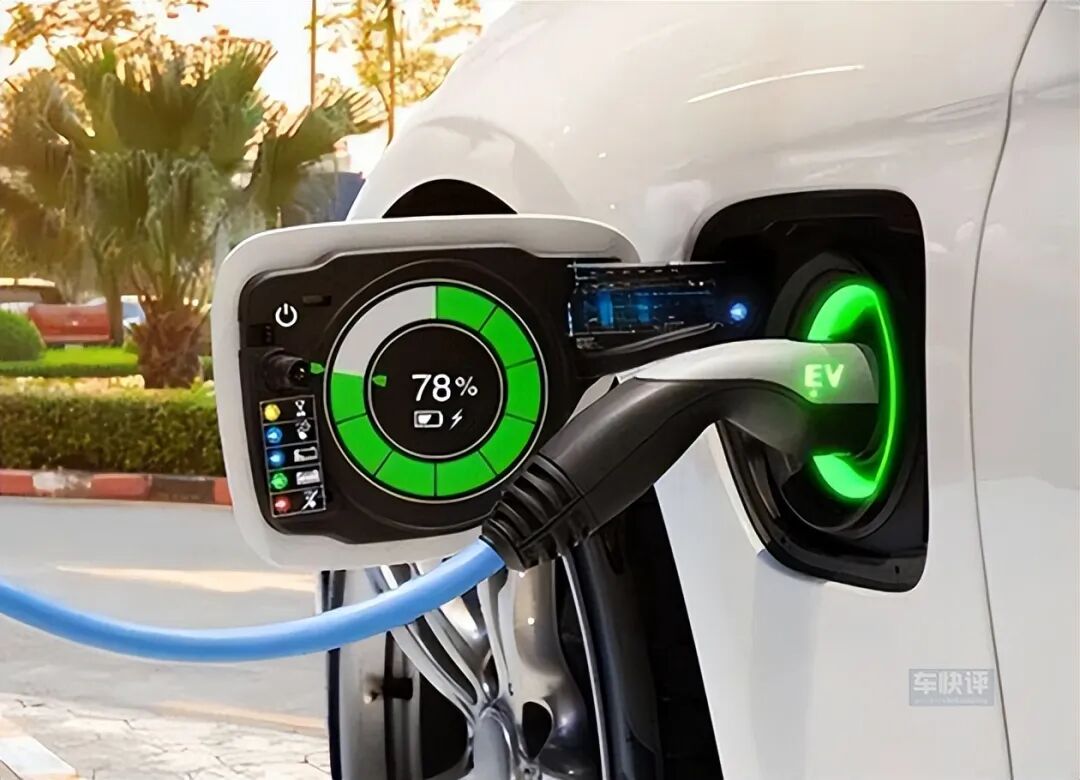
The popularity of Chinese-brand NEVs in the domestic market is thus self-evident, without the need for extensive examples or data. In today’s article, we will shift our focus to the global market performance of Chinese NEVs and compare them with industry giants like Toyota and Volkswagen.
First, let’s examine the global sales data for NEVs in August. The Tesla Model Y took the top spot with 93,545 units sold worldwide. Its long-standing dominance as the global best-seller in NEVs is largely attributed to strong sales in the three largest NEV markets: China, Europe, and North America. Ranking second is the Geely Xingyuan, with 52,058 units sold, including 39,651 units in the domestic market. With its upcoming launch in overseas markets, the Geely Xingyuan has a significant chance of vying for the global NEV sales crown.
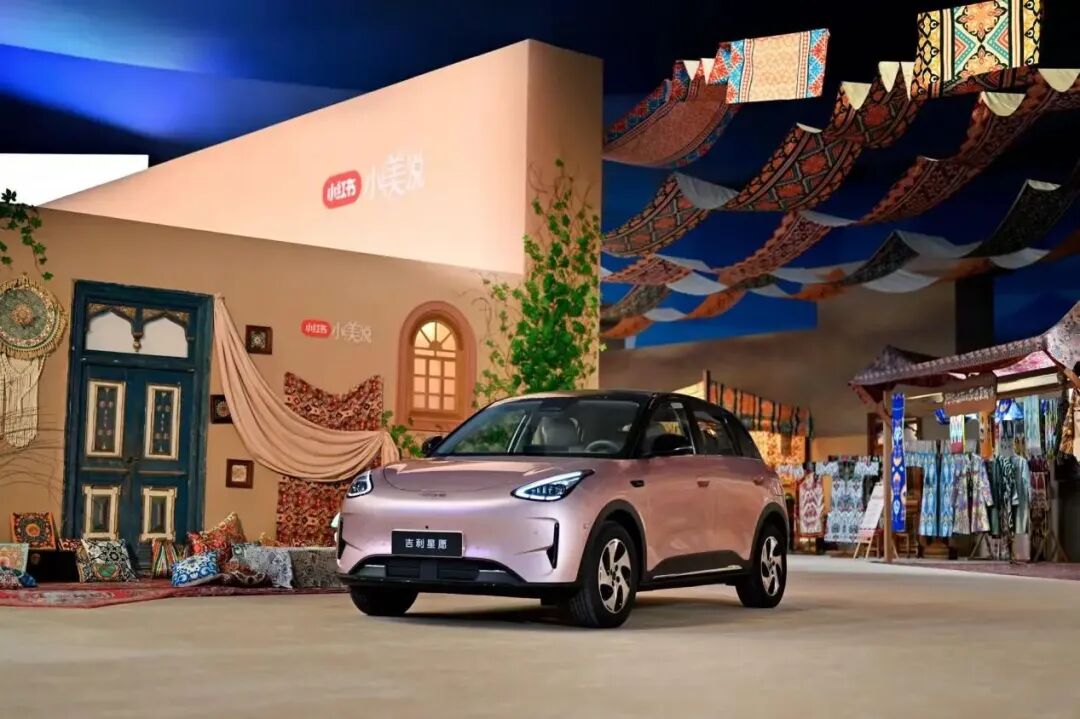
The third place goes to the BYD Song series, with a cumulative global sales volume of 48,944 units, encompassing both plug-in hybrid and pure electric models. The fourth-ranked model is the Tesla Model 3, with global sales of 46,917 units. The fifth-ranked BYD Yuan sold 34,857 units, followed by the BYD Seagull with 31,207 units, the Leapmotor A10 with 30,778 units, the BYD Dolphin with 28,388 units, the Fangchengbao Titan 7 with 23,884 units, and the MG MG4 with 19,459 units.
In other words, among the top 10 best-selling NEVs globally in August, Chinese auto brand models accounted for 8 spots, with 5 models belonging to BYD. Among the next 10 models ranked 11th to 20th, if the Wuling Binguo Pro is considered a Chinese auto brand model, then only the Toyota RAV4 Prime plug-in hybrid remains as a foreign auto brand, with the other 9 models being Chinese auto brands. Among them, BYD accounts for 4 spots, and both Xiaomi models, the SU7 and YU7, have also made the list.
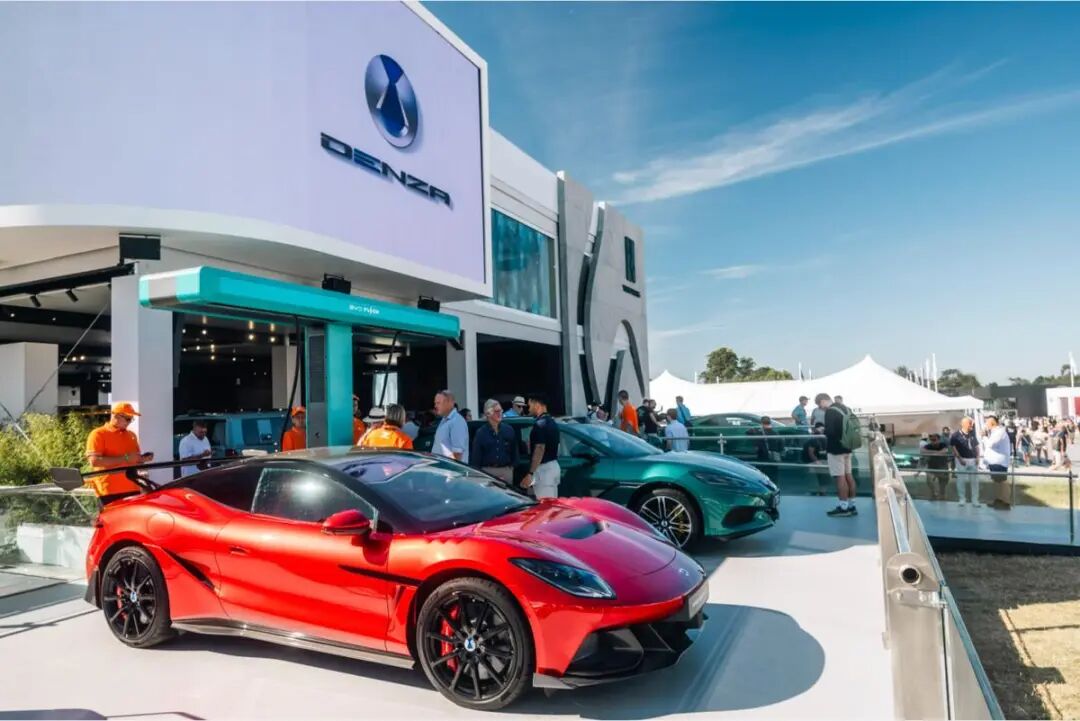
Now, let’s delve into the August global sales of NEVs by auto brand. BYD, ranking first, also holds a significant lead with sales of 375,000 units. Tesla ranks second with 142,000 units, followed by Leapmotor with 103,000 units and Geely Auto with over 100,000 units.
Only these four auto brands surpassed 100,000 units in global NEV sales in August. Apart from Tesla, the other three are all Chinese auto brands. It should be noted that the sales data for BYD and Geely do not include their subsidiary brands such as Denza, Fangchengbao, Zeekr, and Lynk & Co.
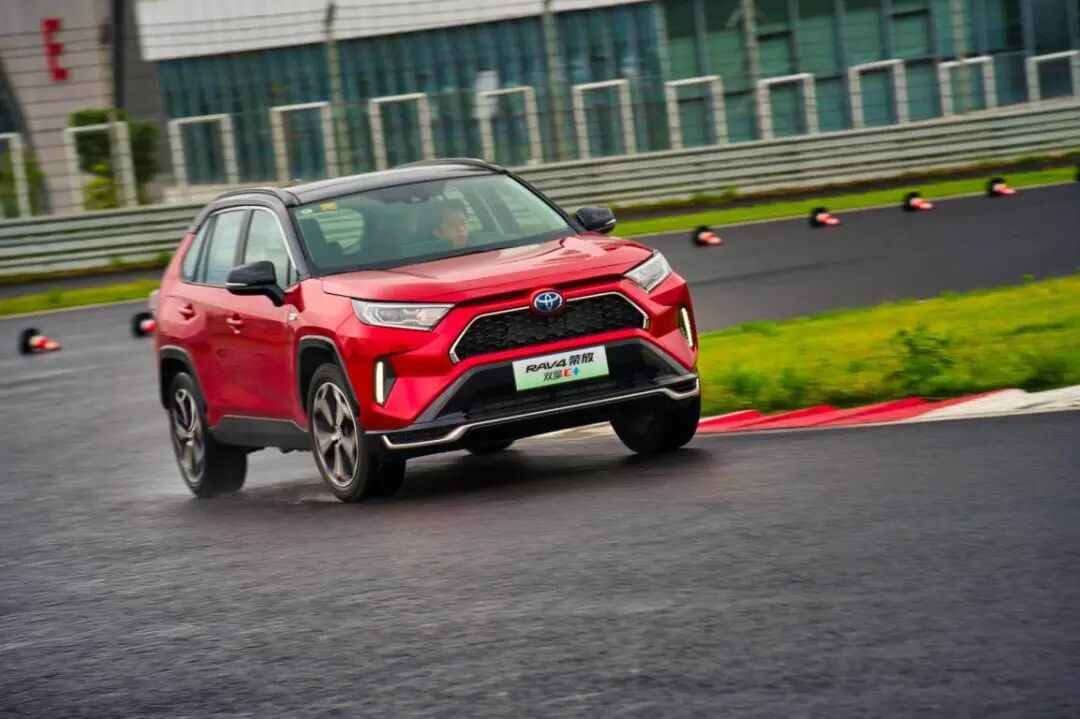
Toyota, the global best-selling automaker, sold only 52,576 NEVs globally in August, ranking fifth on the list. Don’t be misled into thinking Toyota’s sales are poor; Volkswagen sold only 36,650 units, ranking 13th on the list, far below the sales of NEV manufacturers like Li Auto, XPeng, and Zeekr. Surprisingly, Fangchengbao sold 41,568 NEVs globally in August, also ranking first among all NEV manufacturers.
Xiaomi Auto, with sales of 30,155 units, ranked 19th on the list. Although Xiaomi’s sales in the domestic market can already rival Tesla, the global gap remains significant. Specific sales data is provided below for those interested in further research.
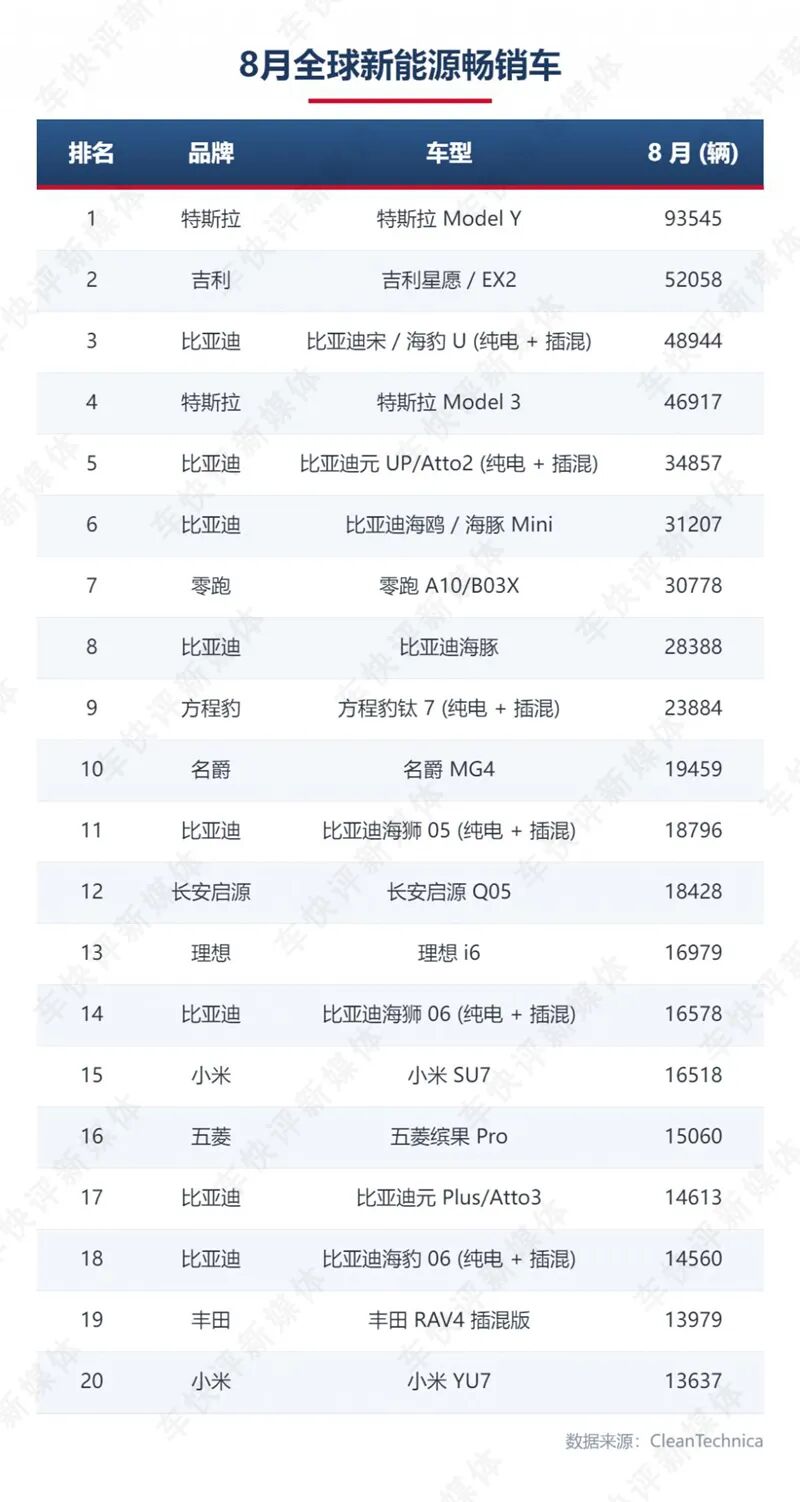
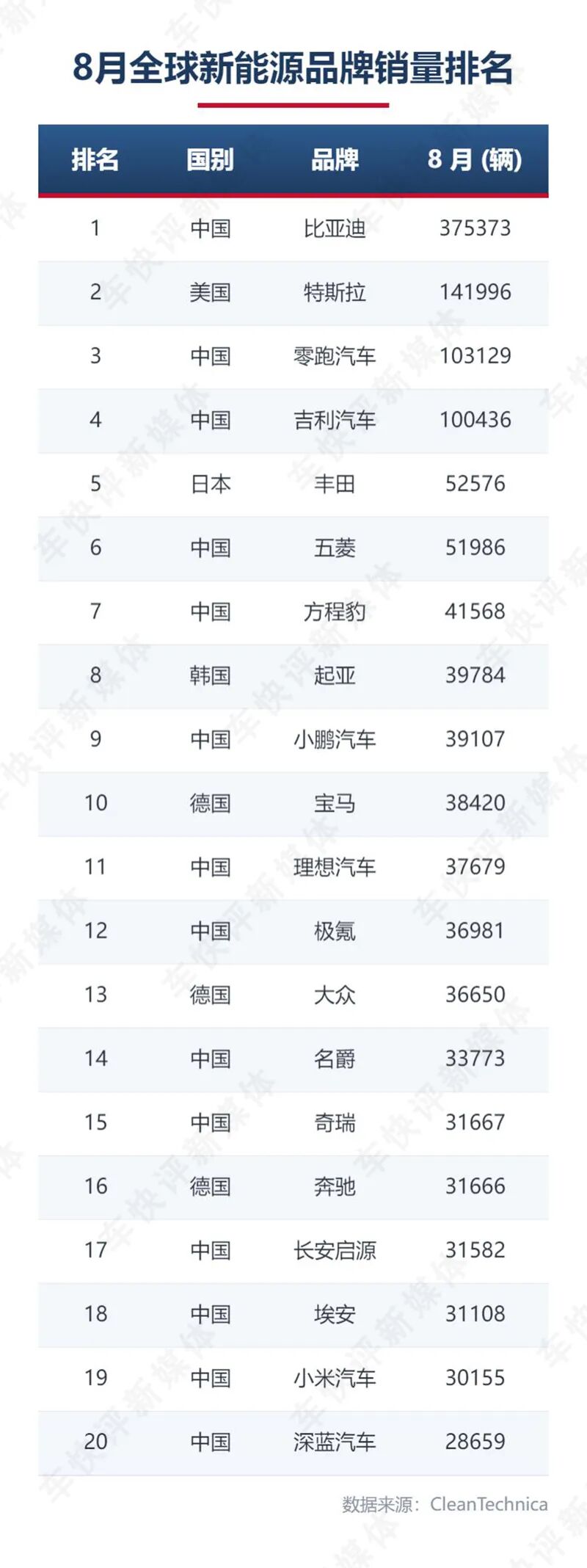
From the two ranking lists above, it is evident just how robust Chinese brands are in the global NEV market.
Copyright Notice: This article is original content from Che Kuaiping. Reproduction requires permission. Unauthorized reproduction and any form of plagiarism or misappropriation of text and images are strictly prohibited and will be subject to legal action. Some images in the article are sourced from the internet, with copyright belonging to the original authors. If your work is used, please contact us for royalties or deletion.
-
![]()
How 79-Year-Old Lao Gan Ma Founder Tao Huabi Leveraged AI to Achieve 5.4 Billion Yuan in Revenue
-
![]()
Breaking News! Doubao Faces a Collective 'Ban' from Tencent, Alibaba, and Others for Attempting Mobile Phone Manipulation
-
![]()
How Robust Are China’s New Energy Vehicles? A Look at Eight Months of Global Market Sales
-
Competition in Ecosystems: AI’s Next Frontier
-
![]()
The cost per vehicle is 73,000 yuan higher in Europe than in China; European markets can't stop Chinese cars by any means
-
![]()
Why Has Renault, Which Doesn't Sell Cars in China, Become the Biggest Winner in Europe?
-
![]()
ZTE: First-Half Net Profit Plummets Over 40%, Computing Business Grapples with Low-Margin Challenge
-
![]()
OPPO Could Be Manus's First Domestic Partner?