The Second Half of AI Short Dramas: A 40 Billion Yuan Feast with 98.7% in the Red
 10/16 2026
 532
532
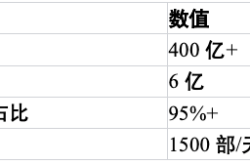
If 2025 was dubbed the "first year of AI short dramas," then 2026 marks the industry's first confrontation with commercial realities. On one hand, multi-source projections suggest a market size exceeding RMB 40 billion, over 600 million users, and 1,500 new releases daily. On the other, a mere 0.48% of content achieves 100 million+ views, while 98.7% of projects cannot recoup costs within six months of launch. Technology has flattened content production barriers but pushed most entrants into a war of attrition where majority are destined to lose. Understanding this industry hinges not on growth rates but on identifying where value truly accumulates.
01 Industry Overview: Five Years of Growth in One Year, Then a Collision with Overcapacity
The expansion of AI short dramas (including AI comic dramas and AI human-simulated short dramas) has few precedents in content industry history. According to China Research & Intelligence, the domestic market for AI-animated micro-dramas reached RMB 18.98 billion in 2025, surging 276.3% year-on-year. DataEye and Juyuan Engine estimated the 2025 AI comic drama market at RMB 16.8 billion. By May 2026 alone, DataEye's H1 2026 AI Drama & Comic Drama Report showed a RMB 22 billion domestic market, with full-year projections exceeding RMB 40 billion (+138% YoY)—though narrow definitions of "AI comic dramas" suggest RMB 24 billion. User-side, domestic AI short drama users surpassed 600 million in H1 2026, while AI comic drama users grew from 120 million in 2025 to 280 million in 2026. Overall, the micro-drama market (including AI content) is conservatively estimated to exceed RMB 120 billion in 2026.

The supply-side explosion is even more striking. China's Online Audio-Visual Association reported 128,000 micro-drama launches in Q1 2026, of which 122,000 (95%+) were AI-powered. Platforms released 367,000 micro-dramas in H1 2026. Douyin alone added 221,900 AI dramas/comic dramas, equating to one new title every 20 seconds at peak. Qichacha data shows 22,000 AI short drama-related firms in China by April 2026, with 5,465 new registrations in 2025—a decade high.
The supply surge stems from collapsing costs. ByteDance's Seedance 2.0 slashed commercial pricing to ~RMB 1/second in March 2026. By July, Seedance 2.5, Kling 3.0, MiniMax H3, and Alibaba's Wan 3.0 debuted with breakthroughs in multi-shot consistency, audio-visual sync, and character stability. Production costs plummeted: one-minute AI short drama quotes fell from ~RMB 5,000 in H2 2025 to hundreds of yuan today. Premium AI human-simulated dramas now cost
02 The Flip Side of Prosperity: 98.7% in the Red, Money Devoured by Traffic Costs
Yet cost reductions haven't boosted industry-wide profits. DataEye-ADX data shows just 1,055 of 221,900 new AI dramas/comic dramas on Douyin in H1 2026 surpassed 100 million views (0.48% hit rate). Using 50 million views as the breakeven threshold, only 1.3% of projects recouped costs within six months—meaning 98.7% of AI micro-dramas failed to break even. The industry's key profit metric, "revenue per 10,000 views," crashed from RMB 30–100 in H2 2025 to RMB 5–10 in 2026—a 90% drop.
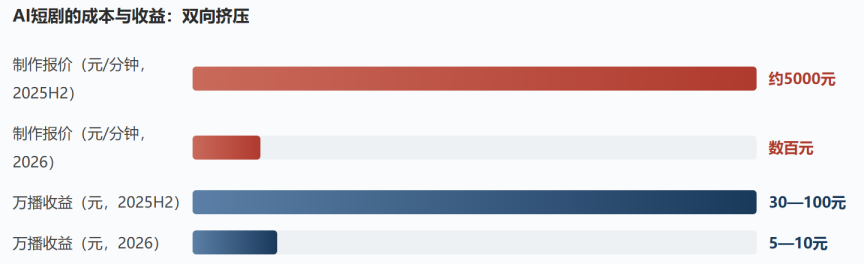
Source: DataEye-ADX (industry range, not exact statistics)
The crux lies in cost allocation: production accounts for a small fraction of total costs, with traffic acquisition consuming ~70%. While AI slashed production expenses, savings were eaten by soaring traffic and computing costs—daily industry-wide spending on drama promotion reached RMB 150–170 million in 2026, up >100% YoY. As Nanfang Plus noted: "Who controls traffic entry points controls distribution." Nearly 90% of early AI short drama profit-makers have exited the ordering market. Profits now flow decisively to two poles: upstream IP owners and downstream platforms, leaving midstream production as a value trough. Mango TV's Journey to the West II allocated just 20–25% of its RMB 900,000 per-episode budget to computing, with most costs going to writers, artists, directors, and post-production—AI replaces "execution," not "creativity."
03 Three-Tier Structure, Each with Existential Thresholds
Technology Tier: Domestic Models Dominate, Sora Exits
In March 2026, OpenAI terminated Sora's video business, ending its reign as an industry benchmark. Domestic models seized control: ByteDance's Seedance commands ~80% market share, followed by Kuaishou's Kling (~14%). Kling generated >RMB 850 million in Q2 2026 revenue (+200% YoY), surpassing 100 million global users with a post-investment valuation of RMB 122.8 billion. However, Kuaishou plans RMB 11 billion in 2026 spending on Kling computing power—model development remains capital-intensive. Model vendors now differentiate strategies: Jimeng raised prices to screen clients and target B-end API sales, Kling cut prices to retain P-end payers, while Vidu and Hailuo compete on cost (as low as cents per clip) for budget-conscious teams.
Content Tier: IP Reserves Become the Dividing Line
With model capabilities converging, "ammunition" matters more than "guns." China Literature leveraged 5.6 million digital content assets to launch >1,200 premium AI short dramas by June 2026. Palm Reading's short drama revenue hit RMB 1.185 billion in H1 2026 (+41.45% YoY). China Reading Group partnered with Art Picture to launch the industry's first officially licensed AI animation based on a web novel IP. Among traditional studios, Mango Supermedia established an AIGC Innovation Center, with its AI long-form drama Journey to the West II topping Hunan TV's prime-time ratings on August 31. Bona Film Group's AI theatrical film Sanxingdui: Tales of the Future, the first Chinese AI film to receive National Film Bureau approval, is set for October 23. Huace Pictures, H&R Century, Jiecheng Media, and Decai Group are also staking claims.
Platform Tier: Hongguo Leads, Kuaishou Grows Fastest, Global Top Five Battle
Domestically, ByteDance's Hongguo leads with ~245 million MAUs, offering up to RMB 1 million in guarantees per premium comic drama. Kuaishou ranks second with 18.6 billion views (~24.6% share) and the fastest growth (AI comic drama daily revenue up 900% vs. Q4 2024). Baidu secured ~14.8% share by licensing 100,000+ web novel IPs for adaptation. iQIYI raised exclusive profit-sharing for comic dramas to 100%.
Global expansion is another front. MPA reports the non-Chinese micro-drama market will reach $3.6 billion in 2026 and $9.5 billion by 2031, with AI dramas/comic dramas accounting for ~$4 billion. The global landscape features five leaders: ReelShort (49%-owned by China Literature) leads with ~29% share, projected to earn $1.05 billion in 2026 (+34% YoY) with Large scale profitability (scalable profitability). DramaBox (Dianzhong Tech) holds ~21%, DramaWave (Kunlun Wanwei) ~13%, NetShort ~10%, and GoodShort ~6%. Regional dynamics show "developed markets driving revenue, emerging markets driving downloads": North America contributes ~37% of revenue, while Southeast Asia, Latin America, and the Middle East dominate downloads.
04 Four Clear Directions
First, from comic dramas to human simulations. AI human-simulated short dramas surged from 7% of comic drama top 100 lists in 2025 to >60% in H1 2026, with visual quality, lip-sync, and character consistency crossing user tolerance thresholds—eliminating the "AI stigma."
Second, from volume to premium. Mass-production models have peaked, with scarcity of hits forcing a shift from "speed/volume" to "creativity/IP." Hongguo recently culled >10,000 low-quality AI dramas, signaling clear platform priorities.
Third, from dubbed exports to industrialized globalization. Locally produced overseas dramas rose from 27% to 46% of market share, while dubbed content fell from 73% to 54%. Local dramas achieve 8–10% Paid conversion rate (paid conversion rates), well above dubbed content. ReelShort's partnerships with Indonesia's Vidio, Thailand's Charoen Pokphand, and the Philippines' Globe mark China's shift from "content sales" to "ecosystem building."
Fourth, regulatory standardization accelerates shakeouts. The Micro-Drama Development Management Measures, effective September 1, 2026—China's first dedicated micro-drama regulation—introduces a dual-dimensional, three-tier classification system based on "investment scale + theme." AI-generated content must be labeled episode-by-episode, while addictive algorithms are banned. Combined with April's mandatory AI comic drama filing rules, compliance thresholds rise systematically, accelerating the exit of low-end producers. Meanwhile, AI content is expanding into long-form dramas, theatrical films, and interactive games. Sanxingdui: Tales of the Future's box office performance will test AI cinema's transition from "platform revenue-sharing" to "theatrical distribution."
05 Certainty Lies at "Both Ends," Flexibility in "Globalization"
The industry has shifted from "technology-driven capacity expansion" to "structural competition in premium content and globalization." Along the value chain, investment certainty ranks as follows:
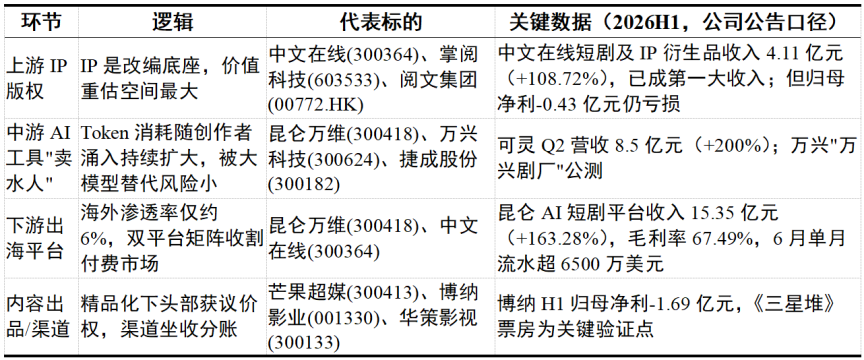
A sobering reality: most concept stocks remain "revenue-growing but profit-shrinking." China Literature, Bona Film Group, and H&R Century posted net losses in H1 2026. Kunlun Wanwei's RMB 1.088 billion H1 net profit included ~RMB 1.479 billion in non-recurring gains from subsidiary dilution; its adjusted RMB 434 million profit reflects a 62.32% sales expense ratio, indicating heavy spending on user acquisition. China Literature's October 8 announcement to terminate its Hong Kong IPO and RMB 2.833 billion A-share private placement plan triggered a 12.75% stock price drop—a reminder that even leading players face unmet fundamentals. Since mid-October, AI comic drama concepts have fluctuated (China Literature and Mango Supermedia hit daily limits on October 9, with a sector-wide rally on October 12), but AI film/drama stocks remain down ~15% YTD. The rally stems more from "oversold + event-driven" catalysts than trend reversal.
Epilogue: AI short dramas represent a genuine efficiency revolution—costs slashed by 90%, production cycles compressed from months to weeks. But efficiency ≠ commercial success. When "production" becomes commonplace, industry profits shift to IP owners and distribution channels. Only companies with Authentic Story Library (licensed story libraries) and control over distribution/global platforms can claim a share of this RMB 40 billion feast. The 98.7% loss rate is its most honest footprint. The second half belongs not to the fastest runners but to the steadiest standers.
- END -
-
Why is Meta’s Muse, an AI ‘Not the Smartest,’ Taking the World by Storm?
-
The Next Battleground Isn't Computing Power, It's Security: Jensen Huang's New AI Gamble
-
![]()
Sichuan Airlines Seeks to Offload 6 Aircraft in One Fell Swoop: What's Behind the Move?
-
![]()
New Wave of Major Industry Consolidation: VW Sets Sights on Toyota, Anhui Focuses on Chery and JAC
-
![]()
The Second Half of AI Short Dramas: A 40 Billion Yuan Feast with 98.7% in the Red
-
![]()
Breaking News! Three Departments Initiate Joint Probe into Zunjie, Unveiling 4 "Potential Scenarios" and 2 "Regulatory Measures"
-
![]()
Amidst the Frenzied Competition in New Energy Vehicles, 4S Dealerships Face Sudden 'Collapse'
-
![]()
We Shouldn't Invest in More 'Tian Keyu' Clones