Sichuan Airlines Seeks to Offload 6 Aircraft in One Fell Swoop: What's Behind the Move?
 10/16 2026
 444
444
Source: Shenlan Finance
A recent announcement has suddenly thrust Sichuan Airlines into the limelight.
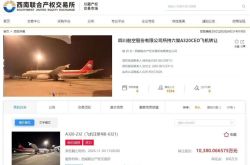
Sichuan Airlines has recently placed six Airbus A320CEO aircraft up for public transfer on the Southwest United Property Rights Exchange.
This has sparked considerable interest among netizens: Is Sichuan Airlines also facing a cash crunch?
1. 'Veterans' Approaching 20 Years of Service, with a Combined Reserve Price of RMB 613 Million
Let's not jump to hasty conclusions.
First, let's take a closer look at these six aircraft. They are not new arrivals but rather a fleet of 'veterans' nearing the end of their operational lifespan.
The announcement reveals that these six aircraft, bearing registration numbers B-6321, B-6322, B-6323, B-6325, B-6347, and B-6348, are all A320-232 models fitted with V2500 engines. Manufactured between 2007 and 2008, they boast an average age of 18-19 years.
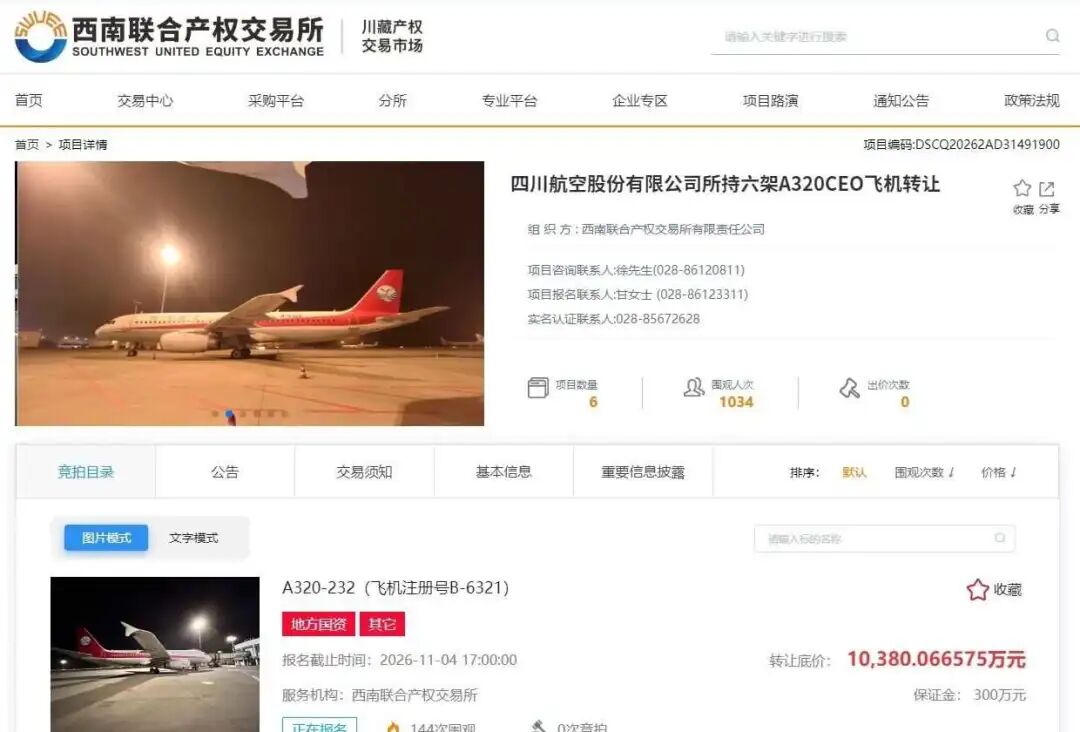
The value of second-hand aircraft hinges not solely on their age but also on factors such as engine life, maintenance history, and inspection status. Consequently, the reserve price for each of these six aircraft ranges from RMB 91.85 million to RMB 114.6 million, summing up to a total of RMB 613 million.
Despite their advanced age, these aircraft boast relatively unencumbered property rights. All are being transferred in their current physical state, free from any third-party claims such as pledges, guarantees, or leases.
The news of Sichuan Airlines listing these six aircraft for sale came as no surprise to industry insiders.
As early as December 2025, Sichuan Airlines announced on its official procurement and bidding platform the 'Asset Evaluation Project for the Sale of Aging A320CEO Aircraft (Second Time),' explicitly stating its intention to assess the market value of six A320CEO series aircraft and three spare engines in anticipation of subsequent sales. Based on the information available at the time, these six aircraft are the ones currently up for sale.
The disposal of aging aircraft is a common practice within the aviation industry. Generally, the operational lifespan of common aircraft models spans 25-30 years. The Civil Aviation Administration of China defines civil aircraft that have been in service for over 14 years as aging.
As aircraft age, they experience increased fuel consumption, higher failure rates, and soaring maintenance costs, significantly diminishing the economic feasibility of continued operation.
The A320CEO, once the mainstay narrow-body aircraft of the previous generation, was the backbone of Sichuan Airlines' fleet. However, with the widespread adoption of the new-generation A320NEO series, its fuel efficiency, maintenance costs, and environmental performance have become markedly inferior.
The primary impetus behind Sichuan Airlines' decision to dispose of these aircraft en masse lies in their advanced age and dwindling economic viability.
2. Fleet Aging and Cash Flow Concerns Drive Sichuan Airlines to 'Upgrade Its Fleet'
Focusing on Sichuan Airlines, there are multiple factors driving the disposal of old aircraft.
Firstly, the issue of fleet aging is becoming increasingly pronounced.
Sichuan Airlines is renowned in China and globally as an all-Airbus fleet airline and ranks as the world's second-largest 'all-Airbus' operator.
As of the end of 2025, Sichuan Airlines boasts a fleet of 214 all-Airbus aircraft, with the A320 series serving as the mainstay. This includes 55 A320CEOs, 39 A320NEOs, 50 A321CEOs, and 28 A321NEOs.
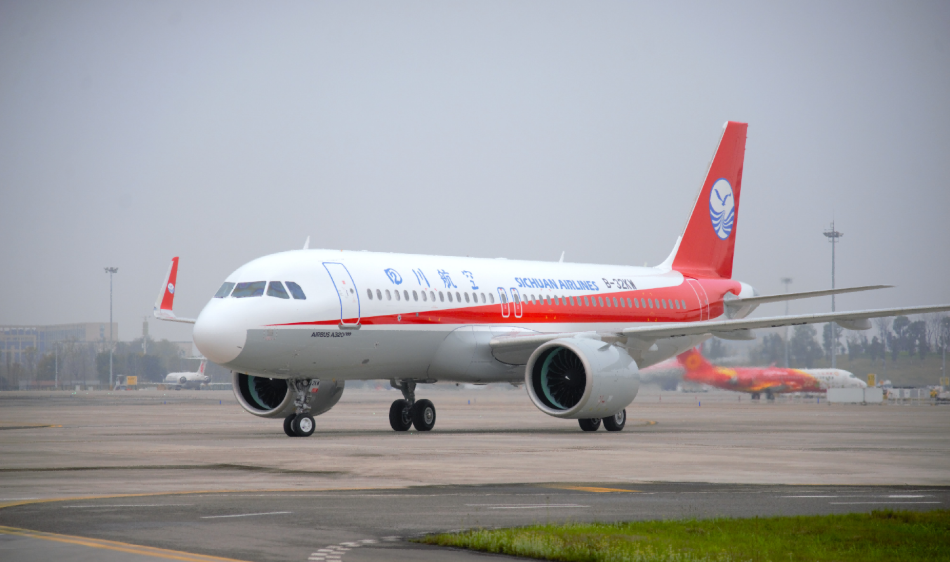
Behind this expansive fleet, the issue of aging is beginning to rear its head.
Among its A320/A321CEO fleet, over 14 aircraft are over 15 years old.
The aircraft that Sichuan Airlines rapidly expanded and introduced between 2005 and 2007 are now entering their twilight years. For Sichuan Airlines, the fleet is undergoing a period of renewal.
Since last year, Sichuan Airlines' A319s have begun to retire one after another. This year, A320CEOs have also started to be phased out of operations, with more retirements likely in the future.
Only by disposing of aging aircraft can Sichuan Airlines create space and secure funds to replace them with new ones. This financial consideration also underpins Sichuan Airlines' concentrated disposal of old aircraft: to recoup funds.
While the reserve price for each aircraft may not seem exorbitant, hovering around RMB 100 million, they still hold significant value for Sichuan Airlines.
In the public's perception, airlines typically generate revenues in the hundreds of billions or even trillions and are assumed to be highly profitable. However, despite high revenues, few airlines are actually profitable. Among the seven major listed airlines in China, the three major state-owned airlines with the most flights are perennially unprofitable, while profitable ones are usually private airlines like Spring Airlines. In the first half of this year, China Eastern Airlines incurred a loss of RMB 2.179 billion, Air China RMB 2.286 billion, and China Southern Airlines RMB 3.696 billion.
Sichuan Airlines is a subsidiary of China Southern Airlines. According to China Southern Airlines' interim report, Sichuan Airlines generated revenue exceeding RMB 17.7 billion in the first half of the year but incurred a net loss of RMB 1.889 billion, with negative net assets.
Although RMB 600 million may pale in comparison to Sichuan Airlines' hundreds of billions in half-year revenue, selling the aircraft would still result in substantial cash recoupment. If the aircraft remain in service, significant expenses will continue to be incurred for maintenance and overhauls.
By listing these old aircraft for sale, Sichuan Airlines can not only recoup cash and alleviate burdens but also free up space and funds to purchase new aircraft, fostering fleet renewal. This approach yields multiple benefits.
3. Where Do the Sold Aircraft Ultimately End Up?
Some may also be curious about the potential buyers of these old aircraft from airlines.
Despite their advanced age, these aircraft still possess considerable value.
Typically, these old aircraft from airlines have three possible fates:
1. They are acquired by overseas low-cost airlines for continued operation;
2. They are refurbished and converted into cargo aircraft;
3. They are dismantled and sold for their engines and aviation materials.
Many retired aircraft from airlines can be refurbished into cargo aircraft. It is reported that currently, three-quarters of the world's cargo aircraft are converted from retired passenger aircraft, with an average age exceeding 20 years. Express companies in China, such as China Post, YTO Express, and SF Express, primarily rely on retired passenger aircraft converted into cargo aircraft.
From an industry perspective, dismantling old aircraft into components may yield higher value than selling them as a whole.
A passenger aircraft comprises tens of thousands of components, not all of which age simultaneously. Many components can be dismantled and sold separately.
For instance, engines, landing gear, and core avionics equipment boast the longest lifespans and highest values, serving as 'hard currency' in the aviation market with constant demand from numerous small and medium-sized airlines and maintenance enterprises. The composite materials of the fuselage are high-value industrial materials with high recycling rates. Even interior components such as cabin seats, galley equipment, windows, and control panels can be refurbished and directly reused.
4. Conclusion
Sichuan Airlines' decision to list six A320CEO aircraft for sale may initially appear to be a straightforward asset disposal. However, it reflects a comprehensive strategy encompassing airline fleet cycles, cost pressures, and cash flow management. With an age nearing 20 years and diminishing economic viability of continued operation, the sale cannot be simply reduced to a 'cash shortage' but rather represents a strategic 'fleet upgrade.'
For Sichuan Airlines, selling old aircraft not only recoups cash and reduces maintenance burdens but also creates space for introducing new-generation aircraft like the A320NEO.
Old aircraft will inevitably retire. What truly determines Sichuan Airlines' future is not how much money can be made from selling these 'veterans' but whether it can successfully complete fleet renewal, repair its balance sheet, and enter the new round of civil aviation competition with a lighter load.
*Disclaimer: The views expressed in this article are solely those of the author. The market involves risks, and investment decisions should be made with caution. Under no circumstances shall the information or opinions expressed in this article constitute investment advice to any individual.
The Shenlan Finance new media cluster, originating from the Shenlan Finance Journalist Community, boasts a 16-year history and is a well-known financial new media outlet in China. Its accounts focus on China's most valuable companies, cutting-edge industry developments, and emerging regional economies, providing valuable content for investors, corporate executives, and the middle class. We welcome your attention.
-
![]()
Three Departments Launch Joint Probe into Zunjie Brake Issue; Yu Chengdong: Justice Will Prevail
-
Why is Meta’s Muse, an AI ‘Not the Smartest,’ Taking the World by Storm?
-
The Next Battleground Isn't Computing Power, It's Security: Jensen Huang's New AI Gamble
-
![]()
Sichuan Airlines Seeks to Offload 6 Aircraft in One Fell Swoop: What's Behind the Move?
-
![]()
New Wave of Major Industry Consolidation: VW Sets Sights on Toyota, Anhui Focuses on Chery and JAC
-
![]()
The Second Half of AI Short Dramas: A 40 Billion Yuan Feast with 98.7% in the Red
-
![]()
Breaking News! Three Departments Initiate Joint Probe into Zunjie, Unveiling 4 "Potential Scenarios" and 2 "Regulatory Measures"
-
![]()
Amidst the Frenzied Competition in New Energy Vehicles, 4S Dealerships Face Sudden 'Collapse'