Breaking News! Three Departments Initiate Joint Probe into Zunjie, Unveiling 4 "Potential Scenarios" and 2 "Regulatory Measures"
 10/16 2026
 370
370
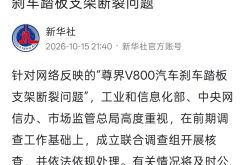
The widely publicized issue concerning the brake pedal fracture in the Zunjie V800 has finally prompted intervention from regulators at the national level. On the evening of October 15, the Ministry of Industry and Information Technology (MIIT), the Cyberspace Administration of China, and the State Administration for Market Regulation jointly declared the establishment of an investigation team to tackle the brake pedal bracket fracture problem in the Zunjie V800. Based on preliminary investigations, the team will carry out a lawful review, with the findings to be announced at a later date.
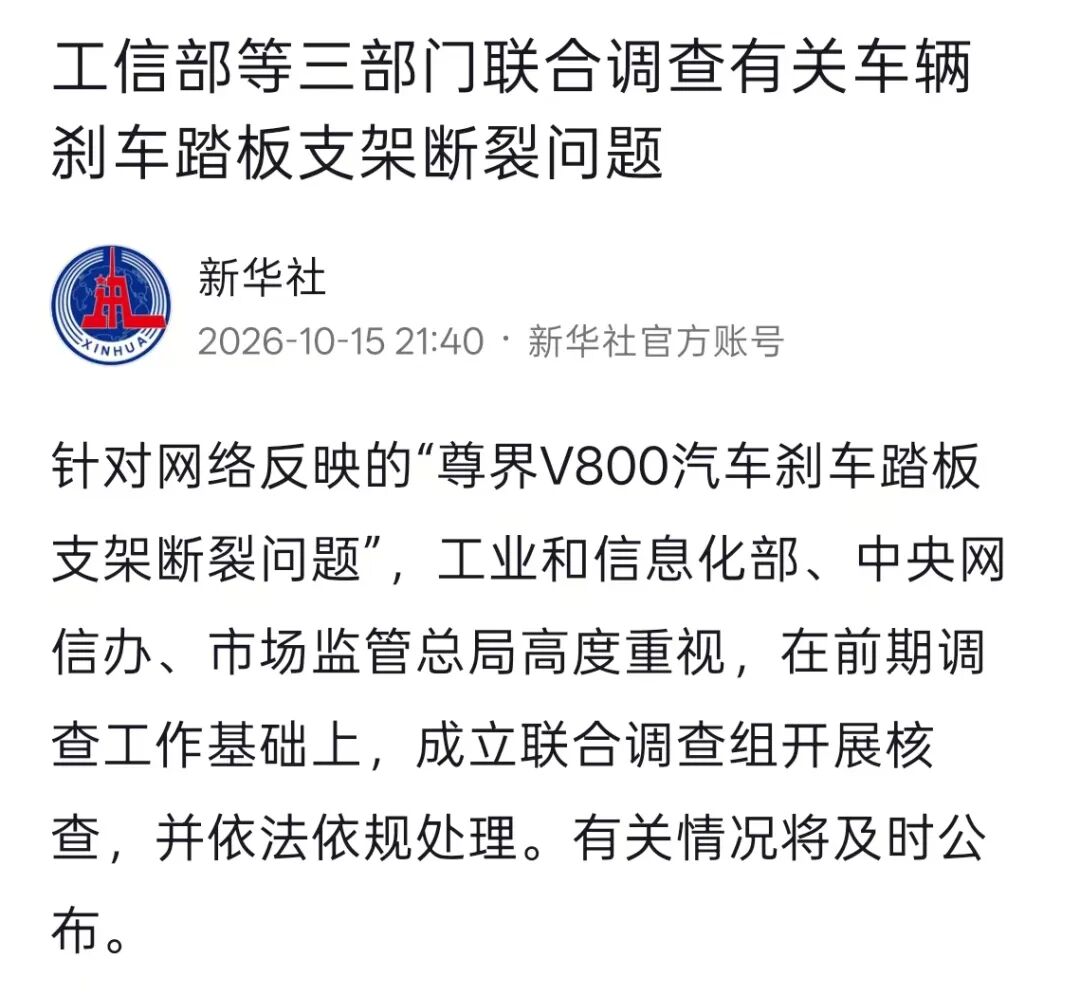 Image source: Douyin
Following this announcement, Zunjie Auto promptly issued a statement: On October 15, the MIIT and two other departments released a joint investigation notice. We are proactively responding and fully complying, pledging our utmost cooperation with the investigation team's efforts. We are dedicated to protecting consumer rights and maintaining the overall stability of the new energy vehicle (NEV) industry.
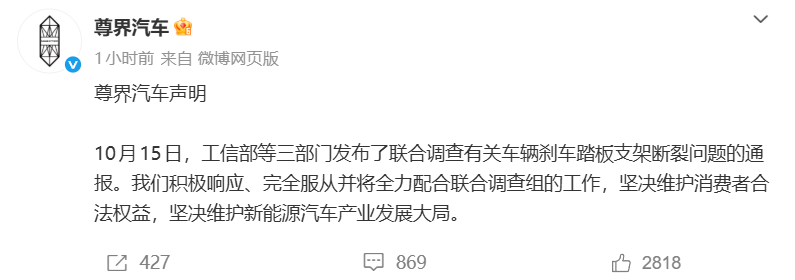 Image source: Weibo
After prolonged online debates and clashes between opposing groups, the public opinion drama has temporarily subsided. The incident has shifted from a self-media-fueled online controversy to an official technical verification process. From the perspective of Dachang Finance and Economics Society, the joint investigation is likely to conclude with one of the following four scenarios.
Four Potential Investigation Scenarios
1. Widespread safety defects identified in mass-produced vehicles.
If the investigation team uncovers concrete evidence indicating that the brake pedal brackets in all mass-produced Zunjie V800 models are inherently flawed and do not meet safety standards, a large-scale recall will be mandated under automotive recall regulations. In severe cases, regulators may halt production and sales until all necessary rectifications are completed. This scenario is currently the most closely monitored by the market.
2. Issues limited to specific production batches.
If the pedal fracture is attributed not to design flaws but to lapses in raw material quality, component casting processes, or assembly line errors in a particular batch, a broad recall will be avoided. Regulators will utilize Vehicle Identification Numbers (VINs) to identify affected vehicles and mandate part replacements for those specific batches only. Automakers must also investigate gaps in supply chain quality control and production line inspections, submitting comprehensive rectification plans.
3. Irregularities found in third-party testing methods.
If the investigation team determines that the loading methods used in the DCD test imposed artificially extreme loads far exceeding real-world usage scenarios, the test's credibility will be reassessed. However, a critical point remains: even if testing methods are flawed, it does not automatically absolve the vehicle of safety concerns. The investigation team will independently evaluate whether the pedal's safety margins are adequate, ensuring the issue is not dismissed outright.
4. Dual issues in testing methods and vehicle design.
Both scenarios could coexist. On one hand, the testing protocol or loading standards may be controversial and fail to meet standardized detection requirements. On the other, the vehicle's pedal bracket design may lack sufficient safety margins, making it prone to failure under extreme forces. If this conclusion is reached, separate actions will be taken: regulating third-party testing operations while requiring automakers to redesign the pedal structure for enhanced safety.
Frankly, the greatest significance of this tri-departmental joint investigation lies in providing concrete technical evidence to put an end to the endless online debates. Previously, conflicts over automotive evaluations often devolved into automakers and testing agencies trading accusations while netizens took sides, lacking a neutral authority to settle disputes. This time, the investigation team, overseeing industrial regulation, online content, and market quality enforcement, ensures the final report serves as the definitive answer.
Two Long-Term Industry Regulatory Reforms
While short-term attention focuses on the Zunjie V800 safety dispute, the incident may prompt the implementation of two new industry rules, reshaping domestic automotive evaluation and new vehicle R&D acceptance practices.
Regulation 1: Standardizing civilian automotive evaluations with licensing and unified protocols
The domestic automotive self-media evaluation landscape has long been chaotic. Testing protocols are arbitrarily determined by media outlets, with no unified standards for loading, environmental conditions, or vehicle sampling. Many evaluations chase traffic by designing extreme scenarios, selectively editing trial processes, and withholding raw data for reproducibility. Some testing agencies even conceal commercial collaborations with automakers, raising suspicions of biased conclusions.
Industry reforms may introduce accreditation thresholds for evaluators, explore a licensing system, and establish unified testing protocols with post-evaluation audits. Key requirements could include: using normally marketed vehicles (not custom-built models) for testing; clearly labeling test boundaries against national/industry standards for safety limit tests; prominently disclosing commercial ties between evaluators and automakers; and mandating full video documentation and reproducible raw data for critical safety tests.
In short: automotive evaluations will no longer be a free-for-all. Qualifications, protocols, and raw evidence will matter more than traffic. Objectivity must take precedence over sensationalism.
Regulation 2: Tightening controls on "rushed-to-market vehicles" and upgrading acceptance standards for vehicles and key components
As new energy vehicle (NEV) iteration cycles accelerate, some automakers drastically shorten R&D validation phases, skimping on bench durability and real-world reliability tests. These "rushed-to-market vehicles" treat public roads as free testing grounds, a practice common in the industry. The pedal fracture incident has exposed vulnerabilities in validating critical structural components.
Regulators will raise pre-market validation thresholds, demanding robust safety margins beyond mere compliance with national standards for mass production. Stricter standards will apply to material mechanics, extreme load durability, and multi-scenario failure tests for safety-critical parts like brake pedals, chassis, and body structures. Automakers must also strengthen supplier accreditation, incoming material inspections, production consistency controls, and complete component traceability systems.
The underlying logic is clear: components must pass not only normal driving conditions but also extreme-scenario risk resistance. New vehicle R&D validation cannot cut corners; sufficient testing mileage must be completed before mass delivery, and market launch timelines cannot justify shortened validation cycles. This will force automakers to balance innovation speed with safety fundamentals, safeguarding the NEV industry's quality foundation.
Conclusion
The Zunjie V800 incident, while seemingly a single vehicle's safety dispute, marks a pivotal moment in the maturation of China's NEV sector. The investigation team's final conclusions will not only determine the vehicle's fate but also reshape rules governing automotive evaluation and vehicle R&D validation.
Dachang Finance and Economics Society will closely monitor the official investigation report and analyze its industrial implications as details emerge. Thank you for your continued attention!
Interactive Topic: Which investigation scenario do you believe is most likely? Can standardizing the evaluation industry eliminate the "traffic-first" chaos? Share your thoughts in the comments!
Disclaimer: This article represents commentary by Dachang Finance and Economics Society and does not constitute investment advice. All corporate data and regulatory events cited are from publicly available sources and are for reference only; official announcements shall prevail. Images sourced from the internet; please contact us for copyright removal if needed.
-
Why is Meta’s Muse, an AI ‘Not the Smartest,’ Taking the World by Storm?
-
The Next Battleground Isn't Computing Power, It's Security: Jensen Huang's New AI Gamble
-
![]()
Sichuan Airlines Seeks to Offload 6 Aircraft in One Fell Swoop: What's Behind the Move?
-
![]()
New Wave of Major Industry Consolidation: VW Sets Sights on Toyota, Anhui Focuses on Chery and JAC
-
![]()
The Second Half of AI Short Dramas: A 40 Billion Yuan Feast with 98.7% in the Red
-
![]()
Breaking News! Three Departments Initiate Joint Probe into Zunjie, Unveiling 4 "Potential Scenarios" and 2 "Regulatory Measures"
-
![]()
Amidst the Frenzied Competition in New Energy Vehicles, 4S Dealerships Face Sudden 'Collapse'
-
![]()
We Shouldn't Invest in More 'Tian Keyu' Clones