Is the Claim ‘US AI Enhances Productivity, Chinese AI Focuses on Entertainment’ Misleading?
 10/19 2026
 503
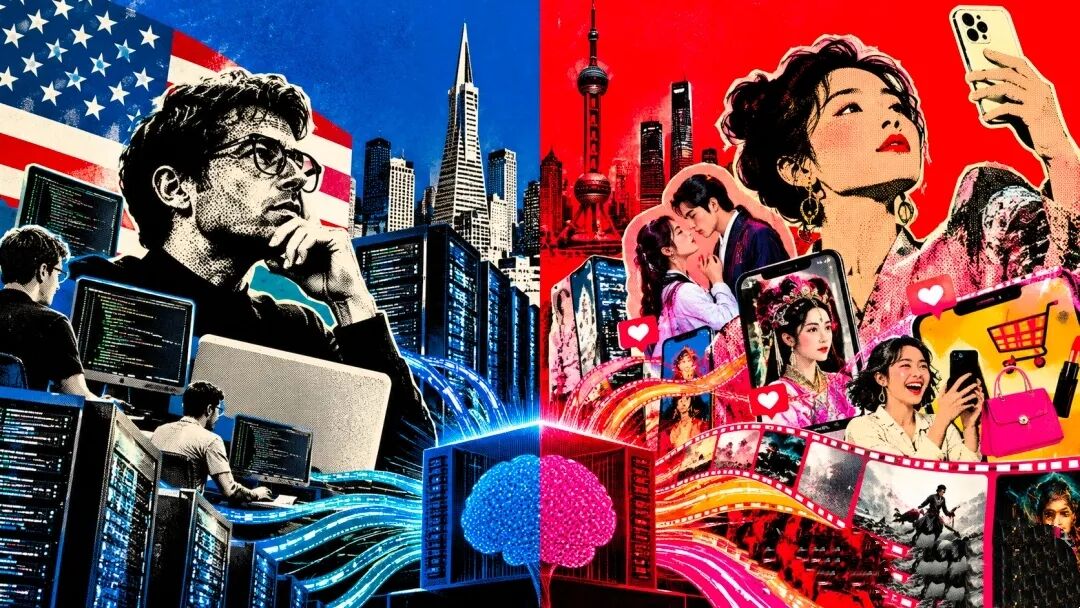
The assertion that '55% of China's AI computing power is dedicated to short dramas, while 58% of the US's AI computing power is allocated to coding' is merely a straw man fallacy. Although it may evoke strong emotions, it is, more likely than not, a false premise.

By She Zongming
'The US Utilizes AI to Enhance Productivity, China Deploys AI for Entertainment'
This statement has gained significant traction in recent times.
The rationale behind this is that COL Digital Publishing Group revealed in its recently published 'Investor Relations Activity Record' that, within the domestic token consumption landscape, short videos and AI-generated short drama scenarios constitute a staggering 55%, e-commerce advertising content generation accounts for 24%, whereas core productivity scenarios such as technological R&D, code development, and model iteration merely represent 15%.
In essence, the token consumption for AI short dramas and video generation has surpassed that of software development by more than double, emerging as the largest core consumption scenario in China's token economy.
Conversely, it is reported that in the United States, approximately 58% of tokens are directed towards code generation and enterprise automation.
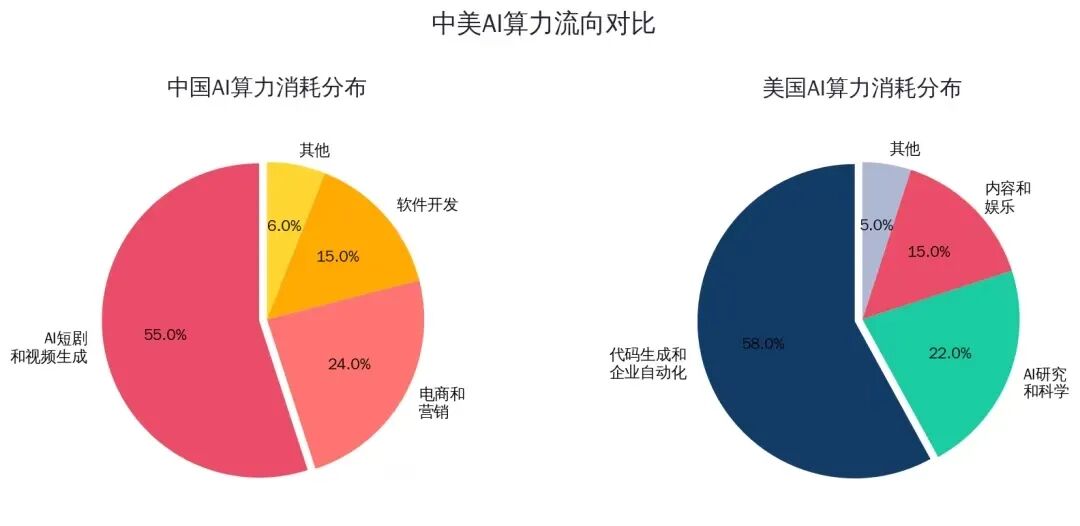
▲This image, titled 'Comparison of AI Computing Power Flows Between China and the US,' has been widely disseminated.
Comparison is the thief of joy. Once the comparison chart of Sino-US token consumption structures emerged, its impact was akin to 'the US AI pioneer Altman versus the Chinese AI trailblazer Li Yizhou'.
Consequently, public opinion erupted. Many individuals remarked: This is tantamount to the West harnessing gunpowder for firearms, while China employs it for fireworks.
Some even expressed profound concern: If computing power is predominantly expended on short dramas, how can China prevail in the Sino-US technology race?
This reminds me of a passage by Mr. Le Bon: What shapes the imagination of the masses is not the facts themselves, but the manner in which they are presented and capture attention. If I were to voice my opinion, I would assert that they must be condensed and processed to create a striking and astonishing image. Those who master the art of influencing the imagination of the masses also command the art of governing them.
Is there a substantial gap in AI between China and the US? Indeed, there exists a notable disparity.
However, if one insists on exaggerating the dichotomy of 'the US employs AI to enhance productivity, while China utilizes AI for entertainment,' I can only dismiss it as laughable.
I am not suggesting that this comparison is entirely devoid of meaning. I am merely emphasizing the importance of clarifying the facts before becoming indignant.
01 /
Firstly, let us establish three premises:
1. The claim that '55% of China's tokens are utilized for short dramas, while 58% of the US's tokens are allocated to coding' lacks an authoritative source and has not undergone rigorous verification.
The former originates from COL Digital Publishing Group. Considering its heavy investment in AI short dramas, you can assess its credibility for yourself; the latter lacks such a 'theory.' Neither a16z, McKinsey, nor Gartner has made this claim. In any case, it does not constitute rigorous industry research data.
2. Token usage and computing power usage are distinct concepts. Stating that 'the majority of China's AI computing power is dedicated to short dramas, while the majority of the US's AI computing power is allocated to coding' is hardly scientific.
Tokens represent the billing unit for large model calls, whereas computing power denotes the computational capability of GPU hardware per unit time. The computing power consumption corresponding to a single token varies across different tasks.
3. The proportion of tokens used for code generation on US API platforms is indeed high, but a significant portion of this is contributed by Chinese programmers. To my knowledge, many programmers at domestic tech giants utilize Claude for coding. These are still recorded in the US token consumption ledger.
Therefore, employing the attention-grabbing '15%:58%' to assess the coding investment intensity of Chinese and Americans may be overly simplistic, overlooking the statistical dislocation that arises from cross-border usage.
What I am attempting to convey is that the proposition that '55% of China's AI computing power is dedicated to short dramas, while 58% of the US's AI computing power is allocated to coding' may merely be a straw man fallacy. Although it may evoke strong emotions, it is, more likely than not, a false premise.

▲Numerous bloggers have followed up and commented on this topic.
Some may argue: Setting aside the facts, isn't the phenomenon of a substantial portion of tokens in China being used to create mindless short dramas cause for concern?
Certainly, it is. However, even if we pursue this line of reasoning, it is still necessary to clarify two points—
Firstly, the fact that AI short videos and dramas have become the core scenario of token consumption in China is a structural outcome resulting from the excessively high computing power consumption density of video generation scenarios, rather than direct evidence that AI resources across society are excessively flowing into the entertainment sector and neglecting technological R&D.
Secondly, the 'US AI focuses on R&D and productivity,' as lauded by public opinion, and the 'Chinese AI focuses on monetization and quick returns,' as belittled by it, do objectively exist. This is essentially an extension of the phenomenon where 'US Internet focuses on basic R&D, while Chinese Internet focuses on application scenarios.' However, before passing judgment from a moral high ground, we must first acknowledge that this is a differentiated path inevitably formed due to the distinct development stages and market environments of the AI industries in China and the US.
It sounds intricate, doesn't it? Allow me to elaborate.
02 /
The public's misunderstanding regarding AI computing power allocation may stem from a common cognitive blind spot: equating the volume of token consumption with the amount of computing power investment, while being unaware of the significant disparity in token consumption density between video and code generation.
Many individuals believe that if more tokens are utilized for short dramas than for coding, it implies that someone has arbitrarily allocated more AI computing power resources to those dominant short dramas.
That is not the case. Generally speaking, video generation is a typical 'high-density token consumption scenario,' whereas code generation is a 'low-density and efficient token scenario.' The consumption densities of the two are as different as night and day.
How different? Industry-wide measurement data serves as evidence: A 10-minute high-definition AI short drama, encompassing the entire generation process such as image rendering, dynamic effects, subtitles and dubbing, and camera switching, requires the consumption of 80 million to 120 million tokens throughout the process.
All those pixel-level modeling, lighting iteration, dynamic correction, and redundant computations for repeated fine-tuning, image quality optimization, and content error correction consume tokens. Who would dare to dispute calling AI short dramas token-guzzling beasts (well, opposing would also be ineffective)?
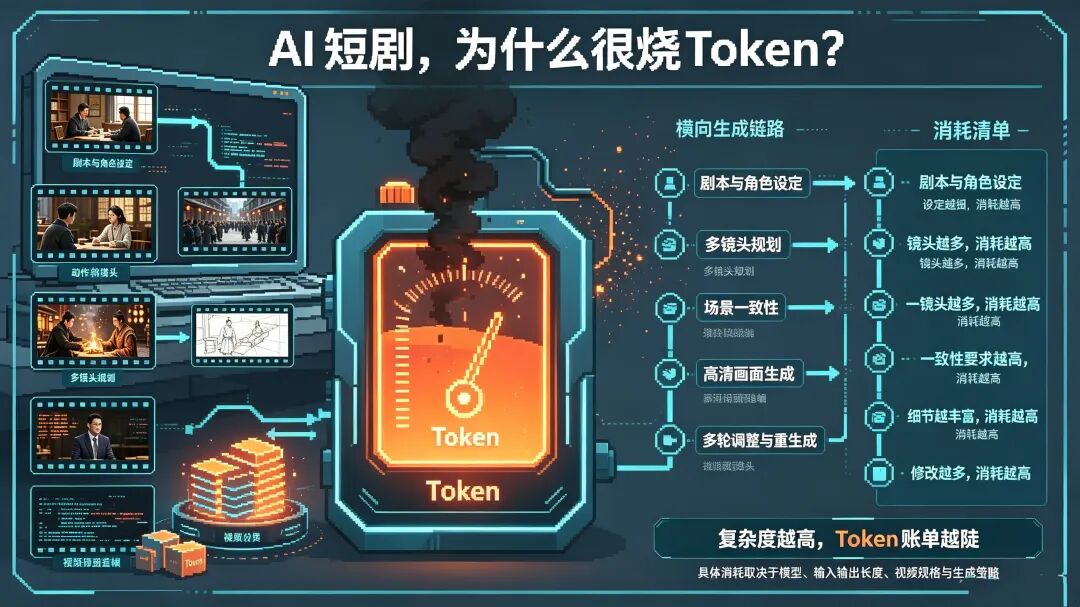
▲AI short dramas are indeed 'token-guzzling beasts.'
In contrast, in an AI-assisted R&D scenario, an 8-to-10-person technological R&D team, relying on AI tools to assist in code writing, bug detection, function iteration, and framework optimization, would probably consume a total of only about 30 million to 100 million tokens in a week of high-intensity R&D.
This signifies that even if I spend a week writing code with AI, the tokens consumed are far less than those used for creating a short drama with AI in a single day.
It should be noted that video tokens and text tokens are two different billing units and cannot be directly compared in terms of equal weight values.
Equating the proportion of token consumption with the proportion of computing power investment and deducing from '55%:15%' that China's AI industry 'focuses on entertainment, neglects R&D, pursues short-term gains, and lacks long-term vision' may not withstand scrutiny by popular science bloggers at all.
Moreover, even if a horizontal comparison is made based on the existing metrics, the difference in token consumption between China and the US for software development may not be as significant as some people imagine.
Currently, China's absolute volume of token consumption ranks among the highest globally. According to public information from the National Data Bureau, as of March this year, the daily average token calls in China exceeded 140 trillion.
Even if the software development scenario truly accounts for 15%, given the enormous overall computing power base, the corresponding scale of computing power investment is not insignificant, and the absolute quantity gap with the US's '58%' is not as vast as some people envision.
Furthermore, the proportion of token consumption of Chinese models on the OpenRouter platform (about 60%) has far surpassed that of US models. The 'State of AI' report jointly released by OpenRouter and a16z indicates that the proportion of tokens for programming tasks on this platform has risen from 11% at the beginning of 2025 to over 50%, becoming the largest single usage category on the platform... Combining these points, the conclusion that 'the software development scenario only accounts for 15% of China's token consumption' is still too taxing on the brains of math representatives.
03 /
Deriving the proposition that 'the US employs AI to enhance productivity, while China utilizes AI for entertainment' from mysterious data and criticizing China by creating a binary opposition that China's scarce computing power is being misused is also setting up a false premise.
It is crucial to reiterate a fundamental principle numerous times: Commercialization is not the antithesis of productivity; it is the lifeblood for productivity.
Throughout the history of global technology industry development, the steam engine was initially used for coal mine water pumping, not for power innovation during the Industrial Revolution; electricity was first used for lighting and entertainment, not for industrial production... Commercialization has always been a necessary stage for the large-scale popularization of cutting-edge technologies and the accumulation of capital and technology.
If AI cannot establish a viable commercialization path and lacks sustainable commercial revenue, basic R&D and technological iteration will not progress far. Therefore, it is not something to be ashamed of for new technologies to first identify landing scenarios and establish viable business models.
Many individuals may inquire: Why can US companies engage in hardcore technology while you allocate resources to produce electronic dopamine?
It is true that the US AI industry utilizes a substantial amount of computing power for cutting-edge model R&D and application software development, but this is supported by a mature hardcore technology investment and financing system and special technology barrier transformation paths: Relying on top-tier venture capital and long-term financial support from tech giants, companies like Anthropic and OpenAI expend tokens with a lavishness no less than that of some tycoons in Hangzhou's skyline or in yacht boxes.
It is also true that some Chinese AI companies employ AI to enhance productivity while others utilize it for 'entertainment,' but this has its inevitability: The primary challenge facing most Chinese AI companies is to 'survive.' Only by establishing a viable commercialization path can the AI industry progress further in a virtuous cycle where model manufacturers, cloud providers, and application vendors all benefit.
And AI short dramas represent the most mature, efficient, and stable commercialization landing scenario for China's AI industry, and we can confidently remove the 'one of.'
Behind AI short dramas lies a vast industrial chain, connecting content providers, platform providers, model manufacturers, cloud providers, and CDNs. Every link utilizes tokens.
Opting for AI short dramas as a significant landing scenario can also be viewed as conducting ultra-large-scale commercialization stress testing: It can demonstrate that China's model capabilities can support high-frequency, high-concurrency, and high-iteration content industrial production. The AI capabilities honed by the 'high frame rate, consistency, and draw convergence' N-fold tests of video generation can also be applied in more fields such as industrial simulation, digital twins, and film and television pre-visualization.
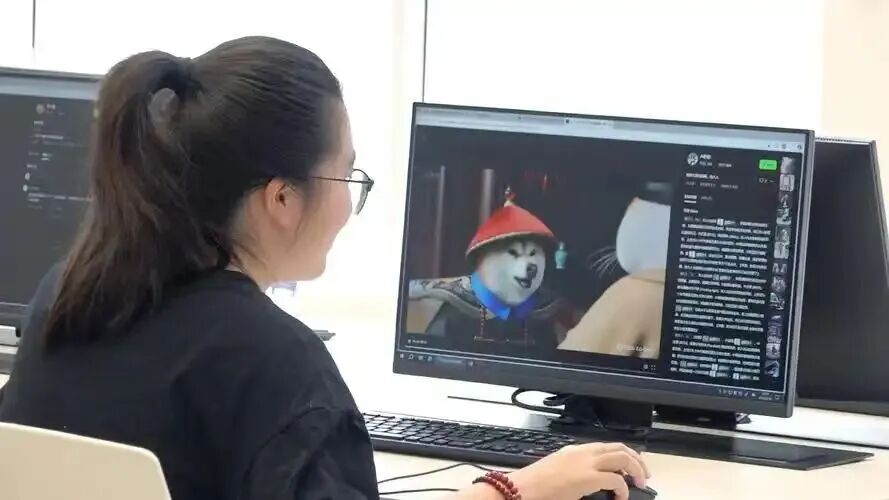
▲AI short dramas represent a mature and vast AI application scenario.
In other words, the entertainment scenario that many individuals look down upon has driven the formation of a 'commercial monetization feeding back into technological R&D' link and has also aided AI capability iteration with 'feeding' from real scenario data, user interaction data, and content generation data.
This can be compared to the role of games for NVIDIA. Just imagine: If NVIDIA hadn't had the revenue and large-scale engineering verification provided by gaming scenarios back then, could the NVIDIA GPU 'tree' have grown as robust as it is today?
There is nothing inherently wrong with 'the US employs AI to enhance productivity, while China utilizes AI for both productivity enhancement and entertainment.' US enterprise-level AI had an early start, possesses a mature software ecosystem, and strong enterprise payment willingness, so programming R&D naturally scaled up first; China has the world's largest content consumption market and e-commerce market, and the short drama and live streaming industrial chains were already mature. After AI video technology landed, it was the market's choice that it first scaled up, not a sign of 'degeneracy.'
Instead, those skeptics should be questioned in return:
You argue that AI computing power ought to be harnessed for software development, but are you prepared to pay for software? After all, isn't it the willingness of users to pay that prompts some companies to employ AI computing power in the production of short dramas?
04 /
There's no need to be excessively distressed and launch a barrage of 'harsh criticisms' simply because a substantial portion of China's AI computing power is directed towards AI short dramas.
However, the anxiety sparked by fallacious assertions like 'the US leverages AI to enhance productivity, while China uses AI to create distractions and amusements' still underscores a social mentality that merits scrutiny.
In my view, this at least unveils two increasingly prevalent social perceptions.
Firstly, there's a widespread belief that the majority of short dramas are digital detritus, devoid of any nutritional value.
Data reveals that in the first eight months of 2026, China witnessed the release of 430,000 micro-short dramas, a staggering 13-fold increase from the previous year, with AI playing a role in the production of over 90% of them. While the extent of AI involvement has surged, the formulas remain largely unchanged: overbearing bosses, sons-in-law, rebirths, revenges, golden fingers, and so on.
Although I've consistently opposed the tendency among netizens to dismiss short dramas as spiritual opium and cyber addictions, citing the 'entertainment-to-death' and 'bread and circuses' theories, I must concede that over 90% of current short dramas are 'thrilling yet devoid of substance'—even though they've become a popular pastime for killing time among the Chinese and a novel cultural export.
To paraphrase my friend Xiao Chang, if movies are about imbuing meaning—even mundane moments are filled with significance through symbolic accumulation—then short dramas are about stripping away meaning. Even profound elements are reduced to mere thrills.
Considering that the breakout rate of AI short dramas/animated dramas with over 100 million views across the entire network is a mere 0.117% (as per monitoring data from DataEye-ADX as of the end of February 2026), and the average completion rate of the AI short drama industry has plummeted from 45%-60% in 2025 to less than 15% in 2026, with many AI short dramas struggling to turn a profit, there are indeed significant issues plaguing the industry's business model.
Secondly, there's an expectation that AI will be increasingly harnessed to tackle 'critical bottleneck challenges.'
The Chinese have been fixated on the term 'critical bottleneck' for far too long: photolithography machines, chips, operating systems... There's a subconscious belief that AI technology of this caliber should be dedicated to genomics, fluid dynamics computations, nuclear reactor design, compiler writing, and large model training. However, when the rankings are examined, it turns out that the most intense consumption is on stories like 'The Overbearing CEO Falls in Love with Me,' leading to a significant psychological disconnect.
Given the limited domestic chip supply and the scarcity of high-end GPUs, if the strained AI computing resources were to flood excessively into AI-generated short dramas with 'short payback periods,' it would inevitably squeeze the 'resource allocation' for cutting-edge technologies. This is a deep-seated concern for many.
Hence, some people hope that while there's no need to ban the 'production of short dramas using AI,' the priority of computing resource allocation should be clarified to ensure that AI computing power intended for strategic directions is not crowded out.
As an ordinary citizen, I comprehend this viewpoint, but as a market fundamentalist, I find it difficult to endorse such a 'planned mindset.'
I would rather hope that those who believe AI computing power should not be squandered on short dramas would themselves watch fewer short dramas. If you and I both refrain from watching them, their market will shrink, and fewer will resort to using AI to create short dramas. Those who think AI computing power should be channeled into software development could first cultivate the habit of paying for and subscribing to AI software. If a business model can be sustained through user payments, companies will naturally have a stronger incentive to allocate more resources toward software development.
If none of this can be achieved, yet people turn around and lament that 'while the US uses AI to boost productivity, China uses AI to create mindless entertainment,' I can only respond with a famous line from Cha Cha Hui (a Hong Kong actor renowned for his humorous roles):
"You chose this, idol."

-
![]()
The Entire Internet Ridicules Tesla’s Flying Car—Don’t Be Short-Sighted
-
![]()
How to De-escalate China-EU Trade Tensions and Enhance Sharing of Hybrid Technology Benefits?
-
![]()
Cook Lauds China’s Unique Manufacturing Prowess: Apple’s Reliance Now Unavoidable
-
![]()
The UK Refuses to Impose Tariffs on Chinese Cars
-
![]()
iPhones Worth $100 Million Plunge into the Sea, as Apple’s Market Cap Soars Past $5 Trillion
-
![]()
【Intelligentization】Li Auto’s Chip Subsidiary Secures RMB 1.625 Billion in First-Round Financing
-
![]()
Weekly Stock Review | Chinese Automakers Shine at Paris Auto Show, Auto Stocks Rally from Low Points
-
![]()
What Is Porsche's Strategy Behind Layoffs and a Re-emphasis on Fuel-Powered Vehicles?