【Intelligentization】Li Auto’s Chip Subsidiary Secures RMB 1.625 Billion in First-Round Financing
 10/19 2026
 385
On October 16, Li Auto announced that its chip subsidiary, Shanghai MaxChip Technology Co., Ltd., has entered into an agreement for its inaugural equity financing round, successfully raising RMB 1.625 billion. This financing round was spearheaded by Hangzhou Jingtao, BlueRun Ventures, and Huaye Tiancheng, with Miracle Plus also participating. Specifically, Li Auto contributed RMB 1 billion through its controlling shareholder, MaxChip Intelligence, while external investors collectively injected RMB 625 million. Notably, Hangzhou Jingtao and its affiliated funds have secured an option for an additional subscription of up to RMB 500 million. If fully exercised, this would bring MaxChip Technology’s post-money valuation to RMB 17.1 billion.
Established in August 2026, MaxChip Technology functions as an independent operating entity for Li Auto’s chip and domain controller businesses. Li Auto’s CTO, Xie Yan, serves as the legal representative, while Wang Yang, the joint company secretary of Li Auto, oversees daily operations. Following this financing, Li Auto will retain approximately 74.01% of MaxChip’s equity, ensuring its controlling stake, with financial results continuing to be consolidated into Li Auto’s financial statements. Additionally, the company has implemented an employee equity incentive plan, allocating 20% of its equity to motivate and retain talent.
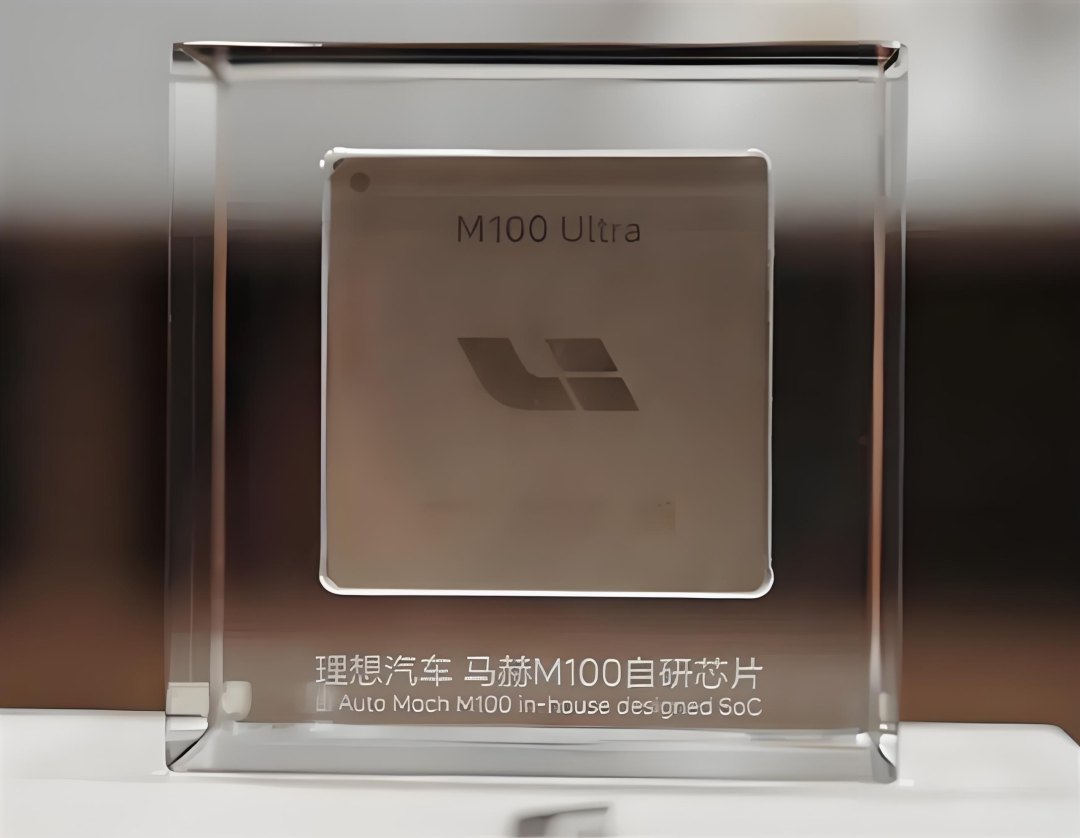
The cornerstone of MaxChip Technology’s portfolio is the MaxChip M100. Built on a cutting-edge 5nm automotive-grade process, this chip delivers an impressive 1,280 TOPS (Tera Operations Per Second) of computing power per unit. It stands out as the world’s first edge AI inference chip based on a dynamic dataflow architecture. Unlike traditional GPGPUs (General-Purpose Graphics Processing Units), which rely on instruction-driven operations and involve frequent data transfers between computing units and memory, the dataflow architecture is data-centric. It employs a compiler to pre-plan data movement paths, facilitating direct transmission between computing units and minimizing data transfer overhead. According to Li Auto’s official data, the MaxChip M100 achieves 82% computing power utilization, reduces inference latency by 35% under equivalent power consumption, and cuts energy consumption per unit of computing power by 40%. Its architectural paper was selected for the industrial track at ISCA 2026, a premier conference in computer architecture, marking Li Auto as the first automotive company to be featured in this track.
The MaxChip M100 commenced mass production in the second quarter of 2026, debuting in the all-new Li Auto L9 Livis edition and providing a total computing power of 2,560 TOPS through a dual-chip configuration. It is currently installed in models such as the Li Auto L9, L8, MEGA, and i9. In September, Li Auto President Ma Donghui indicated that standardized components like MaxChip and silicon carbide modules could be sold externally, with other manufacturers able to achieve compatibility.
From a strategic standpoint, Li Auto is transitioning its chip business from internal support to independent operations and external supply. Earlier in the year, Li Auto’s silicon carbide subsidiary, Sikuo Semiconductor, embarked on a similar path by initiating independent operations and IPO plans, mirroring MaxChip Technology’s trajectory. By attracting external capital, Li Auto aims to bolster financial support for chip R&D and commercialization while lowering trust barriers for future external supply. Li Auto stated that MaxChip Technology will continue to support Li Auto’s products while fostering product supply and collaboration with external customers, expanding its business into non-automotive applications, particularly in areas like embodied intelligence.
However, MaxChip Technology has yet to commence substantive commercial operations and, as of the announcement date, has no assets, revenue, or profits. The external supply of its chip business faces several challenges: On one hand, the trust barriers associated with Li Auto’s identity as an automaker will take time to overcome, and there is uncertainty regarding whether other automakers are willing to purchase chips from a competitor. On the other hand, the algorithm ecosystem for the MaxChip M100 is still maturing, requiring external customers to shoulder the cost of algorithm migration. Furthermore, leading companies such as NVIDIA and Tesla continue to rapidly iterate their next-generation chips, necessitating continuous innovation by MaxChip Technology to sustain the long-term competitiveness of the M100.
From an industry perspective, in-house chip development by automakers has emerged as a prevailing trend. NIO’s chip subsidiary, Anhui Shenji, completed its first round of financing in February this year, raising RMB 2.257 billion and achieving a post-money valuation of nearly RMB 10 billion. Li Auto’s decision to secure the first round of financing for MaxChip Technology at this juncture serves to validate the technical value of its chips and lay the groundwork for subsequent independent development and external commercialization. The pivotal challenge for MaxChip Technology will be whether it can transform the M100, a chip already in mass production and installed in vehicles, into a standardized product for external sales.
-
![]()
The Entire Internet Ridicules Tesla’s Flying Car—Don’t Be Short-Sighted
-
![]()
How to De-escalate China-EU Trade Tensions and Enhance Sharing of Hybrid Technology Benefits?
-
![]()
Cook Lauds China’s Unique Manufacturing Prowess: Apple’s Reliance Now Unavoidable
-
![]()
The UK Refuses to Impose Tariffs on Chinese Cars
-
![]()
iPhones Worth $100 Million Plunge into the Sea, as Apple’s Market Cap Soars Past $5 Trillion
-
![]()
【Intelligentization】Li Auto’s Chip Subsidiary Secures RMB 1.625 Billion in First-Round Financing
-
![]()
Weekly Stock Review | Chinese Automakers Shine at Paris Auto Show, Auto Stocks Rally from Low Points
-
![]()
What Is Porsche's Strategy Behind Layoffs and a Re-emphasis on Fuel-Powered Vehicles?