Who Can Achieve Big Results with AI During Double 11?"],"keywords":["Double 11, AI, Doubao, Qianwen, shopping recommendations"],"content":["During Double 11, Douyin and Alibaba attract users to use AI
 10/20 2026
 331
Alibaba's approach is more closely aligned with addressing the cumbersome processes in shopping. On October 13th, Qianwen opened up applications for the personal agent experience of "Qianwen Go" and showcased cases of users obtaining refunds on the consumption platform. The focus is no longer just on consumption itself but on getting users to understand that agents can take on more functions in the consumption chain.
Purchase demands, products, and merchant budgets all converge during this period, and with platforms willing to bear some trial costs, a wave of user activation battles is imminent.
Double 11 has brought a batch of new tasks for personal agents. Who can reliably meet the demands of C-end users in the most effortless, considerate, and straightforward way?
01 Effective User Acquisition, but Shopping Habits Still Need Nurturing
An effective observation sample is the AI battle during the Spring Festival. No matter how large the subsidies are at the consumption level, they cannot match the effectiveness of direct cash incentives.
During the Spring Festival, Qianwen offered a total of 3 billion yuan in "Spring Festival Free Orders," and its daily active users (DAU) surged from 7.066 million before the event to 73.52 million at one point. By February 23rd, DAU had dropped to 32.453 million, still significantly higher than before the launch. According to data from QuestMobile, the mobilization indeed led to a leap in usage scale.
In the following months, Doubao and Qianwen continued to grow. According to QbitAI Think Tank statistics, in March, the average DAU of the two apps exceeded 110 million and nearly 44 million, respectively. By September, they exceeded 200 million and 62 million. Although Doubao's downloads in September decreased by about 47% compared to August, its average DAU still grew by about 2%. After a large influx of new users, daily usage has a larger foundation.
However, the proportion of new users who stay is still around 30%. In the same monthly reports, Doubao's three-day retention rate for new users changed from 30.92% in March to about 28.6% in September, while Qianwen's changed from 27.99% to about 27.2%. The statistics for both months cover new installations of their respective apps. While platforms have expanded their user bases, they still need to provide ongoing reasons for new users to return.
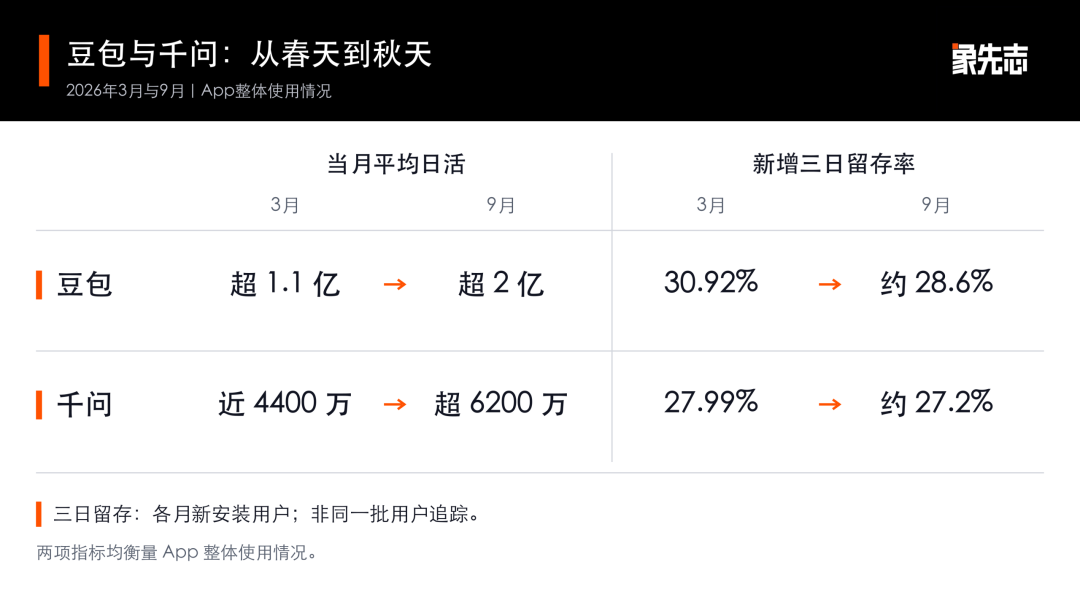
Doubao and Qianwen's DAU and Three-Day Retention Rates for New Users in March and September 2026
Shopping is becoming Qianwen's way of securing these usage opportunities. Alibaba disclosed that by the end of February, nearly 140 million users had experienced AI shopping for the first time through the agent function of the Qianwen App; the cumulative number increased to 250 million as disclosed in the August financial report. After the Spring Festival, about 110 million more users remained.
Behind this lies the long-term accumulation of products, payment, and delivery systems within the Taobao ecosystem. Consumers express their needs, and the assistant needs to find suitable products, ensure orders are accepted, and products are delivered. Alibaba can connect these services, making subsidies conditional on turning a trial into an actual purchase. This provides Qianwen with a reason for use that ordinary chat tools lack.
However, the 250 million figure records cumulative first-time experiences. After a single attempt, whether consumers continue to use Qianwen for shopping or return to the familiar Taobao page requires data on shopping frequency and repurchase rates to answer. Currently, publicly disclosed figures do not include the proportion of shopping users among active users during the same period.
Doubao has also seen new orders in travel scenarios. Douyin Life Services disclosed that during the recent Mid-Autumn Festival and National Day holidays, the order volume for "Doubao Hotel Bookings" increased by more than 56% month-on-month. The assistant can already handle some consumer demands, with growth occurring in specific services.
This time, Doubao has placed coupons within the app, aiming to have users open it when they think of shopping. Qianwen Go showcases price protection and refund capabilities, extending the scope of tasks from purchase to after-sales. Platforms need to find more repeatedly usable scenarios to bring festival trials into daily life.
This year's Double 11 thus faces an additional test: discounts can attract people, but next time, without coupons, the assistant still needs to be useful. Users open the app with different needs, and to have them return when they have purchasing needs, agents must handle specific shopping issues effectively.
This puts the onus on merchants. AI requires accurate product information, and promised prices and services must be fulfilled. After consumers are willing to delegate tasks, why would sellers continue to participate?
02 Merchants Want to See Tangible Benefits
Merchants first ask how much business AI brings. ByteDance has set up a dedicated section for Doubao in its business analytics tool, allowing merchants to view the business scale from this channel and the shopping questions users frequently ask. As assistants begin to participate in selection, merchants also need to know what details buyers care about and what is unclear in product descriptions.
During the promotion period, the analytics tool helps merchants analyze operations, and the intelligent customer service tool, Feige, is temporarily free. Merchants have the opportunity to use these tools at a low cost and see if they can reduce manpower and handle more inquiries. Platforms issue coupons on the consumption side and lower trial barriers on the operational side, both requiring a try.
Qianwen Office has chosen a deeper dive into daily work. The newly launched e-commerce version integrates cross-platform operation dashboards, product selling point analysis, and bulk material creation into one tool. It disclosed that among its existing paid users, 20% are e-commerce users. Even before this product was specifically designed for e-commerce, merchants were already willing to pay for its office capabilities.
Chen Yusen, in charge of Qianwen Office, has integrated several previously dispersed teams within Alibaba. The newly launched e-commerce version gives these teams specific operational needs to address. Users ask Qianwen about price protection, while merchants use Qianwen Office to prepare for store openings. Alibaba is seeking usage frequency at both ends of the transaction.
Of course, the efficiency improvements in vendor case studies need to be measured against each store's own costs. Large stores have complex systems and divisions of labor, while small merchants may care more about whether they can hire fewer people or make fewer images. Whether they are willing to continue paying after the free period ends reflects the tool's value more than a single demonstration.
Orders should be viewed the same way. Purchases originally completed on Douyin, if now completed through Doubao, will increase channel data; merchants also care about whether sales have increased and whether refund and service costs have decreased. Platforms need to clearly present these changes for merchants to more easily plan their next investments.
Beyond the benefits brought by operational tools, AI will also affect how merchants acquire customers. Assistants will also screen products for users, deciding which products deserve to be seen. For merchants who rely on promotions to acquire customers and platforms that rely on advertising for revenue, this poses a more difficult question.
03 AI Recommendations Need to Consider More People's Incomes
Pinduoduo faces very specific consumer demands: prices must be low, and the right products must be bought. When looking for a tennis racket, users may already specify the model, weight, and grip size, as well as limit the version, black label, or billion-subsidy option. In previously disclosed AI search experiences, Pinduoduo has attempted to provide product links and shopping advice based on these conditions.
Such demands are suitable for assistants to handle. Why do similarly priced products vary greatly, and are the additional accessories in a package useful? Buyers often need to compare across multiple pages repeatedly. If AI can explain this clearly, consumers have the opportunity to purchase categories that originally required effort to research, and merchants have another chance to explain product differences.
Pinduoduo's merchant recruitment arrangements for this year's Double 11 require merchants to Perfect (improve) material, style, and other attributes, standardize specifications and packages, as these factors affect event review and label acquisition. For AI to explain product differences clearly, accurate attribute, specification, and package information is also needed first.
So, it can't be said that Pinduoduo is completely AI-averse, but what it saves is actually the workload on the B-end, which has little to do with consumers.
Meanwhile, brands are still investing in traffic. Some invited brand flagship stores can purchase promotion packages for the event and participate in off-site official microblog exchanges to strive for (compete for) traffic and subsidy benefits; regular event registration does not charge extra fees, nor does it have event deductions or commissions. Behind Pinduoduo's price advantage, merchants are also calculating the cost of acquiring customers.
If consumers increasingly accept a small number of recommendations screened by AI, brands' chances of repeated exposure may decrease. Recommendations that can clearly explain differentiated products will also make merchants care more about the reasons for being selected. Pinduoduo needs to continue proving that promotion investments can lead to effective purchases; assistants must give consumers a reason to trust recommendations. The deeper AI search delves into shopping, the more these two aspects need to be considered together.
However, Double 11 has never been Pinduoduo's main battleground. In comparison, Xiaohongshu is worth observing more.
Xiaohongshu's "Ask" feature has attempted to quote community notes to answer questions, and some product names can continue to link to searches. Diandian also syncs chat records within Xiaohongshu to a standalone app. Existing conversations can continue, and if users supplement their budget and living conditions, the assistant has the opportunity to find experiences closer to their needs. The value here comes from the details written by authors after use.
Recommendations will also encounter conflicts with the original advertising business. Xiaohongshu internally discussed such conflicts in the first half of this year: according to reports, taking hair dryers as an example, paying big clients may not necessarily rank at the top of recommendations, and the commercialization team once hoped that AI search would not actively generate shopping recommendation lists.
This discussion points to a practical trade-off: brands pay to influence consumer choices, while consumers hope assistants choose based on their own conditions. Xiaohongshu needs to arrange how commercial collaborations appear in answers and also make advertisers understand what value the new recommendation method can bring.
Authors' incomes are generated along another path. The "Planting and Harvesting Linkage" program in Pu Gong Ying (Dandelion) provides note cooperation fees and affiliate commissions; in the newly updated "Collaboration Plaza" rules, when using the ad revenue sharing model, authors with 1,000 to 10,000 followers can receive at least a 3% share of the ad spend on authorized notes, paid by brands and settled by the platform.
These incomes are tied to specific cooperation notes, affiliate behaviors, or ad records. After AI synthesizes multiple notes, one may help users exclude unsuitable products, while another facilitate (facilitates) the final purchase, but they may not both receive original readings. Reference links retain the opportunity for users to review, and for experiences to generate revenue, someone still needs to design specific methods.
This is also where Xiaohongshu can differentiate itself. Pu Gong Ying already has off-site tracking tools supporting cooperation projects with Taobao, JD.com, Vipshop, Meituan, etc., capable of providing feedback to brands on subsequent actions. The community has the opportunity to let brands see the value brought by content, even if the purchase ultimately occurs elsewhere. To apply this approach to AI answers, it also needs to address the contributions of multiple notes and author rewards.
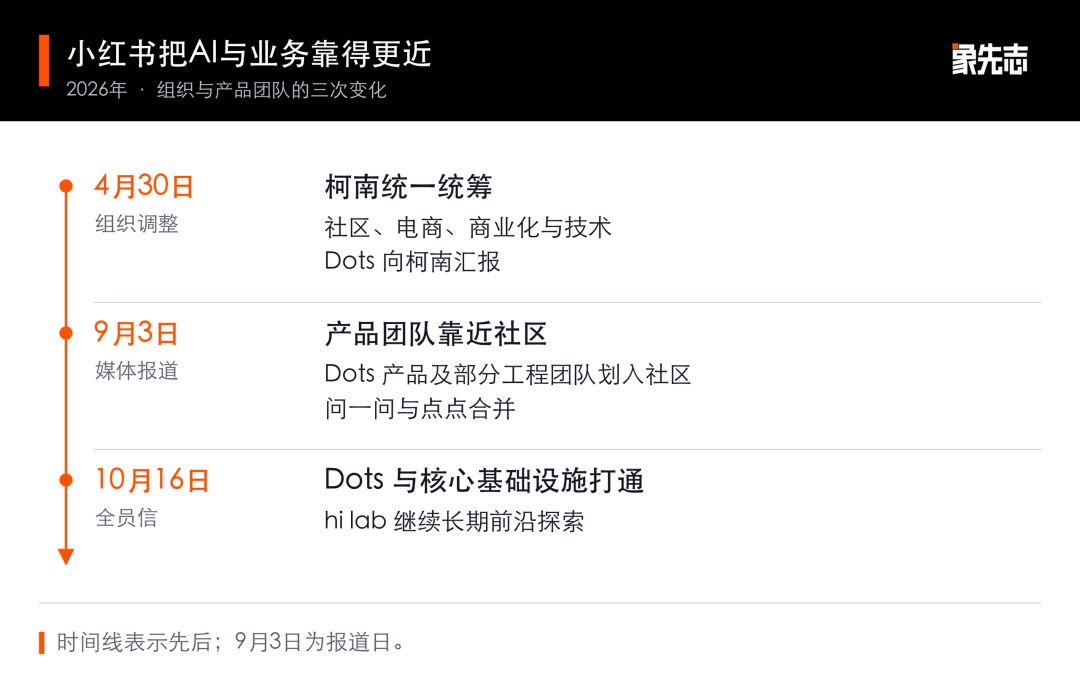
Xiaohongshu's Three Organizational and Product Team Changes in 2026
These trade-offs require the community, commercialization, and technology teams to handle them together. Conan has already overseen these business areas, and Xiaohongshu's latest company-wide letter announced the integration of the Dots and core infrastructure teams. The organizational adjustment provides conditions for joint decision-making, which now needs to be implemented in terms of commercial collaborations and author rewards in recommendations.
Pinduoduo can make it easier for users to buy the right products from low-priced options, while Xiaohongshu can make scattered consumer experiences more useful. Both have existing shopping demands, and AI enters along familiar user behaviors but also needs to ensure that those who originally provided products and content continue to be rewarded.
Double 11 discounts can encourage trials. For user acquisition costs to translate into daily business, users must be willing to open the assistant for their next shopping trip. To continue providing services, platforms must also ensure that those who provide products and experiences are rewarded.
-
![]()
The Data Centers of AI Giants Are Hitting a Wall Harder Than Chips
-
How Far Is AI from Independently Contributing a Nobel Prize-Level Achievement?
-
![]()
SU8 and SU9 Are on Their Way! Xiaomi Unveils a Fleet of New Vehicles
-
![]()
Settlement of Smart Horizon's 'Household Registration': First Independent Automaker Status Approved for Hongmeng Zhixing, Paving the Way for Listing
-
![]()
Why Not Opt for Price Reductions When Car Sales Are Sluggish?
-
![]()
Chang'an Automobile: Ushering in a New Era of 'Young Leaders'
-
![]()
What?! The Bumper is No Longer the First Line of Defense!
-
![]()
Who Can Achieve Big Results with AI During Double 11?"],"keywords":["Double 11, AI, Doubao, Qianwen, shopping recommendations"],"content":["During Double 11, Douyin and Alibaba attract users to use AI