Jev Sparks the Era of Decision-Making Models: Large Models Dive into the Infinite Game
 10/20 2026
 447
Author | Hao Xin
Editor | Wang Pan
Decision-making models are transitioning from a novel concept to a distinct product category, with offerings now available in the form of models, APIs, and data platforms.
Initiated by TypeSafe's Jev, decision-making models—also known as 'System One models'—have rapidly proliferated, with over a dozen models emerging within a month. Tech giants like Microsoft, AWS, Perplexity, and Snowflake have also entered this burgeoning field.
Suddenly, the entire industry finds itself amidst a 'Hundred-Model Battle,' a pace of innovation rarely witnessed even in the AI sector.
The rise of decision-making models fundamentally separates the decision-making layer from the reasoning layer in intelligent agents. This trend is driven by the recognition that agents generate numerous small, repetitive decisions during their operations, determining their next actions, validation outcomes, and routing to specific models or tools.
In practice, making these decisions does not necessitate the complex reasoning capabilities of large models, yet they consume substantial computational resources and incur significant costs. Decision-making models are specifically designed to handle these high-volume, bounded agent decisions efficiently.
Moreover, decision-making models have provided a much-needed boost to the implementation of agent technology in Chinese enterprises.
Through discussions with frontline enterprises and tech giants, Photon Planet has learned that digitally advanced companies have already integrated AI into their workflows. Many have shifted their focus from training vertical large models to resolving bottlenecks in various business processes while incorporating business logic.
Questions such as who should handle a work order, whether a request requires human intervention, and whether the current step should continue are now addressed by specialized execution layers provided by decision-making models.
Independent Decision-Making Layer
Over the past two years, the approach to building agents has involved using general-purpose large models to handle all aspects, from complex reasoning to simple tool routing. This approach was logical when agents were in their infancy, as a single model could address all problems simply and directly.
However, bottlenecks emerged once agents were deployed. A single agent task involves numerous trivial judgments with limited answer spaces, high call volumes, and critical path dependencies. Utilizing the most powerful general-purpose large model for each judgment adds seconds to task latency and increases costs with each token.
Decision-making models serve as judgment executors, generating no text but returning calibrated probability scores given a set of fixed options. Microsoft's Microsoft-Decision-1, for instance, supports true/false questions, multiple-choice questions, and scoring options, as well as evaluating AI responses and agent operations based on scoring criteria.
By separating the decision-making layer from large models, each judgment node in an agent's workflow can be independently optimized. Decision-making models do not replace large models but rather form a division of labor and coexistence. General models handle complex reasoning and generation tasks, while decision-making models manage numerous lightweight, repetitive judgments in agent workflows.
The primary drivers behind this division are cost and latency. TypeSafe's figures indicate that Jev's end-to-end latency ranges from 70 to 500 milliseconds, 20 to 200 times faster than comparable large language models.
When Microsoft's Decision-1 processed over 10,000 feedback items in Xbox Research, its quality matched GPT-6 Sol while being 14 times faster and 200 times cheaper. This performance gap becomes evident only in high-frequency, continuous decision chains, not in single agent calls.
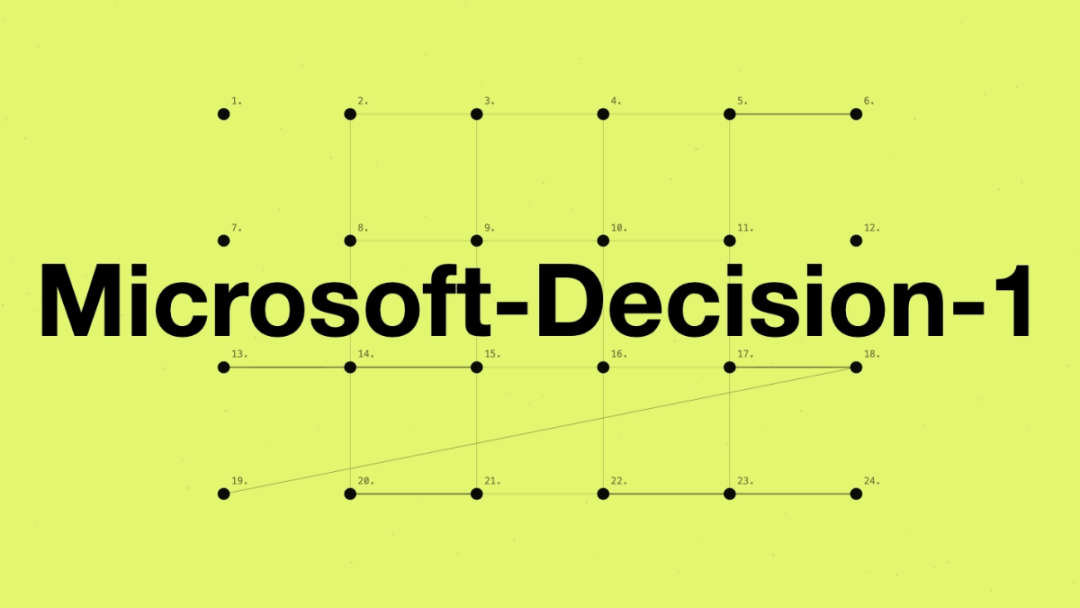
Microsoft's demo visually demonstrates the speed improvement in analytical scenarios when using decision-making models. When ChatGPT Sol and Microsoft-Decision-1 executed the same classification and routing request, Microsoft-Decision-1 returned results in 182 milliseconds, while Sol took 6.4 seconds.
It should be noted that current decision-making models still have clear boundaries. For example, Jev currently supports only PNG and JPEG static images for input, with side lengths between 256 and 1568 pixels and a maximum file size of 16MiB per image. Costs are calculated based on input tokens. Officials caution that Jev's performance in multimodal tasks still lags behind pure text tasks. Decision-making models are better suited as judgment components in business processes, handling classification, ranking, screening, or suggesting next steps.
Among Microsoft's 17 listed use cases for decision-making models, nearly all involve high-frequency, repetitive 'nodes' embedded in workflows. These use cases essentially form two infrastructure layers for agent systems: an 'immune system' layer consisting of security screening, data validation, and AI review, responsible for identification, judgment, and verification; and a 'traffic system' layer consisting of model routing, agent control, and event response routing, responsible for evaluation, selection, and scheduling.
Emergence of Model Division of Labor
A notable trend is that decision-making models achieve competitive quality with general-purpose models at extremely small parameter scales.
For example, the open-source decision-making model THX-01 has only 322 million parameters. In internal testing involving 2,843 customer service work orders in English, Russian, Turkish, and Azerbaijani, the development team reported a classification accuracy of 98.4%, slightly higher than Jev 1.13's 97.4%, with a GPU inference latency of about 10 milliseconds.
This demonstrates that for multilingual work order classification with clear options and task boundaries, a dedicated decision-making model with a small parameter scale can achieve competitive performance compared to larger models while significantly reducing inference latency.
This phenomenon is not a 'comeback' of small models but rather the emergence of model division of labor.
Decision-making models achieve competitive performance with smaller parameter models on limited tasks, which can easily be misinterpreted as 'small models catching up to large models.' However, it is more accurate to say that general-purpose models and decision-making models handle different types of work, eliminating the need for a single model to handle all aspects.
The value of general-purpose models lies in handling open, complex, and variable tasks, such as understanding ambiguous intentions, conducting multi-step reasoning, and integrating diverse information. Decision-making models, on the other hand, operate within narrower scopes, judging which option is more appropriate or providing probabilities and scores for various options based on existing states, rules, and candidate actions.
In summary, cutting-edge models drive capability, while decision-making models drive efficiency. This division of labor resembles the evolution of traditional software architectures, where a capability becomes so frequent and well-defined that it is extracted from general-purpose components and made into a dedicated module.

At this juncture, competition in AI system capabilities begins to shift from model size to how clearly tasks are defined. When business problems can be defined in terms of states, criteria, and limited actions, dedicated small models may be more suitable than general-purpose large models for handling high-frequency judgments. Future advantages may come not from using a single model for everything but from assigning different tasks to appropriate models and rules and having them work together in reliable processes.
For Chinese agent teams, the competitive barrier in the decision-making layer will shift from model scale to scenario understanding. Currently, the quality of decision-making models depends more on the quality of training data and the clarity of judgment logic. Chinese teams have more opportunities to translate the judgment logic in specific business scenarios, such as when to escalate, wait, or involve human intervention, into trainable, deployable, and calibratable decision-making layers.
Parameter scale is no longer a barrier; scenario binding is.
This new opportunity may bring about a new round of market reshuffling. General-purpose large model companies excel at investing huge resources to build foundational models for broad tasks. However, the competitiveness of many decision-making models comes from task definition, industry data, decision criteria, and process integration. These assets are often held by industry software vendors, in-house enterprise teams, and vertical-domain startups. Large models can provide the foundation, but they do not inherently possess the business rules, exception samples, and outcome feedback for every niche industry.
Therefore, the market may gradually stratify. A few model vendors will provide foundational decision-making models and general APIs, while more teams will develop specialized decision-making capabilities and workflows for specific scenarios such as finance, customer service, manufacturing, healthcare, and logistics. The competitive focus will shift to who can consistently make business-compliant judgments at an acceptable cost and safely and stably integrate these judgments into actual processes.
Implementation Scenarios: The Battleground for the Decision-Making Layer
Domestically, there is a stronger emphasis on 'scenarios,' as evidenced by the approach to decision-making models.
Foreign companies, represented by Microsoft, tend to API-ize general-purpose decision-making models, distributing them through cloud platforms on a token-based pricing model for developers to call upon. In contrast, Chinese teams focus more on deeply embedding decision-making capabilities into enterprise business systems, agent frameworks, and workflows, primarily using open-source models and local deployments to address judgment problems in specific scenarios.
On one hand, sectors like finance, healthcare, and government have strict data compliance requirements, making closed-source API calls infeasible in many scenarios. On the other hand, implementing agents in Chinese enterprises often involves deep integration with existing business systems. The decision-making layer needs to understand specific business rules, permission systems, and workflow logic, information that general APIs cannot provide.
Model routing is the most mature entry point for domestic implementation and the scenario with the highest frequency of decision-making and relatively clear rules in agent workflows.
Practice with office agents has shown that routing and scheduling are becoming economically viable for large-scale use. However, model routing is just the starting point. The greater value of the decision-making layer lies in serving as an execution engine for business rules. For example, Unisound's open-source U2-Decision 4B is built around three core capabilities: determining who handles a task, whether a task can be executed, and the path to complete a task—namely, intelligent model routing, security decision-making, and workflow routing.
Similar 'pre-judgment' capabilities are crucial for enterprise scenarios. For instance, the decision-making layer of an insurance claims agent needs to know which missing materials can be automatically supplemented, which must be returned, and which require human verification.

While routing addresses the question of 'who handles a task,' enterprise scenarios require binding decisions to business knowledge to create reusable decision assets.
Chinese-Jev demonstrates an operable route: first train Chinese decision-making capabilities with 10 million general decision samples, then fine-tune for healthcare, legal, and financial sectors separately. The fine-tuned model outperformed Jev by 4.0% on healthcare test sets, achieving an average accuracy of 92% of Jev's performance in professional domains while accelerating processing by about 17 times, with an average latency of 15 milliseconds per sample. This indicates that judgment patterns in some fields can be codified into model parameters through specialized training.
Ultimately, the emphasis on 'scenarios' by domestic teams highlights the ownership of judgment authority. When decision-making capabilities are embedded in business systems, connected to data, and bound to rules, agents can transform from question-answering systems into production systems that assume responsibility.
Model routing is just the first proof of concept; the real arena lies in security, permissions, processes, and compliance. The journey to transform judgments into reusable and codified enterprise assets has only just begun.

-
Automotive Industry Undergoes Profound Transformation
-
![]()
Observation | XGIMI and OBE Enter the AI Glasses Track, Extending the Battlefield of Projector Manufacturers from Living Rooms to Faces
-
![]()
September Compact Car Sales Review: Traditional Fuel-Powered Models Remain Dominant
-
![]()
In the First Three Quarters, 8.2 Million Vehicles Sold: Overseas Markets Emerge as a Competitive Frontier for Chinese Automakers
-
![]()
China and the EU Both Achieve Success! Will the Export Volume of New Energy Vehicles to Europe Rise or Fall?
-
![]()
After a Year of Restructuring, WM Motor Encounters Fresh Hurdles in Production Restart
-
![]()
German Luxury Car Brands Encounter Group Pressure in Q3, with Porsche Seeing the Sharpest Drop
-
![]()
Sales of Fuel Vehicles Drop Below One-Third for the First Time, Now It's New Energy's Turn to Face Intense Competition