Unchecked Production Boom and Traffic Gridlock: What’s the Real Battleground for AI Short Dramas? | China’s AI Short Drama Global Expansion Report
 10/21 2026
 509

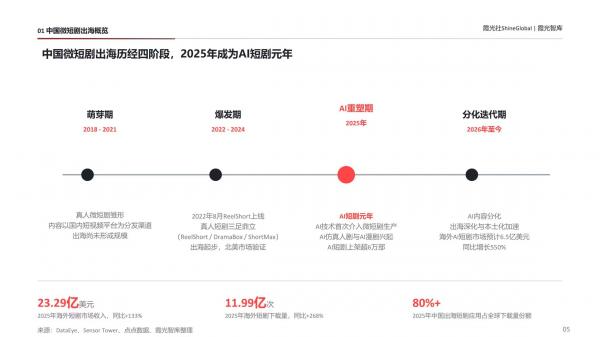
While domestic micro-short dramas are still locked in a fierce competition over star power, Chinese companies have already propelled AI-driven content onto the global stage.
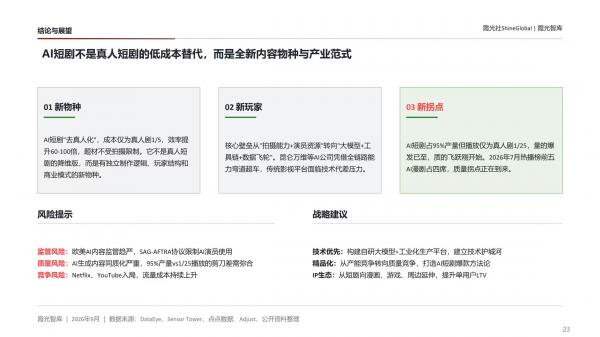
Yet behind the frenzy of international expansion lies a stark reality: AI short dramas now dominate 95% of production output but capture just 4% of global viewership.
As AI slashes content production costs to near-zero, traditional barriers to entry crumble. Meanwhile, traffic acquisition costs on distribution platforms remain stubbornly high, and compliance standards continue to tighten.
This isn’t merely an upgrade in production tools—it’s a struggle for control over industrial value distribution.

From Production Boom to Quality Divide
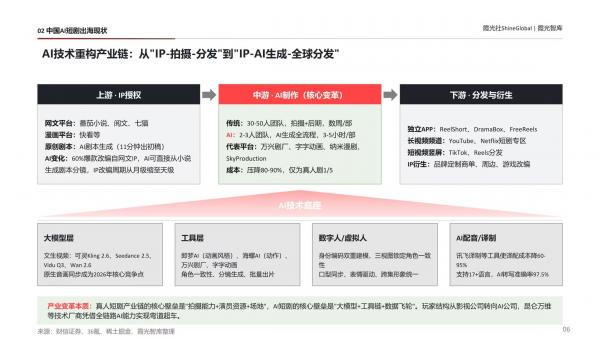
AI’s transformation of short drama production is ruthlessly efficient. Compared to live-action counterparts, AI slashes single-episode production costs from ¥500,000–1.5 million to ¥50,000–240,000, while boosting output efficiency by 60–100 times.
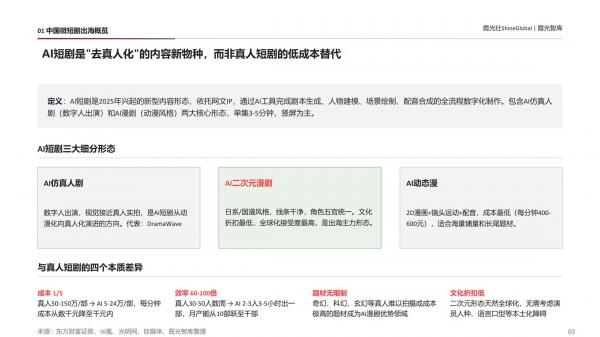
This seismic shift has triggered an immediate production surge: the AI short drama market is projected to explode to $650 million by 2026, growing at a staggering 550% CAGR.
But behind this production feast lies a harsh truth.
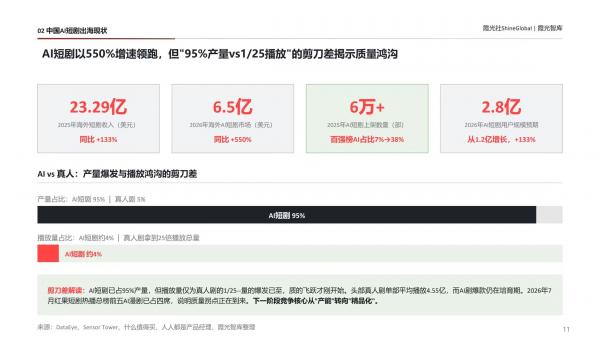
AI short dramas now account for 95% of global output but only 4% of viewership, with live-action dramas still commanding 25 times the audience share.
AI’s "quantum leap" in quantity has reached saturation, while the "qualitative leap" is just beginning.
In July 2026, AI-animated dramas occupied four of the top five spots on Hongguo Short Drama’s popularity chart.
The core competition in AI short dramas is shifting from "who can produce more" to "who can create unskippable content."

Efficiency Gains Eaten Alive by the "Traffic Tax"
Many mistakenly assume AI-driven production savings translate directly into profit.
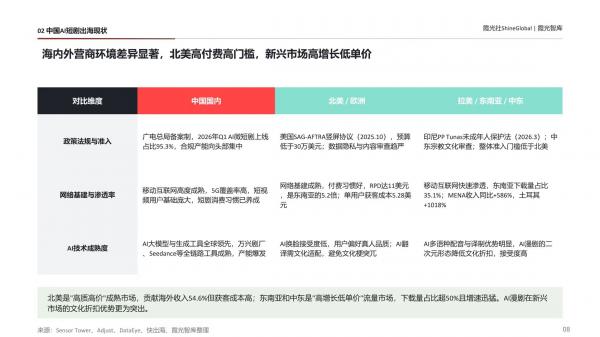
The report reveals that traffic acquisition costs now consume nearly 50% of total overseas short drama expenses, with North American customer acquisition costs soaring to $5.28 per user.
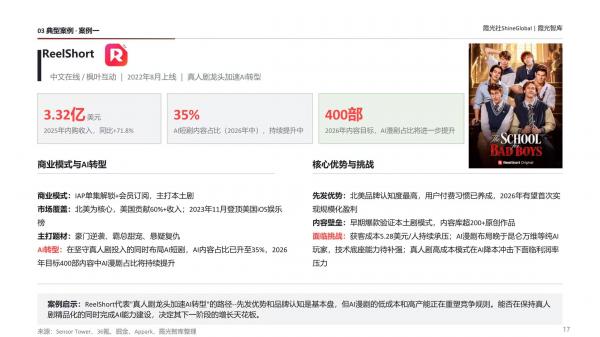
In 2025, despite ReelShort’s $332 million in in-app purchase revenue, profit margins remained under pressure due to skyrocketing acquisition costs.
As AI drives content supply costs toward zero, competition inevitably shifts from content creation to traffic acquisition. AI-saved production costs are effectively redistributed as "traffic taxes" to distribution platforms: Meta (65%), Google (20%), and TikTok (10%).
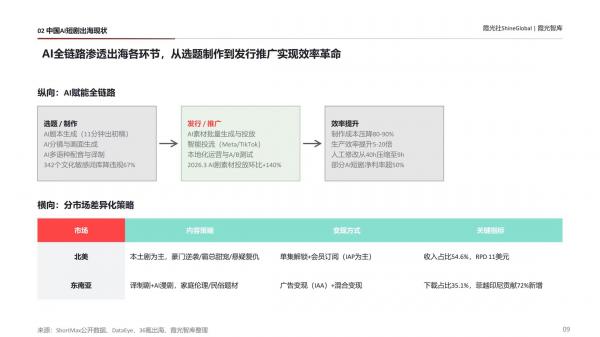
Each new drama launch requires renewed traffic purchases, with AI-enhanced production capacity intensifying the cyclical consumption of "produce-distribute-churn-reproduce." Greater capacity demands more promotional materials, fueling fiercer traffic bidding—this isn’t an efficiency dividend but a self-reinforcing cost trap.

Who’s Building Genuine Competitive Moats?
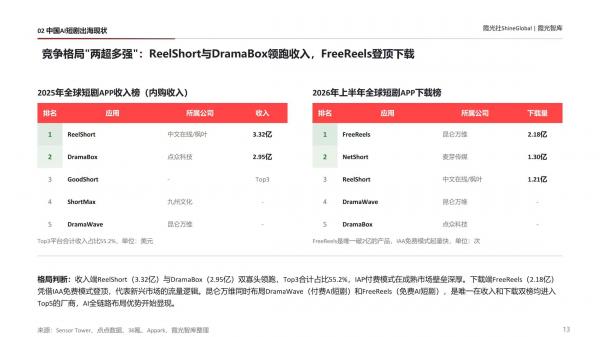
Under the dual pressures of rising traffic costs and compliance standards, the competitive landscape for AI short drama global expansion has evolved from an early "two superpowers and multiple strong players" (ReelShort and DramaBox leading revenue, FreeReels topping downloads) to deeper differentiation.
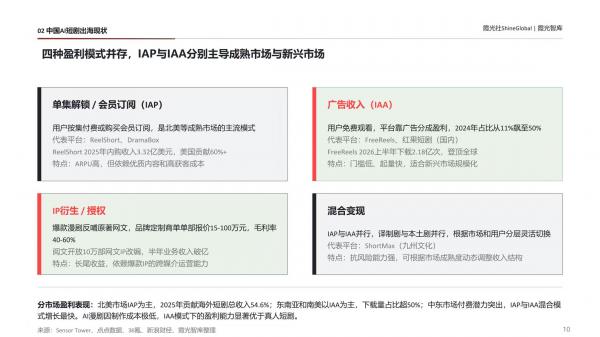
The IAP (in-app purchase) model has established a duopoly in mature markets like North America (ReelShort and DramaBox dominate revenue), while the IAA (in-app advertising) model drives traffic scale in emerging markets (FreeReels leads downloads). Kunlun Group, with its "paid+free" dual-product strategy, stands as the only company ranking top 5 in both categories, validating the competitive advantage of a full-chain layout.
Technology Foundation Players: Kunlun Group’s Disruptive Impact

Through proprietary large models (SkyReels), industrialized production platforms (SkyProduction), and a "paid DramaWave + free FreeReels" dual-product matrix, Kunlun Group aims to establish a technological moat with full-chain capabilities spanning "model + tools + distribution." Its MAU ranked first overseas in H1 2026, proving technological infrastructure as a core competitive edge. However, building technological barriers requires time, with marketing expenses outpacing revenue growth, creating short-term loss pressures.
Content Platform Players: Niche Cultivation by ReelShort and DramaBox
ReelShort stabilizes its brand premium with live-action content while covering long-tail distribution with AI content, now accounting for 35% of its portfolio.
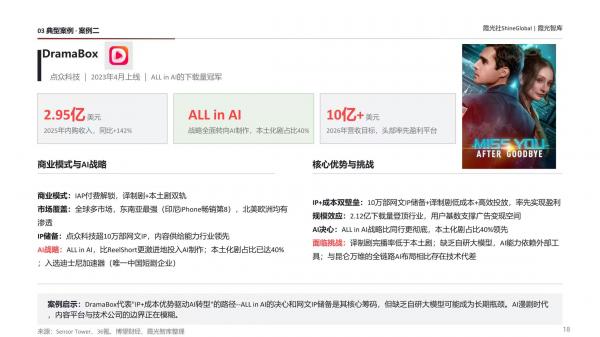
DramaBox has gone all-in on AI with 100,000 web novel IP reserves, achieving 40% localized drama content. Both share a common approach: AI serves as leverage, not the anchor. Their content libraries and user mindshare form the bedrock against technological volatility.
Ecosystem Players: Rule Reconstruction by ByteDance’s PineDrama
Platform-level players subsidize the market through the "free+advertising" (IAA) model, prioritizing user engagement and ad inventory scale over single-title profitability. This approach rewrites the rules, eroding pricing power for traditional IAP platforms.

From Compliance Afterthoughts to Market Entry Credentials
AI brings not just production capacity but significant compliance risks.
From China’s SAPPRFT filing requirements to North America’s SAG-AFTRA vertical screen agreements and Southeast Asia’s religious and minor protection reviews, compliance is transforming from a marginal cost to a market entry threshold. The evaluation criteria for AI content systems are being restructured: native compliance capabilities (copyright tracing, AI labeling, sensitive word detection) directly determine distributability.
Meanwhile, the SaaS trend in service ecosystems lowers overseas entry barriers but creates external dependency for small-to-medium teams in compliance capabilities. When platforms tighten standards, teams lacking compliance infrastructure will be eliminated first.

The Next Phase of Efficiency Narratives
Looking back from 2026, AI short drama global expansion is shifting from "supply-side scale expansion" to "all-factor efficiency competition."
When production costs cease to be a scarce resource, value inevitably concentrates at both ends: upstream engineering controllability (stable high-quality content output) and downstream distribution rights (low-cost user attention acquisition).
The report predicts that by 2026–2028, we will witness the maturation of AI-simulated human dramas, the rise of interactive short dramas, and native multilingual generation completely breaking through cultural discounts.
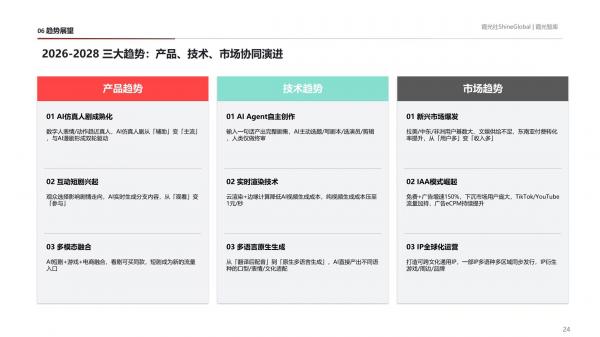
But before then, the industry must first bridge the current chasm—shifting from "competing on output" to "competing on quality," from "buying traffic" to "building retention," and from "single monetization" to "hybrid monetization."
For all global players, the question is no longer "how much can AI save me" but: when everyone uses AI to cut costs, where does my irreplaceability lie?
-
![]()
Tencent Leads, Baidu Follows, but the AI Office Race is Far from Over
-
![]()
Not Waveguide, Nor BirdBath: TDK Explores a 'Third Path' for AR Displays
-
![]()
Musk Intends to Gift Every U.S. Child a Share of SpaceX: Will They All Become Musk Shareholders?
-
![]()
Hippoc Data Tempers Market Enthusiasm This Time
-
![]()
[Science Popularization] How to Keep 1 Million GPUs Running Without 'Work Stoppage'?
-
![]()
Changan Automobile: Seizing the Moment
-
![]()
Unchecked Production Boom and Traffic Gridlock: What’s the Real Battleground for AI Short Dramas? | China’s AI Short Drama Global Expansion Report
-
![]()
Tesla’s Aerial Vehicle Captures Global Attention, China’s Flying Car Advances with Regulatory Sandbox Trials