Tencent Leads, Baidu Follows, but the AI Office Race is Far from Over
 10/21 2026
 474

Migration Barriers Lowered: Are Your Clients Still Secure?
Author|Yixiu
Editor|Xiaobai
Illustrations|AI-generated
Produced by|Qiangdiao Next
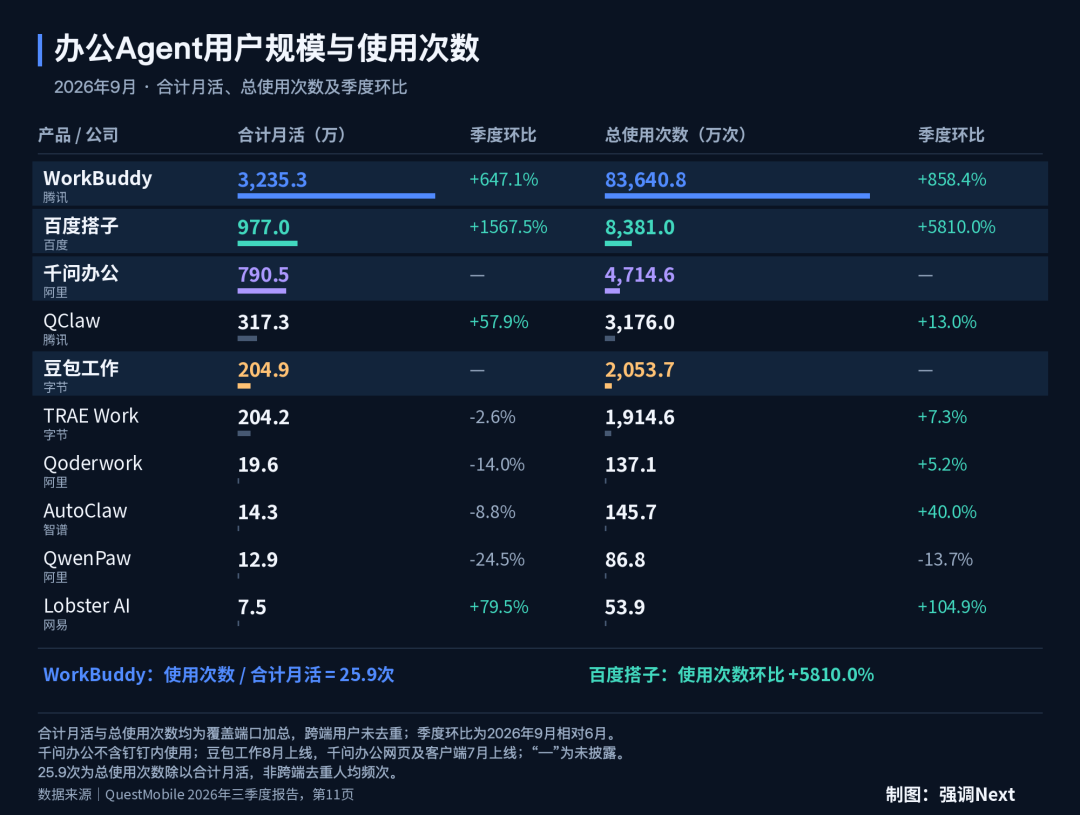
On October 20, QuestMobile released its Q3 AI application market report. In September, the total active users in the AI office sector reached 142 million, a year-on-year increase of 50.6%. The top three typical office agents were Tencent's WorkBuddy, Baidu Dazi, and Alibaba's Qianwen Office, with active user bases of 32.353 million, 9.77 million, and 7.905 million, respectively.
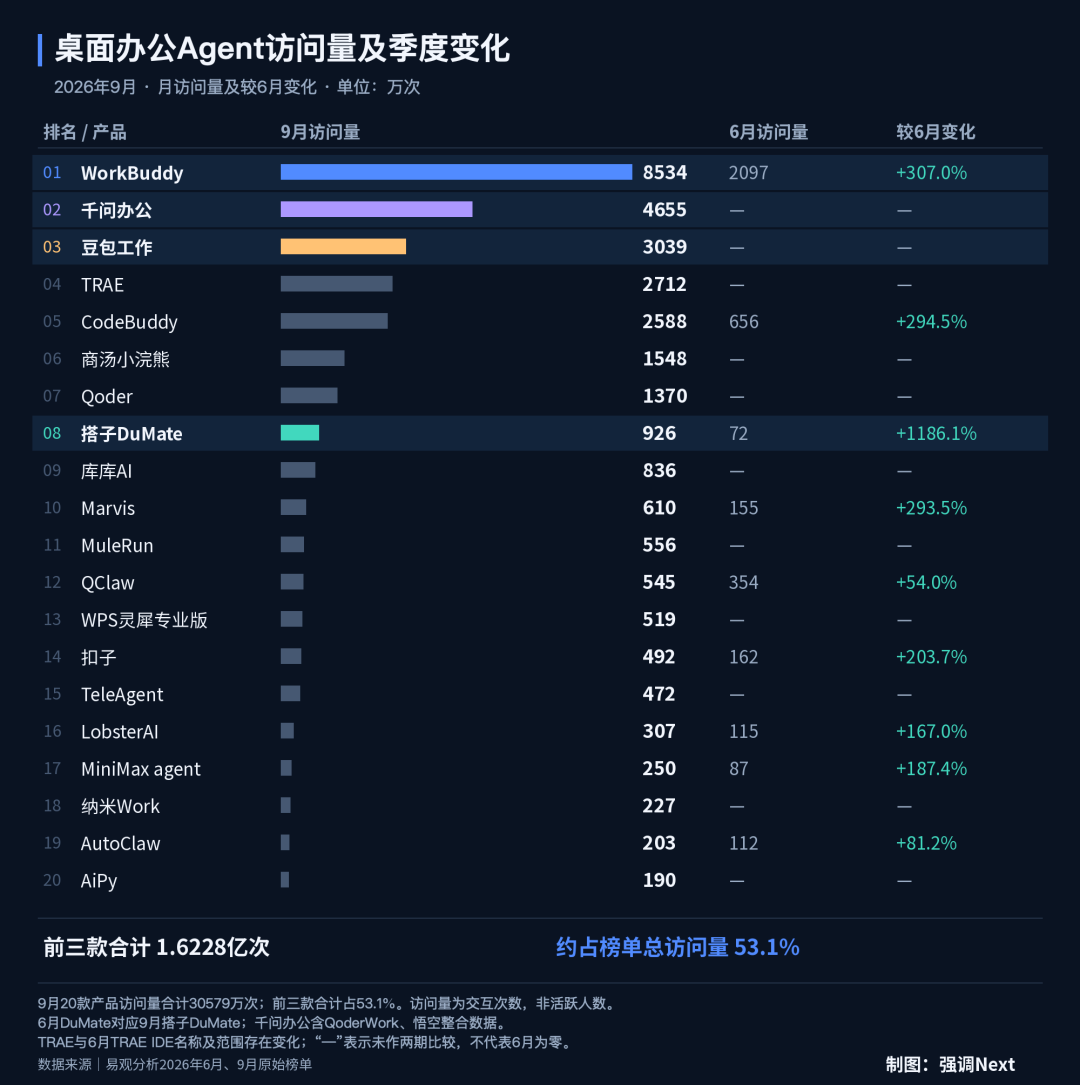
Another ranking offers a different perspective. According to Analysys' September statistics on desktop office agents, WorkBuddy, Qianwen Office, and Doubao Work had monthly visits of 85.34 million, 46.55 million, and 30.39 million, respectively. These three products accounted for 53.1% of the total visits among the 20 listed products.
The two rankings measure different aspects—QM sums up monthly active users across product ports without deduplicating cross-platform users, while Analysys looks at interaction counts on desktop applications. Neither ranking directly reflects corporate orders, but both aim for the same goal: converting individual trials into fixed team expenses.
Major players have started poaching clients from each other. Qianwen Office supports migrating local historical data from WorkBuddy; Doubao Work allows users to transfer conversations, skills, and memories from other AI tools; Tencent integrates WorkBuddy into WeCom and provides robot access for DingTalk and Feishu.
Businesses can continue using their original software for meetings, chats, and approvals while delegating some tasks to another company's AI. Existing collaboration software clients are becoming common targets for office agents.
Tencent's Contact List Can't Secure All AI Budgets
Tencent maintains its leading position. According to QM, in September, WorkBuddy's total monthly active users were approximately 3.3 times those of Baidu Dazi and 4.1 times those of Qianwen Office, with multi-platform usage reaching 836 million times. Based on Analysys' desktop data, WorkBuddy's monthly visits increased from 20.97 million in June to 85.34 million in September, a 4.07-fold increase in three months.
But to sustain this lead, Tencent cannot just defend its base.
On October 9, WorkBuddy introduced a standalone file browser, allowing local files to be previewed and edited by AI directly. On October 14, WeCom and WorkBuddy jointly released a new version: after enterprises activate and allocate seats, employees can access WorkBuddy from the contact list or sidebar, or log in to the client with their WeCom accounts to handle messages, documents, meetings, and to-dos within authorized limits.
This eliminates a step in customer acquisition for Tencent. Employees already communicate on WeCom, and work materials are stored there. WorkBuddy can take on tasks based on existing records without requiring users to re-upload files or explain contexts each time.
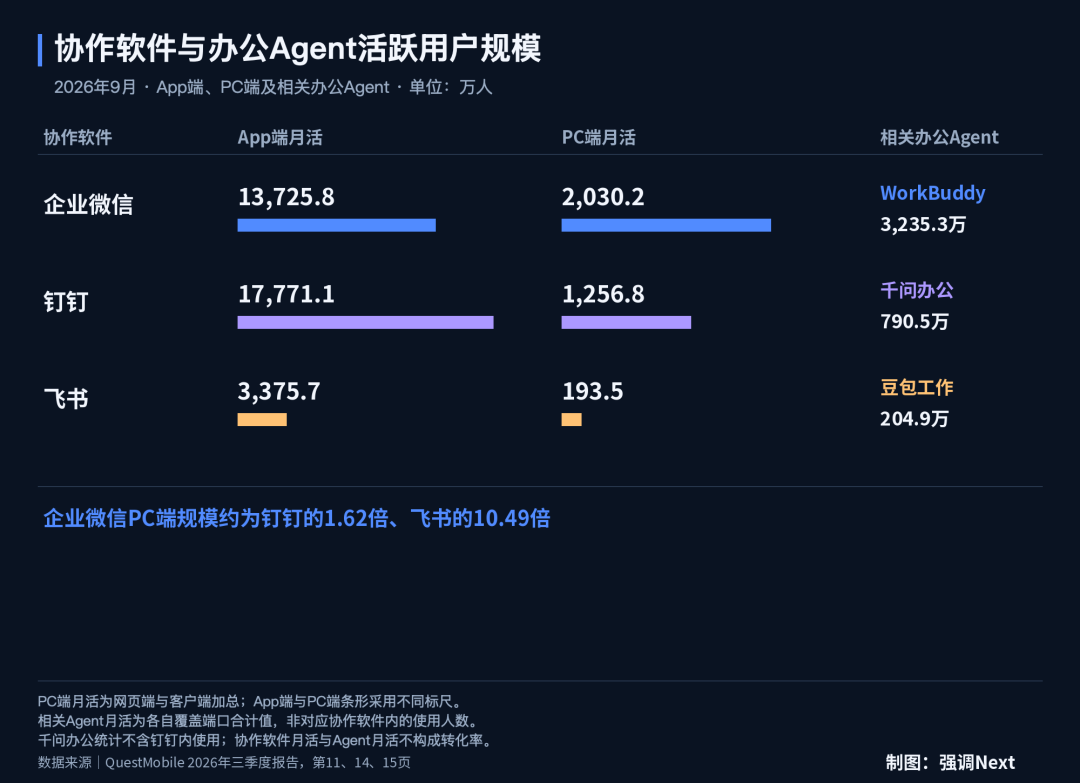
QM's data illustrates the scale of this advantage: in September, WeCom's PC-end monthly active users totaled 20.302 million, compared to DingTalk's 12.568 million and Feishu's 1.935 million. With a larger desktop presence, Tencent is closer to where work happens.
However, Tencent hasn't locked WorkBuddy inside WeCom. The official guide also provides access methods for DingTalk and Feishu. After configuration, users can assign tasks to WorkBuddy on their computers via robots.
This opens up competitor client bases for Tencent and weakens the rule that "businesses using a certain collaboration software will buy its AI." The contact list reduces client acquisition costs but no longer solely determines where new budgets go.
On October 16, WorkBuddy's update log recorded a fix: after the WeCom robot generated a file, the reply got stuck in thinking mode, and the file wasn't sent back to the conversation. For Tencent, model generation is only half the battle. Employees need results in their original work windows for the task to be considered complete.
Baidu Competes for a Task First
Baidu Dazi lacks a collaboration portal of similar scale but ranks second on QM's office agent list.
In September, its total monthly active users reached 9.77 million, with multi-platform usage totaling 83.81 million times. Compared to June, the former grew by 1567.5%, and the latter by 5810.0%. While early low bases amplify growth rates, usage outpacing user scale suggests this expansion involves more than just new users opening the product.
Baidu also has another product in the rankings. On Analysys' desktop list, Kuku AI ranked ninth with 8.36 million visits, just behind Dazi (9.26 million). This means Baidu's desktop office users are split between two products. Baidu states that Kuku AI's global AI office monthly active users exceed 40 million, including over 10 million from the overseas version Kooko. However, this metric covers portals like Wenku and Wangpan, differing from the rankings.
The two lines have different roles. Dazi, from Baidu Smart Cloud, integrates into enterprise processes, connecting to internal systems and professional agents like MiaoDa, FaMou, and ShengSuan. Kuku AI, from Baidu Wenku Wangpan, starts from users' existing files, accessing private Wangpan data and public Wenku content upon authorization to directly deliver Word, Excel, and PPT files.
In sales, both convey the same message: turning individual achievements into reusable team assets. Pricing-wise, Baidu's official website currently lists Dazi enterprise seats at a limited-time price of 132 RMB/seat/month, with a minimum purchase of one seat; enterprise increment packs cost 10 RMB/1000 resource points, usable for Dazi, MiaoDa, FaMou, and ShengSuan. Kuku AI enterprise version pricing is undisclosed and customizable.
Starting with just one seat lowers the barrier for departmental trials. Shared resources give Baidu a chance to bundle different tasks into a single purchase. Baidu targets tasks employees are already doing: Dazi enters through enterprise processes, while Kuku AI starts from employees' stored files, both without requiring businesses to switch collaboration software first.
The barrier remains where it was—an individual's successful outcome only justifies a trial. The key is whether another employee can replicate the same results. For Baidu, another challenge overlaps: Dazi and Kuku AI simultaneously sell two similarly capable enterprise versions, requiring sales to first answer which one clients should buy.
Thus, Baidu's second-place ranking shows there's still room to enter businesses beyond collaboration software. With Kuku AI, its office user base is larger than the rankings suggest. However, this doesn't prove it has the second-most enterprise clients. The commercial value lies in turning individual tasks into fixed organizational processes, and Baidu must first prove its two solutions don't cannibalize each other.
Alibaba Starts Competing for Merchants' Operational Budgets
Alibaba's path was hinted at by a set of payment data.
On October 14, Qianwen Office launched an e-commerce version and began inviting testers. The launch revealed that e-commerce users already account for 20% of Qianwen Office's paying clients. This means Alibaba, while chasing general office scale, has found a client base with concentrated needs willing to pay.
The e-commerce version integrates with tools like Business Advisor, Youzan, and Qianniu, offering cross-platform operation dashboards, bulk material generation, and ad return optimization. The next day's client update added an e-commerce operation mode for managing related conversations, projects, and scheduled tasks separately.
When merchants purchase such products, their reference points shift. Estimating how long it takes to create product materials, how much manpower is needed to consolidate store data, and whether order and inventory inspections still require manual checks becomes easier than measuring "how much office efficiency has improved."
Qianwen Office can now vie for budgets allocated to material creation, operational analysis, and daily operations. These recurring tasks could support sustained payments. While 20% doesn't prove Alibaba's profitability in this area, it explains its deep dive into e-commerce.
The issue lies here. Qianwen Office CEO Chen Yusen positions the e-commerce version as a third-party agent for all e-commerce platforms and merchants. For Alibaba, this means the product must balance interests across channels: merchants need holistic store input, conversion, and profit insights, not just Taobao-centric advice.
At launch, proactively identifying inventory, ad, and after-sales anomalies and assisting in handling them remained planned features. The e-commerce version's ability to take over operational tasks will ultimately be proven by actual delivery.
Meanwhile, Alibaba hasn't stopped pursuing general office users. The September 18 update added support for migrating local historical data from WorkBuddy. While merchant scenarios help find paying reasons, migration tools directly reduce costs for Tencent users switching over.
Doubao Aims to Transfer Users' Completed Work
ByteDance's most easily overestimated advantage is the user base of its Doubao App.
QM data shows Doubao App had 419 million monthly active users in September. In the same report, Doubao Work's total monthly active users reached 2.049 million; on Analysys' desktop list, its 30.39 million visits lagged behind WorkBuddy and Qianwen Office. Launched in August, Doubao Work's current gap includes a market entry time difference, but the massive mobile user base hasn't automatically converted to office clients.
ByteDance now directly targets users already working with AI.
On October 14, Doubao Work introduced data import and synchronization, supporting migration of task preferences, skills, connectors, working memory, and historical conversations from products like ChatGPT, Claude Code, and Trae Work.
The value of this content lies in the time users have already invested—adjusting report formats, explaining common requirements, and discussing project backgrounds. Switching AI tools would render these preparations obsolete, requiring new products to offer significant advantages to offset reconfiguration hassles.
Migration tools give ByteDance a chance to win over ongoing work. For competitors, the historical conversation-based user stickiness now faces an additional exit path.
However, importing personal data only solves the initial adoption problem. QM's report lists Feishu as Doubao Work's connection carrier, but organizational knowledge, business records, and collaboration networks are its next steps into teamwork. In September, Feishu App had 33.757 million monthly active users, with its PC version totaling 1.935 million, still far behind WeCom and DingTalk in Entrance scale (portal scale).
ByteDance must accomplish two things simultaneously: reducing migration costs for existing AI users and convincing companies to continue work there. The former relies on import tools, while the latter depends on results usable by colleagues.
Renewal Costs Hinge on Usage Volume
The growth of office agents clearly favors standalone apps that directly handle files and tasks.
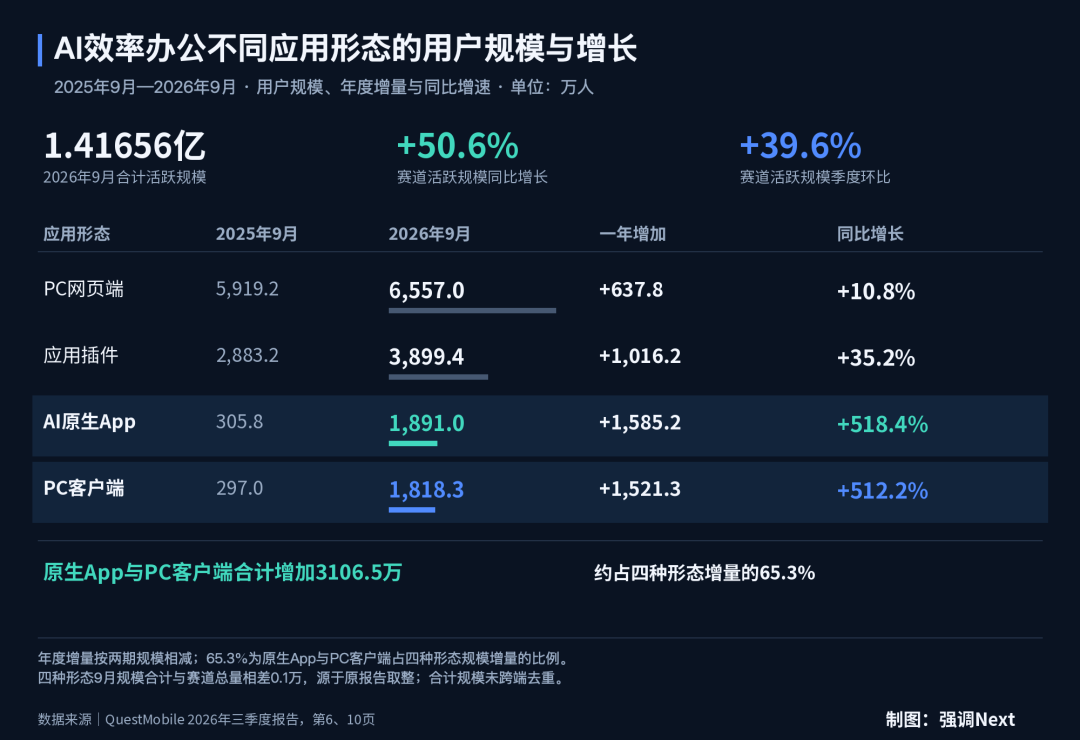
Calculated from QM's reported values, over the past year, the combined active scale of native AI office apps and PC clients increased by 31.065 million, accounting for about 65.3% of the total growth across web, plugins, native apps, and PC clients. While not deduplicated new users, this indicates users are increasingly delegating work to standalone tools.
Standalone tools also bring standalone bills. WorkBuddy's domestic personal version offers three continuous monthly subscription tiers: 70 RMB, 140 RMB, and 700 RMB, with varying point allocations and additional top-up packs. Baidu sells enterprise seats and incremental resources separately. Purchasers now consider more than "how many accounts were bought."
Repeated task execution consumes quotas, while manual checks, modifications, and takeovers occupy work hours. Increased visits signify growth for vendors but may also mean higher costs for enterprises to complete the same work. Ranking popularity doesn't replace this calculation.
This explains why the four companies continue enhancing products beyond models. Files must be findable, permissions inheritable, results returnable to original work windows, and errors addressable. Falling short in any step could push AI-delegated labor back to employees.
Existing collaboration systems retain data, permissions, and work habits, making vendor switches not cost-free. However, AI vendors have found a smaller entry point: take over a repetitive task first, then vie for its corresponding budget.
A company can keep using Feishu for meetings, DingTalk for approvals, and simultaneously pay WorkBuddy for file processing. The seller of the last office software suite no longer naturally owns the next AI bill.
When renewal day arrives, procurement leaders will tally subscription fees, extra usage, and employee rework time. On that bill, how much work is completed for less money matters more than AI call volume.
Header Image: "Battle After Battle"
- END -
-
![]()
Tencent Leads, Baidu Follows, but the AI Office Race is Far from Over
-
![]()
Not Waveguide, Nor BirdBath: TDK Explores a 'Third Path' for AR Displays
-
![]()
Musk Intends to Gift Every U.S. Child a Share of SpaceX: Will They All Become Musk Shareholders?
-
![]()
Hippoc Data Tempers Market Enthusiasm This Time
-
![]()
[Science Popularization] How to Keep 1 Million GPUs Running Without 'Work Stoppage'?
-
![]()
Changan Automobile: Seizing the Moment
-
![]()
Unchecked Production Boom and Traffic Gridlock: What’s the Real Battleground for AI Short Dramas? | China’s AI Short Drama Global Expansion Report
-
![]()
Tesla’s Aerial Vehicle Captures Global Attention, China’s Flying Car Advances with Regulatory Sandbox Trials