Changan Automobile: Seizing the Moment
 10/21 2026
 434
Introduction
Stepping into a New Era at Changan Automobile Post-Zhu Huarong
At a pivotal point in the transition to new energy vehicles, where every company is striving to gain an edge, Changan Automobile has made a daring move by changing its leadership.
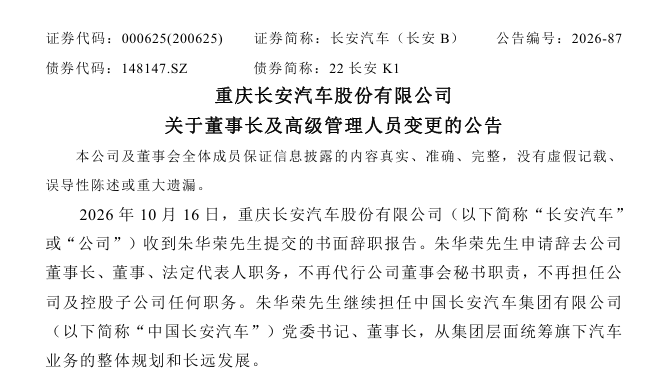
Recently, Changan Automobile Co., Ltd. (Changan Automobile) announced that Zhu Huarong had stepped down as chairman, director, and legal representative, relinquishing all positions within the company and its subsidiaries. However, he will continue to serve as party secretary and chairman of China Changan Automobile Group Co., Ltd. (China Changan).
Simultaneously, the board elected Zhao Fei as the new chairman of Changan Automobile, appointed Ye Pei as president, Yang Dayong as executive vice president, and Deng Chenghao as executive vice president.
The announcement clarified that the adjustment aims to enhance China Changan Automobile's role as a specialized automotive industry group in areas such as "strategic planning, resource allocation, collaboration facilitation, risk control, and incentive strengthening."
In a media interview on the same day, Zhu Huarong explained that the intention was to delineate the governance boundaries between the group and the listed company, with the president position now filled internally rather than directly by group leadership.
Given that this personnel adjustment involves Zhu Huarong, the top leader of Changan Automobile, especially since he had just been re-elected as chairman last month, the sudden resignation has sparked widespread speculation within the industry.
For Zhao Fei, who is stepping in at a critical juncture in Changan's new energy transition, it is clear that the group has entrusted him with significant responsibilities. Currently, Changan Automobile's share of fuel vehicles is declining, while new energy vehicles have yet to fully shoulder the sales burden. Additionally, the challenge of managing multiple brands looms large, indicating that Zhao Fei faces considerable pressure.
Changan Automobile's Financial Performance
Let's first examine the September figures. Changan Automobile sold 215,400 vehicles, a year-on-year decrease of 19.11%. Among them, 119,800 were new energy vehicles, up 15.64% year-on-year, accounting for 55.6% of group sales; overseas sales reached 94,200 vehicles, accounting for 43.72%.
Structurally, this is a commendable performance. New energy vehicles account for over half, and overseas sales exceed 40%, indicating that fuel vehicles are no longer the mainstay. According to data from the China Passenger Car Association, domestic passenger car retail sales in September declined by 28% year-on-year. Maintaining this structure under such market conditions suggests that the direction of the transition is sound.
The issue lies in the cumulative data. From January to September, Changan Automobile's cumulative sales were 1.6927 million vehicles, down 18.07% year-on-year; new energy vehicle sales totaled 709,300 vehicles, down 2.07% year-on-year. While the 15.64% growth in new energy vehicle sales in September is promising, it cannot alter the trend of the first three quarters. Last year's subsidy-driven purchasing spree raised the base, and this year's slower pace of new vehicle launches has squeezed the cumulative data.
Looking at individual brands, the performance of the three business segments varies greatly.
Qiyuan is the only one that has truly taken off. With 46,500 vehicles sold in September and 45,900 in August, maintaining over 45,000 units for two consecutive months, the brand's cumulative sales surpassed 1 million in September. In the first half of the year, the Qiyuan Q05 consistently sold over 15,000 units per month, ranking first among compact pure electric SUVs for three consecutive months. In the second quarter, Qiyuan achieved quarterly profitability for the first time, with the average selling price per vehicle increasing by 12,000 yuan year-on-year. In this year's price war, achieving volume growth, price increases, and profitability simultaneously is no easy feat.
Shenlan has established its scale but slowed down. With 30,200 vehicles sold in September and 252,200 from January to September, up 8.59% year-on-year, the 1 millionth vehicle rolled off the production line on September 28. Last year's growth rate was 36.6%, dropping to single digits this year. In the first half of the year, the Shenlan S05 ranked first in sales for four consecutive months in the 120,000-180,000 yuan pure electric compact SUV segment. The product itself is sound, but the issue lies in the limited capacity of this price segment, and Shenlan is still operating at a loss.
Avita's situation is the most challenging. With 8,183 vehicles sold in September, down 25.8% year-on-year, and about 51,500 vehicles from January to September, just slightly higher than the monthly sales of 30,000-40,000 units of leading new luxury brands. While losses are narrowing and the average selling price per vehicle is increasing, with a Hong Kong Stock Exchange IPO in progress, it is difficult for a high-end brand selling fewer than 10,000 units per month to cover fixed R&D and channel investments.
The three brands combined sold 84,900 vehicles in September.
Profitability tells an even more telling story. In the first half of the year, Changan Automobile's operating revenue was 65.634 billion yuan, down 9.71% year-on-year; net profit attributable to shareholders was 817 million yuan, down 64.32% year-on-year; net profit attributable to shareholders excluding non-recurring items was 251 million yuan, down 83.01% year-on-year, with second-quarter net profit excluding non-recurring items at only 8 million yuan. Net cash flow from operating activities was negative 11.413 billion yuan, compared to negative 8.607 billion yuan in the same period last year.
While sales are growing, profits and cash flow are deteriorating, indicating that the scale of new energy vehicles has not yet reached the point where it can cover investments. Indicators such as penetration rate, product mix, and partial profitability have been achieved, but overall economic viability has not been realized.
Overseas data can serve as a reference. In the first half of the year, Changan's overseas gross margin was 20.13%, compared to only 11.67% domestically; overseas revenue was 21.942 billion yuan, up 78.77% year-on-year, accounting for 33.43% of total revenue, up from 16.89%. Currently, profits are largely driven by overseas gross margins compensating for thin domestic margins. The 43.72% overseas sales share in September reflects this. However, overseas markets are still in the investment phase, with factories in Rayong, Thailand, and Anápolis, Brazil, ramping up production, and channels, inventory, and local teams requiring upfront spending, resulting in increased revenue but not yet profits in the short term.
Industry Positioning: At the Forefront of the Second Tier
Placing Changan among the major automotive groups clarifies its position.
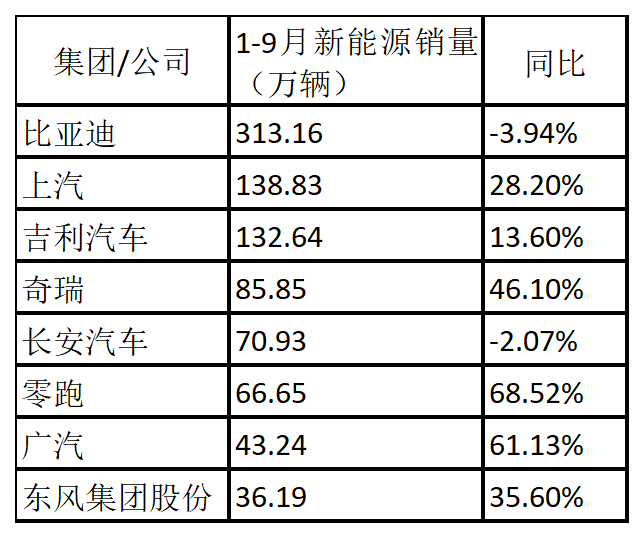
The data in the table is sourced from company announcements or production and sales reports, with inconsistent statistical scopes, and is provided for reference only.
Among these eight companies, Changan and BYD are the only two with negative figures, but for different reasons. BYD is actively adjusting its structure at a volume of 3.13 million units, shifting incremental sales overseas, with overseas sales reaching 180,700 units in September, nearly 40% of total sales. Changan, at a volume of 700,000 units, is held back by product transitions and the phase-out of fuel vehicles.
The paths of several competitors are also worth comparing.
BYD is fully committed to new energy vehicles, using vertical integration to drive costs down to a level others cannot match, now relying on overseas markets for growth. At over 3.13 million units, four times Changan's volume, this path is not yet feasible for Changan.
Geely sold 190,900 new energy vehicles in September, with a penetration rate of 65%, also operating multiple brands, but the difference is that each brand leads in its respective price segment.
Chery relies on exports for growth. With 858,500 new energy vehicles sold, up 46.1% year-on-year, and 207,800 vehicles exported in September, a record high, a significant portion of its new energy growth comes from overseas markets.
Changan's approach of a multi-brand strategy plus overseas markets is most similar in form to Geely, with the gap lying in scale. Qiyuan's 46,500 units in the 80,000-250,000 yuan mainstream market is not weak, but it faces Geely Galaxy's 130,500 units and BYD's Wangchao and Ocean series' 394,900 units. Shenlan's 30,200 units have established a foothold in the 150,000-200,000 yuan new energy SUV segment, but the pool itself is not large. Avita's 8,183 units in the 300,000 yuan-plus segment face Zeekr's 37,200 units, doubling year-on-year, as well as Aito and Nio. Combined, the three brands amount to only two-thirds of Geely Galaxy's volume.
The issue multi-brand strategies face in 2026 is common across the industry. The market has shifted from incremental expansion to stock substitution, with new energy vehicle retail penetration at 67%, domestic retail penetration of new energy vehicles by independent brands at 84.5%, and mainstream joint ventures at only 15.9%. The share that can be divided is largely divided, leaving only the last stronghold of joint venture fuel vehicles. Multi-brand strategies, originally intended to cover blank price segments, now involve slicing the same market multiple times. The finer the slice, the harder it is for each brand to amortize R&D, platform, and channel costs.
Adjustments in the past two years reflect this direction. Changan has merged the styling, product development, platform technology, and human resources and finance of Avita and Shenlan into the newly established AD Synergy Development Department; GAC Group merged Hyper and Aion into the same business division by the end of 2025. The approach is the same—reducing the number of brands to increase the scale of individual brands.
This leadership change continues this line of thinking. Zhao Fei, in his role as group general manager, also serves as chairman of the listed company, while Ye Pei is promoted from executive vice president to president, and Deng Chenghao, chairman of Shenlan, joins the listed company's executive vice president ranks. This arrangement aims to shorten the decision-making chain between the group and the listed company, translating collaboration between Avita and Shenlan from documents into departments. It primarily addresses efficiency issues.
Now, it remains to be seen where Zhao Fei and the new core leadership team can lead Changan Automobile.
-
![]()
Tencent Leads, Baidu Follows, but the AI Office Race is Far from Over
-
![]()
Not Waveguide, Nor BirdBath: TDK Explores a 'Third Path' for AR Displays
-
![]()
Musk Intends to Gift Every U.S. Child a Share of SpaceX: Will They All Become Musk Shareholders?
-
![]()
Hippoc Data Tempers Market Enthusiasm This Time
-
![]()
[Science Popularization] How to Keep 1 Million GPUs Running Without 'Work Stoppage'?
-
![]()
Changan Automobile: Seizing the Moment
-
![]()
Unchecked Production Boom and Traffic Gridlock: What’s the Real Battleground for AI Short Dramas? | China’s AI Short Drama Global Expansion Report
-
![]()
Tesla’s Aerial Vehicle Captures Global Attention, China’s Flying Car Advances with Regulatory Sandbox Trials