Not Waveguide, Nor BirdBath: TDK Explores a 'Third Path' for AR Displays
 10/21 2026
 477
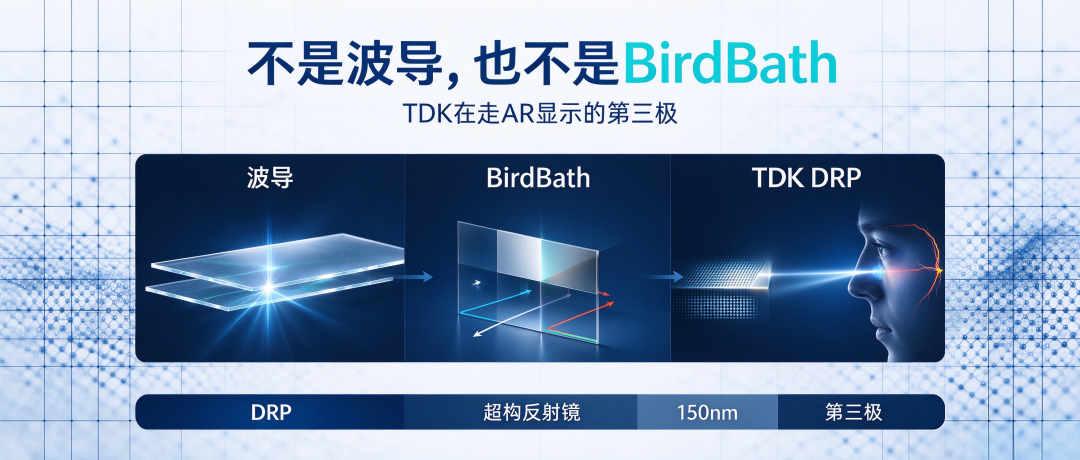
Summary: TDK's innovative meta-optical mirror solution diverges from both waveguide and BirdBath designs, opting instead for a Direct Retinal Projection (DRP) approach.
By utilizing a 150nm planar nanoscale mirror to replace traditional bulky curved mirrors, this technology enables lasers to project images directly onto the retina. The success of this approach hinges on two main challenges: achieving full-color display capabilities and maintaining costs at a level that is affordable for consumers.
Waveguides have long been hailed as the 'ideal optical solution' for AR glasses within the industry, while BirdBath provides a more budget-friendly option for the lower-end market.
In October 2026, TDK introduced a groundbreaking solution: a single layer of meta-optical mirrors, just 150 nanometers thick, capable of projecting laser images directly onto the human retina.
This technology is neither a waveguide nor a BirdBath design, potentially paving the way for a 'third path' in AR display innovation.
The Logic of DRP: Projecting 'Behind the Eyes,' Not 'In Front'
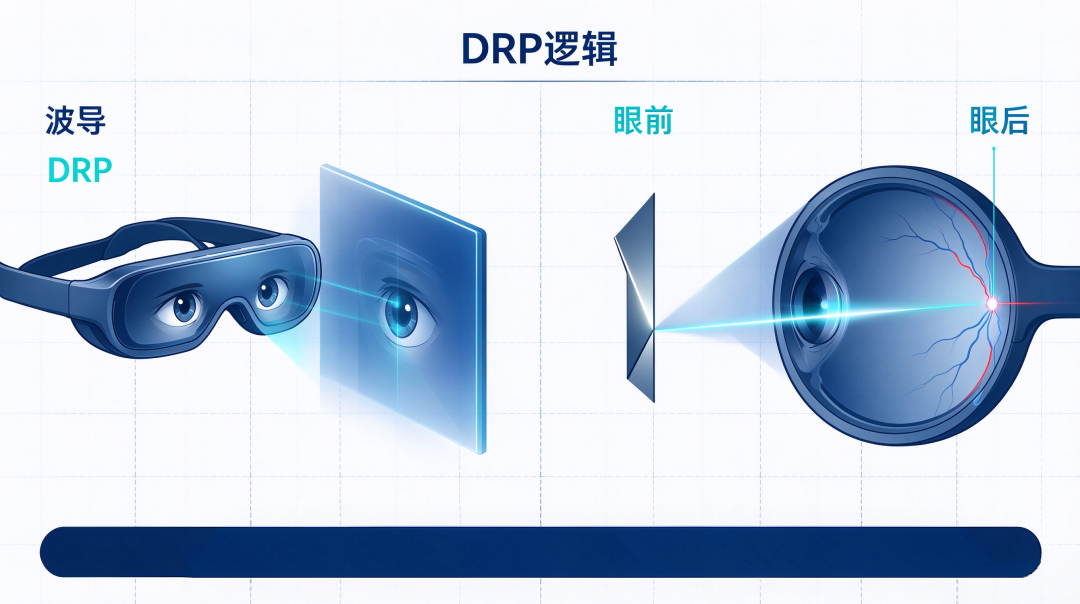
To appreciate the uniqueness of TDK's solution, it's essential to understand the fundamental differences between Direct Retinal Projection (DRP) and waveguide technologies.
The waveguide method generates a virtual image in front of the eyes, requiring the eyes to focus on this image for clear viewing. Essentially, the image is positioned ahead of the eyes.
Conversely, the DRP approach involves lasers carrying image information, adjusting their direction through optical elements, passing through the pupil into the eyeball, and relying on the eye's own refractive system to form an image directly on the retina.
The image is not situated in front of the eyes but behind them. This key distinction offers several inherent advantages: DRP imaging clarity remains unaffected by the wearer's refractive errors, enabling nearsighted users to view digital images clearly without the need for additional corrective lenses; while viewing the real world may still necessitate prescription glasses, digital images do not require extra corrective optics.
Theoretically, DRP significantly reduces image leakage, making it difficult for onlookers to discern what the user is viewing; lasers inherently possess high brightness and color purity, avoiding the optical efficiency losses associated with waveguides.
TDK's Breakthrough: Replacing 'Convex Curved Mirrors' with 150nm Planar Mirrors
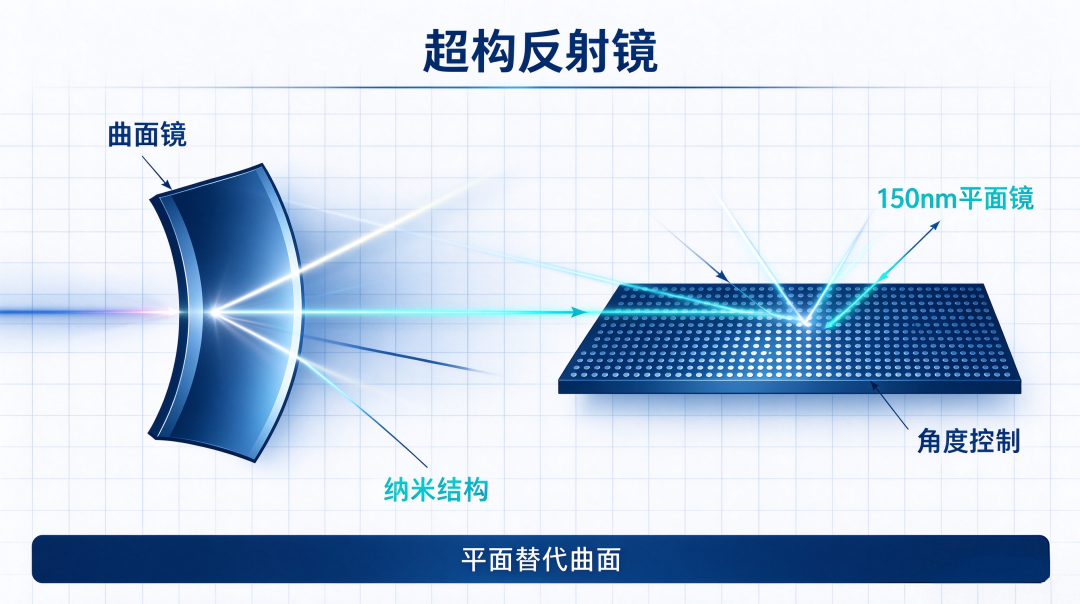
DRP is not a completely novel technology; however, it has traditionally faced a significant drawback: the necessity for a bulky curved mirror in front of the eyes to adjust the laser's optical path.
This outwardly convex mirror gives the glasses a sci-fi appearance, making it challenging to achieve the sleek form factor of everyday eyewear. TDK's solution introduces the meta-optical mirror, which replaces these traditional curved mirrors.
This reflective film is a mere 150 nanometers thick, boasting approximately 80% visible light transmittance.
It achieves a position-dependent phase/angle response through nanostructures, breaking the conventional fixed relationship between the angle of incidence and reflection in ordinary planar mirrors. This allows the planar mirror to perform the deflection function typically associated with curved mirrors.
By arranging numerous nanoscale reflective units on a planar substrate, and relying on the nanostructures at different positions on the mirror surface to alter the reflection angle of light, lasers entering from multiple angles are emitted at the precise angles required by the DRP optical path.
While ordinary planar mirrors strictly adhere to the law of reflection (angle of incidence equals angle of reflection), meta-mirrors utilize nanostructures to control the light's phase response, achieving optical field control that is beyond the capabilities of ordinary planar mirrors.
In simpler terms, by leveraging the spatial design of nanostructures to replace the geometric shape of curved lenses, a single planar mirror can perform the functions of a curved mirror.
Why It's 'Neither Waveguide Nor BirdBath'
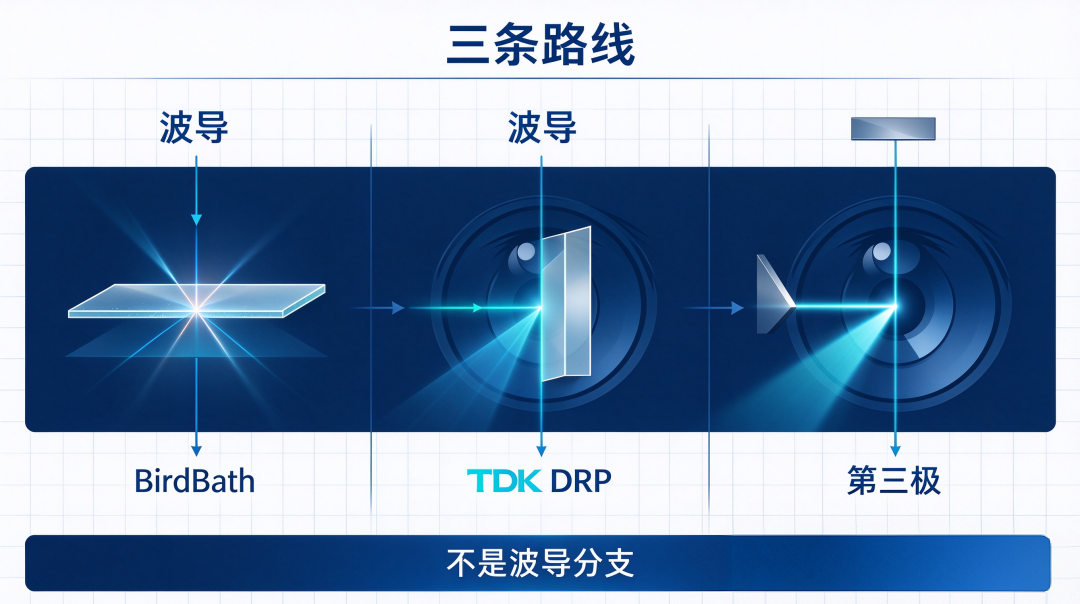
From a technical standpoint, TDK's solution fundamentally differs from the two current mainstream approaches.
Waveguide technologies (including geometric, SRG, VHG, metasurface, and PVG variants) share a unified logic: light propagates through total internal reflection within the waveguide medium, then exits through a coupling structure into the human eye, with light transmission occurring internally within the waveguide.
The BirdBath solution, on the other hand, involves a microdisplay outputting an image, which is then reflected into the eye via a semi-transparent mirror, with light traveling through free space and undergoing mirror reflection.
TDK's DRP solution operates differently: lasers do not propagate inside a waveguide nor rely on a semi-transparent mirror for beam splitting; instead, light is adjusted by the meta-mirror and directly enters the pupil, traveling through free space and undergoing meta-reflection.
As discussed in the previous article 'Waveguide Technology Classification: Five Paths, Five Physical Logics,' geometric, diffractive, metasurface, and PVG approaches all fall under the waveguide system.
TDK's solution, however, does not represent a new branch within the waveguide system but rather a third path that exists independently of waveguides and BirdBath.
The Two Main Challenges for TDK's Solution: Full Color and Cost
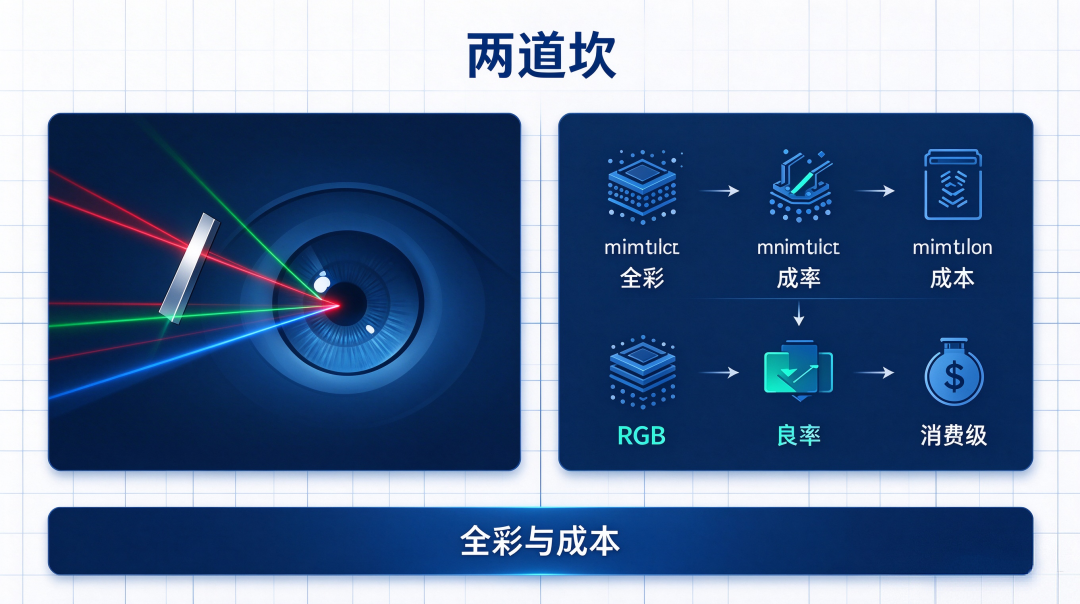
TDK's current public demonstration is a monochrome prototype, with the company explicitly stating that the meta-optical mirror currently supports only monochrome operation. Full-color demonstrations and mass production are anticipated in the coming years.
The challenge of achieving full color lies in the fact that DRP requires red, green, and blue lasers to synchronously enter the pupil at precise angles.
Given that the wavelengths of these three colors differ, the meta-mirror must independently control the reflection angles of all three wavelengths while maintaining high transmittance and suppressing channel crosstalk.
Although TDK has developed a compact full-color laser module (FCLM) and a 4K visible light laser control device, these represent supporting component capabilities and do not indicate that the monochrome prototype has achieved full-color imaging.
Cost considerations are also paramount. TDK mentions that the meta-mirror can be manufactured using semiconductor-like processes, potentially enabling cost-competitive mass production in the future.
However, semiconductor-like processes do not automatically guarantee low costs; nanostructure overlay registration, wavelength sensitivity, and large-area uniformity remain significant challenges in the industry. Achieving stable high-yield production with this visible-wavelength nanofabrication process is still a widespread hurdle in the meta-optics industry.
What Does This Mean for the Industry? The value of TDK's solution for the AR industry lies not in the performance limits of the current prototype but in providing a completely different physical path.
If this route proves viable, AR optics will no longer be limited to just waveguides and BirdBath designs.
Several potential advantages of meta-reflective DRP include: being unrestricted by waveguide optical efficiency, enabling nearsighted users to view digital images without corrective optics, and theoretically significantly reducing image leakage, directly addressing several key pain points of waveguides.
However, whether this 'third path' can gain a foothold depends not on the elegance of the principle but on two core factors: whether a mature full-color solution can be achieved in the coming years and whether costs can be reduced to a range acceptable for consumer-grade glasses.
In summary, while TDK's solution is worth tracking continuously, the 2026 monochrome prototype is still a considerable distance from representing a truly mature third path.
Interactive Topic: Compared to waveguides, which path do you think is more likely to succeed first in consumer-grade AR glasses—TDK's meta-reflective DRP solution? Feel free to leave a comment sharing your judgment.
【Risk Disclaimer】This article provides an overview of the AR industry; descriptions of TDK's solution are based on publicly disclosed technology. Prototype performance, full-color development progress, yield, and mass production costs remain uncertain. The technology's implementation timeline and final product performance are subject to official announcements from the manufacturer.
— AR Andy | Focusing on waveguide and AR microdisplay sectors, deeply analyzing the underlying logic of the optics industry
-
![]()
Tencent Leads, Baidu Follows, but the AI Office Race is Far from Over
-
![]()
Not Waveguide, Nor BirdBath: TDK Explores a 'Third Path' for AR Displays
-
![]()
Musk Intends to Gift Every U.S. Child a Share of SpaceX: Will They All Become Musk Shareholders?
-
![]()
Hippoc Data Tempers Market Enthusiasm This Time
-
![]()
[Science Popularization] How to Keep 1 Million GPUs Running Without 'Work Stoppage'?
-
![]()
Changan Automobile: Seizing the Moment
-
![]()
Unchecked Production Boom and Traffic Gridlock: What’s the Real Battleground for AI Short Dramas? | China’s AI Short Drama Global Expansion Report
-
![]()
Tesla’s Aerial Vehicle Captures Global Attention, China’s Flying Car Advances with Regulatory Sandbox Trials