"DeepSeek and Its Peers" Prioritize Computing Power Over Meta's Ace
 10/27 2026
 365
Addressing Vulnerabilities: A Unified Approach Domestically and Abroad
Authored by: Chen Dengxin
Edited by: Li Ji
Layout Design: Annalee
The open-source model arena has welcomed another formidable contender.
Meta recently unveiled Muse Spark Open, the most potent open-source model in the U.S., boasting a staggering 816 billion parameters. Each token can activate around 42 billion parameters, supporting a context window of 1 million tokens and accepting inputs in text, image, video, and audio formats.
Upon its launch, Muse Spark Open garnered acclaim from Apple's newly appointed CEO, John Ternus.
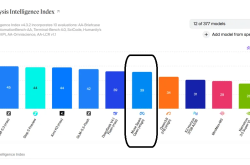
However, on the Artificial Analysis open-source model leaderboard, Muse Spark Open only managed to secure the seventh position at that time, with evaluation scores on par with DeepSeek V4.1 Flash.
It's clear that in the open-source model domain, "DeepSeek and its peers" maintain an unchallenged lead. Yet, to advance further in the global large model competition, tackling the computing power challenge is crucial.
Undoubtedly, "DeepSeek and its peers" are less concerned about additional competitors and more focused on addressing their vulnerabilities.
The Ultimate Goal of Large Models: Chip Manufacturing
Currently, addressing vulnerabilities has become a shared objective both domestically and internationally.
Abroad, closed-source large models are favored due to their significant competitive edge in data security, commercial monetization, and response speed. Coupled with the示范效应 (which can be translated more naturally in English as "leading example" or "influential precedent") set by ChatGPT, Claude, and Gemini, closed-source models dominate.
The issue, however, lies in their disadvantage in market penetration, AI accessibility, and ecosystem development.
Against this backdrop, open-source large models have emerged as a formidable force. Yet, differing factions hold divergent views, leading to a prolonged debate between open-source and closed-source models.
Unexpectedly, DeepSeek's emergence has revolutionized the competitive landscape of large models, expanded the horizons of open-source models, and prompted an increasing number of domestic players to switch allegiances.
Consequently, domestic large models have gone global.
Data from OpenRouter reveals that Chinese open-source large models have topped the weekly call volume rankings for 25 consecutive weeks, rivaling international top models in influence.
Zhang Qian, founding partner of Tianji Capital, stated, "The commercial revenue of closed-source models may decline, while that of open-source models will rise."
As a result, overseas players such as OpenAI, Google, and NVIDIA have also shown keen interest in open-source models.
Ultimately, Meta played its trump card. Although Muse Spark Open trails behind leading domestic open-source models, it still ranks among the top tier of open-source models.
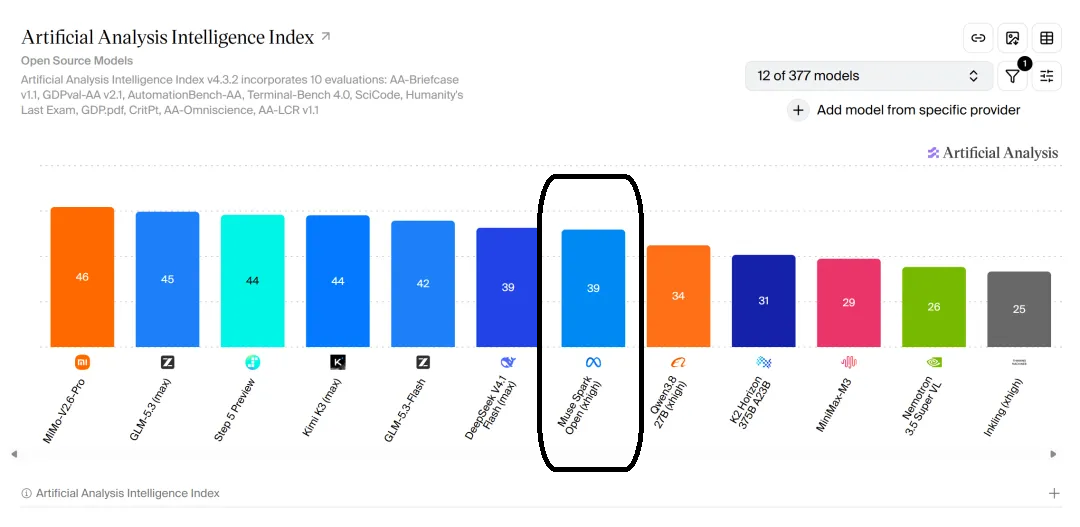
Muse Spark Open Falls Slightly Short of Leading Domestic Open-Source Models
Correspondingly, domestic "DeepSeek and its peers" are also addressing their vulnerabilities.
Their focus, however, is on computing power dominance: As AI transitions from training to inference, token consumption surges, driving up computing power costs. Self-developed chips can significantly reduce these expenses.
This is evident from Amazon's self-developed chips.
Ron Diamant, chief architect of Amazon's Trainium chips, revealed that these chips offer a 30% to 40% cost advantage over third-party chips on AWS.
Consequently, domestic model companies of all sizes, including DeepSeek, Zhipu, Tencent, and ByteDance, have embarked on self-developed chip paths, not only to save costs but also to deeply integrate algorithms with hardware, further unlocking computing power potential.
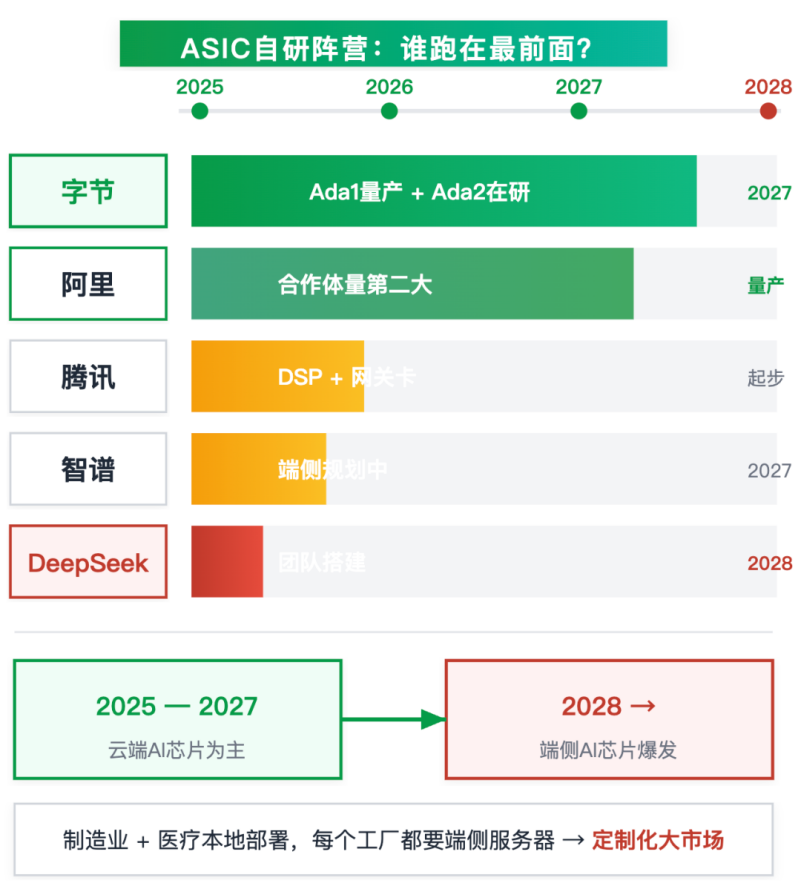
Source: Business Analyst
Chen Ning, Chairman and CEO of Yuntian Lifei, stated, "Model companies, including DeepSeek, are rumored to be exploring self-developed chips. These chips primarily supplement existing computing power systems rather than simply replacing general-purpose platforms. However, this trend indicates that as AI enters large-scale deployment, the importance of computing power costs and software-hardware synergy is rising."
Hypernodes: A Shortcut to Bridge the Computing Power Gap
Consequently, domestic computing power continues to surge.
Public data shows that domestic intelligent computing power reached 1590 ExaFLOPS in 2025 and surged to 2185 EFLOPS in the first half of 2026, a 177% year-on-year increase, indicating explosive growth.
Domestic chips have taken center stage in this growth.
IDC data reveals that nine out of the 11 mainstream Chinese chip companies achieved year-on-year shipment growth in the first half of 2026. Among them, HiSilicon, T-Head, Kunlunxin, and Cambricon collectively accounted for 95% of China's non-GPU accelerator market.
Non-GPU accelerators are primarily used for inference. As AI shifts from training to inference, domestic chips have capitalized on the surge in inference demand, transitioning from "usable" to "highly effective."
During this process, Kunlunxin and T-Head deserve special mention.
As early as 2018, the first-generation Kunlunxin chip was introduced, followed by continuous iterations, enabling deployments of tens of thousands of cards. It became the cornerstone of Baidu's ERNIE Bot large model, expanding beyond internal use to nearly 100 central and state-owned enterprises, including China Mobile, China Merchants Bank, and China Southern Power Grid, becoming a significant force in the computing power market.
Goldman Sachs data shows that Kunlunxin's sales reached approximately 3.5 billion yuan in 2025 and are expected to rise to 6.5 billion yuan in 2026. JPMorgan Chase provides an even more optimistic estimate, projecting 8.3 billion yuan in sales for Kunlunxin in 2026.
Beyond Kunlunxin, T-Head has also performed admirably.
Public information indicates that T-Head has launched the Zhenyue series storage controller chips, Yitian series Arm server CPUs, Zhenwu series AI chips, ICN Switch interconnect chips, and Panmai series smart NICs, achieving full-stack self-development of computing power, network power, and storage power for data centers.
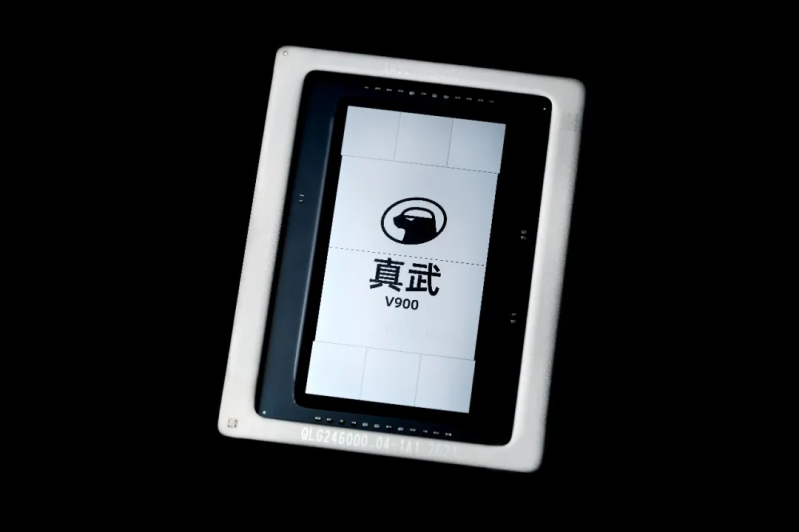
Source: T-Head Semiconductor
A market insider told Zinc Scale, "T-Head's development path is not limited to large model inference but covers mainstream chip systems, pursuing a full-stack self-development route. However, it currently serves Alibaba's computing power ecosystem and has not yet extended its capabilities externally."
Nevertheless, based on Alibaba's computing power ecosystem, it can empower various industries.
Take the Zhenwu series chips as an example. They have served over 650 enterprise clients across finance, energy, large models, embodied AI, and new energy vehicles.
The latest Zhenwu V900 offers three times the performance of the M890, and a single cluster built on it can scale up to 500,000 cards, garnering significant attention.
A hypernode integrates multiple, dozens, or hundreds of AI chips into a supercomputing system with computer-like characteristics. Compared to traditional methods of stacking servers, hypernodes offer lower communication overhead and higher computing power utilization, providing a shortcut to bridge the gap with overseas computing power despite single-card performance differences.
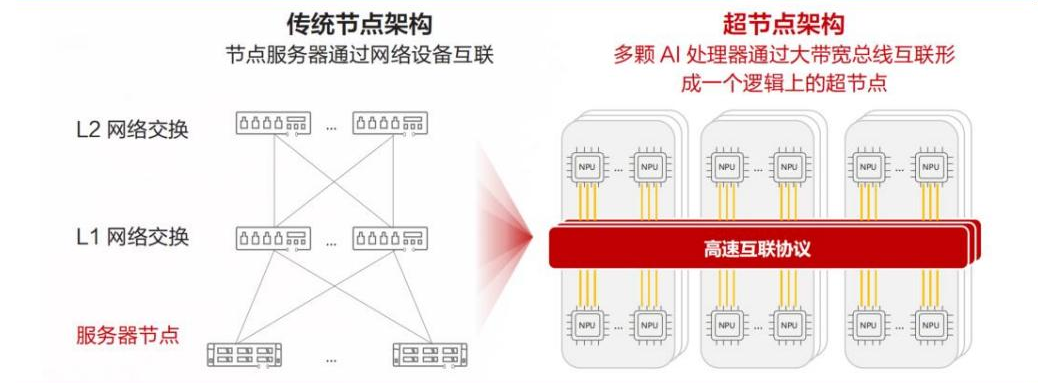
Source: Caitong Securities Research Institute
As a result, hypernodes are becoming a standard feature for domestic large model deployments.
"Letter Rankings" stated, "Hypernodes are becoming a collective selling point for domestic chips. By packaging hundreds of chips into a computing system for clients, they bypass single-card comparisons with NVIDIA, showcasing the overall model size and efficiency the system can achieve. This approach also integrates networking, storage, and other supporting products into the chip business."
Currently, the hypernode track is flourishing, with participants including internet giants like Baidu and Alibaba, information industry leaders like Inspur Information and Dawning Information Industry, and emerging chip companies like MetaX Technologies and Moore Threads.
For example, the Ascend 960 is the world's first hypernode to apply NPO (Near-Package Optics) technology, scalable to 4096 cards, delivering 8 EFLOPS FP8 and 16 EFLOPS FP4 computing power, with a memory pool capacity of 1PB, supporting the training and inference of large models with tens of trillions of parameters.
Another example is Alibaba's Panjiu AL64, a hypernode featuring fully self-developed core chips, integrating Zhenwu V900, ICN Switch, Panmai smart NICs, and Zhenyue SSD controller chips. Combined with Alibaba Cloud's next-generation intelligent computing center network architecture, it achieves full-stack system-level synergy of computing, storage, and networking.
It is clear that hypernodes offer greater imagination for domestic computing power.
Alibaba Group CEO Wu Yongming predicted, "Due to the maturity of T-Head's chip product line and widespread client adoption, we expect a significant increase in the annual shipments of T-Head's AI chips."
In summary, in the open-source model arena, "DeepSeek and its peers" are unafraid of overseas competition. Their immediate priority is to address computing power vulnerabilities, breaking through with self-developed chips. The emergence of hypernodes provides a new approach for catching up, focusing on overall computing efficiency rather than single-chip performance.
In short, computing power vulnerabilities are temporary, not permanent.
-
![]()
Anthropic Officially Files for IPO, Aiming for the Largest IPO in History
-
![]()
Anthropic: Shedding the 'Money-Guzzler' Tag; Becoming a 'Mortgage Slave' Instead, with a Trillion-Dollar Long March Still Ahead
-
From Radical Electrification to 'Quality Over Quantity': The Price and Redemption of Porsche's Strategic Shift
-
![]()
"DeepSeek and Its Peers" Prioritize Computing Power Over Meta's Ace
-
![]()
Is the Inner Screen of the 16,000-Yuan iPhone Duo Cracking After Less Than 20 Folds?
-
![]()
Apple’s Priciest Model Fails to Impress
-
![]()
Foxconn Worker Claims Apple Eased iPhone Duo Quality Checks; Insider Denies Reduction in Yield Rate Standards
-
![]()
How can a company that lost $80 billion in six months justify a valuation of nearly $2 trillion?