How can a company that lost $80 billion in six months justify a valuation of nearly $2 trillion?
 10/27 2026
 533
When the most loss-making AI company in history and the largest IPO in history are written into the same document, the public market is forced for the first time to answer a most fundamental question: What exactly are you paying for?
/
Text by Luo Xiaomei, Edited by Yang Xiaoruo
Image source | Generated by AI
On October 26 (Eastern Time), Claude's developer Anthropic publicly filed a 335-page S-1 prospectus, applying to list on Nasdaq under the ticker ANT. Goldman Sachs and Morgan Stanley are leading 24 underwriters, with the listing window pointing to the week of November 16.
If priced at the rumored maximum valuation of $2 trillion, it would surpass SpaceX's June record of $1.77 trillion, becoming the largest IPO in Wall Street history.
On the day of the announcement, the three major U.S. stock indices closed higher, led by chip stocks. Jay Woods, chief market strategist at Freedom Capital Markets, told the media that the market needed this news just as it had needed SpaceX, with people having waited and discussed this listing for a long time.
But enthusiasm aside, the truly interesting aspect of this prospectus is that it presents two contradictory yet equally compelling sets of facts.
Both bulls and bears can find ammunition here, and this time, both sides are going public with their real names.
01 Two Sides of the Coin
Let's first dissect that most eye-catching number: an $80.7 billion net loss in the first half.
This figure is largely an accounting illusion. About $72.4 billion came from fair value changes in convertible notes and financial instruments. The more the company's valuation surges, the greater the book losses on these future equity-converting liabilities.
In other words, most of this $80 billion loss precisely reflects the capital market's strongest confidence in it.
Stripping away the noise, Anthropic's true operating performance looks entirely different.
Data shows Anthropic's operating loss narrowed sharply to $693 million from $2.135 billion year-on-year; adjusted operating profit reached $1.62 billion with a margin of about 10%; net operating cash flow turned positive at $3.9 billion, with $131.65 billion in cash and short-term investments on hand. Second-quarter revenue surged 1,368% year-on-year, while computing expenses grew only 300% in the same period.
The revenue curve has steepened beyond comparison. Data shows $41 million in 2023, $386 million in 2024, $4.59 billion in 2025, and $16.29 billion in just the first half of 2026—3.5 times last year's full-year total. Net revenue retention rate hit 900%, with existing customers increasing spending ninefold within a year.
"If anything deserves emphasis, it's that the business is accelerating. Making a large company grow is difficult, but unthinkably, the prospectus states 12x revenue growth for 2025—truly astonishing," commented Michael Field, chief equity strategist at Morningstar, after the prospectus disclosure.
He also outlined the bulls' valuation logic: "Obviously $2 trillion sounds outrageous, but broken down as a price-to-sales ratio, it's about 18-20x—far more reasonable than the recent SpaceX IPO."
But the historical significance of these numbers outweighs the prospectus itself. Previous doubts that all large models were bottomless money pits were based on the assumption that revenues couldn't catch up with costs. Now, that assumption has been disproven by an SEC-backed filing.
AI companies can be self-sustaining—they just need to scale sufficiently first. This is the source of Jay Woods' enthusiasm and the watershed moment when the industry narrative shifts from faith to financials.
If the income statement represents the sunny side, contract liabilities are the shadow side.
The publicly disclosed S-1 reveals future computing commitments exceeding $600 billion (about $657 billion by some measures), extending as far as 2045: at least $110 billion from Amazon (through April 2036), $114.5 billion from Google (through July 2033), and up to $120.5 billion from SpaceX.AI contracts, with monthly expenses of about $3.1 billion after full delivery. According to 36 krypton , commitments to Microsoft were raised from $31.4 billion in the draft to $44.9 billion in the public version.
Moreover, these commitments are virtually irrevocable. The prospectus discloses that about 80% of the $518 billion in future computing expenses cannot be canceled or must be paid regardless of actual usage. A single contract with SpaceX requires monthly payments of $1.25 billion until May 2029.
In comparison, its average monthly revenue in Q3 was about $5.6 billion, leaving no room for demand fluctuations in this rigid expense structure.
This hides a structural issue the market hasn't fully priced in. Anthropic's largest suppliers are also its major shareholders, while the primary use of IPO proceeds is to pay these suppliers. Amazon holds $6.2 billion in convertible notes, Google is deeply tied to TPUs, and SpaceX leases Colossus data center computing power—creating a self-reinforcing cycle of revenue, equity, and procurement.
This is the classic financial structure of the capital bubble era.
Bears are unrelenting. "We believe Anthropic has no viable business," wrote independent research firm New Constructs in an early October report, arguing that closed-source models have struggled to generate profits since open-source models rose. Founder David Trainer called this offering "the most ridiculous IPO of 2026," noting that a $2 trillion valuation would require profits double NVIDIA's net income over the past four quarters (over $190 billion), while its reasonable valuation should be around $150 billion.
Michael Burry, the real-life inspiration for "The Big Short," offered an even more intuitive (intuitive) calculation: at the rumored valuation, investors could buy 78 profitable S&P 500 companies—from Domino's Pizza and Clorox to Stanley Black & Decker and Norwegian Cruise Line—all mature businesses operating for decades.
"In bubble times, an interesting game is to see how many profitable public companies a private firm's valuation can buy," he wrote on X.
On one side, an 18-20x price-to-sales ratio sounds reasonable; on the other, the most ridiculous offering in history. The 18x divergence is the entire suspense (suspense) of this referendum.
02 What Are You Buying with One Share of ANT?
Viewing governance arrangements and dual-market pricing together reveals a profound answer.
First, governance. The prospectus discloses that seven co-founders hold Class F shares controlling 50.1% of all shareholder voting rights; a trust will appoint a majority of the board. Meanwhile, 94 pages warn that advanced AI may pose catastrophic or existential risks to humanity, with potential damages exceeding any insurer's coverage.
Bradley Tusk, founder of Tusk Ventures and a longtime early-stage tech investor, sees this structure most clearly. "By definition, investors ask every quarter where the growth is," he told CNBC.
His concern isn't financial but institutional distortion: public market pressure to meet revenue targets might force this safety-focused company—whose CEO has repeatedly called for slowing frontier model development—to balance safety and revenue. "If an AI bubble exists, which I'm fairly certain it does, once you truly expose it, that's when risks materialize," he estimated. By loose measures, Anthropic trades at about 27x revenue, "which may not be sustainable unless you generate consistent revenue before entering 2027."
Put together, this creates a rare scenario. The public will pay up to $2 trillion to buy a company absolutely controlled by seven individuals, whose products are officially labeled as potential human threats, without any say in major decisions. You may admire this determination to pursue AGI without capital pressure, but as Tusk implies, this essentially requires public markets to infinitely underwrite a private belief.
Interestingly, the same question has already seen different rehearsals in two markets. Zhipu (02513.HK) listed on the Hong Kong Stock Exchange on January 8 this year at HK$116.2, becoming the first large model stock, with its market cap once hitting HK$1.07 trillion on June 22 before plunging to HK$236.38 billion by October 20. This 84% retreat from its peak in four months—wiping out over HK$830 billion in market cap—and similar cooling in Hong Kong's other large model stock (MiniMax retreated about 87%) reflects fading scarcity premiums for Chinese Anthropics as competitors list and open-source models impact (impact) the market.
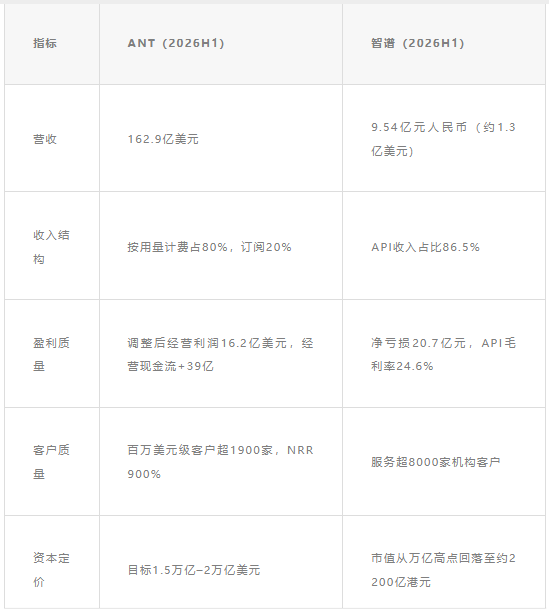
Data sources: S-1 filing, The Paper's "2026 AI Listing Boom," Zhipu's 2026 interim results announcement.
The numerical gaps are orders of magnitude, but structural similarities warrant scrutiny. Both companies' revenues are rapidly converging toward API/usage-based billing, relying on three pillars: major clients, high retention, and price hikes.
Zhipu's API average selling price rose about 101% in H1, with usage surging over 40x since the beginning of the year (year-start). The terminal form of large model monetization is globally converging: not selling models, but selling calls; not doing projects, but building infrastructure.
And Zhipu's rollercoaster ride offers exactly the textbook case ANT's potential shareholders face: markets will pay an AI premium, but emotions can withdraw it anytime. One hasn't listed yet; the other has already lost 80%. Either way, you're buying belief without voting rights.
03 Wall Street's Divide and a Pricing Referendum
Reuters interviewed a row of institutions on prospectus day, laying the divide bare.
Bulls emphasize milestone significance. "This is a major milestone in AI development history. The IPO's outcome will largely determine whether markets continue supporting AI R&D capital expenditures," said Peter Andersen, founder of Andersen Capital Management.
Lukas Muehlbauer of IPOX Schuster highlighted its pricing power value: "Anthropic's IPO will set valuation benchmarks for leading AI labs, influencing subsequent listings and confidence in companies funding AI infrastructure."
Cautious voices calculate more coldly. "A company with $16 billion or $32 billion in annualized revenue losing $80-$160 billion a year at a $1.5 trillion valuation seems too expensive," Speak frankly (bluntly stated) Great Hill Capital chairman Thomas Hayes. "This offering is for believers. The stock may rise short-term because they control supply, but markets are weighing machines long-term. It'll lose money for years before turning around—you'll get better entry points than the IPO."
Renaissance Capital senior strategist Matt Kennedy noted timing subtleties: "A few months ago, investors wouldn't have questioned valuations this much. This summer's hottest AI IPOs already broke issue prices. Even Anthropic won't get a blank check now."
Zacks chief market strategist Brian Mulberry added liquidity concerns: "Meta just announced another $95 billion raise. These two offerings drawing water simultaneously will saturate markets, likely proving fatal for smaller, lower-quality AI plays."
Based on these institutional views, "Business Show" makes three judgments:
First, this IPO's outcome will redefine AI companies as an asset class. This is nearly rare consensus between bulls and bears. What Andersen said about determining capital expenditure support and Muehlbauer said about setting benchmarks are two sides of the same coin.
Second, the real focus isn't valuation numbers but how markets price governance rights and risk disclosures. The 50.1% locked voting control and 94-page existential risk warnings are terms public markets have never seen. Tusk's safety-vs-revenue tradeoff will be repeatedly questioned with each quarterly report.
Third, the timing choice itself is a statement. According to Reuters, Switch and Nscale postponed IPOs, Firmus Grid shelved listing due to valuation disputes, and OpenAI's window pushed to early 2027. ANT's counter-trend sprint suggests management believes the window for mega AI IPOs is closing. And Mulberry's liquidity saturation warning is precisely this sprint's biggest variable.
In mid-November, when ANT rings the Nasdaq opening bell, the world's deepest capital pool will deliver the first public pricing for frontier large models.
Either AI gains hard currency status, or the bubble bell tolls. As Thomas Hayes said about markets being weighing machines: short-term emotions matter, but long-term, they only weigh substance. "The End"
(Note: This article does not constitute investment advice)
-
![]()
Is the Inner Screen of the 16,000-Yuan iPhone Duo Cracking After Less Than 20 Folds?
-
![]()
Apple’s Priciest Model Fails to Impress
-
![]()
Foxconn Worker Claims Apple Eased iPhone Duo Quality Checks; Insider Denies Reduction in Yield Rate Standards
-
![]()
How can a company that lost $80 billion in six months justify a valuation of nearly $2 trillion?
-
![]()
FAW and GAC Strengthen Ties, Outlining Six Pivotal Cooperation Domains
-
[Insight] The airbag control unit (ACU) is a core component of automotive passive safety systems, with numerous market participants in China.
-
![]()
Grassroots Actors, the First Casualties of AI | Wave Trends
-
![]()
China’s Premier Provincial Capital, Guangzhou, Stages a Remarkable Comeback!