Two Contrarian Bets: Can Wang Tao Really Succeed Zuckerberg?
 10/30 2026
 505
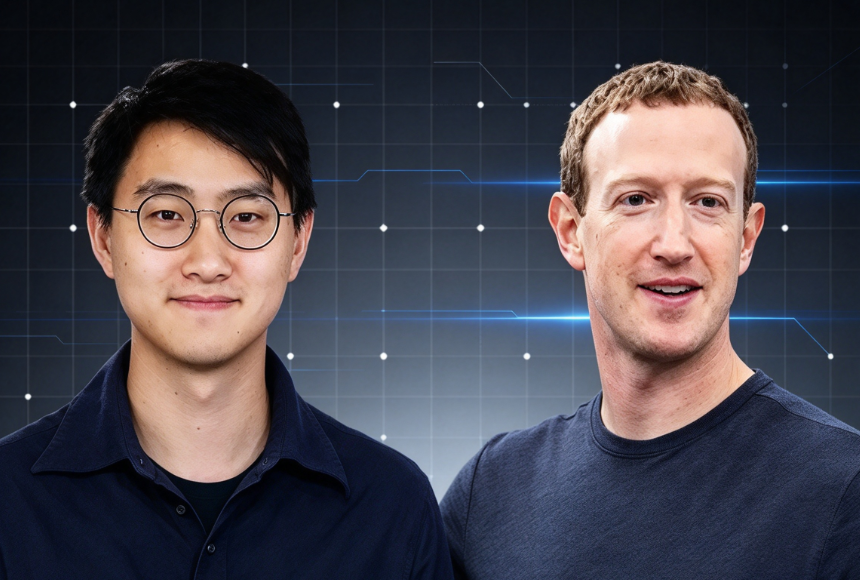
Image generated by AI
How do you become the youngest billionaire at 24?
Written by/ Li Jinlin
Edited by/ Chen Dengxin
Layout/ Annalee
The AI industry throws up one wave of opportunity after another, and every wave draws a crowd—but a crowd does not necessarily mean a gold mine. In Wang Tao's ten-year trajectory, two choices ran against the mainstream: at 19, he dropped out of school to go into data annotation; at 29, he walked away from the company he had founded nine years earlier to join Meta. Both brought him worldly success.
The labels outsiders later attached to Wang Tao were remarkably consistent: MIT dropout, founder of Scale AI, top AI product leader. Stacked together, they form a seemingly smooth and impressive résumé of sci-tech innovation. But setting aside the halo bestowed by the outside world, Wang Tao's ten-year trajectory is no legendary comeback story.
Or rather, the two important decisions he made in those ten years do not in themselves constitute a complete story. What is truly worth writing about is what happened after he made those choices—including the things that were not up to him.
Los Alamos and a Disney ticket
Wang Tao's parents were physicists at Los Alamos National Laboratory. He grew up surrounded by scientists; dinner-table topics were atomic theory and numerical simulation, and Halloween activities were science experiments. His parents did not assign him piles of homework; when they discovered his interest in computers, they simply hired him a programming tutor. They never banned video games—but Wang Tao never had the time to get addicted.
In sixth grade, there was a chance to go to Disneyland for free by winning MATHCOUNTS, and that was how Wang Tao first came into contact with math competitions. He later admitted to Forbes that it was that free ticket that sparked his interest in competitive mathematics.
Wang Tao went on to compete all the way to the USA Mathematical Olympiad Program and the U.S. Physics Team, and also reached the USACO finals. By high school, he was already working as a full-time engineer in Silicon Valley—first at Addepar and later at Quora, where he met Lucy Guo, who later became co-founder of Scale AI. At 17, he was managing systems handling hundreds of millions of requests per day.
At 18, he entered MIT and in his first semester took graduate-level computer science courses. A year later he dropped out. What he told his parents was, "This summer I'm going to do something"—and then he never went back to school.
In 2016, Wang Tao and Lucy Guo founded Scale AI in San Francisco, doing data annotation. How non-mainstream was this choice at the time? The whole industry was focused on algorithms, and data annotation was regarded as repetitive manual labor with no technical content and no room for imagination.
But Wang Tao's judgment followed a different logic. He believed algorithms determine the upper limit of a model, while data determines whether the model can be deployed. Betting directly on the "shovels" of the entire AI industry was more meaningful than competing on algorithms.
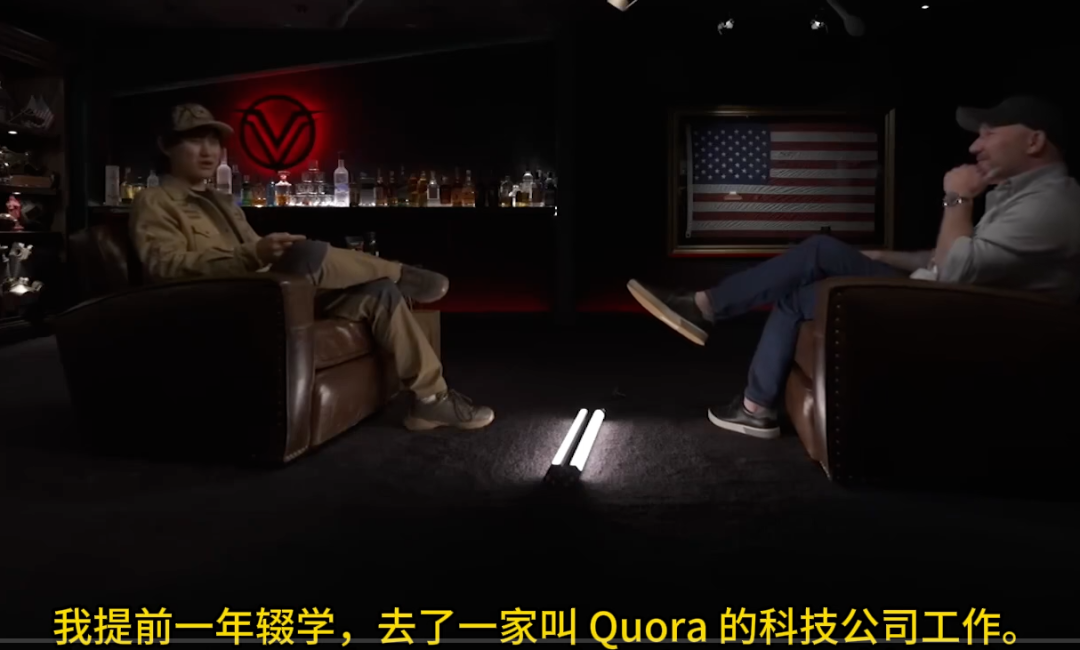
Wang Tao mentioned his experience in an interview
Scale started with autonomous driving, signing Cruise and Tesla, signed its first contract with Facebook in 2019, and later expanded to OpenAI, Microsoft, and the U.S. Department of Defense. In 2021, at 24, Wang Tao's net worth surpassed $1 billion, making him the youngest self-made billionaire at the time.
Behind the narrative of success is the situation of "AI laborers." According to reports, Scale's Remotasks platform has about 240,000 registered independent contractors worldwide, concentrated in countries such as Kenya, the Philippines, and Venezuela. Investigations show that these workers earn only $1 to $3 per hour and generally lack pensions, medical insurance, and long-term contracts.
In Amnesty International's records, a Filipino worker said he worked ten to twelve hours a day, seven days a week, on Remotasks, earning about $8 a day. A 2022 Oxford University study pointed out that the platform met only two of ten fair work standards.
It is worth mentioning that Wang Tao's relationship with co-founder Lucy Guo was not always smooth. While managing the operations team, Wang Tao and Lucy Guo had disagreements over philosophy. Lucy Guo believed Wang Tao had not solved the problem of contractor payments, while Wang Tao insisted on his own view. Eventually Wang Tao fired Lucy Guo, and the two parted ways.
Going to Meta, creating the hit Muse
After leading Scale AI to become a top player in its industry segment, Wang Tao gradually saw the limitations of the business clearly. Data services belong to the supporting infrastructure of the AI industry, always serving algorithms and end products. They cannot directly reach consumer users and make it difficult to deploy AI product forms closer to ordinary life. This ceiling in the track made him begin to seek a new direction of development.
Just as Wang Tao was planning a transformation and breakthrough, Meta AI was facing a development bottleneck. Zuckerberg took the initiative to call Wang Tao, opening with just one line: "Do you have time for a call?" The two had first met through a friend's introduction, and a full year passed from the referral to their first meeting. It was only after the release of Llama 4 that Zuckerberg truly came knocking. From first contact to announcing the deal took only five or six weeks.
The final plan was for Meta to acquire 49% of Scale AI for $14.3 billion. Wang Tao stepped down as CEO and became Chief AI Officer, taking charge of the Superintelligence Lab. Leaving the company he had run for nine years, Wang Tao described it as "like giving up my own child."
Regarding Wang Tao's joining, former Meta Chief AI Scientist Yann LeCun once gave a very direct and sharply worded comment: "Wang Tao has no research experience, does not know how to carry out research activities, and understands even less what researchers prefer."
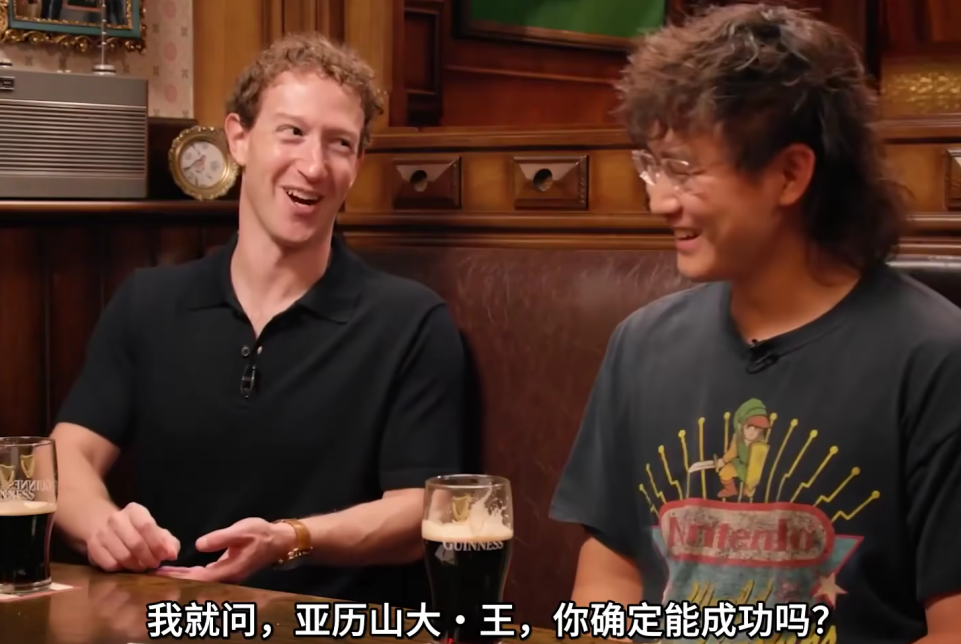
Zuckerberg and Wang Tao
That was true. Wang Tao knew it himself, so he did not try to play the technical leader. He gave the chief scientist position to Zhao Shengjia, while he himself was responsible for hiring, direction, and pace. He mentioned on a podcast that he is not an AI researcher, and that his most important task is to recruit excellent talent and create an environment for the research team. He manages more than 200 direct reports, but emphasized that "I am not the best manager for more than 200 people."
But the other side of listening is purging. In October 2025, Meta laid off about 600 employees, with the focus falling on FAIR basic research lab founded by Yann LeCun, while TBD Lab, directly led by Wang Tao, was unaffected. Before the layoffs, FAIR researchers had to have their papers reviewed by TBD Lab before publishing externally, and valuable papers would be "held back." A former Meta executive said: "At the time there were many deeply entrenched vested interests, but everyone knew they had to make way."
A person who once worked with both said Wang Tao reminded him of Zuckerberg when he was young. Zuckerberg did indeed give Wang Tao autonomy that few in the company enjoy, so some believe Wang Tao is already seen as a potential successor to Zuckerberg.
By early 2026, the entire industry was rushing toward coding agents, and Claude was far ahead in the coding field. Wang Tao recalled that at the time many people believed Coding Agent was the only direction worth fighting for in AI, but he told Zuckerberg the opposite: "What Meta is best at is consumer products. Its apps cover about 3.5 billion users every day. AI should help people complete the work they have to do and free up time to do what they really want to do."
So Wang Tao took the team and began to "play." Product lead Nat Friedman was the first person inside Meta Superintelligence Lab to deeply use the open-source tool OpenClaw. He had an Agent connect to his home camera to supervise him drinking water, and after finishing he even had to be praised with "good job."
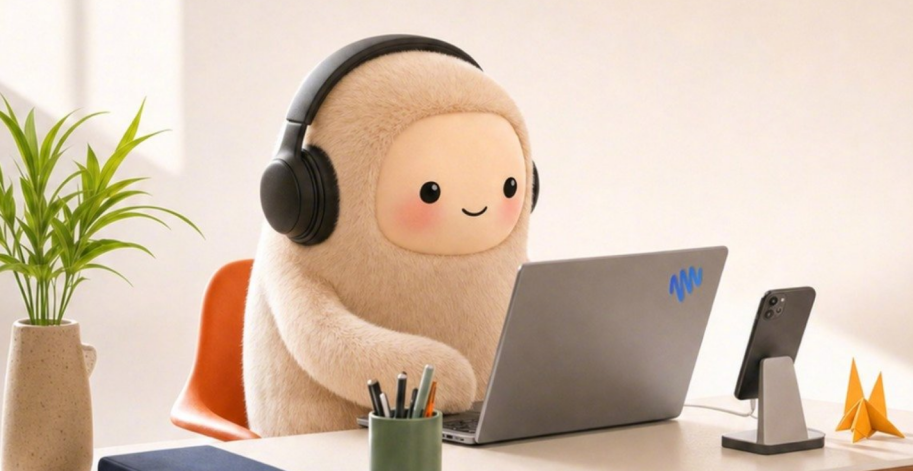
JollyBot
Wang Tao had the Agent read his emails and photos and conducted several rounds of deep questioning. He described that feeling as equivalent to "compressing three years of psychotherapy into a single moment."
In February 2026, the two each wrote memos. Friedman wrote "The Lobster Is the Law" and "Trust Is Indispensable," while Wang Tao wrote that "the personal super agent may be the ultimate form of consumer products." In less than two weeks, the Muse prototype was born, and the mascot JollyBot and the hardware prototype were also completed at that time.
But polishing Muse took a great deal of time and effort. Wang Tao's method was to use a table of more than a hundred rows, each row corresponding to a capability Muse must have, with evaluation standards and launch thresholds. At a certain stage, if 80 items were green and 20 were still red, it would not be released. Only when a version of Muse Spark 1.3 turned all green for the first time did the team let it through.
Muse team member Vu Tran later recalled that the product was basically completed as early as May 2026, but Zuckerberg insisted on delaying to prioritize improving safety mechanisms. Vu Tran actually disagreed; he was used to the "release first, iterate later" approach and wanted to launch before competitors, but Zuckerberg insisted on waiting.
However, by August, a 14-person startup called Instinct launched a competing agent product. Zuckerberg convened a meeting with Wang Tao and Friedman and decided to release. On September 8, Muse launched.
After Muse launched, according to Sensor Tower estimates, it reached 5 million U.S. downloads in about 22 days, faster than ChatGPT, Grok, and Claude at comparable points in their histories. It once topped the U.S. App Store free chart and stayed first for multiple days. Meta's market value surged by about $234 billion within five trading days.
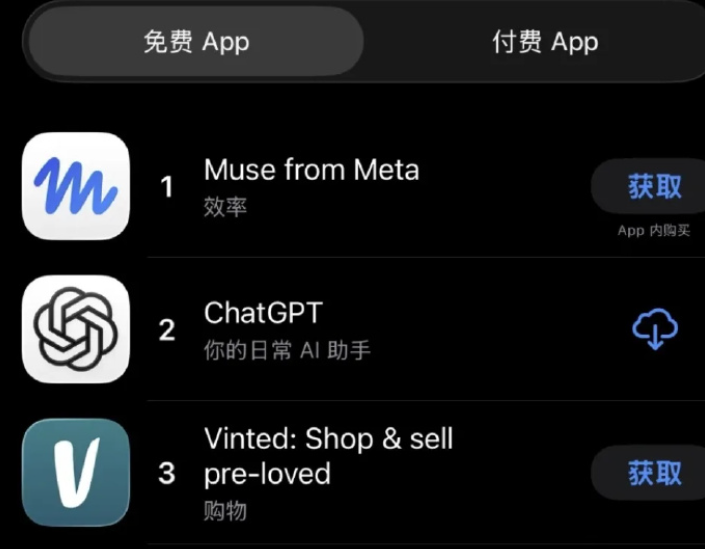
After launch, Muse quickly topped the U.S. App Store free chart
From founding Scale at 19 to taking over Meta's AI business at 29, Wang Tao, as a new-generation Chinese-American sci-tech practitioner, has provided a pragmatic sample of growth.
There is an easily overlooked symmetry in his story. At 19, he chose a path no one thought much of—data annotation. At the time the whole industry was competing on algorithms, and no one believed that the hard labor of feeding data could grow into anything. Nine years later, Scale AI became infrastructure the AI industry cannot do without.
At 29, he again chose a path few were optimistic about—not making coding agents, but making a personal assistant for ordinary people. When the whole industry was rushing toward Coding Agent, he insisted that Meta's DNA lies with its 3.5 billion daily active users. Muse topped the App Store ten days after launch, seemingly proving his judgment once again.
When he goes on stage wearing a $30 second-hand camouflage T-shirt and Crocs, makes memes and posts during meeting breaks, and says "the internet rewards risk-taking," these gestures look casual, but they are actually the same as the way he makes products: do things to the extreme where you can exercise control, and accept the cost where you cannot.
At 29, with a net worth of $3.2 billion and regarded as a potential successor to Zuckerberg, these labels look dazzling together, but perhaps they are not enough to define Wang Tao's future.
-
Mercedes-Benz's All-Electric E-Class
-
![]()
The Largest IPO in History Has Officially Filed Its Application
-
![]()
Prefabricated Data Centers Are Suddenly Catching On
-
![]()
Two Contrarian Bets: Can Wang Tao Really Succeed Zuckerberg?
-
![]()
Diffraction or Scattering? The Two Physical Mechanisms Behind Stray Light in Optical Waveguides
-
![]()
Solid-State Batteries: Policy Targets 2030, but Industry Leaders Say the Technology Is Only at Level 4
-
AI Is About to Dismantle America's Internet Toll Booths?
-
![]()
Phone Sales Hit a Ten-Year Low While Prices Keep Climbing—What's Going On?