Solid-State Batteries: Policy Targets 2030, but Industry Leaders Say the Technology Is Only at Level 4
 10/30 2026
 575
On September 28, 2026, the Ministry of Industry and Information Technology (MIIT), together with six other departments, jointly issued the 15th Five-Year Plan for the Development of the New Battery Industry (MIIT Joint Regulation [2026] No. 220)—the first national-level special plan in China's battery sector.
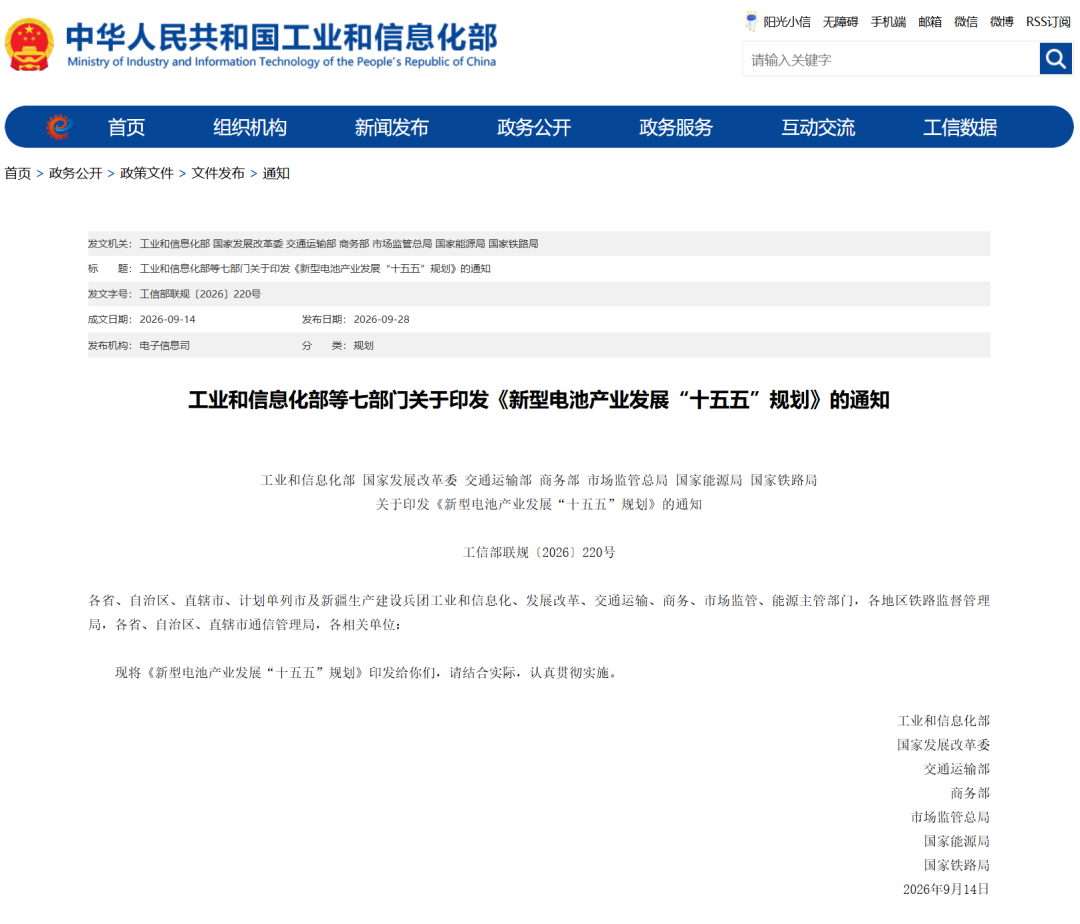
The plan sets only three hard targets for solid-state batteries, all pointing to 2030: preliminary large-scale application of all-solid-state batteries, a cycle life of 15,000 cycles for long-life lithium batteries, and product defect rates at leading enterprises reaching the parts-per-billion (PPB) level. The first of its 19 key tasks is to "accelerate breakthroughs in industrialization technologies for all-solid-state batteries."
On the question of mass-production progress for solid-state batteries, judgments from the industry front line are relatively conservative.
Zeng Yuqun (Robin Zeng), Chairman of CATL, said at the 2026 Dalian Summer Davos Forum that on a technological maturity scale of 1 to 9, solid-state batteries currently reach only Level 4, with Level 9 representing the mass-production stage; achieving million-vehicle-level installation before 2030 is "very unlikely."
Ouyang Minggao, an academician of the Chinese Academy of Sciences, put it more bluntly at the 2026 annual expert media exchange meeting of the China EV100 Research Institute: "Many people are now waiting for solid-state batteries. I don't think there's any need to wait—today's electric vehicles are already very good." He predicted that all-solid-state batteries will begin to be installed in vehicles in 2027, but that reaching a 1% market share may still take five to ten years.
Automakers echo this view. Sun Huajun, CTO of BYD Lithium Battery, said that batch demonstration installation of all-solid-state batteries will begin around 2027, with large-scale vehicle installation around 2030; Deng Chenghao, Vice President of Changan Automobile, said there will be small-scale demonstration operation in 2027 and gradual commercialization after 2030.
Everything currently delivered is hybrid solid-liquid
Measured against this standard, as of September 2026, the "solid-state battery vehicles" delivered to consumers in China—the NIO ET9, NIO ET7, IM L6, MG4X, and Foton light trucks—are all equipped with hybrid solid-liquid batteries, and none is all-solid-state. To judge promotional claims, one need only ask two questions: What proportion is electrolyte? Is there a third-party test report?
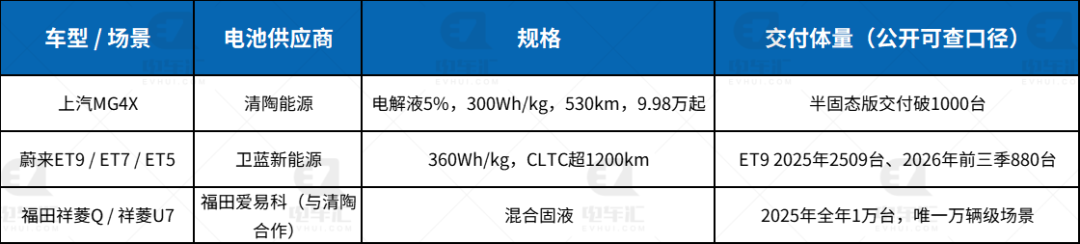
Semi-solid-state batteries have indeed been scaled up, but volumes remain low, accounting for less than 3% of total power battery installations during the same period. According to its prospectus, Qingtao Energy held a global market share of 33.6% and a China market share of 44.8% in 2025 shipments, and its products have been used in more than 30 models with cumulative deliveries exceeding 16,800 units. However, its losses from 2023 to 2025 were 853 million, 999 million, and 1.302 billion yuan, respectively.
It is worth noting that some models are offered in both a "solid-state battery version" and a liquid-battery version, and manufacturers announce sales data for both together in their promotional materials. The actual sales scale of models equipped with the solid-state version may be even smaller.
Three hard indicators before mass production: pilot lines, yield, and cost
The first is pilot lines: whether they exist, whether they have been successfully run, and whether public sample pack data are available. Only answering "yes" to all three qualifies as the first tier. CATL, BYD, Gotion High-tech, Farasis Energy, EVE Energy, Qingtao, WeLion, and CALB—those with only a timetable but no production lines or cell parameters are just a piece of paper.
Also pay attention to capacity mismatches. While pilot lines are being landed intensively, some cell materials are still at the vacuum glove box laboratory preparation stage, with daily output measured in grams.
The second is yield. The comprehensive yield of all-solid-state pilot lines is 60%–70%, and CATL's Hefei line was about 65% in the initial production period; by contrast, the mass-production yield of liquid batteries has long exceeded 94%. These 30 percentage points determine whether unit costs can converge.
The third is cost. All-solid-state cells cost 1.6–2.2 yuan/Wh, while lithium iron phosphate costs 0.39–0.5 yuan/Wh—a price gap of 3–5 times. The core master switch for cost reduction is lithium sulfide, which accounts for 77%–80% of the material cost of sulfide electrolytes; in September 2026, the average price of battery-grade lithium sulfide was about 1.3 million yuan/ton, and domestic annual output is expected to be less than 100 tons. Gotion has set its cost-reduction target at 500,000 yuan/ton and 1 yuan/Wh for cells.
The standards system is still being completed. Wang Fang, Chief Scientist of the China Automotive Technology and Research Center, revealed at the 2026 World Power Battery Conference that three national standards—performance specifications, safety specifications, and life specifications—have been established as projects and a draft for comments is expected to be released by the end of the year; the first international standard proposal for solid-state batteries led by China has been established as a project in IEC.
In addition to power batteries, there is another hidden line: Samsung SDI, LG Energy Solution, and others have invariably shifted their first commercialization scenarios to humanoid robots, AI data centers, and aerospace. Accumulating engineering data on robots and eVTOL first before returning to attack whole vehicles may be the true path for all-solid-state batteries.
-
Mercedes-Benz's All-Electric E-Class
-
![]()
The Largest IPO in History Has Officially Filed Its Application
-
![]()
Prefabricated Data Centers Are Suddenly Catching On
-
![]()
Two Contrarian Bets: Can Wang Tao Really Succeed Zuckerberg?
-
![]()
Diffraction or Scattering? The Two Physical Mechanisms Behind Stray Light in Optical Waveguides
-
![]()
Solid-State Batteries: Policy Targets 2030, but Industry Leaders Say the Technology Is Only at Level 4
-
AI Is About to Dismantle America's Internet Toll Booths?
-
![]()
Phone Sales Hit a Ten-Year Low While Prices Keep Climbing—What's Going On?