Prefabricated Data Centers Are Suddenly Catching On
 10/30 2026
 399
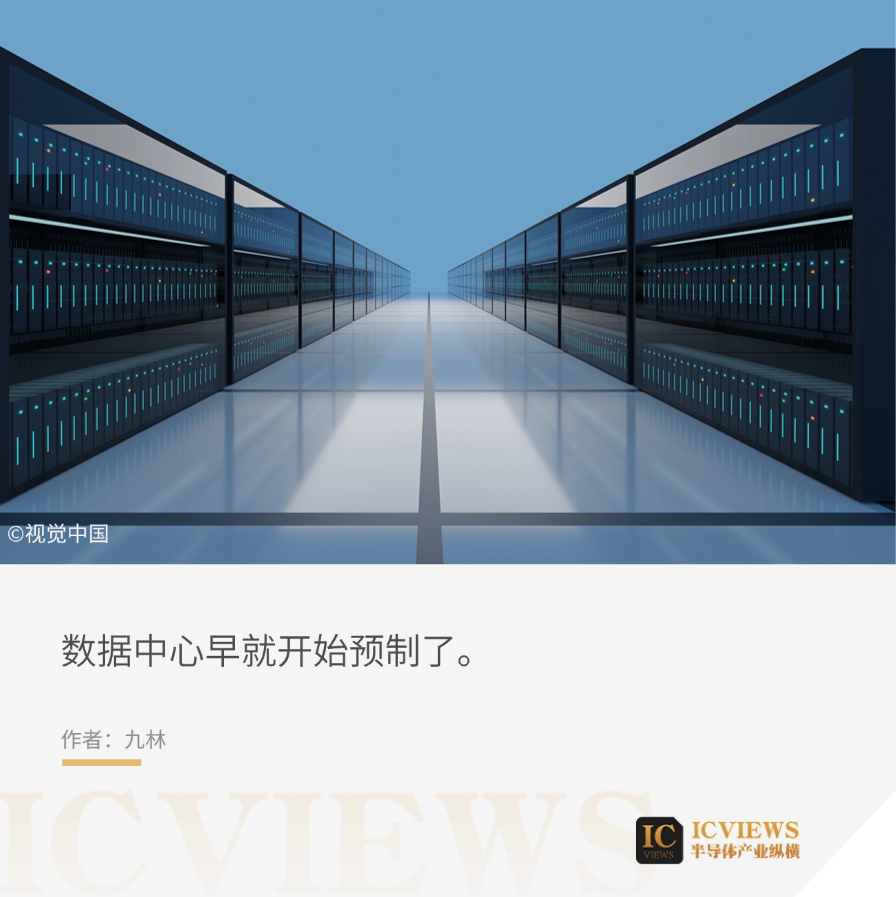
Jensen Huang has once again set his sights on data centers. This time, however, his focus is not merely on which chips go inside, but on a more fundamental question: how to build a data center faster.
Huang's answer: prefabrication.
The entire Vera Rubin AI factory is packed into modular containers at partners' factories, with cables, circuits, and liquid cooling pipes fully laid out and functionally verified. Once on site, it only needs to be hooked up to power, cooling, and network to start up. With this approach, on-site deployment has been compressed from six months to as little as 14 days.
Prefabricated data centers are hardly Huang's brainchild alone.
Huawei has launched 3D data centers that combine spatial layout adjustments with factory prefabrication; Luxshare Precision's Luxshare Intelligent Computing has also demonstrated a containerized prefabricated data center solution. Everyone is trying to solve the same problem: enabling data center construction and equipment delivery to keep pace with the growth in computing power demand as much as possible.
After all, in the AI era, if data centers are still built at the old leisurely pace, an awkward situation can easily arise: the grandfather approves the project, the father carries out construction, and the grandson powers it on—incidentally holding a nostalgic exhibition for the previous generation of GPUs. By the time the data center is finished two years later, it is too late, and it can only serve as an AI heirloom.
01
Data Centers: The Big Spenders
Just how hot AI infrastructure really is can be seen first from two indicators: spending and electricity use.
In its 2026 report, the International Energy Agency pointed out that capital expenditure by five technology companies exceeded US$400 billion in 2025 and is expected to grow by another 75% in 2026. Electricity consumption is growing in tandem. According to IEA statistics, global data center electricity demand grew by 17% in 2025, with AI-oriented data centers growing by 50%; its updated baseline forecast is that global data center electricity consumption will rise from 485 TWh in 2025 to about 950 TWh in 2030.
Domestically, the Ministry of Industry and Information Technology disclosed that as of the end of September 2026, China's intelligent computing power scale reached 2,592 EFLOPS, a year-on-year increase of 146%. And these numbers ultimately all have to be realized through specific equipment and data centers.
Chips need servers, servers need networking and storage, and they also consume power and need cooling. When it comes to high-density AI systems, power supply, liquid cooling, equipment weight, installation space, and maintenance access all need to be designed together. In its DSX POD technical description, NVIDIA also lists computing, networking, power, liquid cooling, and transportation structures as engineering aspects requiring coordinated handling.
This means that the expansion of computing power brings more than just "building a few more data centers." As the degree of equipment integration increases, supporting systems also need to be adjusted accordingly.
At the same time, the way computing equipment itself is organized is changing. Facing the communication requirements in large model training and inference, manufacturers have begun to organize more accelerators into systems that work collaboratively through tighter high-speed interconnection, and super nodes have become an important direction within this.
How super nodes are designed will directly affect how data centers are matched, how they are installed, and how long delivery takes.
02
Super Nodes in Various Forms Pose New Challenges for Data Centers
As data center demand grows and servers cannot keep up, the entire industry is looking at super nodes.
Currently, what manufacturers call super nodes does not correspond to completely uniform physical dimensions. It can be concentrated in a single rack or span multiple racks. For example, H3C has products with 32 cards or 64 cards per rack, while Huawei's published Atlas 950 maximum configuration covers 160 racks.
When looking at super nodes, one should not focus only on "how many cards." At least three numbers need to be distinguished: how many cards are installed in a single rack, how many cards are connected in one super node, and how many cards there are in the entire cluster. These three numbers relate respectively to deployment density, the scale of tight interconnection, and the overall construction scale.
First, let's look at rack form and quantity.
According to the number integrated per rack, super nodes in the industry have roughly formed three tiers. 32 cards and 64 cards are relatively common baseline configurations. Among them, Huawei Atlas 950, MetaX Xijing S600, as well as Baidu Tianchi and H3C's related solutions, all adopt a design of 64 cards per computing rack.
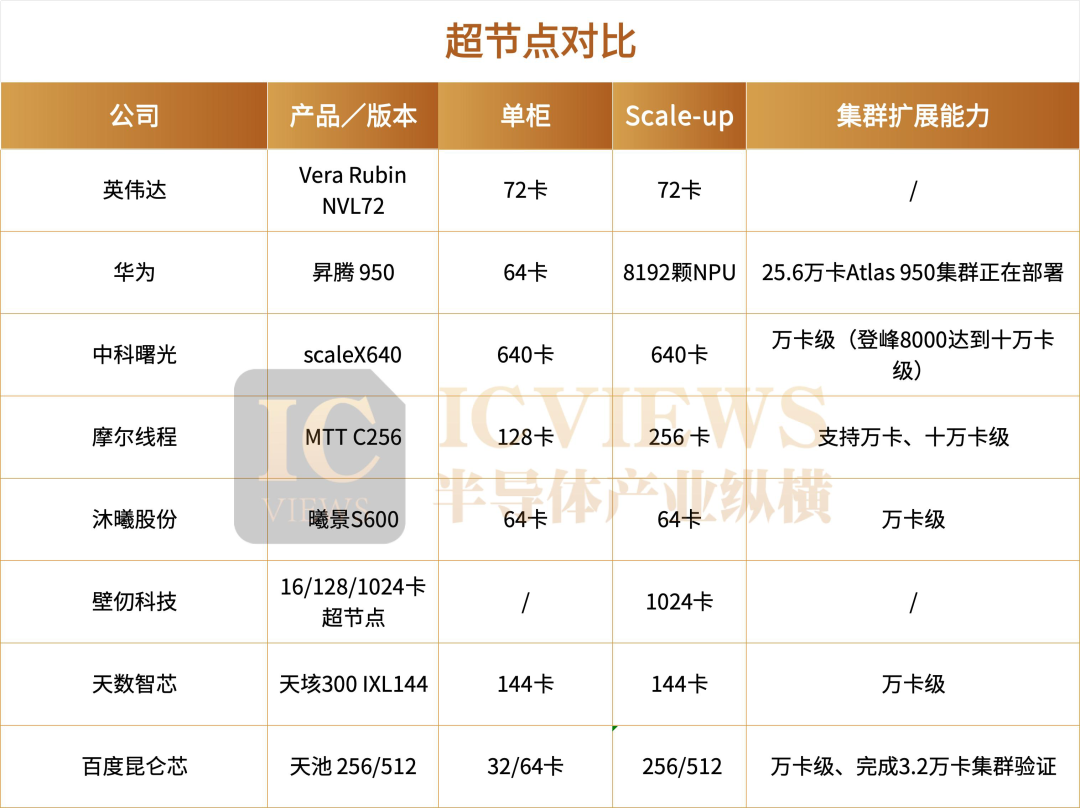
Going further up, there are solutions that increase the number integrated per rack to more than one hundred cards. Moore Threads' MTT C256 showcased at WAIC 2026 adopts a configuration of 128 cards per rack; Iluvatar CoreX's showcased IXL144 emphasizes integrating 144 GPUs into a single rack.
What is particularly special here is Sugon's scaleX640, which adopts a "one-to-two" high-density architecture and highly customized blade modules (integrating accelerator cards, memory, and interconnect chips into a space of 30 cm x 20 cm x 5 cm), accommodating 80 blade modules in a 1.8-meter standard rack and pushing single-rack density to an astonishing 640 cards.
Next, let's look at the interconnection behind the density. The more cards installed, the busier the data traffic. In large model training and MoE workloads, communication between chips has become a focus of system design.
When discussing interconnection, it can be divided into three levels: what protocol is adopted, how the hardware is connected, and whether signals are transmitted through copper or optics.
At the protocol level, Huawei organizes computing resources through its Lingqu interconnect system, Baidu builds its communication domain around self-developed XPU-Link and programmable switching technology, and Biren has laid out the BLink super node interconnect protocol. There are also open accelerator interconnect standards such as UALink in the industry. For example, H3C's UniPoD series includes products based on both Ethernet protocols and PCIe protocols, among which the F80000 adopts PCIe optical interconnection.
At the hardware connection level, the industry is discussing designs such as orthogonal direct connection and Cable Tray. For example, MetaX Xijing S600 emphasizes a "three-zero" design for in-rack connections, improving deployment and maintenance by reducing traditional cable connections; Baidu, in its Tianchi solution, designs the XPU-Link protocol, switching technology, and Cable Tray copper cable interconnection together.
What is worth noting is the optical connection players.
Biren's launched 1024-card solution adopts NPO near-packaged optics and a distributed decoupled architecture, deploying GPU nodes and switch nodes separately, organizing resources through optical connections, and supporting scale-up expansion of up to 1024 cards per super node. Huawei is also very advanced in the application of optical modules. Previously, 384-card configurations used 400G optical modules; currently, 1024-card configurations have upgraded to 800G GPU optical modules, doubling the rate while reducing usage.
Third, look at migration cost, that is, the software ecosystem. For customers who have already accumulated a large number of CUDA applications, changing computing platforms involves more than just procurement.
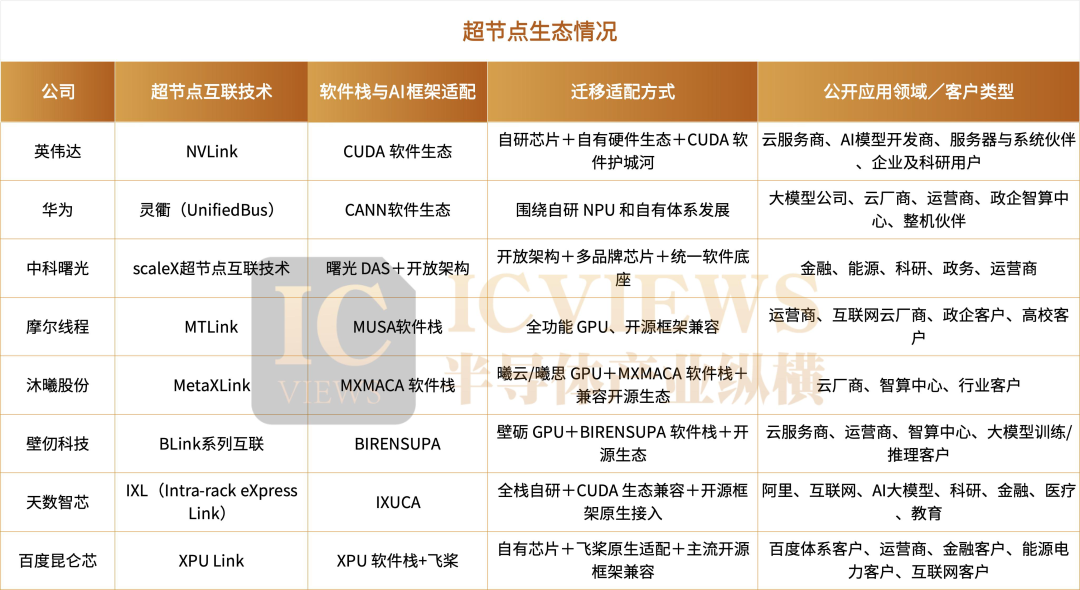
Each domestic chip vendor has its own software foundation: Huawei has CANN, Moore Threads has MUSA, MetaX has MXMACA, and Kunlunxin and Iluvatar also have built supporting software stacks respectively. In terms of framework-layer migration, customers continue to use familiar frameworks such as PyTorch while switching the underlying hardware platform. Huawei connects PyTorch to Ascend through TorchNPU, Kunlunxin adapts with PaddlePaddle, and other manufacturers also provide framework support so that model development can continue in the original way.
For the parts of applications that directly use CUDA interfaces and custom kernels, Moore Threads' MUSA provides two specific approaches: musify converts CUDA source code into MUSA code, while MUSA Mapping completes the mapping during compilation, allowing source code within the supported scope to retain CUDA syntax and then be compiled into programs for Moore Threads GPUs. Kunlunxin also provides CUDA-compatible interfaces in XPU Runtime. Sugon focuses on openness and inclusiveness, being compatible with mainstream ecosystems and supporting mixed deployment of domestic cards from multiple brands.
Finally, let's look at which scenarios these super nodes are entering. From actual demand, super nodes are currently mainly advancing along three types of scenarios: large model training and inference, public intelligent computing infrastructure, and industry applications such as scientific computing.
Large models are the most direct driving force. The expansion of model scale and the increase in training tasks led internet companies to develop demand for large-scale tight interconnection earlier. As the first-generation officially commercialized super node, the Ascend 384 super node has been commercially deployed in more than 750 sets, applied at scale in industries such as the internet, telecom operators, finance, education, healthcare, transportation, and manufacturing, and is also the only domestic super node that has trained a SOTA model.
Baidu's super node has been validated by Baidu's own core business and has achieved mass production delivery, making it one of the first super node products in China to achieve mass production delivery.
The core node of Sugon's national supercomputing internet in Zhengzhou has been put into trial operation. It is reported that the computing resources of this node are supported by three sets of Sugon scaleX ten-thousand-card super cluster systems, and can provide more than 30,000 cards of domestic AI computing power externally.
At the same time, the cluster business of domestic GPU manufacturers is also advancing. Moore Threads' MTT C256 is currently in the stage of "commercial readiness and early customer validation"; however, Moore Threads' Kuae intelligent computing cluster has already been delivered in multiple locations. Moore Threads disclosed a RMB 660 million Kuae intelligent computing cluster contract, which was completed and recognized as revenue in the first half of the year. At the same time, the first phase of the Wuxi Huishan Intelligent Computing Center deployed 2,000 S5000 cards and was basically fully loaded two months later, with more than 20 customers already testing or officially using it.
Biren has successfully delivered multiple thousand-card-level intelligent computing clusters, including a 2048-card optically interconnected optical switching GPU super node. It previously launched the "LightSphere X" super node solution and quickly achieved the implementation of a 128-card commercial version within half a year.
Iluvatar CoreX's Tiangai series GPUs have achieved ten-thousand-card-level large-scale implementation, serving more than 380 government and enterprise, research, and industry customers, with more than 1,000 projects deployed.
The product forms and commercialization progress of each company differ, but these cases have already brought a problem to the forefront: when computing equipment begins to be organized at the scale of entire racks, multiple racks, or even ten-thousand-card clusters, the data centers that host them also need corresponding construction and delivery capabilities.
Computing, networking, power supply, and cooling need to be considered together. The approach provided by prefabrication is to put integration and validation work that can be completed in advance into the factory, leaving less item-by-item installation and coordination on site.
03
Data Centers Began Prefabrication Long Ago
As early as 2006, Sun released Project Blackbox, packing computing, storage, networking, and supporting power and cooling facilities into standard containers, emphasizing convenient transportation and rapid deployment.
The launch event at that time already demonstrated the idea of putting it into operation after connecting to external power, cooling water, and network.
In other words, the idea of "boxing up data centers and connecting them upon arrival" is old enough to attend a twentieth-anniversary reunion. Calling prefabrication a new invention that suddenly emerged in the AI era is somewhat like belatedly issuing a birth certificate for an old technology.
Today, AI demand has given this old route greater scope for use. From electromechanical modules such as power supply and cooling, to containerized data centers, and then to complete integration around specific computing platforms, various companies are advancing prefabrication to different levels.
First, let's look at modular data centers that have already begun large-scale delivery. Taking CIMC Group as an example, the company disclosed in its investor relations activity record on March 30, 2026 that its cumulative delivered modular data centers in regions such as the Middle East and Southeast Asia exceed 1,000 MW, with more than 17,000 modules; at the same time, it is providing prefabricated data center technology and manufacturing delivery services for industry customers with more than 300 MW.
The secret of China Speed lies in "dual-factory collaboration" and full-process integrated delivery: more than 90% of structural construction, electromechanical installation, and interior decoration are completed in domestic factories, and on site only assembly like building blocks is needed.
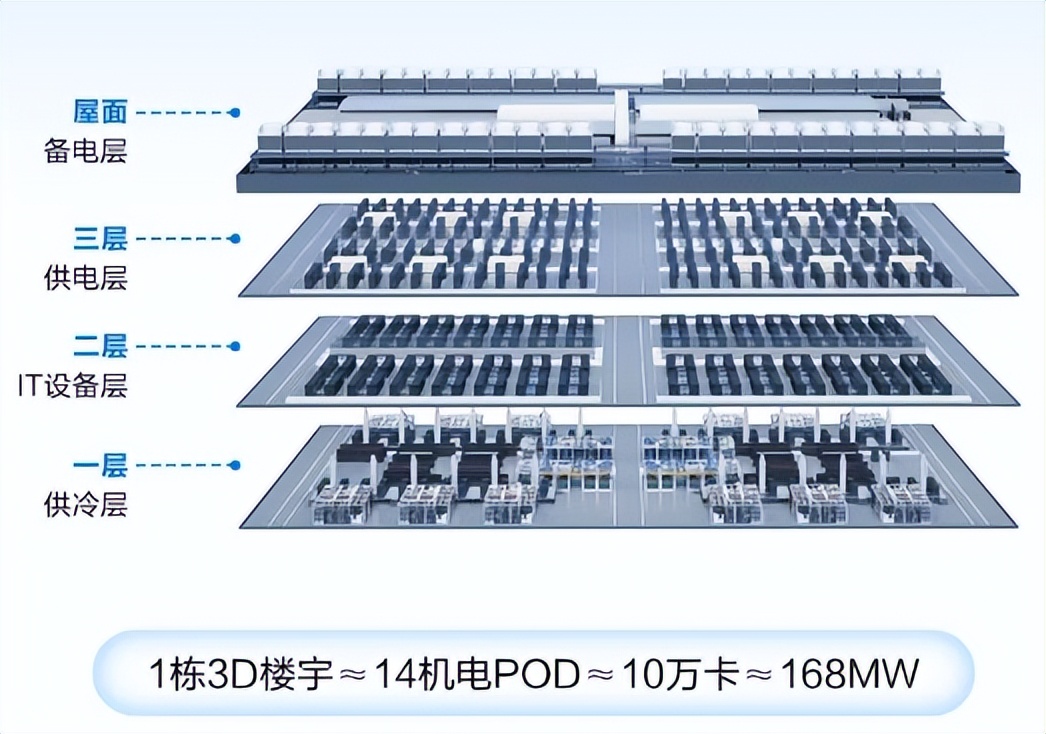
Domestically, Huawei's 3D data center borrows a concept from chip fabs: the strict separation of the "power layer" and the "IT layer." Through layered decoupling and three-dimensional stacking, it vertically stacks functional spaces that are traditionally laid out horizontally, creating a vertical architecture of "cooling on the first floor, IT equipment on the second, power supply on the third, and backup power on the roof." This enables vertical power distribution and vertical cooling, shortens cable runs to the minimum, and minimizes losses—supporting high-density deployment of AI computing clusters while leaving room for future computing evolution.
In terms of construction, Huawei has turned core electromechanical systems such as power supply and cooling into standardized PODs—the smallest independently operable data center units—so that prefabrication, assembly, and testing are completed in the factory, with on-site work limited mainly to assembly and connection. The prefabrication rate for both large and small electromechanical systems exceeds 90%, and electromechanical delivery time has been cut from roughly six months to three.
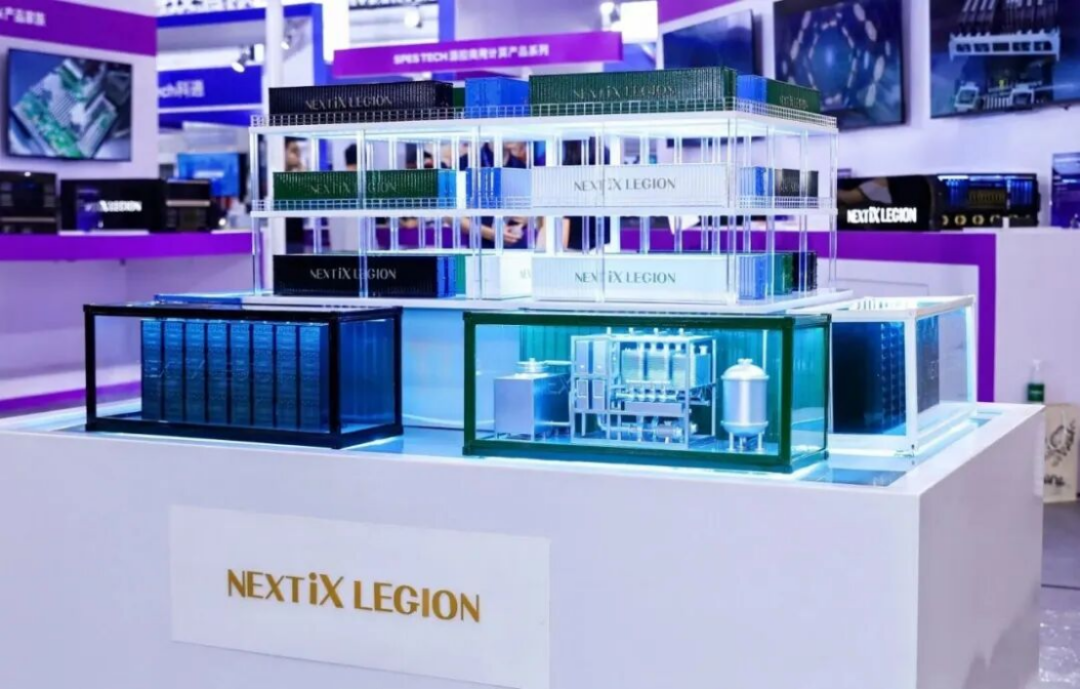
Luxshare Intelligent Computing has launched a containerized prefabricated data center solution. The data center is split into standard container-sized modules, with power supply, cooling, computing power, networking, and storage all integrated and pre-commissioned in the factory. Once transported to the site, they are assembled like building blocks and can be used as soon as they are connected to power. One pod is a data center ready to run the moment it is switched on.
The energy module integrates power transformation and distribution with energy storage and is responsible for a stable power supply; the liquid cooling module uses a coolant distribution unit (CDU) and cold-plate piping to deliver coolant directly to the chips and carry away heat; the computing module consists of rows of GPU racks and provides computing power once powered on; the networking module connects all racks at high speed based on Orthogonal Fabric; and the tenant module can be configured as needed, supporting multi-tenancy in a single pool. Customers choose whatever they need, and once the key is handed over, the data center goes online immediately.
Inspur's offering is the PrefabDC-C1000 series AIO pod, a prefabricated pod data center. With a standardized cabinet design, its mainstream specifications cover 20-foot and 40-foot international standard sizes and can be flexibly selected, combined, or expanded according to computing power needs. Construction is understood to have already been implemented in Japan, Saudi Arabia, and Almaty, Kazakhstan.
Now back to NVIDIA. The DSX POD prefabricates seven Vera Rubin racks, together with cabling, into a container in the factory. Partners can complete inter-rack connections, piping installation, and functional verification in the factory, and then transport the pre-installed modules to a prepared site. Partners involved in this solution include Dell, HPE, Lenovo, Schneider Electric, Vertiv, and others, with delivery planned to begin in early 2027.
According to the deployment target set by NVIDIA, DSX POD can compress on-site deployment time to as little as 14 days, provided that external supporting facilities are ready. Factory integration completed in advance, together with on-site infrastructure preparation, accelerates the launch of the AI factory.
04
Conclusion
Prefabricated data centers have always addressed one question: how to reduce the time required for on-site assembly and integration.
What has changed today is that the systems requiring advance integration are more complex, and the coordination among computing, networking, power supply, and cooling is tighter. Every additional process and every additional verification completed in the factory means less installation and coordination on site.
Data centers began to be prefabricated long ago. The reason this old technology is regaining popularity today lies in an increasingly urgent requirement: computing equipment is upgrading, and the construction and delivery of machine rooms must keep pace.
After all, you can buy a new generation of GPUs, but machine rooms cannot remain stuck in the construction cycle of the previous generation.
-
Mercedes-Benz's All-Electric E-Class
-
![]()
The Largest IPO in History Has Officially Filed Its Application
-
![]()
Prefabricated Data Centers Are Suddenly Catching On
-
![]()
Two Contrarian Bets: Can Wang Tao Really Succeed Zuckerberg?
-
![]()
Diffraction or Scattering? The Two Physical Mechanisms Behind Stray Light in Optical Waveguides
-
![]()
Solid-State Batteries: Policy Targets 2030, but Industry Leaders Say the Technology Is Only at Level 4
-
AI Is About to Dismantle America's Internet Toll Booths?
-
![]()
Phone Sales Hit a Ten-Year Low While Prices Keep Climbing—What's Going On?