Will Anthropic Become the Most Valuable Company in Human History?
 10/30 2026
 546
On October 26, 2026, Anthropic—the parent company of Claude—officially filed its S-1 prospectus with the SEC (U.S. Securities and Exchange Commission), seeking to raise over $100 billion at a valuation of $2 trillion.
If it prices its IPO at that valuation, Anthropic will become the highest-valued company at the offering stage in human history.
Its predecessors are a roster of illustrious names:
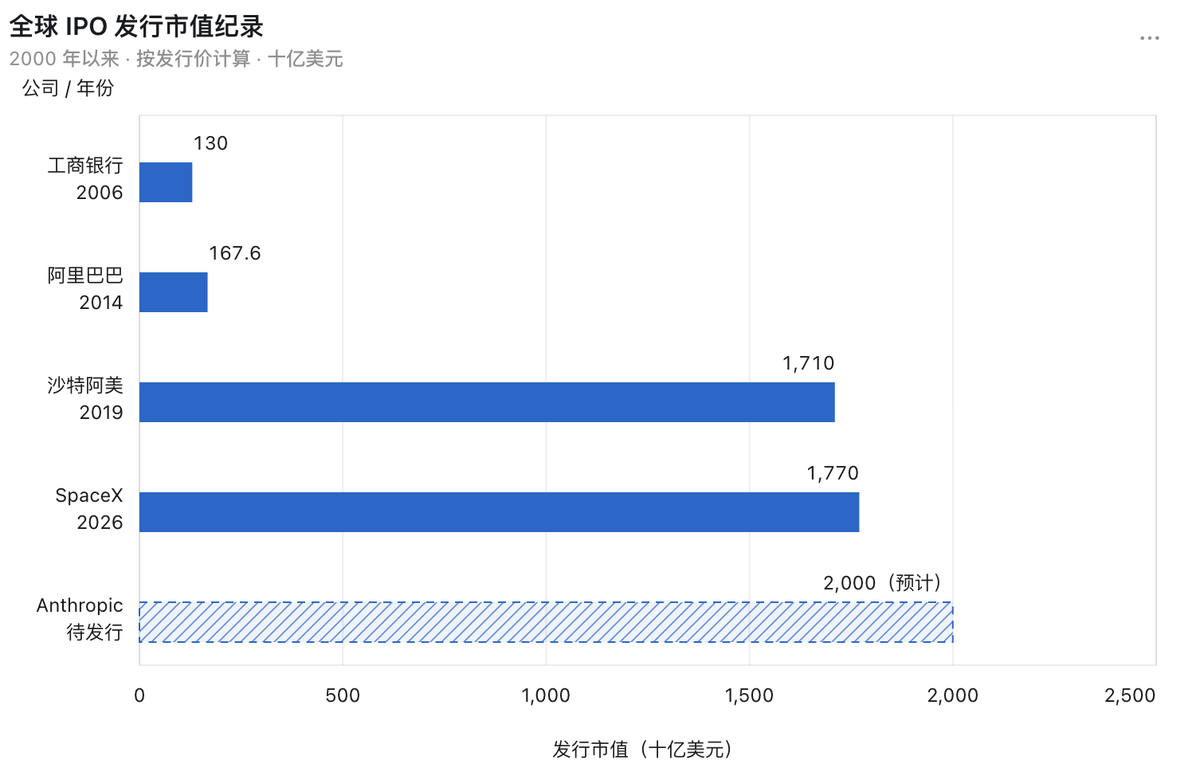
Among them, ICBC and Alibaba—both listed for more than a decade—saw their peak market values climb more than 200% above their offering prices.
Should Anthropic achieve a comparable gain of over 200%, its market value would surpass the current record (Nvidia's intraday peak of $5.37 trillion on October 29, 2025) and make it the most valuable company in human history.
Will that day arrive?
Not All Large-Model Companies Are Unprofitable
For most people, Anthropic is not a familiar name, but its flagship product Claude is certainly no stranger to readers who have long followed the AI field.
Simply put, Claude is currently the AI with the strongest overall capabilities, the best usability, and the largest base of paying users.
Leaderboard comparisons are meaningless; productivity doesn't lie. Major enterprises are all using Claude—especially for programming work, which is where AI currently excels most.
At the end of 2025, the venture capital firm Menlo Ventures surveyed 495 AI decision-makers at major enterprises across the United States. All of these respondents had the authority to decide which large model their companies would use, how much quota they could allocate, and whether to pay.
The data shows that Claude's share reached an astonishing 54%; the market shares of all other AIs on the market combined cannot match Claude alone.
That sounds like a lot already, but according to the S-1 prospectus submitted by Anthropic, in 2025, behind this 54% market share, Anthropic's annual revenue was only $4.585 billion.
In the first half of this year alone, Anthropic's revenue had already grown to $16.286 billion—3.5 times that of the entire previous year.
AI programming alone cannot account for such a massive increment. The surge in revenue means that Claude is not only the undisputed No. 1 in the programming field; in fact, it has become the large model with the strongest overall capabilities.
Recon Analytics conducted a survey in October, and the data shows that more than half of Claude's users use the paid version—55%; by comparison, ChatGPT has only 29%, less than 30%; Gemini is even worse, at only 13%.
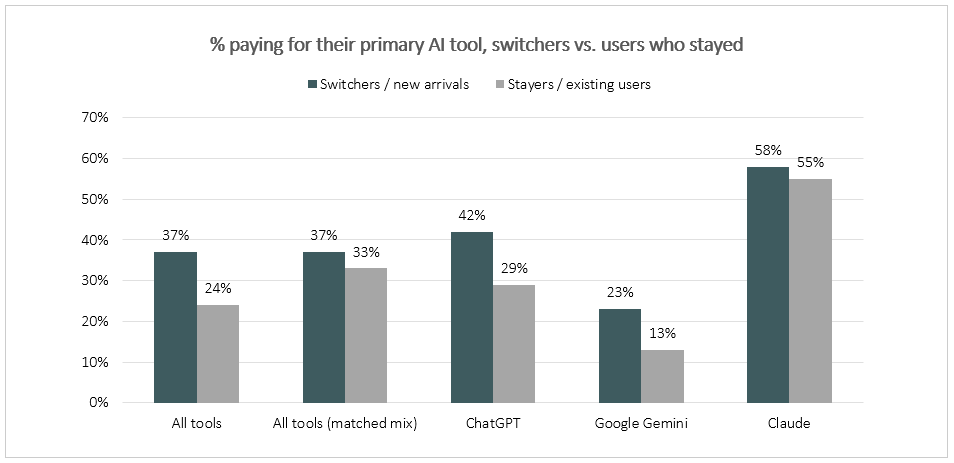
Source: Recon Analytics; the data shows the proportion of paying users among long-term stable users
Among them, a considerable number of users are enterprise customers. According to the prospectus, as of September 30, 2026, the number of customers with TTM revenue ≥ $100,000 exceeded 11,900; on September 30, 2025, that number was only 950.
A huge paying population and extremely high willingness to pay make Anthropic different from the common perception: it is no longer an AI company that burns money; it is already making money.
In the first half of 2026, Anthropic recorded positive operating cash flow of +$3.929 billion. According to non-GAAP metrics defined by the company itself (mainly excluding factors such as stock-based compensation), in the first half of 2026, adjusted operating profit was $1.618 billion, with an operating margin of about 10%.
Of course, you may come across articles telling you that Anthropic lost $80 billion in the first half of this year, but this is actually just accounting magic, mainly stemming from losses from changes in the fair value of convertible notes, derivative liabilities, and SAFE instruments.
According to the prospectus, Anthropic still has convertible notes with a principal value of about $6.2 billion. These notes mainly originated from Amazon's financing of Anthropic in 2023 and 2024.
Amazon can choose to convert the notes into shares before 2034 or 2035. Based on the current valuation of $2 trillion, this batch of notes is worth about $108.566 billion, or 1,750% of the principal.
Amazon will of course choose to take stock, so Anthropic has to record this money as a loss.
There are many other tech giants investing in Anthropic like Amazon. Microsoft and Nvidia jointly invested last November, with $5 billion and $10 billion respectively; Google invested another $10 billion in April this year; AMD invested another $5 billion in July this year...
Like Amazon Cloud Computing, all these investors are suppliers of Anthropic. Anthropic purchases compute from them, and they turn around and invest the money back into Anthropic, so that even now Anthropic still has more than $100 billion in cash and cash equivalents on its books.
Users are surging, revenue is growing wildly, and upstream suppliers are all showing favor. Anthropic does not seem to lack money, so why raise $100 billion?
Others Lose Money, but Others Have "Fathers"
Anthropic's founders, the Dario siblings, and five other people all came from OpenAI.
The details are complicated, but to sum it up in one sentence: the founders had a conflict of ideas. Dario believed it was necessary to be extremely vigilant that AI might become like Skynet in the movie *The Terminator* and betray humanity.
So he left with a few people and founded Anthropic.
This has made Anthropic attach great importance to independence. According to the prospectus, even after listing, the Founder LLC composed of Anthropic's seven founders will hold one Class F super-voting share, corresponding to 50.1 voting rights, to ensure control over the company.
No big company can tolerate having no say at all, so Anthropic's pursuit of independence has made it the only one among the five frontier large language model companies in the United States that has no "father" behind it.
Of the remaining four, each is backed by a listed company.
Gemini is supported by Google. According to the financial report of Alphabet (Google's parent company), the company's overall operating profit in the second quarter of 2026 was $40.770 billion. Although Gemini's financial data is not listed separately, Google has deep pockets and can still afford to burn money for now.
Grok was packaged by Musk into SpaceX and listed together with it. According to the financial report, the entire Super Intelligence segment of SpaceX had a combined loss of $3.295 billion in the first three quarters, but this does not matter. Tesla can still sell, so there is no reason for Musk to give up Grok.
Muse is a new player. Before launching Muse to the market in September, Meta (third-quarter net profit of $9.86 billion) originally could not get a seat at the table in this AI transformation war, so Zuckerberg cherishes this opportunity very much and plans to increase investment.
Finally, there is ChatGPT. Its parent company OpenAI can be said to have been raised single-handedly by Microsoft. Its founder Sam Altman said in an exclusive interview with *Fortune* in September that the company has no pressure to go public and that its IPO plan is postponed.
As long as Windows remains the most commonly used operating system for humanity, OpenAI will not lack money at all.
In other words, all its competitors on the market are rich second-generation companies; only Anthropic truly has to rely on itself.
But the hundreds of billions of dollars in its account are really not enough to burn.
This stems from Anthropic's compute dilemma. Because it is not itself a cloud service/chip manufacturer, Anthropic's compute reserves are severely insufficient.
In order to keep the level of compute development in step with users' growing access demands, Anthropic disclosed in its prospectus that it has signed compute construction contracts exceeding $650 billion over the next ten years with 8 compute suppliers:
-- Broadcom: $161.2 billion, chips and compute leasing
-- SpaceX: up to $120.5 billion, compute leasing
-- Google: $114.5 billion, cloud and compute
-- Amazon: $110 billion, cloud services
-- Microsoft: $44.9 billion, cloud infrastructure
-- Nscale: $44.6 billion, compute
-- Lambda: $41.3 billion, compute
-- AMD: over $20 billion, compute procurement
Even more alarming, in order to lock in this compute and prevent the giants from no longer providing compute services to Anthropic in order to improve their own models' competitiveness, more than 80% of these contracts have no right of withdrawal. Even if Claude later cannot use so much compute due to declining competitiveness, the money still has to be paid in full.
So Anthropic must genuinely pay out more than $500 billion in the future. The cash currently on its books can only cover 20%; after the IPO is completed, it can cover about half; the rest must be figured out somehow.
If the speed of making money cannot keep up, it may have to continue issuing more shares.
Will the U.S. Stock Market AI Tech Bull Market Continue?
Companies in the U.S. stock market AI chain have not performed well recently.
The Philadelphia Semiconductor Index has fallen about 13% from its recent high and 21% from its historical high in June; Alphabet fell 12.6% on October 29 alone, while Amazon and Intel fell 7% and 23% respectively after their financial reports were released on the 29th (after-hours trading data).
Companies queuing up for IPOs are also beginning to consider postponing or withdrawing, such as Holtec Nuclear, SB Energy, Nscale, and other upstream companies in the AI industry chain.
Among the top-tier companies in the AI chain that are queuing for IPOs, only Anthropic is left.
The entire market is watching Anthropic. Based on past experience, under such circumstances, the period before listing is basically a frenzy of gains.
SpaceX is the best example: its offering market value was $1.77 trillion, and both its market value and timing are relatively close to Anthropic.
On June 12, 2026, SpaceX went public at $135 per share. It closed up 19.22% on the first day of listing, then rose another 19.60% at the close the next day. In its first week of listing, it rose as high as $225.64, with a first-week closing gain of 37.04%.
Anthropic is likely no exception. Hot money in the market will always flow to the companies with the highest attention. The key is how long it can rise, how high it can go, and whether it can drive the next wave of the AI tech bull market.
It looks difficult.
The former top valuations (except SpaceX, whose time is too short) were able to maintain or even continue to push up their stock prices because their revenue, costs, and business models all tended to be stable. But Anthropic is not like that. It may have used Claude to sit on the throne of the strongest overall large model, but that does not mean it can sit there securely forever.
First, there is the uncertainty of R&D. All tech companies must face R&D risks in the early stage of industry development, because the technological moat has not been accumulated for long enough, and latecomers may overtake them at any time.
For example, in 2025, Gemini was still the large model with the strongest overall capabilities at the time. By the second half of 2026, everyone was already calling it the "North American Doubao."
Maybe Claude will have such a day too.
Second, Chinese competitors are encircling the cities from the countryside. Although the overall capabilities of models such as DeepSeek lag slightly, just look at the price. DeepSeek is truly attractive.
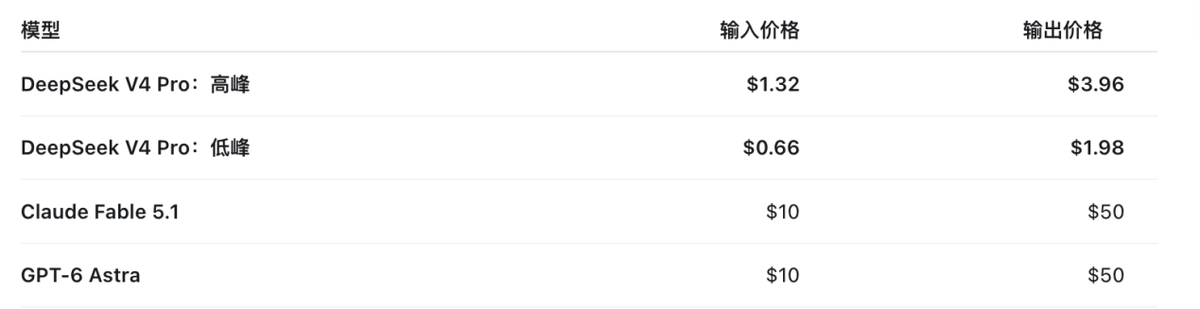
Unit: USD/million tokens
At off-peak prices, Claude and GPT are more than ten times more expensive than DeepSeek. Is the extra performance really worth so much money?
Of course, in the short term, the concept of "U.S. domestic substitution" that Trump is vigorously promoting should not yet collapse, and Claude will not face threats from China in the U.S. market in the short term. But once there is a policy change in the future, its revenue will probably immediately be called into question.
Anthropic, however, appears very confident. In its prospectus, it says it is competing for business in a market as large as $40 trillion. Converted into RMB, that should be 266 trillion RMB, A15, enough to repay the debts of 133 Boss Xu.
Human history has never seen anyone dare to boast like this.
Of course, Anthropic has its own logic. According to its explanation, this price is the sum of the value created by all mental laborers in humanity, and AI will one day be able to replace all mental laborers.
If that day really comes, then perhaps the most valuable company in human history will indeed be an AI company, but whether it will be Anthropic depends on its fate.
Source: Chaoyang Capital Theory
-
![]()
Will Anthropic Become the Most Valuable Company in Human History?
-
![]()
Zhongrun Optics Q3 Report: Consolidation Drives Revenue Up 38.85%
-
Tianyi Ma Q3 Report: Net Profit Plunges 50%, Gross Margin Under Pressure, Interest Expenses Devour Profits
-
Foxconn Industrial Internet Q3 Report: AI Computing Power Delivered, Quality of Growth Improves
-
Mercedes-Benz's All-Electric E-Class
-
![]()
The Largest IPO in History Has Officially Filed Its Application
-
![]()
Prefabricated Data Centers Are Suddenly Catching On
-
![]()
Two Contrarian Bets: Can Wang Tao Really Succeed Zuckerberg?