AI Hardware: Don't Even Think About Bypassing Privacy
 10/30 2026
 521

Author | Peng Kunfang
Editor | Lü Xinyi
Produced by | AI Wuzhao
The tech industry always has a ready justification for why people should surrender more of their privacy.
In the internet era, that justification was convenience. To hail a ride, order food delivery, or stay in touch with friends, people clicked "agree" beneath one lengthy user agreement after another. Many of those authorizations were hardly the product of careful deliberation; it was simply that once you refused, the task at hand could no longer be done. In the AI era, the same bargain comes wrapped in even bigger promises: devices must understand you, models must learn about the real world, and artificial general intelligence must keep moving forward.
So cameras and microphones are installed in glasses, cars, watches, and robots, edging ever closer to people's bodies and daily lives. For some of these products, it is worth asking anew: is the consumer the person being served, or the person helping the manufacturer obtain data? Especially when the hardware price has already been paid, yet data is still treated as a resource to be continuously extracted—this deal is far less simple than the ads make it out to be.
Frankly, much of today's hardware is not built to serve consumers at all, but to serve "data."
Several recent news items have pushed this unease to the forefront. Research on car data flowing to third parties has once again drawn attention; Apple Watch's 15-second conversation replay has sparked controversy; and Meta, while mired in surreptitious-recording controversy, has launched a camera-less model and added an option to opt out of AI training for some visual data. The common question they present is: tech products enter life very quickly—can people's refusals come in time?
We need to make our stance clear: there must be brakes, and the cost must be paid. More cumbersome authorization, more limited collection, and potentially slower model progress should all be seriously absorbed by the industry. Ordinary people have no obligation to use their own lives to fill in the conditions for a company's technology roadmap.

The phrase "trading privacy for convenience" once made the internet's data business seem perfectly natural. Platforms provide free services, users contribute attention and behavioral data, and companies recoup their investment through advertising. Even though this exchange is full of information asymmetry, consumers could at least see a surface-level explanation: I'm not paying directly, so I'm paying with something else—this "transfer" was still defensible.
Hardware makes this explanation harder to sustain. Cars, glasses, watches, and home robots all have clear price tags; some products even require ongoing subscriptions. Users have already paid for the device and the service, so why should they still be expected to accept data uses unrelated to the current service? How does buying a product incidentally become a commitment to the manufacturer's long-term data needs?
On September 29, The Verge reported on a connected-vehicle privacy study conducted by Northeastern University in collaboration with Consumer Reports, covering 21 cars and 30 companion apps. The study found connections between vehicles and advertising, tracking, and analytics domains, and in some companion apps found vehicle identification numbers, location, and other information being transmitted to ad networks.
Suffice it to say, many consumers have no idea where the data behind their cars goes. Once the car is bought, the data relationships revolving around it far exceed the buyer and seller.
A more direct case is General Motors. The settlement order finalized by the U.S. Federal Trade Commission in January 2026 addressed allegations that GM and OnStar collected and sold precise location and driving behavior data without adequate notice or explicit consent. The order includes a five-year ban on disclosing such data to consumer reporting agencies and requires more consent, access, deletion, and opt-out mechanisms.
Cars need to sense the road, navigation needs to know location, and voice assistants need to process commands—these all have specific purposes. What truly needs to be justified item by item are the downstream uses: why should information obtained to complete this service be retained long-term, why should it be handed to other companies, and why should it enter the training pipeline?
AI makes this confusion even easier. Data can help a product complete the task at hand, and it can also help manufacturers improve models and develop next-generation products. When both values exist simultaneously, companies have an incentive to expand collection as much as possible. Rather than guessing whether a company's "intentions are impure," analyzing its data acquisition behavior should focus on actual product design: after a user refuses additional uses, how much of the service they already paid for remains?
For robots, this question is also imminent. Robots entering homes and devices recording human operations may come into contact with room layouts, household routines, work processes, and cohabitants. Manufacturers can explain the value of such information for training, but they still need to answer: who is qualified to authorize this slice of life? If a homeowner agrees to trial a robot, can the lives of visitors, domestic workers, and other family members all be handed over along with it?
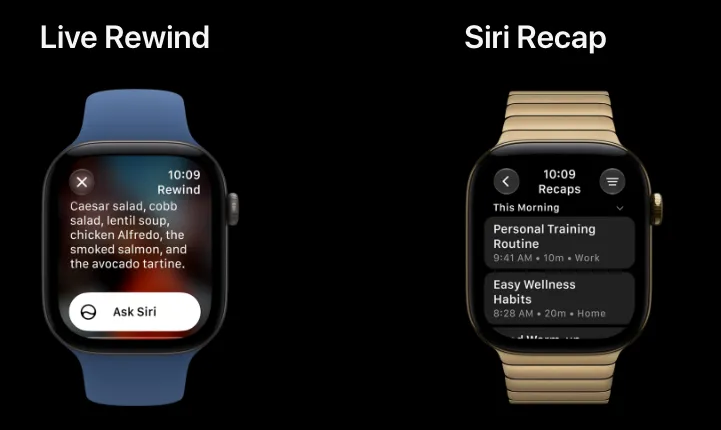
The Apple Watch case mentioned above also reminds us that privacy controversies cannot focus only on "whether the manufacturer is using it for training." According to Apple's published design, Live Rewind will retroactively display text snippets from the previous 15 seconds of conversation, and Siri Recap will generate conversation summaries; both features are planned to launch in beta within the year, enabled at the user's choice. Apple says raw recordings are not stored, and the saved text and summaries are protected by end-to-end encryption.
These protections should be acknowledged—they genuinely limit data exposure. But the other party in the conversation can still ask: do I want this exchange to leave behind a machine-generated record?
Personal hardware is producing effects that extend beyond the individual. In the past, if you didn't accept an app's rules, you could try uninstalling it; but faced with the glasses, watches, and robots of people around you, refusal often means actively interrupting the conversation, asking the other person to stop using the device, or even leaving the scene. The convenience brought by the device goes to the user, while the trouble of maintaining boundaries falls on bystanders.

Among these controversies, Meta is a fitting observation sample. Its privacy boundaries keep shifting with products, policies, and external pressure.
In April 2025, Meta notified U.S. glasses users that it was removing the option to turn off storage of voice recordings; users could still manually delete recordings in settings. Then in June of this year, WIRED reported that code related to facial recognition, not yet publicly enabled, had appeared in the Meta AI app and was subsequently removed. Meta responded that the feature was still exploratory and no final decision had been made.
These online reports cannot be exaggerated into "Meta has already opened to the public the ability to identify strangers at will." But they are enough for consumers to ask: where exactly is the privacy boundary accepted when buying a pair of glasses? This uncertainty itself consumes trust.
That is precisely why two recent Meta adjustments deserve recognition. The Ray-Ban Meta Audio released in September removed the camera while retaining audio and AI interaction capabilities. Foreign media noted that the camera-less model still has audio privacy issues. There is no need to ascribe a pure motive to the company on its behalf—consumers having one more product choice that collects fewer images is a concrete improvement, regardless of whether it was forced by various pressures.

The same goes for the "training opt-out" option. On September 25, Business Insider cited confirmation from a Meta spokesperson that glasses users can turn off "store visual data from AI experiences," opting out of storing this portion of data for AI training. This option covers only visual data, not voice interactions.
Here we must also distinguish ordinary photography from AI visual interaction. Meta states that photos and videos taken for the album are by default saved on the device or in the user's album; asking AI about things in front of you will invoke the camera to help answer. When a user says "what is this," it may involve an entirely different data processing flow. The features look seamless, but the authorization boundaries need to be explained with particular clarity.
Allowing opt-out from training at least acknowledges one thing: a user invoking AI to complete the current task and allowing the manufacturer to continue using the information for model improvement can be different choices. If these two things can be separated, the choice should be returned to the user. Uses that were previously bundled together also need to be re-examined.
However, the opt-out entrance still solves only part of the problem. What is more concerning is that everyone is accustomed to entrusting this choice long-term to companies' "voluntariness." If a company is willing to add an opt-out switch, that is of course welcome; whether a company can take it away again in the next update equally needs constraints. The reasonable expectations users form when buying hardware should not change arbitrarily with model training plans and growth targets.
Meta's repeated flip-flopping ultimately brings the discussion back to a simple question: who decides where the privacy boundary lies? Manufacturers can of course design new features, but before extending new uses into consumers' lives, they need to seek consent anew. And those who did not buy the product or register an account should also be included in the scope of product responsibility.

"For better AI" is a reason that needs to be seriously scrutinized. It can explain why companies want data, but it cannot by itself answer whether companies have the right to obtain data. Expanding the reason to AGI and the tech race does not eliminate the authorization, boundaries, and responsibility in between.
Once refusing to provide data is framed as not understanding technology or not supporting innovation, consumers bear an extra moral pressure. Ordinary people buy devices hoping to solve their own problems; they have not thereby promised to join an indefinite data contribution plan. The future technological dividends are full of uncertainty, but the life handed over today is very concrete.

For refusal to be truly valid, products must first accommodate refusal. For training and marketing uses unnecessary to completing the service, consent should be sought separately and cannot be obtained through bundled authorization. Turning off necessary sensors and affecting related functions can be explained; refusing extra training and having even unrelated functions restricted accordingly requires manufacturers to explain why. The two should not be vaguely packed into a prompt saying "you cannot use the service if you disagree."
Protection for bystanders must also move forward into product design. Which places should restrict collection, how recording status can be made easily noticeable, whether devices can be easily paused, and how recorded individuals can complain and request handling all need clear arrangements. Indicator lights and notification sounds are useful, but they are only part of notification. It is clearly unreasonable to expect restaurant servers, office colleagues, and household visitors to research the light meanings of every device themselves and then actively negotiate.
Of course, these requirements may increase costs. Collecting less data may mean giving up useful samples; adding on-device processing may require more computing power and engineering investment; building authorization, access auditing, and deletion mechanisms requires ongoing maintenance; allowing users to refuse may affect the scale of training data. Companies should write these expenditures and trade-offs into product budgets and account for them just like chips, battery life, and after-sales service.
Especially for data collection companies, costs cannot be calculated only as how much collectors earn per hour, how much equipment depreciates, and how expensive data cleaning is. Whether the collection site permits it, whether others in the frame are informed, how private information is handled, and whether the scope of use can be proven afterward should all enter delivery standards. Data whose source and authorization cannot be explained, even if cheap to collect, cannot easily be treated as high-quality assets.
Costs also include giving up part of the revenue and bearing sufficiently clear consequences for overstepping. Rectification, compensation, auditing, and restrictions on related data use should make companies hesitate when making collection decisions. Otherwise, the party that obtains data first gains an advantage, while the party that seriously obtains authorization bears higher investment, and the market instead rewards companies with looser boundaries.
Finally, we must be vigilant that these costs paid cannot simply become another "privacy protection fee" charged to users. Companies need to handle costs honestly in pricing and business models, but consumers being unable to afford a more expensive version should not become a reason their lives can be additionally exploited. Privacy involving others cannot be priced and sold by buyers on their behalf.
The tech industry is already well-versed in discussing computing costs, customer acquisition costs, and mass production costs. But as it steps into the physical world, it must also learn to account for the cost of respecting others. It cannot—every time privacy comes up—offload the hard problem onto consumers, leave the losses to bystanders, and keep the gains from data collection on its own books.
We can acknowledge the value of AI hardware and welcome adjustments like Meta's, while insisting on actively demanding more. A tech industry that claims to understand the physical world should have the courage to understand others' refusals and to clarify the boundaries of data. There must be brakes, and the cost must be paid—even if that means collecting less data, making less money, or delivering the so-called AGI future a little later.
-
![]()
AI Hardware: Don't Even Think About Bypassing Privacy
-
![]()
Will Anthropic Become the Most Valuable Company in Human History?
-
![]()
Zhongrun Optics Q3 Report: Consolidation Drives Revenue Up 38.85%
-
Tianyi Ma Q3 Report: Net Profit Plunges 50%, Gross Margin Under Pressure, Interest Expenses Devour Profits
-
Foxconn Industrial Internet Q3 Report: AI Computing Power Delivered, Quality of Growth Improves
-
Mercedes-Benz's All-Electric E-Class
-
![]()
The Largest IPO in History Has Officially Filed Its Application
-
![]()
Prefabricated Data Centers Are Suddenly Catching On