Silicon Valley Tech Giants Bet on AI Games to Capture the Last Profitable Frontier
 11/05 2026
 345
Author: Utah
Editor: Li Xiaotian
"If your only internship experience is at Google, AI companies will rate you lower."
Earlier this year, a practitioner surviving on the U.S. West Coast told Xiaguangshe this. In the eyes of AI-native companies, a big-tech pedigree is no longer a plus—it may even work against you.
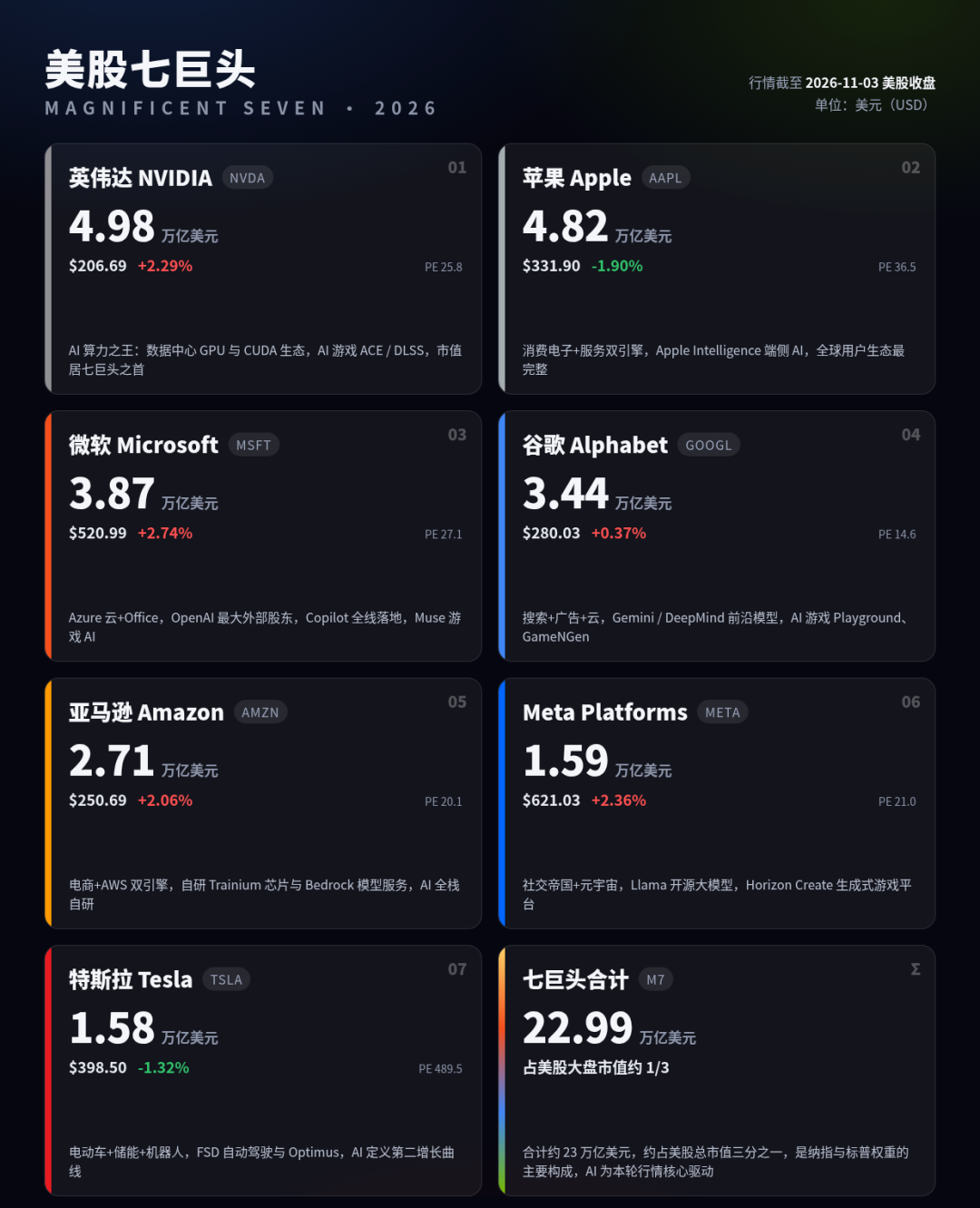
This shift is not limited to resumes and job hunting. At the start of this year, Silicon Valley's M7 (the seven tech companies with the largest market capitalization and deepest impact on the stock market: Apple, Microsoft, Google parent Alphabet, Amazon, Nvidia, Meta, and Tesla) began round after round of layoffs, adjusting their respective "AI integration strategies" step by step while competing for talent and resources in the market. On one side, big-tech credentials are being nitpicked by AI companies; on the other, the giants themselves are pivoting to double down on AI. Silicon Valley's card table has been reshuffled.
One of the most visible battlegrounds in this reshuffle is AI games.
In a previous article, Xiaguangshe introduced Astrocade, an AI game creation platform backed by Fei-Fei Li that raised $56 million in funding.
At the time, the platform was filled with rough casual mini-games like Tetris and Snake, positioning itself around a "personalized recommendation feed." Despite winning investment, practitioners regarded it as a "low-spec TikTok for games," with an unclear target player profile and uncertain prospects.
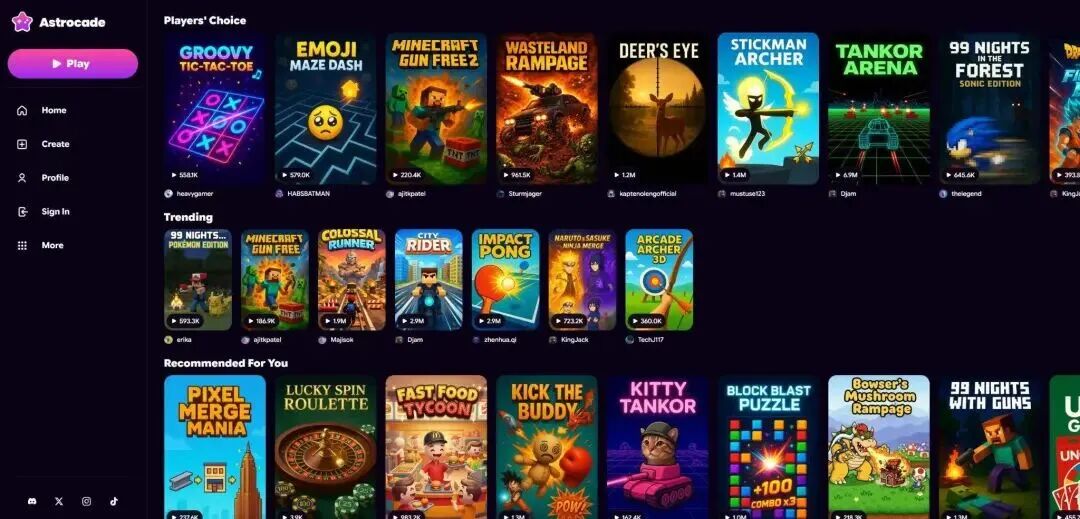
But Astrocade delivered a corresponding strategy—a $10 million creator incentive. Creators could unlock monetization by reaching 100,000 valid plays within 30 days. With publicly disclosed revenue-sharing rules, four months later Astrocade's monthly active users surged to 10 million.
No one knows how long the data driven by such incentives can last, but behind Astrocade's high growth is a more definite message: low barriers opened a window, and AI-generated games have successfully cultivated their first batch of users.
But this batch of users does not belong to traditional internet giants; it attaches to AI-native companies. Thus, Google, Meta, Microsoft and a host of big tech companies have also rushed to race, hoping to find the few remaining profitable prospects in an increasingly grim investment environment.

Silicon Valley tech giants are obsessed with "one-sentence game generation"
Silicon Valley's "one-sentence game generation" has actually been underway for a long time.
Google moved first.
At the end of 2024, Google's AI research unit DeepMind launched Genie 2, which could generate interactive 3D scenes from a single image and text description—and even brought in Musk to try it out.
In January 2026, Project Genie powered by Genie 3 was unveiled, available to U.S. Google AI Ultra subscribers aged 18 and over. After "one-sentence generation," Genie 3's other tagline is "generate and play." Genie 3 can generate scenes conforming to optical physics and complete complex interactions, but it has only about one minute of "visual short-term memory," cannot sustain a coherent game world, and its output is locked at 720p and 24 frames per second, with comprehension errors still occurring.
What's more "terrifying" is that this is a walled city. All results cannot be exported or shared; the platform can observe everything that happens and obtain more data, but players can only get 60 seconds of joy.
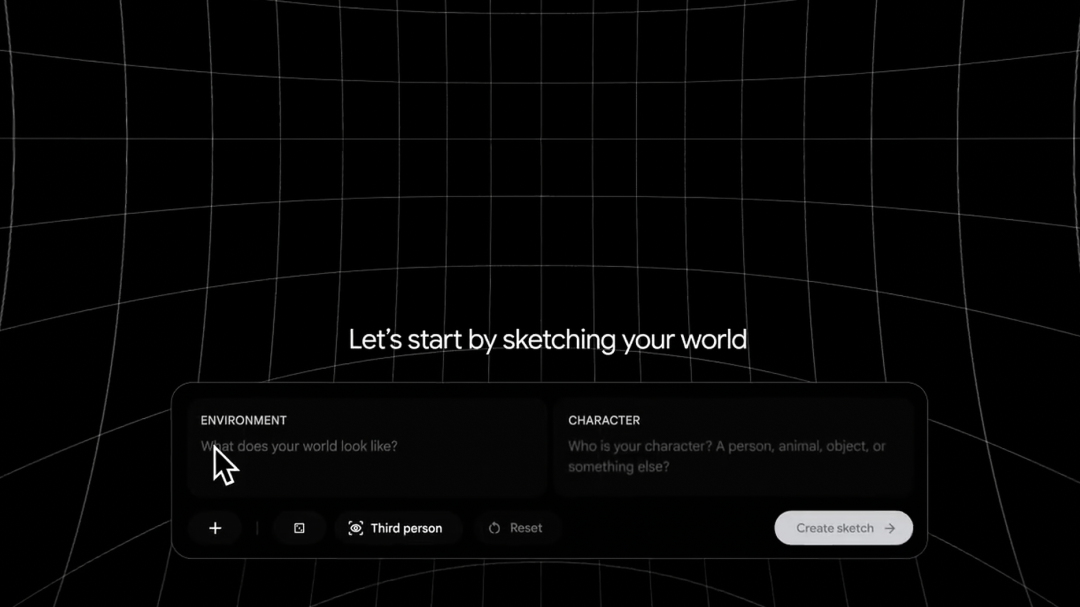
The criticized Google did not stop. On October 7 this year, it launched another AI game creation platform, Google Playground.
Playground still insists on being open only to U.S. users aged 18 and over and on the "one-paragraph game generation" model, but the upside is that users can now publish or share games in the platform community.
Just a week ago, DeepMind released Genie 4, extending single-session playtime after generating real-time scenes to 2 minutes.
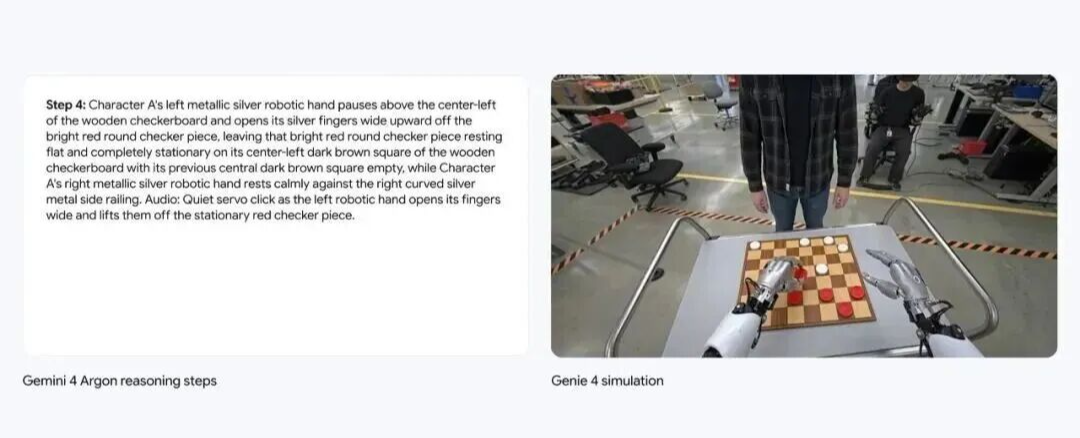
It's fair to say Playground isn't aiming for revolution, nor is it another Google attempt to lower the creation barrier—it's about finding commercialization scenarios for its AI business.
Compared with Google, Meta's (formerly Facebook before 2021) bet on AI games carries a sense of long-premeditated delight.
In 2007, Facebook opened a dedicated gaming platform for third-party developers. In 2016, it launched Instant Games, intending to use H5-based instant games to keep users within the Facebook ecosystem longer. However, because Apple refused to concede margins and platform commissions were high, this business model did not last.
In the following years, Zuckerberg bet on the "metaverse," investing over $15 billion in Horizon Worlds. Yet things went contrary to expectations: by the end of 2025, Horizon Worlds' average monthly active users were fewer than 200,000, and the metaverse business had accumulated $70 billion in losses. The only somewhat memorable news was that bizarre selfie Zuckerberg shared.
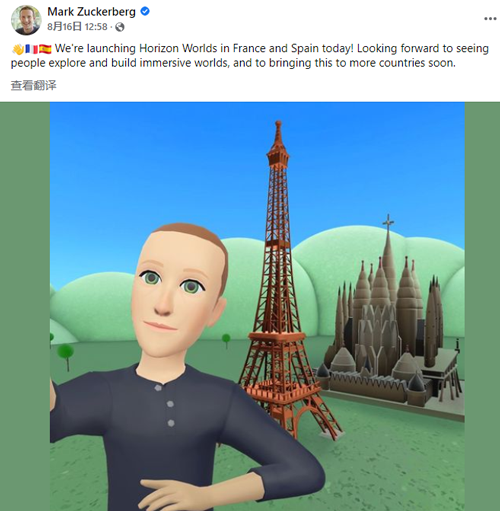
Incidentally, Horizon also launched a $10 million creator program back then—by comparison, Astrocade's results are indeed quite good.
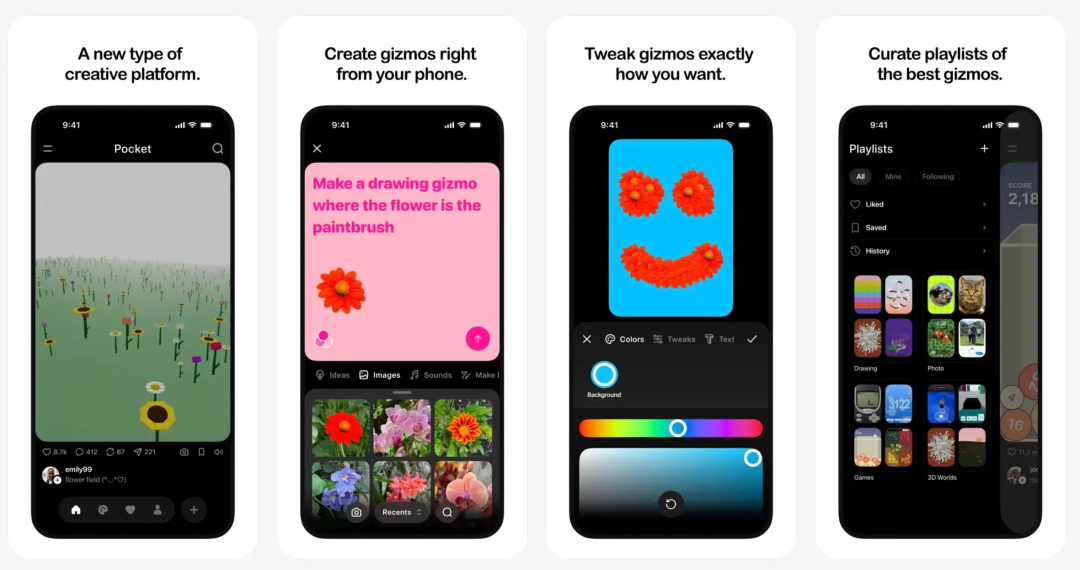
Fast forward to 2026. On June 29 this year, Meta quietly launched an AI creation app called Pocket on app stores. Domestic media defined it as an "Instagram version of 4399," likewise featuring "one-sentence game generation," almost identical in form to Astrocade and Aippy.
It's worth noting that Pocket's predecessor was Gizmo from startup Atma Sciences, whose founding team mainly came from Snap. But this team with a 98% approval rating did not bring another miracle. Pocket launched in 33 countries and regions but totaled only 210,000 downloads, making it the most invisible app in Silicon Valley's AI game race.
Perhaps realizing the track is already full, Meta's attention returned to "heavy industry."
In September, Meta released Horizon Create and Horizon Studio, allowing users to build games based on the creation capabilities of the Meta Horizon Engine agent, officially declaring Horizon's reincarnation as an AI game engine.
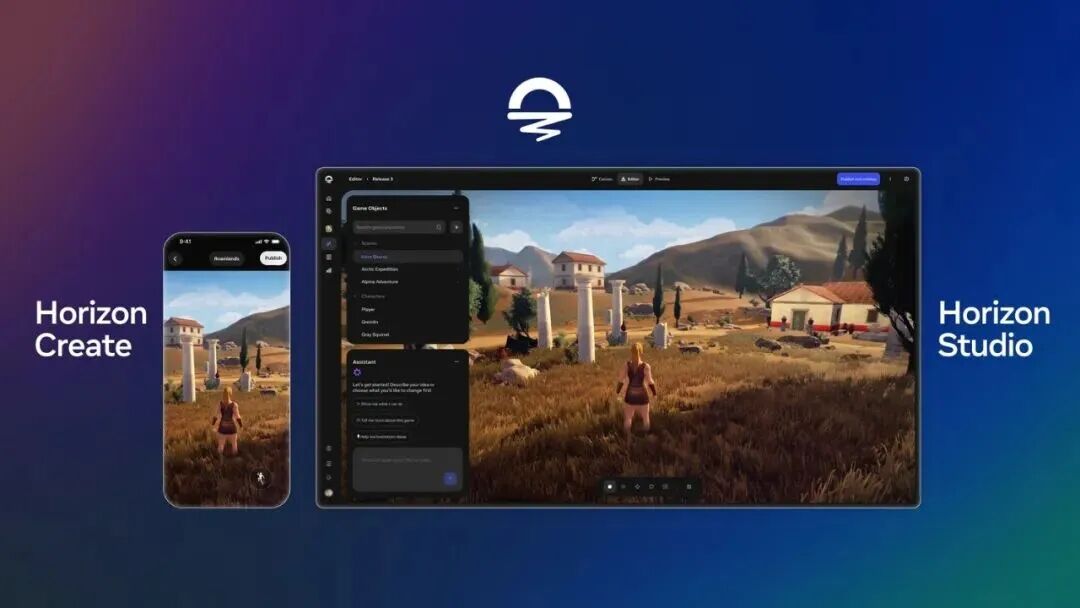
Horizon Create and Horizon Studio have three biggest features. First, games generated by the tools can enter Meta's social platforms and spread across Facebook, Instagram and other social media; second, they share the same backend, enabling seamless switching between mobile and web; third, they support creators in simultaneous multiplayer online creation on Quest headsets or desktop.
Meta's goal is more about folding social elements into AI games, using its strong suit to quickly secure a position in the "one-sentence game generation" AI ecosystem. Native social relationships based on the Meta ecosystem are becoming its core accelerator for laying out the AI track.
By comparison, Microsoft seems a bit "clumsy."
In February 2026, the World and Human Action Model (WHAM) Muse, jointly developed by Microsoft Research and Ninja Theory under Xbox Game Studios, was unveiled and even made it into the international academic journal Nature.
Muse's biggest achievement is that, trained on the 7 Maps dataset (equivalent to more than 7 years of human gameplay), it can ensure generated videos simultaneously maintain consistency, diversity and persistence—though the current generation resolution is only 300×180 pixels.
Such much-cry-little-wool results made practitioners stomp their feet. David Goldfarb, founder of The Outsiders studio, vented bluntly on X—"fuck this shit."

Image source: X
An anonymous developer pointed out directly that Muse's real goal is shareholders. "To show shareholders Microsoft's comprehensive investment in AI, even though it has not delivered any product anyone actually wants."
In October, Xbox established Xbox Labs, responding to the emerging phenomena of AI-assisted game porting, decompilation and recompilation. Interestingly, however, its CEO Sharma seemed to deliberately avoid AI-related wording, drawing quips that it was "a guilty conscience crying out."
In addition, some "conventional entrants" are also continuously betting on AI games. Nvidia released RTX Spark built specifically for AI, creation and gaming, deeply connected with developers such as KRAFTON and NC; Optimus uses game data to train avatars, intending to reshape the robotics ecosystem; OpenAI released GPT-6 Astra, specifically mentioning a "key breakthrough": users can generate a complete playable mini-game within minutes solely by describing their imagination.
In Silicon Valley's AI gaming field, there is no shortage of Chinese entrepreneurs either. Health, who graduated from Tsinghua at 20 and was a core member of Douyin's social interaction direction, founded LinearGame in Silicon Valley in 2024, positioning it as "the next Steam + the next Netflix." In 2025, the launches of Nano Banana and Genie 3 anchored LinearGame's direction; it used world models to build the AI game development platform Yoroll, proposing "engine-free games."
Today's Silicon Valley is relying on "one-sentence game generation" to whip up the final frenzy at the tail end of the AI storm.
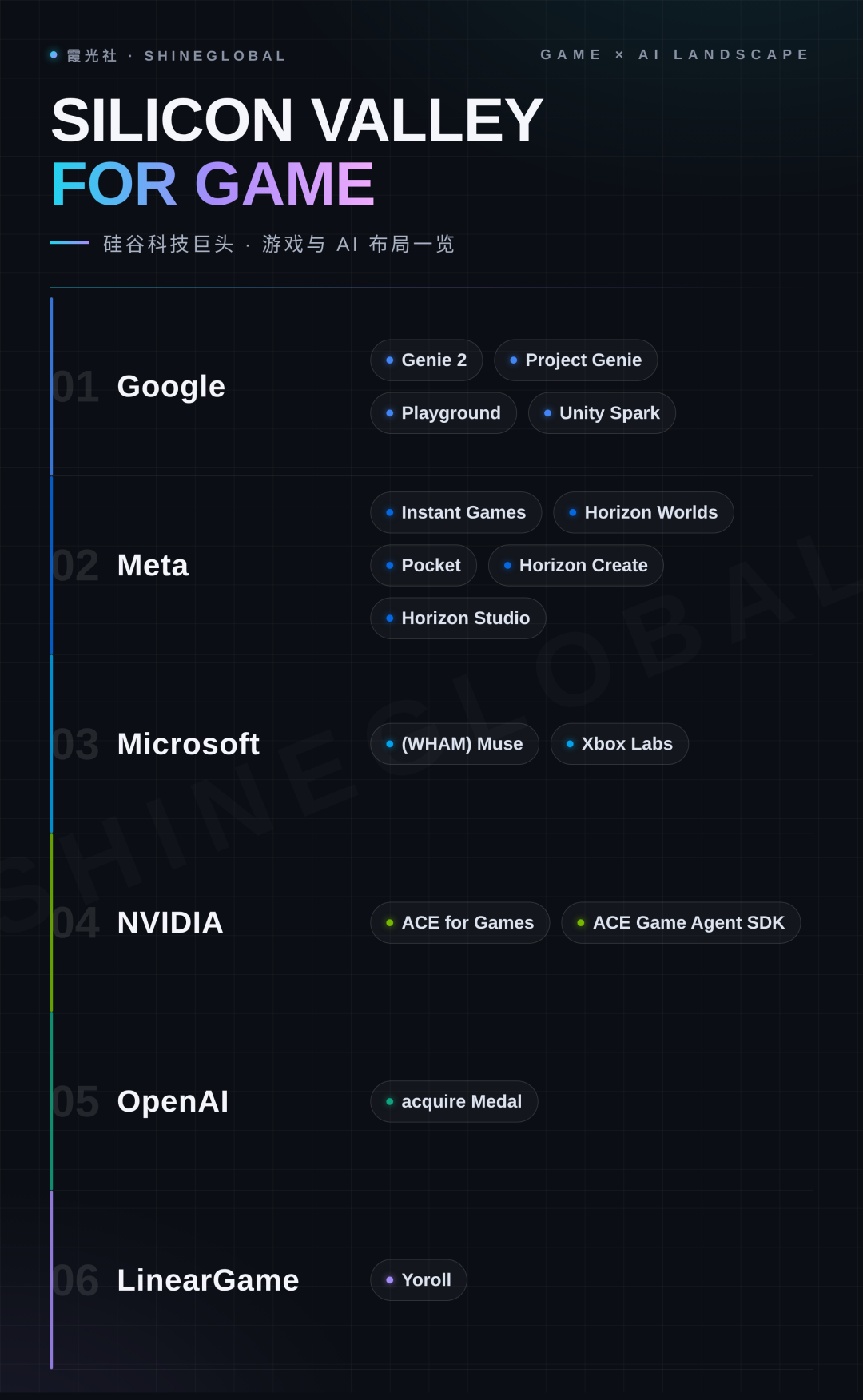

Integration, acquisition, cash grab: three approaches to Silicon Valley's bet on AI games
Why are Silicon Valley tech giants all betting on AI games?
Actually, the capital market's reaction has already given the answer.
One reason lies in the market's AI panic.
In January this year, after Project Genie was released, although most practitioners reacted lukewarmly and remained observant about AI game production, the stock prices of gaming industry giants began a "collective plunge."
Game engine leader Unity fell 24.22%, Take-Two, preparing to launch GTA6, dropped 7.93%, and Roblox, the first metaverse stock, plummeted 13.17%—the three companies "collectively slashed" about $19.5 billion in market value in a single trading day.
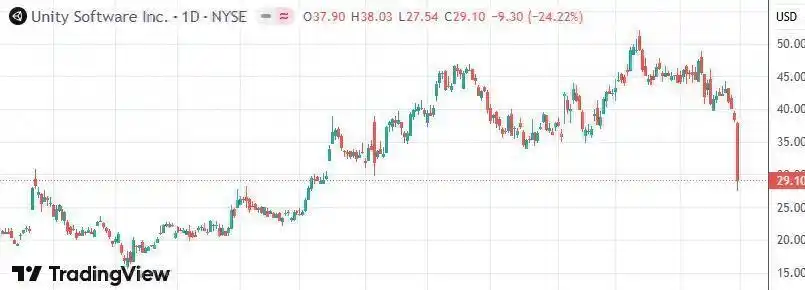
Regardless of whether AI platforms can truly replace practitioners or highly reshape the industry, fear has become an emotion the public cannot dispel, especially under Silicon Valley's frenzied betting. And this panic has bred three development directions.
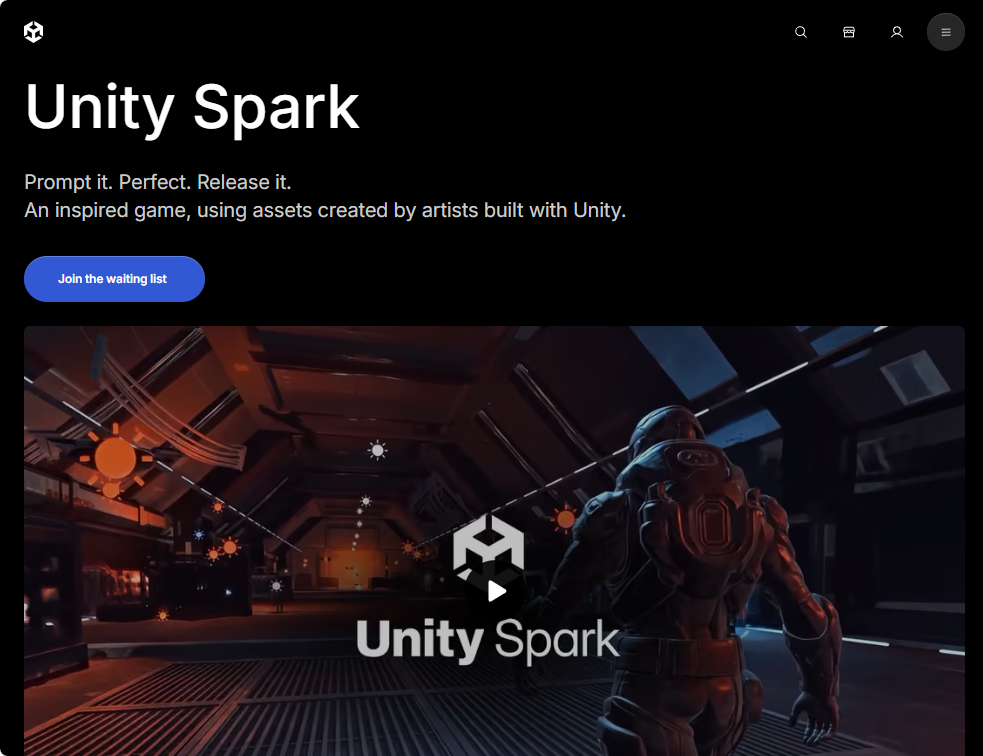
First, "new-old" integration. While announcing Playground, Google also announced another AI game development tool jointly developed with Unity—Unity Spark.
Unlike Playground's product positioning aimed at "game creation newcomers," Unity Spark targets more professional creators.
Although still in testing, one piece of information disclosed so far is that Unity Spark will support more complex game mechanics, visuals, and runtime support, while providing Unity's "content assets": Spark will connect directly to the Unity Asset Store, allowing creators to access materials made by community artists.
In the past, Unity's long-accumulated models, animations, and scene assets only served "engine-experienced developers" who had crossed the technical threshold, but now it will serve more creative work and enable the low-barrier production of more complete, professional games.
In Silicon Valley's race, newcomers and incumbents each holding their own views are stitched together by "visions of the future" and "pressure from the hype," and in the capital race, the form that uses technological strength as the skeleton and creative assets and experience as the flesh and blood stakes out a position first.
The second is asset acquisition. In the ever-changing AI magnetic field, the big companies are the ones with the most choice, and they are also the most willing to avoid excessively long development costs and quickly obtain core resources.
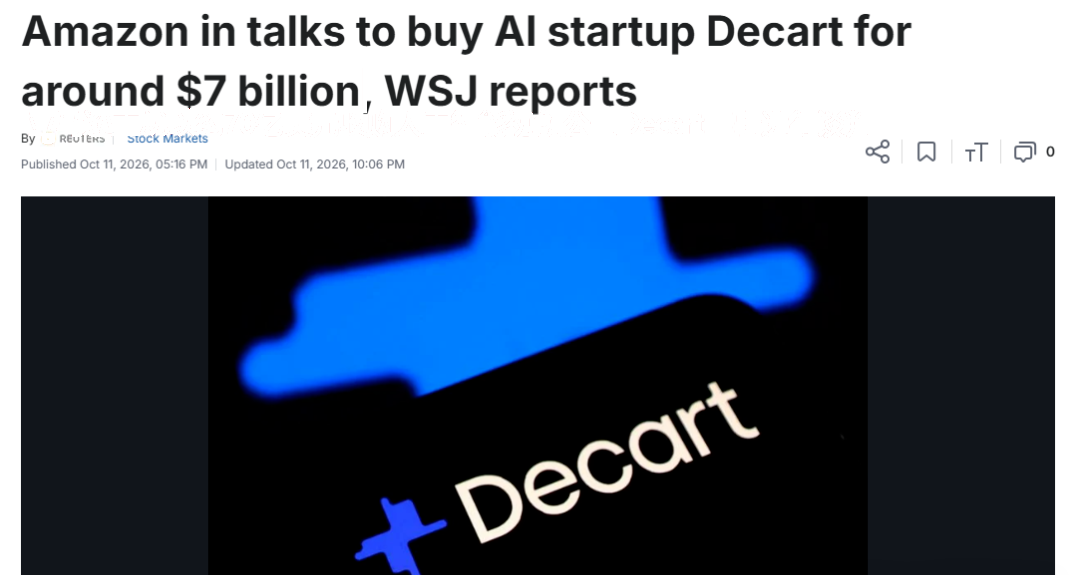
In August 2026, Bloomberg reported that Anthropic was in talks to acquire AI company Decart for $6 billion. After Anthropic's due diligence led it to abandon the acquisition, Amazon sat down at the negotiating table, and the potential transaction amount rose to $7 billion.
This company, founded just three years ago by three Israeli engineers, first attracted attention because of Oasis—a real-time interactive game that Decart calls "the first real-time interactive open-world AI model." After that, Decart developed another core technology—DOS, a translator that helps AI models adapt to different chips and improves computing efficiency.
Simply put, it saves both money and effort, allowing Amazon's chips to achieve a leap in cost-effectiveness. The $7 billion Amazon paid is not at all about "US-Israel ties" and a rich kid chasing his dream, like the Middle East's acquisition of EA; it is purely the pursuit of capital interests.
The third is accelerating the scramble for capital. Those who cannot wait will not only make acquisitions but also want to take money from the market.
On October 21, Meta reported its third-quarter results: revenue rose 26% year over year to $64.6 billion, including $63.1 billion in advertising revenue. Yet the figure, which beat Wall Street expectations, hardly amounted to a victory. The company's operating margin slid from 40% a year earlier to 20%, and free cash flow turned negative for the first time since its 2012 listing, coming in at -$2.1 billion—compared with $10.6 billion in the same quarter last year.
Meta was also hit the same week with a $25 billion penalty signed off by a New Mexico judge, carrying 15% annual interest—the heaviest fine any U.S. state has imposed on a tech company to date. The next day, Meta's shares closed down about 7%, wiping more than $100 billion off its market value.
Curiously, a month earlier, after the release of Horizon Create and Horizon Studio, Meta's stock had climbed as much as 4.5% in a single session—its biggest gain of the year.
Muse's inability to stand on its own—and its struggle to turn a profit—hastened the market's verdict on Meta. Shortly after the earnings release, Meta announced a sweeping investment plan. The acceleration reads as an act of desperation. A Barclays research note observed that part of the reason Meta opted to raise funds early is that "the financing environment is becoming increasingly severe."
Other companies across the AI ecosystem have already begun or plan to begin raising capital, and the AI giants now face a prisoner's dilemma—none more so than Meta, whose valuation is relatively low among the Magnificent Seven and which can only strike first. But someone always gets there sooner: on October 26, Anthropic formally filed a public IPO application with the U.S. Securities and Exchange Commission, targeting a valuation of $1.5 trillion to $2 trillion, seizing the high ground in the race among the major AI players.
In Silicon Valley, this race is truly a matter of life and death.

Can domestic manufacturers still claim a slice of this pie?
In April this year, Xiaguang Society visited dozens of AI companies in Beijing, including the newly renamed Yuandian Building, where we looked out over the nearby Tsinghua and Peking universities alongside practitioners from the building's AI interaction zone. At the time, domestic AI game-interaction platforms were mostly text-based games, and small and mid-sized developers and post-2000s entrepreneurs clustered there.
In May, Xiaguang Society visited another game company expanding overseas and was told that "the company has fully integrated AI for a long time" and "does not use domestic models."
By contrast, the big companies' response looks extremely cautious—even somewhat slow.
miHoYo was probably the earliest to pay attention to this track. In 2018, it used its Anti-Entropy Studio as a window onto cutting-edge technology, and in 2024 it completed filing for its large model Glossa—but that attention did not translate into substantial transformation. Recruitment postings suggest that miHoYo's team only began aggressively expanding AI hiring in March, and no finished product has yet been launched.
This year, the company's major moves have centered on investment. Co-founder Liu Wei revealed at a closed-door meeting a "three-year, hundred-billion" AI investment plan, and in September it invested successively in two chip companies, Jiutian Ruixin and Mingxin Qirui, extending its reach into nearly ten AI companies.
The other two companies that acted first are Kingnet Network and Xindong.
In November 2025, Kingnet Network's Jiyi Artificial Intelligence reached a cooperation with 01.AI to develop a large model for the game industry—SOON. In March 2026, SOON launched its second round of testing, focusing on video-generated games and the two labels of commercial-grade and medium-to-lightweight. It is understood that after completing two rounds of major financing within a year, SOON is about to officially launch in October this year.

In January 2026, Xindong's AI game-creation agent TapTap Maker opened invitation-only testing, and users have already published more than 6,000 games through the tool. TapTap Maker can be summed up simply as a "mini-game version of Playground," and through TapTap's ecosystem, self-made games can run across the entire chain. Xindong added that it will further close its internal loop with the local AI Agent client Cindy.
But no big company can truly escape the AI narrative.
At SPARK 2026 in late May, Tencent revealed its ambition: an AI creation platform also focused on "language-generated games," codenamed Craft.
In short, Silicon Valley's "generate a game with one sentence" wind has finally blown into China—by way of Tencent.
At present, Tencent seems to have set its sights directly on Google, and Codename Craft (Youdianling) looks more like a rough version of Unity Spark.
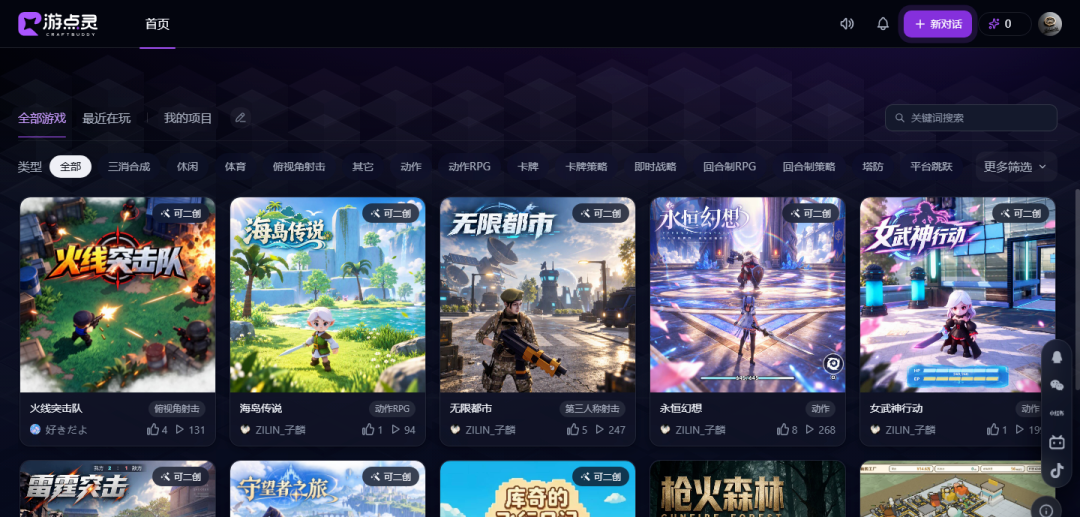
Like Unity, it can "generate games with one sentence" and connects to more than ten thousand kinds of prefabricated art assets. One information point worth discussing is that Codename Craft supports one-click export to Unity. This means it is more like the implementation of a creative framework and can only verify whether the gameplay is feasible; to output a playable finished product, it must inevitably be optimized through Unity. The information also mentions that in the training camp organized by Codename Craft in September this year, what the students produced were all "playable prototypes." How much effective experience a platform that can only generate "prototypes" can actually provide to users is undoubtedly a question mark.
The big companies' caution and slowness reflect less hesitation than a wait for a definitive answer. Now that the wind from Silicon Valley has blown over, the road ahead is long and hard—but on the question of "whether to do it," there already seems to be an answer.
-
![]()
Auto Electronics Leader Posts Consecutive Earnings Growth, Nearly 9.5 Billion Yuan Invested in R&D Over Five Years
-
Awkward Indeed: Chinese Consumers Are Apple's Biggest Fans – iPhone 18 Pro Sales Surge 29%, Revenue Climbs 21%
-
![]()
Silicon Valley Tech Giants Bet on AI Games to Capture the Last Profitable Frontier
-
![]()
Why I'm Not Very Optimistic About Apple Intelligence in China
-
![]()
October 2026 EV Startup Sales Roundup: Silver October Surge! These Three Automakers All Hit New Highs
-
![]()
Tmall's Token Sales Go Viral During Double 11: How Far Is AI From Becoming Like "Utilities"?
-
![]()
How Can AI-Generated Interfaces Escape the "AI Feel"?
-
![]()
Like-new phones become hot commodities, why are second-hand phones so popular?