Tmall's Token Sales Go Viral During Double 11: How Far Is AI From Becoming Like "Utilities"?
 11/05 2026
 534

Produced by|Shi Tianhao Observation
Author|Shi Tianhao
On the evening of November 2, a new term appeared in the product lineup of Li Jiaqi's Double 11 livestream: Token.
Among the 20 trillion Token benefits launched that day, 100,000 Qwen Office Basic monthly membership cards were snapped up. Each Taobao ID was limited to one order, and only new users could activate it. In the livestream, the beauty swatch shots familiar to fans were replaced by office scenario demonstrations. Li Jiaqi and Qwen Office CEO Chen Yusen demonstrated on screen how to generate documents with one click, organize children's wrong answers, and turn livestream replays into business analysis reports.
Eight years ago, in the same livestream room, he sold 15,000 lipsticks in 5 minutes.
In the past, similar limited-order benefits were more about attracting traffic than making money. But this time is different. Behind the ultra-discount monthly cards is Tmall's first inclusion of Token as an independent category in Double 11. On the first day of sales, transactions in this category grew 450% quarter-on-quarter; Zhipu, Alibaba Cloud, MiniMax and others have already lined up to open flagship stores on the e-commerce platform. This business looks a lot like the data packages telecom operators have sold for thirty years, turning computing power into prepaid goods like phone credit.
The problem is that computing power is not data traffic. This statement means that Token during Double 11 is not just a "big news" stunt, but the real beginning of the normalization of AI consumption. What is worth paying attention to is why vendors are willing to offer discounts, why platforms are willing to provide shelves, and what real value the 100,000 monthly cards users buy have for the downward penetration of AI in China. All of these need to be examined one by one.
01 Telecom operators did this business thirty years ago
Token is the unit of measurement for information processed by large models and also the billing unit for AI services. Models read requests, perform inference, and generate answers, consuming Tokens at every step. This is no different in business logic from a phone consuming MB of data for every video watched. What large model vendors have put on Tmall is exactly the shelf solution proven by telecom operators: quantifying and packaging invisible resources into prepaid goods that are selected monthly and deducted as used.
On September 2, Zhipu's first official flagship store landed on Tmall. On September 3, Tmall launched the Token recharge center, connecting Alibaba Cloud, Zhipu, Kimi, MiniMax, and DeepSeek. On October 13, MiniMax opened its brand official flagship store.
As of now, Alibaba Cloud Bailian, Qwen Office, Qoder, Moonshot AI, StepFun and others have also fully settled into Tmall's AI Token store, making computing power and model services products that can be ordered directly. Before Double 11, monthly cards, quarterly cards, annual cards, card codes, and direct recharge were all in place.
Zhipu Coding Plan is priced from 118 yuan to 1,078 yuan and supports more than 20 mainstream Agents including ZCode, ClaudeCode, and Codex; MiniMax's M Plan is divided into Go, Explore, and Build tiers, with 50% off in the first month and monthly plans starting at 24.5 yuan; packages generally retain dual rate limits with a 5-hour rolling window and weekly quota, exactly like the throttling after exceeding data package limits.
Tmall 3C Digital General Manager Si Dengyu put it bluntly: in the past, there was always a membrane between consumers and official websites. "Today we use a standardized store e-commerce transaction system on the platform so that consumers can complete consumption just like recharging phone credit or buying memberships. This is the first step we must take."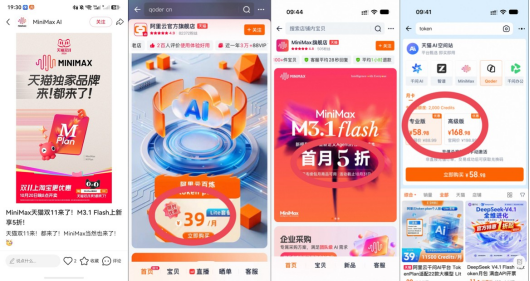
But this analogy only holds on the shelf, not in the cost structure.
This is because the marginal cost of data traffic approaches zero. The larger the user scale, the more sufficient the statistical multiplexing, and overselling costs almost nothing. Token is not like that; every unit has a cost. Costs can be compressed, but cannot approach zero. Every Token corresponds to GPU, electricity, and depreciation and cannot be reused at low cost. Overselling means queuing and throttling. Previously, Ding Ding, deputy general manager of China Unicom Data Intelligence, judged that Token cannot simply apply the logic of buying data traffic. Precisely because costs are rigid, that seemingly troublesome throttling mechanism is essentially a product of cost constraints, not a preference in product design.
The logic of discounts is also determined by this. Data from the China Academy of Information and Communications Technology shows that in June 2026, domestic average daily token consumption was about 500 trillion, nearly four times that of December 2025. During the same period, the normalized average price rose from 6.8 yuan to 13.46 yuan, nearly doubling.
In a market where both volume and price are rising, vendors are willing to give discounts to lock in certain prepaid cash flow, exchanging gross margin for certainty.
Electricity is sold by kilowatt-hour, data traffic by GB, and now computing power by Token. Once a unit of measurement can be purchased in packages, technology moves from professional supply to mass consumption. But before the market matures and before weights and measures are unified, downward penetration involves friction. The same passage of text may consume 20% to 50% different amounts of Tokens across different models, and each company's billing rules vary widely. Prices are similarly disparate: per million Tokens, DeepSeek-flash costs as low as 1 yuan for input and 4.5 yuan for output during idle periods; Zhipu GLM-5.3 costs 8 yuan for input and 28 yuan for output; Moonshot kimi-k3.1-pro-highspeed costs 26 yuan for input and 136 yuan for output. The most expensive and the cheapest differ by dozens of times.
The dual lack of uniformity in measurement and pricing is an unavoidable hard problem for this business. Entering e-commerce may be the best answer.
02 Official websites sell capability, e-commerce sells trust
Before Tokens were listed on Tmall, this business already existed, but there were thresholds.
Users needed to register on the official website's open platform, complete real-name verification, create an API Key, and fill the key into code before they had the basic conditions for use. This logic split "buying Token" and "using Token" into two things, and every step screened out non-technical users.
Here, e-commerce compresses this into three steps: choose a package, pay, and bind with one click. The process is shortened and more convenient. API Keys are replaced by monthly and annual cards. A low threshold is only the ticket to entry; deeper value lies in two other layers.
One layer is the transfer of pricing power.
In the past, Token prices were posted in each company's API documentation, and only developers read them. Developers generally were not highly price-sensitive. Now packages from Zhipu, MiniMax, and Qwen are displayed on Tmall pages, and price comparison pressure has shifted from the demand side back to the supply side.
As of the first half of 2026, China's generative AI users had exceeded 700 million, with a penetration rate of over 50%, but the habit of paying for AI tools on the consumer side has not yet been established. For this group, the ability to compare prices itself is the cultivation of a consumption habit. Tmall has about 64 million 88VIP members, whose average annual spending is 9 times that of non-members, purchasing an average of 19 categories and services. They are the first batch of retail customers this business cares about.
Every search and every page stay by consumers is a mind-touch that vendors cannot buy even with advertising.
The other layer is the information revealed by channel structure.
Although all are listed on e-commerce, Zhipu, MiniMax, and Alibaba Cloud chose self-operated flagship stores, meaning they chose to independently handle product listing, customer service, pricing strategy, and marketing activities, and also pass platform qualification review. It is understood that Zhipu recently even began recruiting a "brand narrative manager." Kimi and DeepSeek chose only authorized agency distribution, leaving pricing, delivery, and after-sales outside their own systems. This shows that the first three are attempting long-term brand operation, while the latter two are testing the waters through channels. The division between the two models corresponds to the differentiation of vendors' organizational capabilities.
In addition, e-commerce platforms' qualification review, order retention, after-sales consultation, and user reviews provide an endorsement of delivery certainty for Token purchases, a kind of "invisible and intangible" virtual consumption. For a purchase where money is paid first, credits arrive later, and quotas run on vendors' servers, what consumers are willing to trust is the payment habit and platform after-sales they have used for twenty years, not a promise on an official website page.
The farther virtual goods are from being "visible," the higher the premium on platform credit.
For consumers, the value is very concrete. Buying Tokens on Tmall means after-sales is backed by the platform, exclusive packages for e-commerce channels are available, and during Double 11 there are promotional bargains. The Qwen AI Lite monthly card is 60 yuan on the official website and 39 yuan at the promotional price; Qoder Professional is 88.99 yuan on the official website and 58.98 yuan at the promotional price. There is also no need to change consumption habits built over twenty years, and no need to first take a technical course before deciding whether to pay for AI.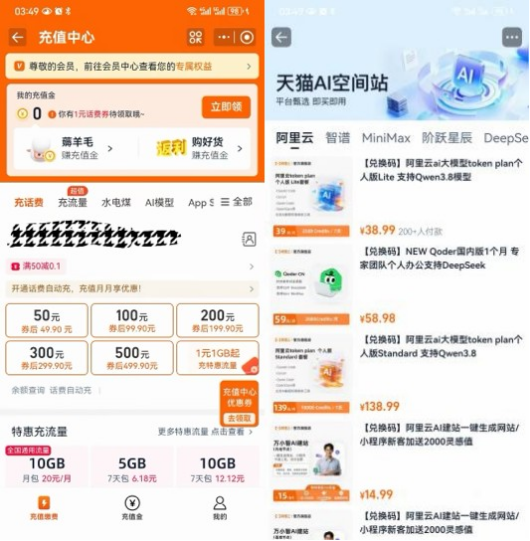
One detail: in Taobao's recharge center, "recharge Token" has already been listed next to recharging phone credit, data traffic, and utilities. Placing Token in the queue of daily consumer goods is Tmall's strategic positioning of this business.
03 The value of 450% growth needs to be calculated separately
Data shows that on the first day of Double 11 sales, transactions in Tmall's Token category grew 450% quarter-on-quarter; within 48 hours of Zhipu's settlement on Tmall, brand searches surged 50 times quarter-on-quarter, driving transactions of AI subscription products on the platform up more than 160%.
In Li Jiaqi's livestream on November 2, 100,000 Qwen Office Basic monthly cards were sold in half an hour. However, high growth includes a low base. It should be noted that the category only opened in September, so the high month-on-month growth is the natural curve of a new category, with symbolic meaning greater than actual transactions. Li Jiaqi's deal is worth calculating more carefully. Each Taobao ID is limited to one order, and only new users can activate it. The so-called "20 trillion Tokens" does not correspond to revenue, but to 100,000 potential paying users; recovery depends on the rate at which monthly cards are renewed at the original price from the second month.
What Li Jiaqi sold is more than 20 trillion Tokens. The retention of AI office use is the real denominator of this customer acquisition calculation.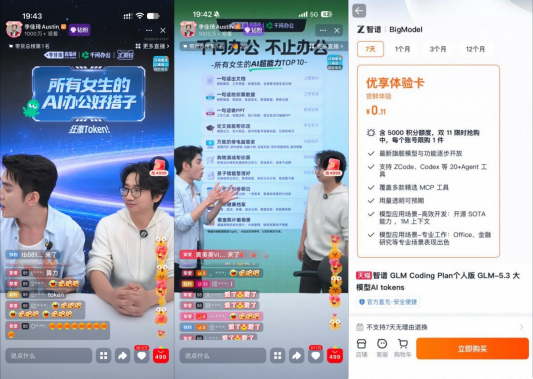
The signals in financial statements and industry chain structure are more solid.
In the first half of 2026, Zhipu's Token call-related revenue was 825 million yuan, up 2,735.7% year-on-year, accounting for 86.5% of total revenue. While most model companies still rely on financing to sustain themselves, Token revenue can support a company's financial statements. Industry chain actions are moving in the same direction. In March this year, Alibaba established the Token Hub business group directly overseen by the group CEO. In the same month, Tencent Cloud upgraded its MaaS platform to Token Hub. In May, the three major telecom operators collectively launched Token packages. From cloud vendors to telecom operators to independent model companies, the entire industry chain is treating the same thing as a standardized commodity. Double 11 is simply a scene where this operation has become visible to the public.
The significance also extends to hardware.
This Double 11, AI PCs, AI glasses, and AI headphones were showcased intensively, but hardware separated from model capabilities is only a concept. Si Dengyu said, "Some brands are already pushing AI PCs and AI phones. If these are separated from Token or from large language models themselves, they are just concepts... We graft this onto hardware products, and in the future consumers can do hybrid deployment. There is a lot of room for imagination."
Consumers buying both hardware and Token Plans is equivalent to giving hardware brands a second curve of subscription revenue beyond the purchase-sale price difference.
As for the significance for consumers of buying Tokens on Tmall, it should be calmly understood in layers. Geeks and heavy users will not be locked in by packages. Wang Zimin, who does AI video production in Beijing, spends 30,000 to 40,000 yuan per month on Tokens and chooses official channels or e-commerce channels depending on who offers more "discounts."
E-commerce packages truly serve low- and medium-frequency consumer users, family users, learning-oriented and research-oriented users, and one-person companies. According to Si Dengyu's judgment, the covered population will start with geeks, then move to office white-collar workers, then to ordinary consumers enthusiastic about technology, and finally to the general public. The current user structure happens to stand at the second link of this expansion chain.
In other words, e-commerce is not replacing official websites, but adding a retail layer to the Token market, reaching people who would never open vendors' official websites.
The wholesale market charges by volume, and the retail market uses package subscriptions. Each layer solves its own problem.
Future packages will become increasingly detailed. According to the vision of platforms and vendors, token packages will resemble beauty brands' curated sets tailored to consumer groups, bundling products around needs such as learning, family, and solo entrepreneurship—turning AI usage needs into goods that are easier to choose. For now, however, real difficulties remain. Measurement standards are not unified, making it hard to convert between packages.
Wang Jiandong, deputy director of the Big Data Development Department at the State Information Center, has proposed unifying the token measurement standard as soon as possible and introducing third-party verification. Fixed-quota monthly cards face a Goldilocks problem: "buy too much and you can't use it all; buy too little and it's not enough." The discount intensity of most products also falls short of "Double 11-level" expectations.
Market sentiment hopes that token purchases can become everyday consumption, but tokens are not yet a utility. Putting them on the shelf is only the first step.
Thirty years ago, data packages did not invent the mobile internet, but they gave ordinary people a justified reason to use it.
In this Double 11, tokens as an independent category were placed in a major promotion and entered top livestream rooms, moving from developer backends into mass consumer goods. Tmall is also becoming a consumer gateway for centralized launches, transactions, and experiences of AI products.
But discounts will be withdrawn, and enthusiasm will fade. How far this business can go depends half on whether vendors can retain acquired users past the second month, and half on whether the platform can make after-sales and fulfillment solid.
It took thirty years, not thirty days, to build data packages into what they are. Tokens on Tmall may also have to travel this path.
END
-
![]()
October 2026 EV Startup Sales Roundup: Silver October Surge! These Three Automakers All Hit New Highs
-
![]()
Tmall's Token Sales Go Viral During Double 11: How Far Is AI From Becoming Like "Utilities"?
-
![]()
How Can AI-Generated Interfaces Escape the "AI Feel"?
-
![]()
Like-new phones become hot commodities, why are second-hand phones so popular?
-
![]()
"I Bought an Extended-Range Car — No Regrets Six Months Ago, But Now I Do"
-
![]()
Can Tmall Turn Tokens into a Mass Consumer Product on Double 11?
-
![]()
What Is the Real Reason for Buying a New Energy Vehicle?
-
![]()
When India Takes Over Iveco, a New Roadblock Emerges for Chinese Commercial Vehicles Going Global