October 2026 EV Startup Sales Roundup: Silver October Surge! These Three Automakers All Hit New Highs
 11/05 2026
 520
As the industry enters the fourth quarter, the auto market is welcoming the "Silver October" peak sales season. New models are launching in clusters, dealer discounts are deepening, and major automakers are stepping up their push for volume. In this sales battle, EV startups delivered a mixed bag of results, with October deliveries painting a picture of winners and losers.
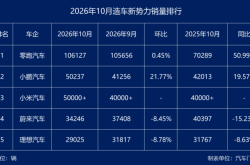
Judging from EV startup sales data, Leapmotor led by a wide margin with more than 100,000 vehicles, firmly holding the top spot among EV startups; XPeng and Xiaomi both broke through the 50,000-unit mark with strong momentum; by comparison, NIO and Li Auto saw declines to varying degrees. The former "NIO, XPeng, Li Auto" landscape has long been broken, and the rankings within the leading group are constantly being rewritten.
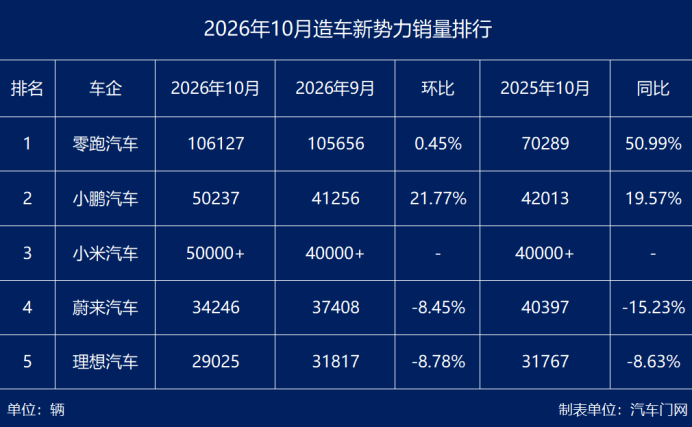
No. 1: Leapmotor — 106,127 vehicles
In October, Leapmotor delivered 106,127 vehicles, up 51% year on year, standing firmly above the 100,000-unit mark for four consecutive months and setting a new monthly sales high.
Such a standout result is inseparable from Leapmotor's combined efforts in domestic and overseas markets. At home, its four major product series — A, B, C, and D — cover different price ranges, providing solid support for sales. Overseas markets also performed well: in the first three quarters, Leapmotor's cumulative exports exceeded 150,000 vehicles, completing its full-year export target ahead of schedule. "Walking on two legs" at home and abroad has become a key driver of Leapmotor's continued sales growth.
In addition, Leapmotor plans to further drive sales through new products. The new Lafa5 will be launched at the Guangzhou auto show at the end of November, and the B series' all-new hatchback model B05 will also begin presales in the same period, adding another push toward its full-year sales target of one million vehicles.
However, Leapmotor is still some distance from its full-year target of one million vehicles. In the first ten months, Leapmotor completed 77.3% of its annual target, and in the final two months it still needs to deliver about 227,400 vehicles; from this perspective, its sprint pressure remains considerable.

No. 2: XPeng — 50,237 vehicles
In October, XPeng delivered 50,237 new vehicles, achieving both year-on-year and month-on-month growth, breaking through the 50,000-unit mark for the first time and setting a new single-month delivery record.
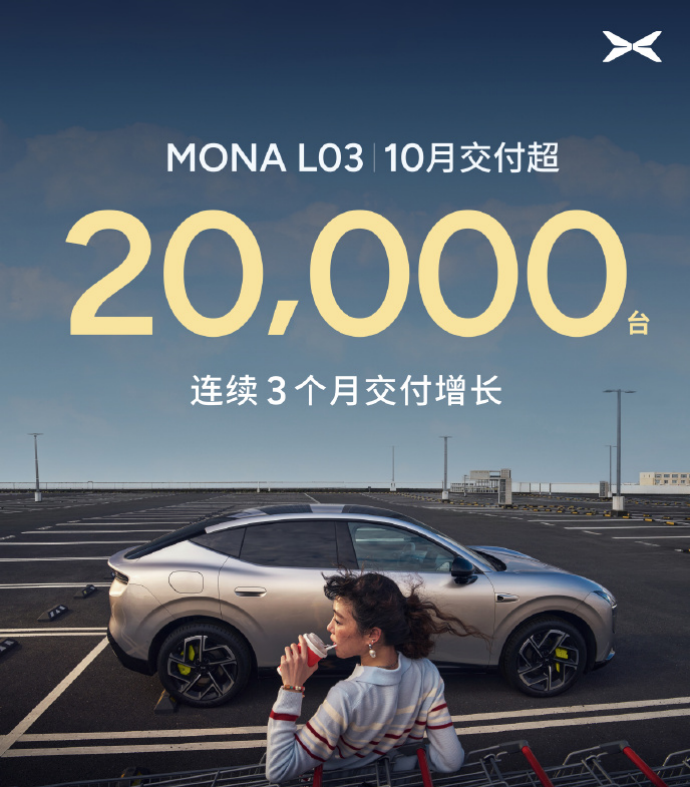
This was thanks to XPeng's absolute sales pillar, the MONA series. Among them, MONA L03 grew from 8,424 deliveries in August to more than 14,000 in September, and exceeded 20,000 in October, showing clear momentum. MONA M03, meanwhile, has been the best-selling pure electric sedan in the 100,000–200,000 yuan range for 24 consecutive months, driving cumulative deliveries of the MONA series to more than 360,000 vehicles.
In addition to the domestic market, overseas markets also contributed considerable sales this month. In October, XPeng delivered 13,326 vehicles overseas, up 166% year on year, accounting for 26.5% of total deliveries. Next, XPeng will further accelerate its overseas market layout. The G9L is scheduled to begin presales successively in Switzerland and Thailand in November, which is expected to add momentum to subsequent sales growth.
However, although single-month sales hit a new high, XPeng still has a considerable gap to its full-year target of 550,000 vehicles. Even with the help of new products and overseas markets, it will not be easy for XPeng to close the gap in the final two months.
No. 3: Xiaomi Auto — 50,000+ vehicles
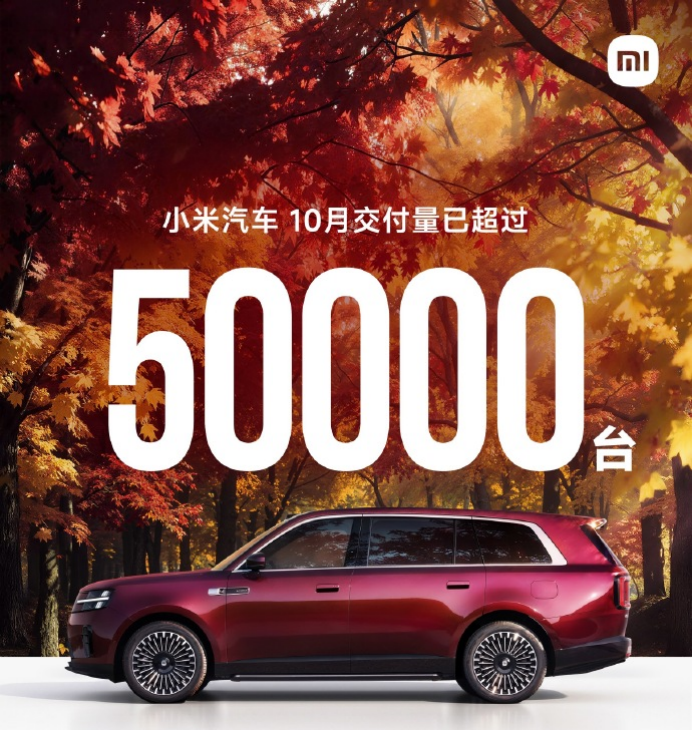
In October, Xiaomi Auto delivered more than 50,000 vehicles, setting a new single-month high for the year. From more than 40,000 in September to more than 50,000 in October, Xiaomi Auto has clearly accelerated its year-end volume push.
This round of growth received a significant contribution from the newly launched Pengcheng series. The N70 and N90 launched in September had their first full delivery month in October, with more than 70,000 locked orders in the first sales month. As production capacity gradually catches up, Xiaomi's orders are also accelerating into actual deliveries. With SU7 and YU7 sales maintained at around 30,000 vehicles, Xiaomi still has some room for sales growth ahead.
However, although Xiaomi's monthly sales momentum is good, its full-year target of 550,000 vehicles is not easy to chase. With only two months left, whether new vehicle deliveries can continue to accelerate remains unknown, and pressure to close the sales gap by year-end is still considerable.
No. 4: NIO — 34,246 vehicles
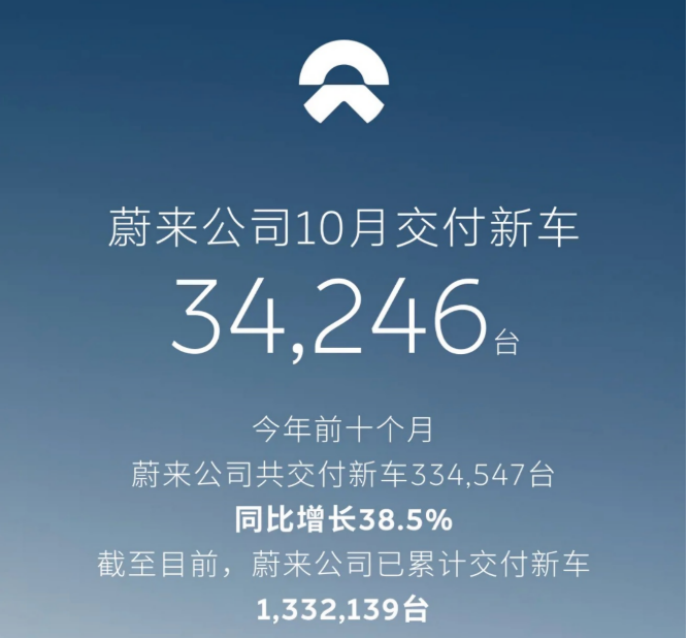
In October, NIO delivered 34,246 vehicles. Although this was down from 37,408 in September, it still remained above the 30,000-unit level overall. As a premium pure electric brand, NIO's sales performance over the past two months has been relatively stable.
Among its three major brands, the NIO brand delivered 18,125 vehicles and Onvo delivered 8,383, both down from September; Firefly delivered 7,738 vehicles, setting a new high for two consecutive months and becoming one of the few bright spots this month. However, Firefly's growth was not enough to offset declines at the other two major brands. The 15.23% year-on-year decline in sales this month was also related to the delivery peak after last year's launch of the Onvo L90 in the same period.
With the decline in "Silver October" sales, NIO's hope of completing its full-year target has also become slim. In the first ten months, NIO cumulatively delivered about 334,500 vehicles, completing only 73% of the lower bound of its full-year target of 456,000 vehicles. With only two months left, based on NIO's current sales level, it will be very difficult to meet the target on schedule.
No. 5: Li Auto — 29,025 vehicles
Once upon a time, Li Auto was the sales champion among "NIO, XPeng, Li Auto," but now it has fallen somewhat behind. In October, Li Auto delivered 29,025 vehicles, down 8.63% year on year and down 8.78% month on month. After a brief rebound in August, Li Auto's sales fell again.
By model, the L series that once drove sales is now facing extended-range competitors such as AITO and Leapmotor, and its original family-use advantages are gradually weakening, while the sales burden is gradually shifting to the pure electric i series. Although October sales by model have not yet been announced, judging from first-three-quarter data, the i6 alone contributed more than 50% of sales, showing Li Auto's clear dependence on it.
It is worth mentioning that the 2026 Li i6 launched at the end of October saw order performance within 72 hours of launch exceed the same period last year, giving Li Auto some additional expectation for subsequent sales growth.
However, with the year-end approaching, there is not much time left for Li Auto to sprint toward its full-year target. This year Li Auto needs to deliver at least about 488,000 vehicles, and in the first ten months it completed only 66% of the target. With current sales below 30,000 vehicles, even if the new i6 brings growth, completing the target by year-end is basically hopeless.

Final notes:
Overall, the sales gap among EV startup automakers in October was obvious. Leapmotor led by a wide margin with more than 100,000 vehicles, while XPeng and Xiaomi both broke through 50,000 units and formed the second tier; NIO and Li Auto hovered around 30,000 vehicles, with both seeing sales declines. Facing fierce market competition, some automakers withstood pressure and continued to grow, while others showed weak growth, and the gap widened further as fortunes diverged.
Now, with only two months left before year-end, automakers have entered the final sprint stage. Next, whether new vehicles can quickly ramp up volume and whether overseas markets can contribute more incremental growth will become key to narrowing each company's target gap. As for who can have the last laugh in the year-end finale, this EV startup sales battle remains full of suspense.
(Images are from the internet and will be deleted if infringing)
-
![]()
October 2026 EV Startup Sales Roundup: Silver October Surge! These Three Automakers All Hit New Highs
-
![]()
Tmall's Token Sales Go Viral During Double 11: How Far Is AI From Becoming Like "Utilities"?
-
![]()
How Can AI-Generated Interfaces Escape the "AI Feel"?
-
![]()
Like-new phones become hot commodities, why are second-hand phones so popular?
-
![]()
"I Bought an Extended-Range Car — No Regrets Six Months Ago, But Now I Do"
-
![]()
Can Tmall Turn Tokens into a Mass Consumer Product on Double 11?
-
![]()
What Is the Real Reason for Buying a New Energy Vehicle?
-
![]()
When India Takes Over Iveco, a New Roadblock Emerges for Chinese Commercial Vehicles Going Global