The Pain Points of Lingguang as a Personal Agent: Xiaohongshu and Rokid Join Forces to Fill the Gaps
 11/06 2026
 539
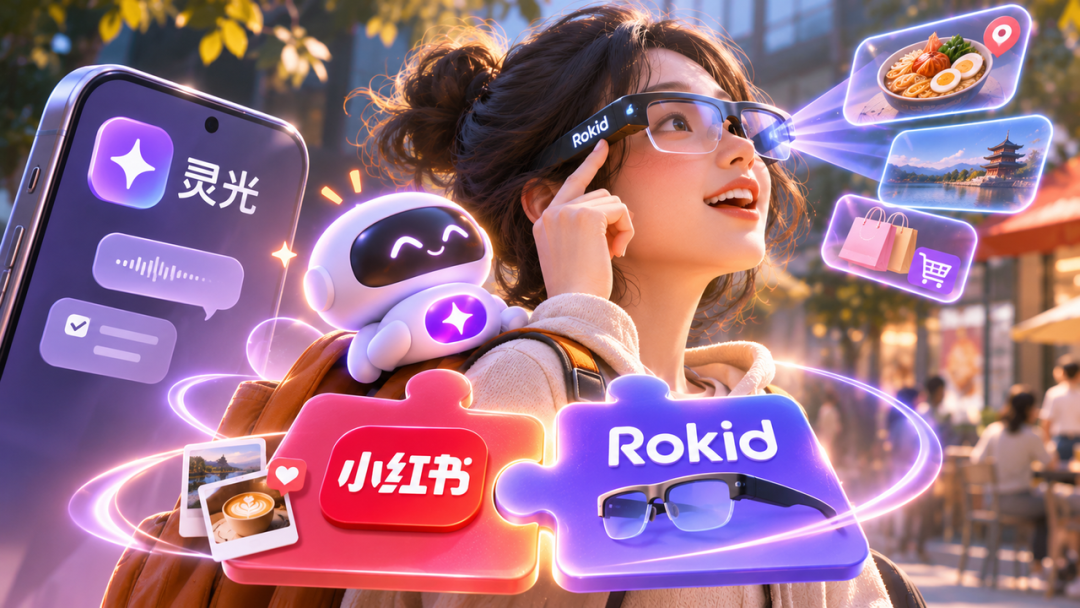
An agent puzzle experiment in which each side gets what it needs
Since Muse went viral, internet giants, large-model companies, and AI entrepreneurs have all rushed to launch their own personal agents. Currently, the most prominent players in the domestic market are Qianwen Go, WeChat Xiaowei, Lingguang 2.0, and Today AI.
Recently, after Lingguang's overwhelming promotional blitz, I genuinely thought China's Muse had arrived and that Alibaba and ByteDance should step aside. But after actually testing it, it fell flat.
Lingguang 2.0 can connect to calendars, alarms, Baidu Netdisk, QQ Mail, and other system and third-party services, but authorization interfaces for high-frequency life scenarios such as WeChat, Douyin, Xiaohongshu, and Meituan are basically not open. Even within Alibaba's own apps, it only connects Alipay and DingTalk. The direction is right, but insufficient permissions clearly make it bland and tasteless.
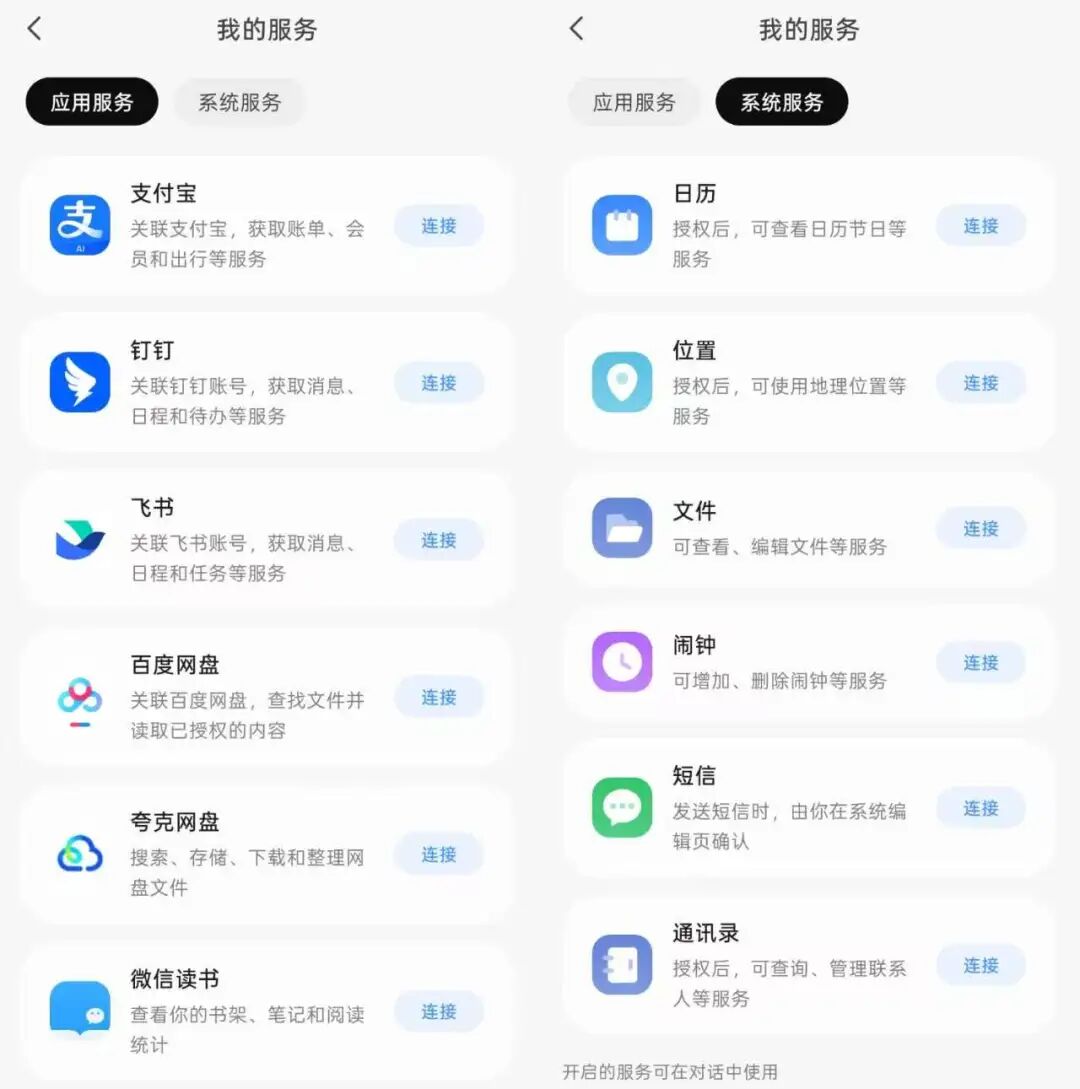
China's internet app ecosystem is characterized by walled gardens. Doubao Mobile Assistant once encountered resistance from a large number of applications, and the national-level applications that Lingguang can deeply bind are likewise limited. Lingguang uses "generating applications" as its entry point, but ultimately runs into the existing boundaries of application distribution and digital service transactions.
In this sense, what Lingguang faces is not a shortcoming that can be eliminated through a single product iteration. It represents the shared ceiling of the path of "building a smarter agent within a mobile phone dialog box." An agent can understand intent, but it is difficult for it to reliably reach the real world to which that intent points.
Permissions are in others' hands, scenarios are in others' hands, and data is also in others' hands. When every action must pass through layer after layer of application barriers to be completed, the "personal" attribute of a personal agent is diluted into a limited agency constrained by platform permissions.
Recently, the "Xiaohongshu Mishu" jointly created by Xiaohongshu and Rokid does not provide a different solution to the same problem, but rather changes the position of the problem itself.
01 What Siri failed to accomplish, AI glasses continue to pursue
Over the past few months, personal agents have been repeatedly described as the "next stop" for consumer AI. It should remember a person's preferences over the long term, proactively discover needs when no one is watching, and complete tasks within the scope of authorization. This vision is not new.
From Siri to Alexa, voice assistants once promised a similar role, but ultimately most stopped at the level of "Q&A" and "commands." Technical conditions were insufficient to support a truly reliable proactive assistant, and platforms lacked the incentive to open permissions.
The real bottleneck is not model capability, but "perception position." Mobile phones are currently the main carrier of personal agents, but they are essentially devices that need to be picked up, looked at, and operated.
For an agent to understand what the user is doing, seeing, and needing at this moment, it can only rely on active user input or call upon historical data already accumulated in the phone. This "after-the-fact perception" model determines that the proactivity of mobile agents always has a structural delay. It knows what you searched for yesterday, but it is difficult for it to determine what shop is across the street from where you are standing right now.
AI glasses offer a different possibility. Their cameras and sensors are naturally aligned with the wearer's line of sight, hearing, and movement state, forming a continuous first-person data stream. This means the agent begins to have the physical conditions to intervene at the "very moment" when a need arises.
The Super Xiao Ai built into Xiaomi AI Glasses supports first-person shooting, object recognition, translation, and QR code payment; Rokid Glasses project teleprompting, navigation, and real-time translation in front of the lenses, making information appear within the line of sight rather than in the palm of the hand.
These functions are not astonishing when viewed individually, but together they point in the same direction—the agent shifts from "you come to me" to "I happen to be present."
This is precisely the long-missing link in the personal agent vision represented by Lingguang. Large models are good at memory, planning, and task execution, but without a continuously present perception terminal, even the strongest planning capability can only be built on the basis of what the user "tells" it. What glasses fill in is that perception entry point that has already begun working before the user speaks.
What Rokid is doing is essentially answering the question of "where the agent lives." YodaOS, released in June 2026, is an operating system centered on intelligent agents and stripped of the traditional app architecture. Its significance is not that there is one more OS, but that it transforms glasses from "hardware that runs applications" into "a platform that carries intelligent agents."
The accompanying AIUI Studio further lowers the development threshold. Agent design, debugging, and publishing can be completed in the browser, and developers can even simulate the runtime environment without a physical device.
By the second half of 2026, its developer community had about 35,000 registered members, and more than 500 agents had been listed on the Agent Store. These numbers are not astonishing, but in a hardware category that has not yet taken shape, they mean an ecosystem prototype is forming—some people are willing to write "skills" for these glasses, rather than just waiting for manufacturers to iterate functions themselves.
What Xiaohongshu fills in is the other end. Its agent "Mishu" previously remained at the stage of an in-site assistant, waiting for users to search and ask before responding. The combination with Rokid glasses changes a key variable: the agent no longer requires users to first "translate" real-world scenarios into text descriptions. The glasses' cameras and sensors can feed "here and now" directly into the decision-making chain.
When a user sees a restaurant and asks, "How is this one?" Mishu combines the captured image with community notes to give a judgment; when browsing the menu, it continuously recognizes new dishes and offers pairing suggestions based on the number of people and taste preferences.
Xiaohongshu calls this model "progressive perception." The core is that the timing of the agent acquiring information changes from "users actively reporting" to "scenarios naturally revealing themselves."
For a community platform long criticized for "lacking consumer transaction data," the strategic value of this layer of offline perception is more noteworthy than how many pairs of glasses it sells in the short term. It allows community content, for the first time, to establish a physical connection with the scene of users' immediate decision-making.
02 Building ecosystems is hard work, building hardware is involution; only platforms create network effects
Between proven success and success at scale, there are still several constraints that are not easy to overcome.
Rokid needs to prove that the glasses are not just a collection of functions that can "take photos, translate, and navigate," but a platform that can carry third-party intelligent agents; otherwise, the hardware will eventually slide toward price competition. Xiaohongshu needs to let life experience accumulated over more than a decade walk out of the app and enter those moments when users do not have time to open their phones.
One side lacks "depth of scenarios," and the other lacks "a physical anchor." This complementarity is closer to the real path for personal agents to move from demonstrations to daily use than one-sided product parameters.
The maturity of on-device computing power is a foundational condition. Hybrid AI architecture is becoming an industry consensus: the terminal side runs efficient vertical models responsible for real-time perception and rapid response; the cloud handles heavier inference and long-term memory.
Glasses do not need to complete all calculations locally; they only need to become the link in the perception chain closest to the person. Qualcomm summarizes this trend as "shifting from smartphone-centered to agent-centered." The distribution of computing is changing, and the definition of entry points is changing as well.
But the migration of entry points has never been only about technology. Quark AI Glasses connect the Qianwen assistant with the ecosystem scenarios of Alipay, Amap, Taobao, and Fliggy, attempting to make glasses the "portable tentacles" of Alibaba's service system, while Xiaomi embeds Super Xiao Ai into its existing smart home and mobile phone collaboration system.
What the two have in common is that the glasses themselves do not create services; what they create is the timing for services to be invoked. Those who master the timing can occupy a more forward position in the agent's process of scheduling services.
This also explains the differentiation that is occurring in the personal agent track.
For big companies doing agents, the advantage lies in ready-made accounts, payments, and ecosystems. They do not need to acquire users from scratch or connect to separate channels. For startups doing agents, they must face a narrower gap: either achieve depth in vertical scenarios that big companies are unwilling to pursue, or hold the perception entry point in their own hands through a software-hardware integrated approach.
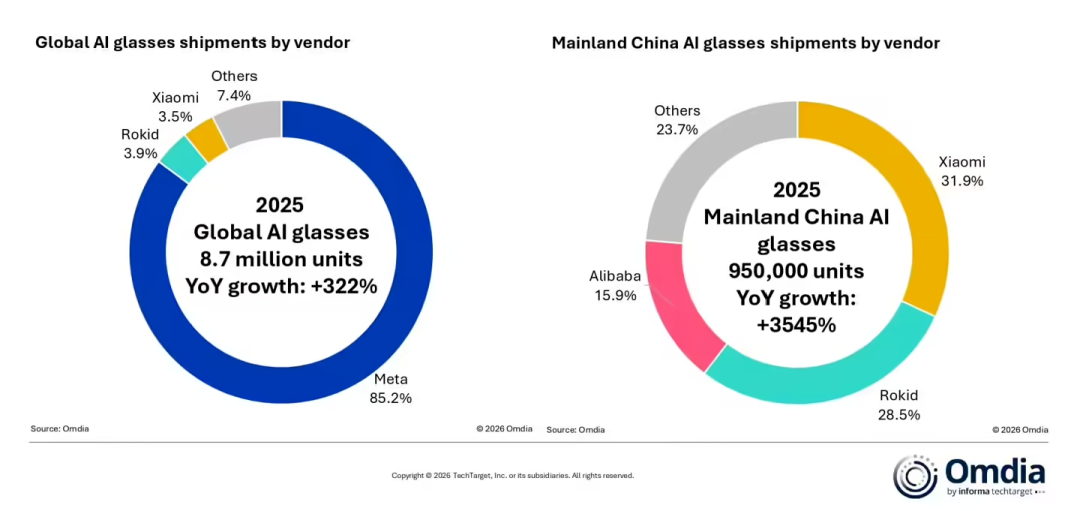
Rokid's choice belongs to the latter. It enters business, cultural tourism, and industrial scenarios with AI+AR glasses that have displays, and in a global landscape where Meta holds an absolute advantage, it defends second place with the differentiated capability of "display."
But this does not mean glasses have solved all the problems of personal agents. IDC analysts point out that the true user value of smart glasses remains to be explored, and the industry is still in a transition stage from "early adoption" to "tool." The data privacy boundaries brought by first-person perception, interaction norms in public scenarios, and the physical constraints of battery life and weight are all variables that have not yet converged.
What glasses fill in is one piece of the perception layer puzzle, not the final answer.
IDC data shows that in 2025, global smart glasses shipments were 14.773 million units, a year-on-year increase of 44.2%; among them, the Chinese market shipped 2.46 million units, a year-on-year increase of 87.1%. Omdia statistics show Xiaomi ranked first in the domestic market with a 31.9% share, followed closely by Rokid with 28.5%. Together, the two accounted for more than 60% of the market.
In the first half of 2026, the industry return rate was in the range of 30% to 70%. Among the more than 200 AI features launched over the past two years, the long-term user usage rate was less than 6%. This means that a considerable portion of the glasses sold have not transformed from "early adoption devices" into "daily wear devices."
This raises an implicit test for the cooperation between Rokid and Xiaohongshu. The value of Mishu depends on whether users are willing to habitually speak to the glasses in real consumption scenarios and let the glasses continuously perceive.
If the wear rate itself is unstable, the data chain of progressive perception will frequently break, and the agent's "understanding you" will degenerate into occasional demonstration moments.
What the glasses currently carry is more like a technology validation field: validating the usability of real-time multimodality, proactive service, and long-term memory in real environments, rather than an already mature mass entry point. Xiaohongshu's positioning of this also shows restraint: polish capabilities first, then talk about scale.
The broader context is that the AI glasses track is undergoing a dense "battle of a hundred glasses," with players such as Xiaomi, Huawei, Alibaba, and Li Auto entering the fray and pushing price and channel competition to the forefront. Rokid's choice to pursue operating systems, developer ecosystems, and offline specialty store systems is a narrow gate. Its threshold is higher and the return cycle is longer, but once the intelligent agent ecosystem forms network effects, the replaceability of the hardware will decline.
Zhu Mingming set the sales target of ten million units before 2030 and said, "If we cannot achieve it, we lose." This time scale highlights that competition at the current stage is not the distribution of final market share, but a qualifier for "who can stay on users' noses and who can enable developers to make money on the platform."
Competition in personal agents is shifting from "whose model is smarter" to "who is closer to human intent." Mobile phones were once the closest, but their interaction logic requires people to act first. Glasses do not; they only need to be put on, and perception has already begun.
This subtle difference may be closer to the threshold for agents to move from "usable" to "useful" than any model upgrade.
- END -
-
![]()
Is Toyota Cutting Ties with the Rest of the World for China?
-
![]()
"China's Buffett" Goes All-In on AI and Crashes Hard! Turns Into a "0.6 Yuan Fund" in Just 4 Months
-
![]()
The Pain Points of Lingguang as a Personal Agent: Xiaohongshu and Rokid Join Forces to Fill the Gaps
-
![]()
Yu Chengdong "Takes Advice": the "Crown Prince" Returns as the New AITO M8 Rolls Back into Huawei Stores
-
![]()
Hongguo Short Dramas Takes on Doubao—Even Jack Ma Can't Sit Still?
-
![]()
Breaking! AITO Secures Major Orders for Smart Policing and Official Vehicles
-
In the AI Era, the Real Competition Is Not Just AI Itself
-
![]()
Toyota's Half-Year Report: New Cars and Robotics as New Business Lines underpin "Stabilization" and "Survival" Transformation