Toyota's Half-Year Report: New Cars and Robotics as New Business Lines underpin "Stabilization" and "Survival" Transformation
 11/06 2026
 337
Over the past few days, everyone in China has been fixated on each company's October new energy penetration rate and year-end sales push. Yet hardly anyone noticed that Toyota released its first-half fiscal year results ending in September—and spent half of the time discussing progress on its "business structure reform."
Accounting Group Chief Officer Azuma covered performance, while CFO Yoichi Miyazaki addressed reform: new cars, North America, China, Asia and the Global South, the value chain, robotics, and capital allocation—seven sections in total.
The relationship between this reform plan and us can be described as half written for China to see, and half learning from China.
In the first half, Toyota and Lexus retail sales in China fell from 914,000 units to 685,000 units, and profit in China (subsidiaries plus joint ventures) nearly halved.
In the reform, China gets a separate page: led by local chief engineers, suppliers regardless of nationality, development cycle shortened by 18 months—and this experience is to be carried over to Asia and the Global South.
In this article, we first look at Toyota Motor's overall and regional sales, revenue, and profit, then break down Toyota's new structural reform chapter by chapter—the new car business, regional strategy, robotics strategy—and finally interpret what these mean for Chinese peers.
Understanding Toyota's half-year financial report in one sentence:
First-half revenue 26.96 trillion yen, +9.5% year-on-year
Operating profit 2.19 trillion yen, -195 billion excluding exchange rate and other effects
China retail -25.1%, total China profit -45%
North America turned profitable, but July-September profit margin was only 0.1%
Value chain profit 2.1 trillion yen, adding another 150 billion each year
01 Overall: Revenue up about 10%, growth driven by the yen
Part 1 · Consolidated Results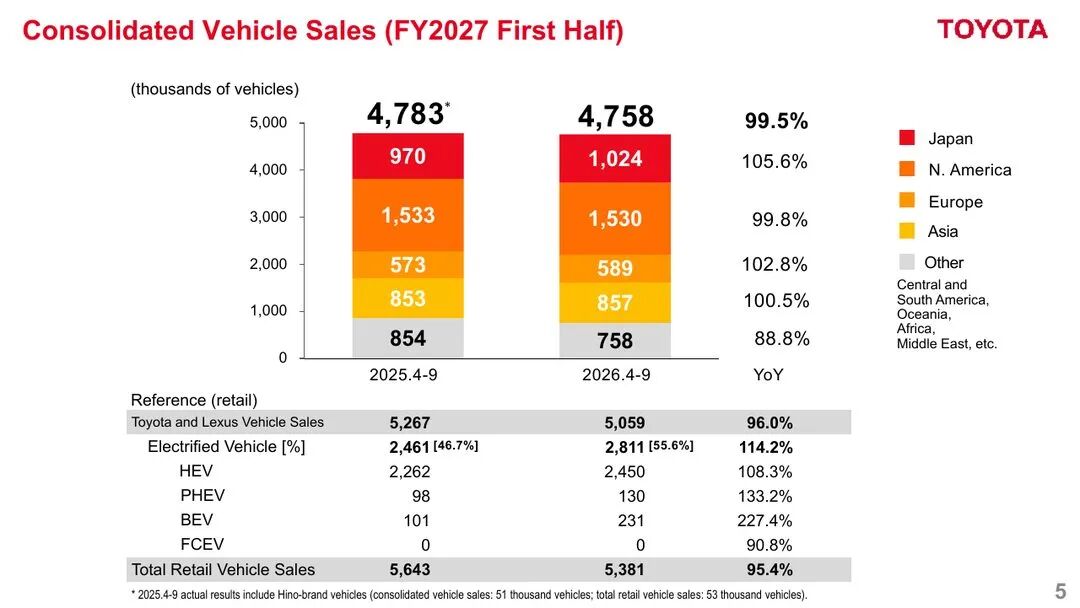
First, look at volume.
First-half consolidated sales were 4.758 million units, down 25,000 year-on-year, because Hino was deconsolidated and not included;
Excluding Hino, it actually sold 26,000 more units, with growth in Japan and Europe.
Toyota plus Lexus retail sales were 5.059 million units, 96.0% year-on-year, dragged down by weak demand in China and the situation in the Middle East.
Electrified share rose from 46.7% to 55.6%:
Hybrids 2.45 million units, up 8.3%.
Plug-in hybrids 130,000 units, up 33%,
BEVs 231,000 units, 2.27 times last year's level.
In turn, pure gasoline vehicles fell by 20%.
Now look at the money.
Revenue 26.96 trillion yen, up 9.5%;
Operating profit 2.19 trillion yen, up 9.2%, with margin flat at 8.1%;
Net profit attributable to owners 2.24 trillion yen, up 26.1%, with the extra portion coming from other income and equity-method gains from Japanese affiliates.
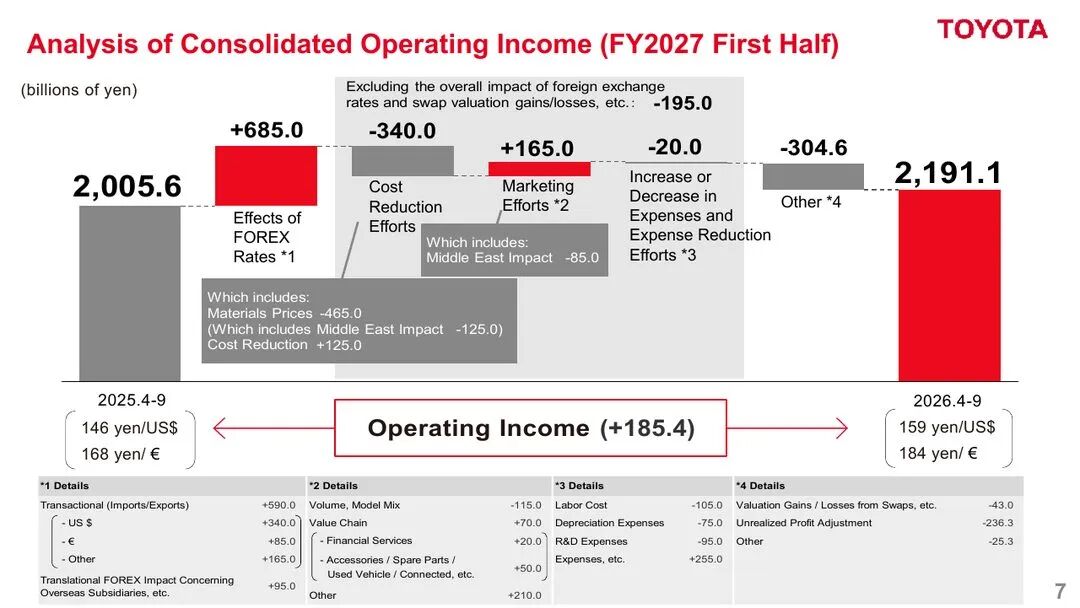
In the operating profit bridge, the yen weakened from 146 to 159 against the dollar, with exchange rates contributing +685 billion yen; note that domestic automakers going overseas generally suffer from exchange rates.
Marketing efforts +165 billion, after deducting 85 billion in Middle East impact.
The cost column is -340 billion: material price increases consumed 465 billion, and cost reductions recovered only 125 billion.
Toyota itself marked a line on the page: excluding exchange rates and swap valuation effects, operating profit was -195 billion yen.
Looking back at this chapter, the book growth mainly came from yen depreciation and easing of U.S. tariffs, while the core business held its ground amid material price increases and Middle East shocks.
02 By Region: Japan Carries Half, China Is Bleeding
Part 2 · Geographic Operating Income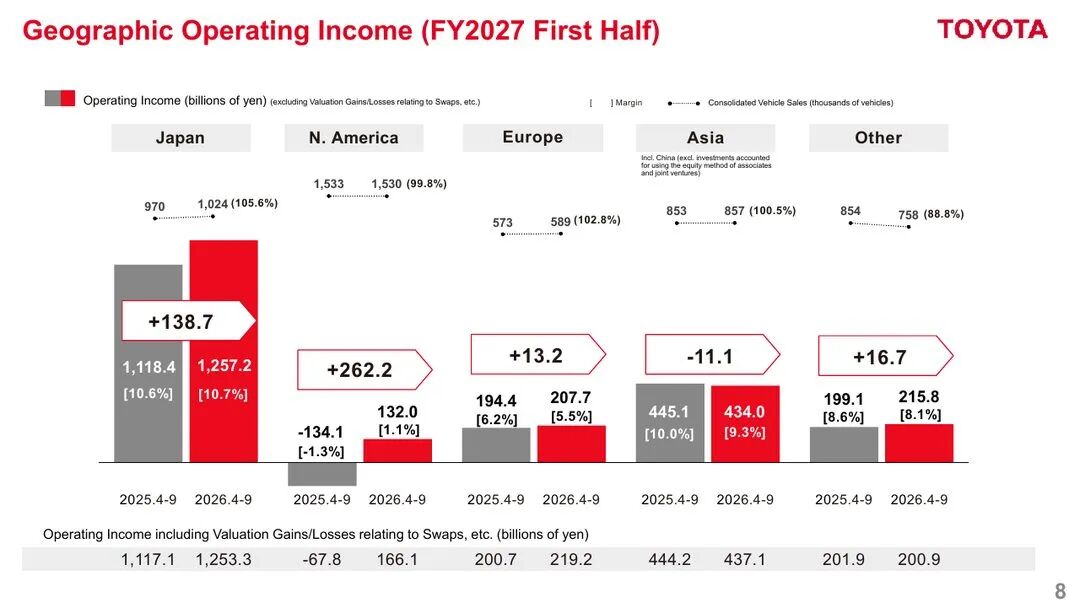
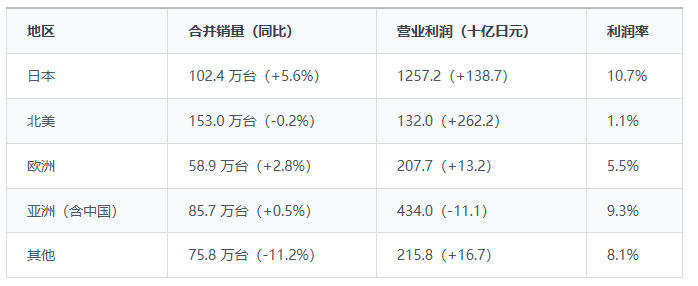
Japan relied on exchange rates and sales volume, with profit of 1.26 trillion yen, accounting for 56% of the total of the five regions.
North America relied on price increases and reduced tariff impact, turning from a loss of 134.1 billion to a profit of 132 billion.
But looking only at July-September, it earned only 6.7 billion yen, with a profit margin of 0.1%.
Europe profit rose slightly, with margin falling from 6.2% to 5.5%;
The "Other" region was affected by the Middle East, with sales down 11.2%; Chinese cars are very strong in the Middle East.
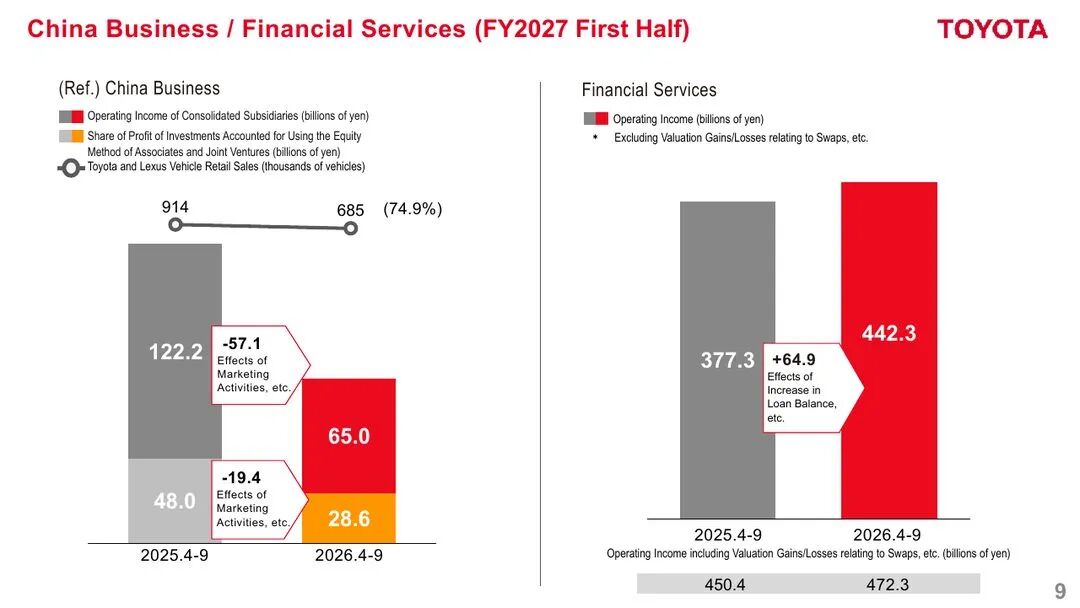
China was listed on a separate page.
Toyota plus Lexus retail sales in China fell from 914,000 units to 685,000 units, 74.9% year-on-year.
The 229,000-unit decrease was more than the total global retail decline of 208,000 units for Toyota and Lexus; other regions overall grew.
Operating profit of consolidated subsidiaries in China fell from 122.2 billion to 65 billion yen, and equity-method income from joint ventures fell from 48 billion to 28.6 billion, a total decrease of 45%.
Toyota's stated reason was "the impact of marketing activities, etc."—that is, promotional spending in the price war; it seems Toyota paid a heavy price just to keep this decline from worsening.
Financial services are the stabilizer, with operating profit of 442.3 billion yen, up 64.9 billion.
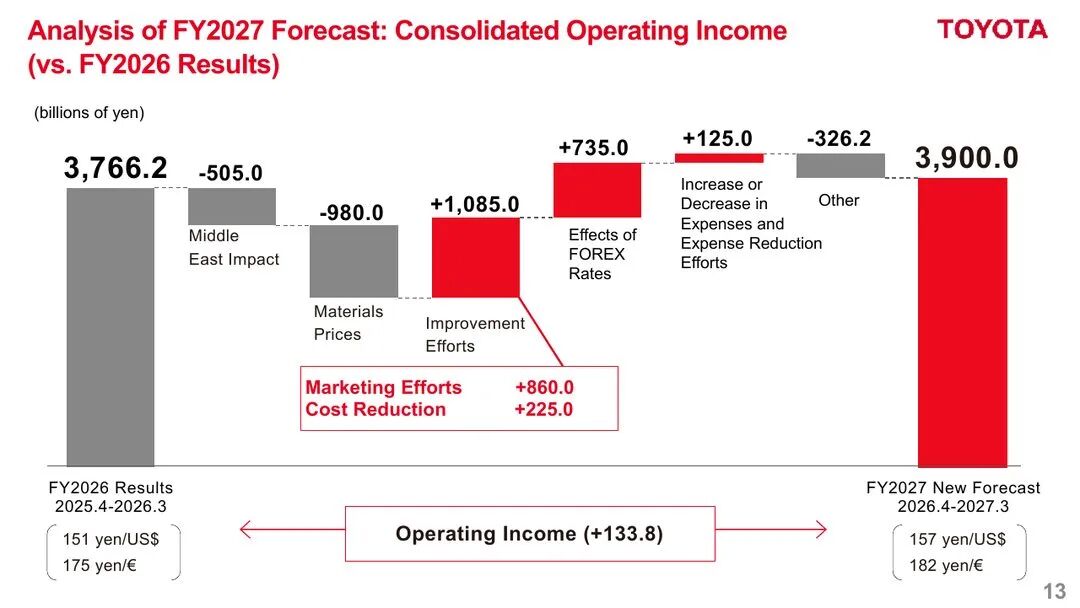
Toyota's full-year forecast maintains consolidated sales at 9.7 million units, cuts Toyota and Lexus retail to 10.3 million units, and cuts BEVs to 463,000 units, also due to China's slowdown.
Operating profit forecast raised by 500 billion to 3.9 trillion yen.
Full-year material price increases are about 980 billion and Middle East impact 505 billion, to be offset by 860 billion in marketing efforts and 225 billion in cost reductions.
Based on the forecast, I calculate that second-half operating profit will be about 1.71 trillion yen, down 2.9% from the same period last year;
Full-year net profit -7.2% year-on-year.
The buyback amount was increased by 300 billion to 1.3 trillion yen.
03 Reform Master Plan: Beyond Car Making, Growing Robotics
Part 3 · Transformation into a Mobility Company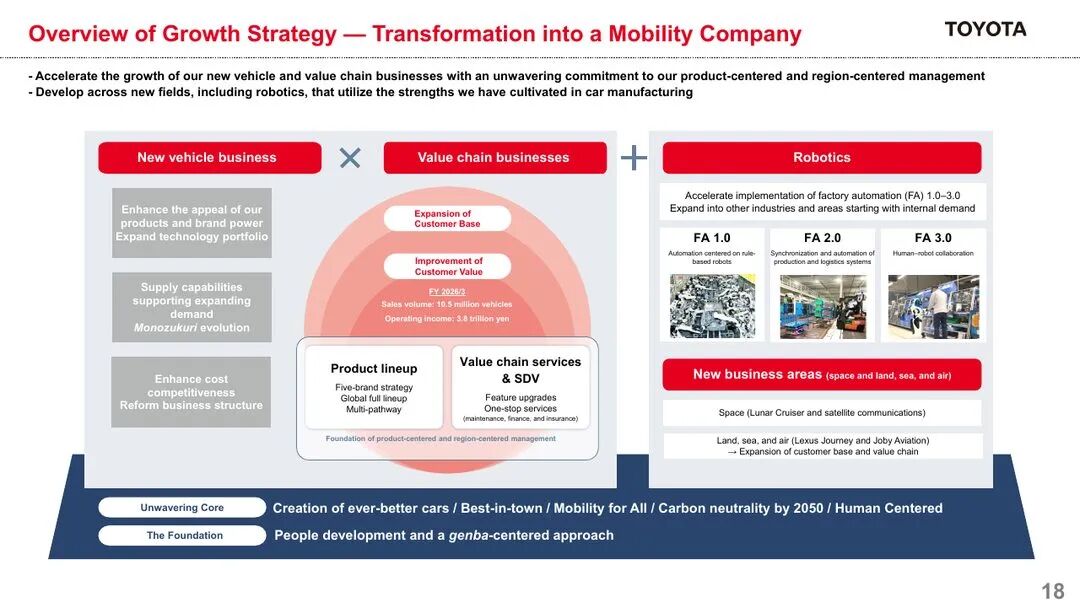
At the annual report in May, Toyota proposed business structure reform in response to U.S. tariffs and the Middle East situation, and this time it discussed progress.
The starting point is 10.5 million units and 3.8 trillion yen in operating profit for fiscal 2026.
Two lines upward: new cars and the value chain continue to accelerate;
use capabilities cultivated in car making to enter new fields such as robotics, space, and flying cars.
The bottom layer is people and the front line.
In January, Toyota established two new organizations:
the Toyota Philosophy and Education Headquarters, with Chairman Akio Toyoda as its first head;
and the KANRI Headquarters, formed by merging the General Affairs and Human Resources Headquarters and the Accounting Headquarters.
"KANRI" sounds the same as "management"; the character "kan" means putting a hand over the eyes, and Toyota wants to change the back office from a control department into a team that supports the front line.
The first cut of the reform falls on organization and people; this is very Toyota.
04 New Car Business: 10 Million Hybrids as the Base
Part 4 · New Vehicle Business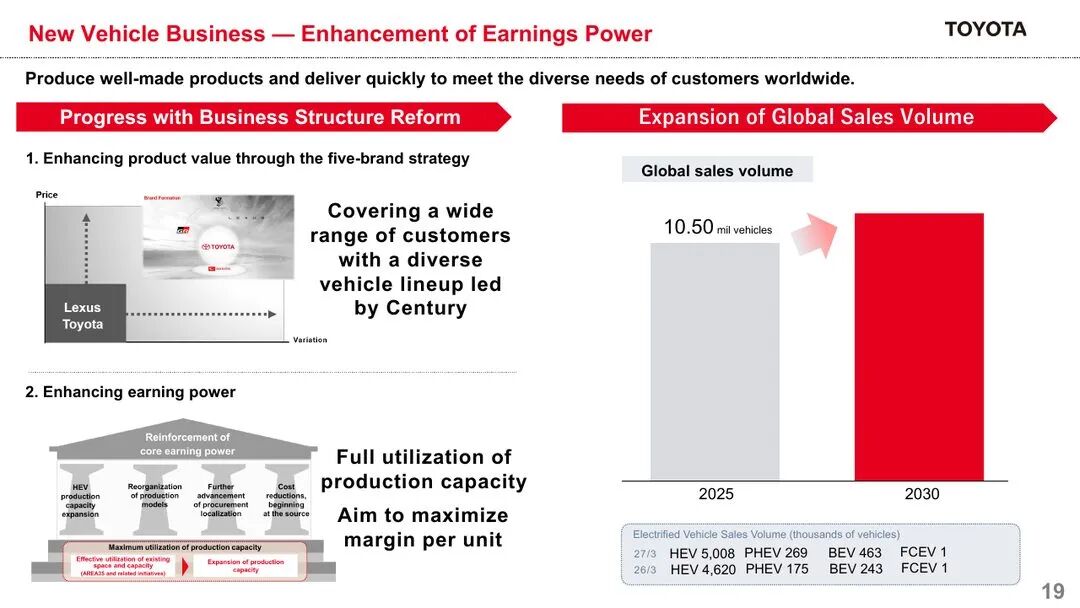
There are two things in the new car business: use five brands to raise product value, and use capacity and cost to improve profitability.
The five brands are Century, Lexus, Toyota, GR, and Daihatsu, with Century raising the price ceiling.
Toyota says each brand has prepared a batch of new cars that will make people say "Wow."
Profitability is drawn as a house: the four pillars are expanding hybrid capacity, restructuring production models, localizing procurement, and reducing costs at the source;
the foundation is using existing capacity to the fullest (measures such as AREA35), and then building new plants in necessary regions.
This fiscal year's forecast is 5.008 million hybrids (4.62 million last year) and 463,000 BEVs (243,000 last year), with hybrid orders still heavily backlogged.
Looking toward 2030, Toyota's wording is: on a solid base of 10 million units centered on hybrids, add BEVs according to actual demand.
It wants to use hybrid cash flow to defend its global base.
05 North America: From Tariff Losses to Thin Profit
Part 5 · Strategy for Key Region (1) North America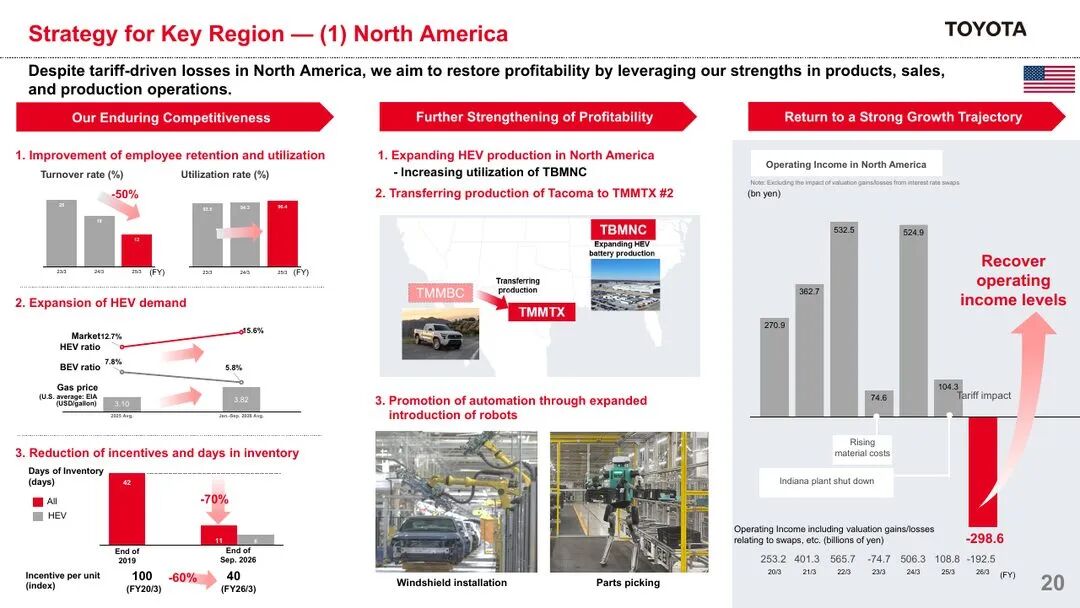
North America operating profit (excluding swaps) has fluctuated greatly: 532.5 billion yen in fiscal 2022.
In fiscal 2025, it was only 104.3 billion due to the Indiana plant shutdown, and in fiscal 2026 it posted a loss of 298.6 billion due to tariff impact.
Toyota believes the foundation is still there.
Employee turnover fell from 25% to 12%, and plant utilization rose from 92.5% to 96.4%.
U.S. gasoline prices rose from $3.10/gallon to $3.82, market hybrid penetration rose from 12.7% to 15.6%, and BEV penetration fell from 7.8% to 5.8%.
Inventory days fell from 42 days at the end of 2019 to 11 days at the end of September 2026, with hybrids at only 6 days;
per-unit incentives fell 60%, which Toyota calls the lowest in the industry.
The next three things:
increase utilization of the North Carolina battery plant TBMNC and expand hybrid production;
move Tacoma pickup production from the Mexico plant to the Texas plant;
introduce robots in processes such as windshield installation and parts picking.
North America's confidence comes from 11 days of inventory and a 60% cut in incentives; with price discipline, price increases can actually be implemented.
Tacoma moving from Mexico back to the United States also reminds Chinese automakers with layouts in Mexico that tariffs will directly rewrite the place of origin.
06 China: Build Chinese Cars at Chinese Speed
Part 6 · Strategy for Key Region (2) China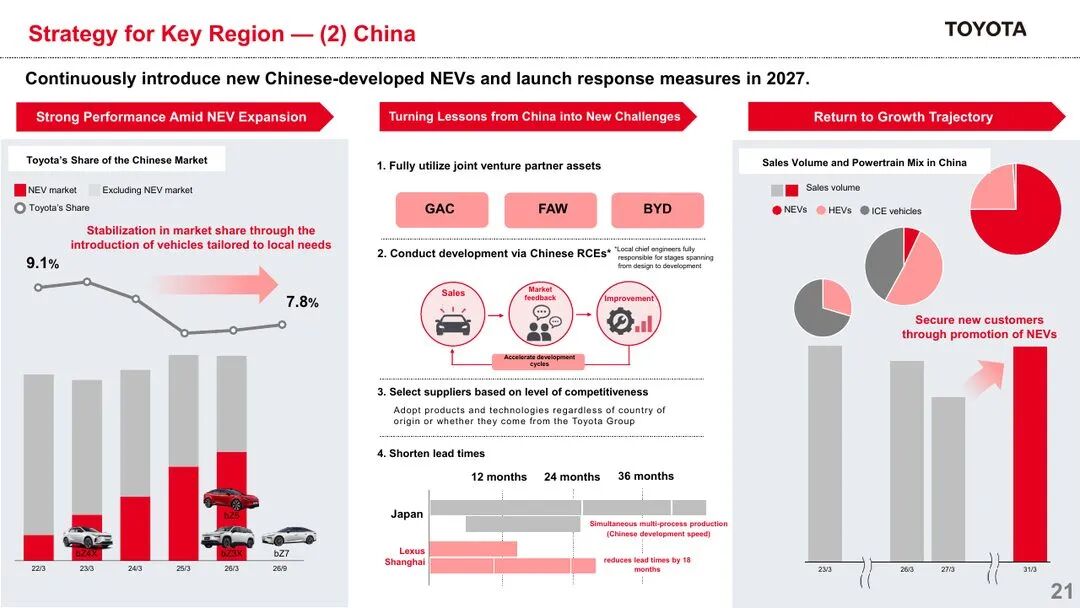
On the left is share.
Toyota's share in China slid from 9.1% in fiscal 2022 to 7.8% in September 2026.
The recent two periods stopped falling, relying on localized models such as bZ3X, bZ5, and bZ7.
In the middle are four actions. We previously shared these in detail in the article "The Road to Redemption for Japanese Auto Brands in China."
First, fully use the assets of joint venture partners; the chart lists GAC, FAW, and BYD side by side.
Second, have Chinese local chief engineers (RCE) take charge of the entire process from design to development, quickly turning market feedback into improvements.
Third, select suppliers based on competitiveness, regardless of nationality, and regardless of whether they are Toyota-affiliated.
Fourth, shorten the development cycle.
The Lexus Shanghai plant, which starts production in September 2027, adopts "China development speed" with multiple processes advancing in parallel, shortening the cycle by 18 months compared with the Japanese process.
On the right is the goal: starting in 2027, continuously launch new energy vehicles under "With China, For China."
By fiscal 2031, make new energy vehicles the main body of sales in China and return sales to a growth track.
What Toyota is making up for in China is exactly the playbook of Chinese automakers themselves.
For Chinese suppliers, "regardless of nationality" plus the later-mentioned "expand to Asia" is a real opportunity.
The risks must also be stated clearly: the "stabilization" of share is Toyota's own wording, and first-half retail sales in China still fell 25%.
07 Asia and the Global South: One Platform Covers A, B, and C Segments
Part 7 · Strategy for Key Region (3) Asia and Global South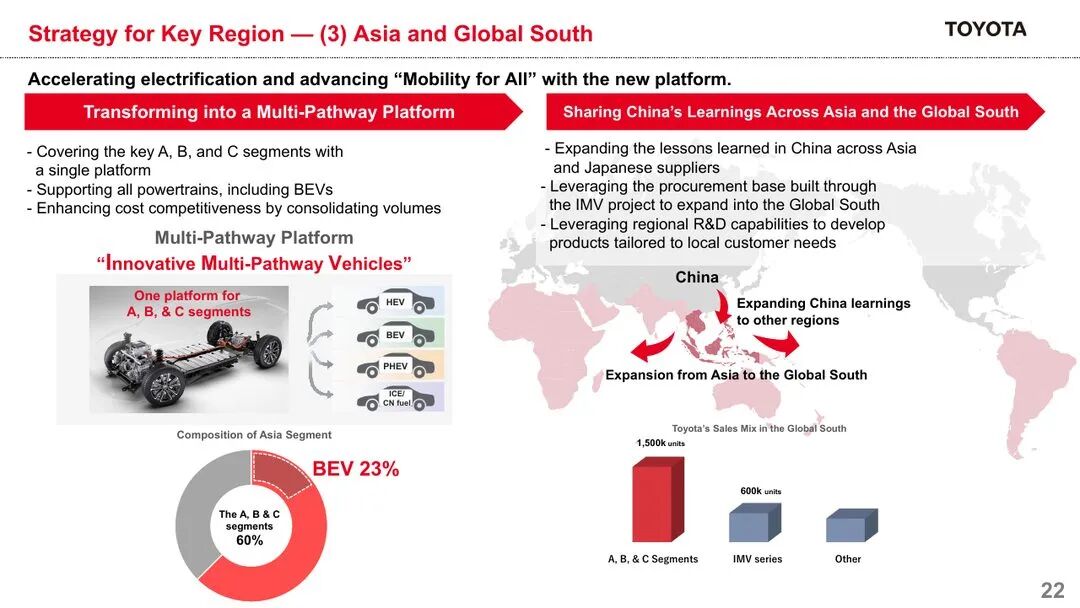
The core of Asia is a new multi-pathway platform: one platform covers A, B, and C segments and simultaneously supports hybrids, BEVs, plug-in hybrids, and gasoline vehicles compatible with carbon-neutral fuels.
The PPT pie chart shows Grades A, B, and C account for 60% of the Asian market, with BEVs already at 23%.
BEVs are rising, but demand for multiple powertrains remains strong, so use one platform to aggregate volume, then bring in the cost experience learned in China.
Looking further out is the Global South.
Toyota leverages the global procurement system of the IMV series, which includes the Hilux, to unify the ABC-grade platform to a scale of 1.5 million units.
IMV adds another 600,000 units, with styling delegated to local R&D for localization.
Toyota is taking the cost playbook learned in China to Southeast Asia—precisely where Chinese brands are expanding overseas fastest; head-on competition in the coming years will be tougher.
08 Value Chain: The Business of 150 Million Vehicles in Operation
Part 8 · Value Chain Businesses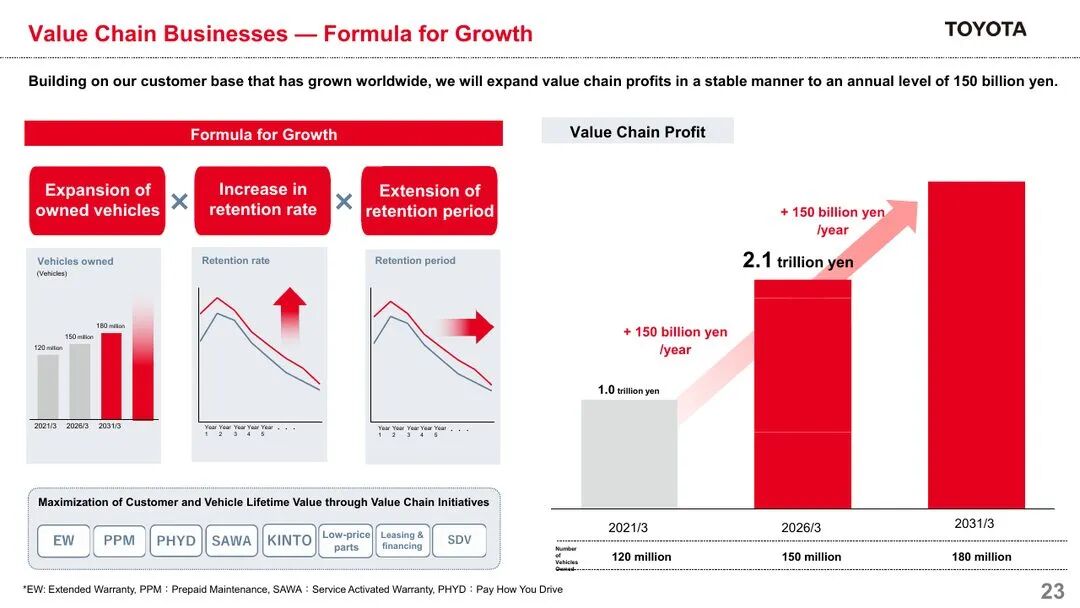
Value chain profit rose from 1.0 trillion yen in FY2021 to 2.1 trillion yen in FY2026, and Toyota plans to steadily increase it by about 150 billion yen each year going forward.
The growth formula is the product of three factors: vehicles in operation, retention rate, and retention period.
Global vehicles in operation will grow from 120 million to 150 million, with a target of 180 million by FY2031.
The toolkit includes extended warranties, prepaid maintenance, driving-behavior-based insurance, KINTO subscriptions, low-priced parts, lease financing, and SDV feature upgrades.
Connected services will also unlock secondary and tertiary business opportunities in used cars.
By my rough calculation, at 150 billion yen per year, that would come to about 2.85 trillion yen after five years;
the script says "grow another 1 trillion" by 2030, so the figures differ slightly.
The 2.1 trillion yen scale is equivalent to more than half of the full-year operating profit forecast (different bases; for magnitude reference only).
The money Toyota earns from vehicles in operation is increasingly resembling a second core business.
09 New Growth: 1 Trillion Yen a Year in Equipment Renewal Becomes a Business
Part 9 · A New Growth Pillar & Robotics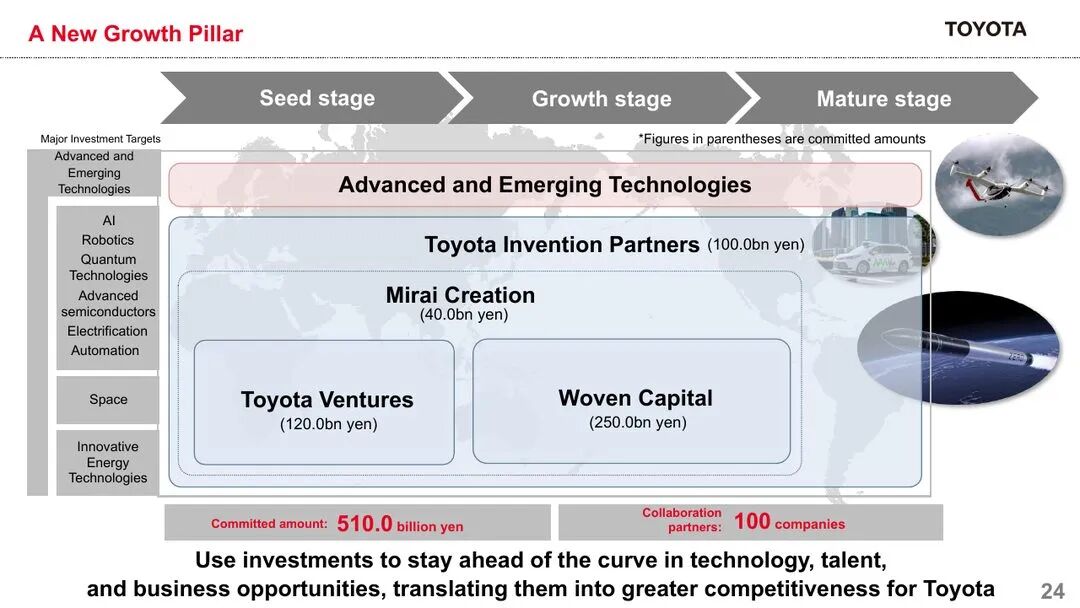
The radar for new businesses is an investment system with committed funding of 510 billion yen:
Woven Capital, 250 billion.
Toyota Ventures, 120 billion.
Toyota Invention Partners, 100 billion; Mirai Creation, 40 billion.
More than 100 partners, covering areas including AI, robotics, quantum, semiconductors, and space.
Robotics is where steps have already been taken.
Toyota's positioning is that robots extend human capabilities, starting with factory automation (FA) and then moving into daily life.
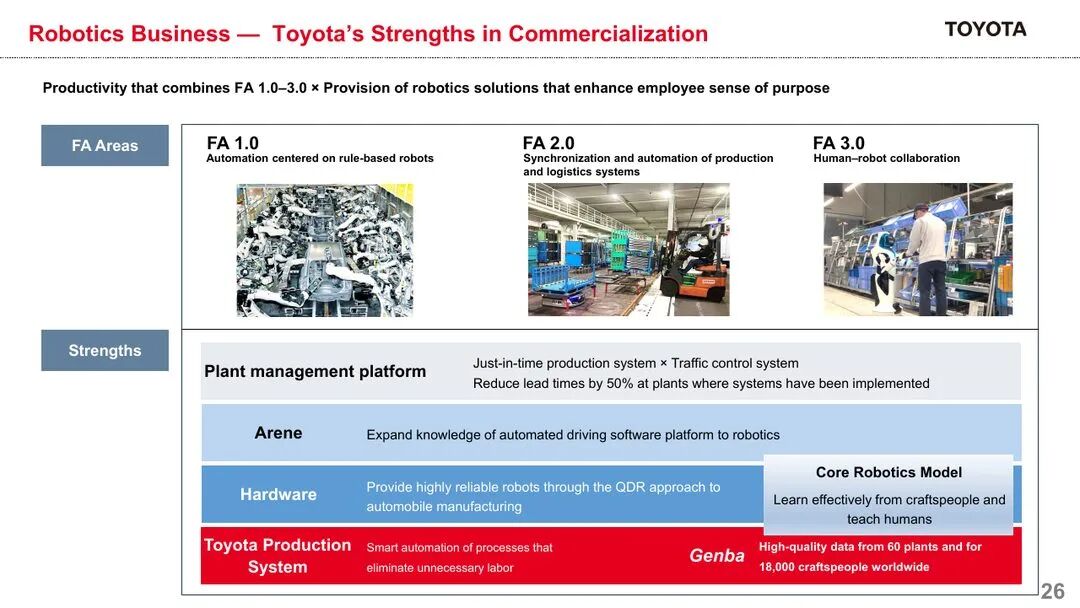
FA 1.0 is rule-based robotics;
FA 2.0 is synchronized automation of production and logistics, with lead times shortened by 50% at factories where it has been introduced;
FA 3.0 is human-machine collaboration.
Toyota lists six advantages, the two strongest being the Toyota Production System of eliminating waste before automating, and the on-site data generated by 60 factories and 18,000 craftspeople worldwide.
The other four are reliable hardware, core robot models, the Arene software platform, and a factory management platform.
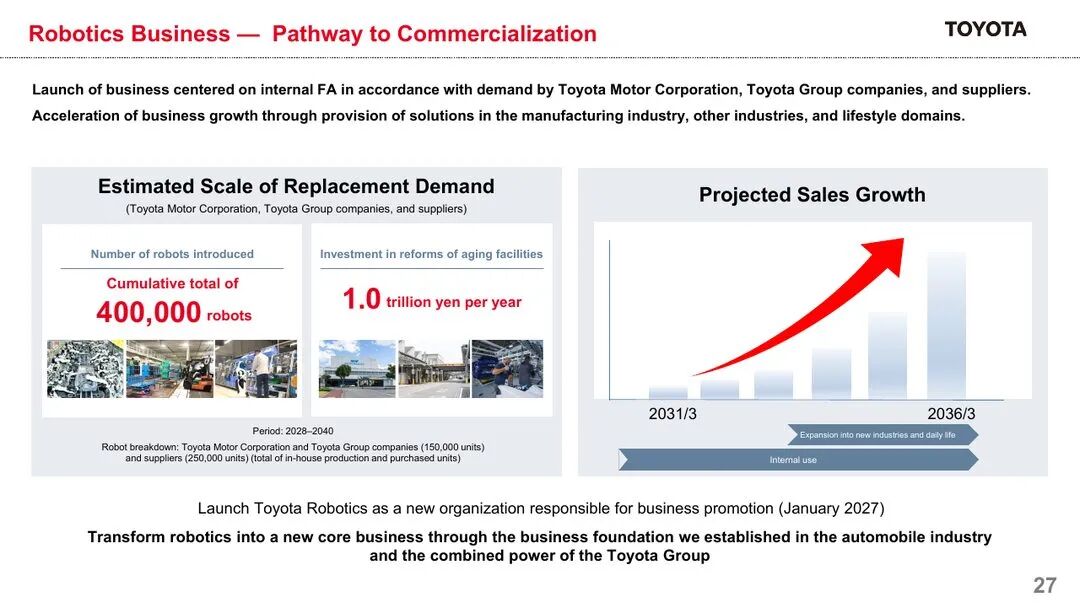
Commercialization will first serve internal demand.
From 2028 to 2040, Toyota, the group, and suppliers will cumulatively need 400,000 robots, and renovating aging facilities will require another 1 trillion yen per year.
Toyota wants to turn this 1 trillion yen a year in equipment renewal from a cost into a growth business. Isn't that taking business from equipment makers? Or does it mean factories will need fewer people going forward?
Use it thoroughly internally first, then accelerate external sales after 2030.
The Toyota Robotics organization will be established on January 1, 2027.
Domestic automakers are also all rushing into robotics; Toyota's starting point is visible orders from its own factories.
10 Closing Remarks
On the books, look at yen; for the future, look at China speed and vehicles in operation
Taken together, Toyota's profit growth in the first half came mainly from exchange rates and tariff relief; excluding these, core business profit is declining.
China is the biggest bleeding point, while North America has just climbed out of losses.
Structural reform efforts are focused on three areas: North America relies on price discipline and localization to withstand tariffs;
China learns China speed, then brings it to Asia and the Global South;
vehicles in operation and factory equipment become two new businesses: value chain and robotics.
Share "stabilizing" and Transformation "surviving" have become the posture of Toyota, the world's No. 1 automaker by output.
It can only be said that the auto industry is undergoing a major transformation and reshuffle, and the workers and factory equipment that follow this industry will all be hugely affected.
That's today's sharing. If you find it useful, please like, repost, and click Wow, and feel free to share your thoughts in the comments.
References and images
Toyota Motor 2026 Q2 earnings presentation and PPT
*Unauthorized reproduction and excerpting are strictly prohibited-
-
![]()
Is Toyota Cutting Ties with the Rest of the World for China?
-
![]()
"China's Buffett" Goes All-In on AI and Crashes Hard! Turns Into a "0.6 Yuan Fund" in Just 4 Months
-
![]()
The Pain Points of Lingguang as a Personal Agent: Xiaohongshu and Rokid Join Forces to Fill the Gaps
-
![]()
Yu Chengdong "Takes Advice": the "Crown Prince" Returns as the New AITO M8 Rolls Back into Huawei Stores
-
![]()
Hongguo Short Dramas Takes on Doubao—Even Jack Ma Can't Sit Still?
-
![]()
Breaking! AITO Secures Major Orders for Smart Policing and Official Vehicles
-
In the AI Era, the Real Competition Is Not Just AI Itself
-
![]()
Toyota's Half-Year Report: New Cars and Robotics as New Business Lines underpin "Stabilization" and "Survival" Transformation