Breaking! AITO Secures Major Orders for Smart Policing and Official Vehicles
 11/06 2026
 462
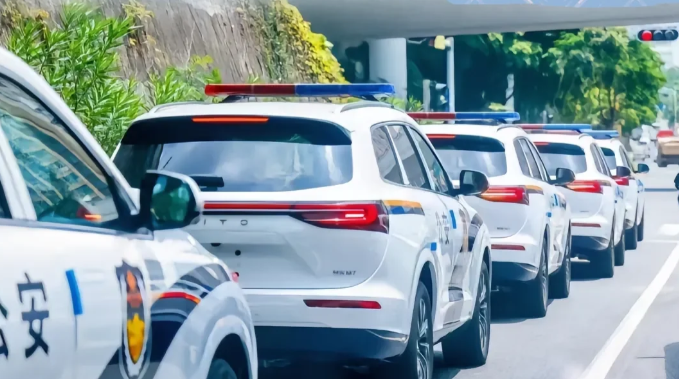 Image source: Weibo
On November 3, the 18th Security Expo opened at the China International Exhibition Center (Shunyi Hall) in Beijing's Shunyi District.
Eight large characters greeted visitors at the entrance: "Intelligent Engine, Reshaping Security."
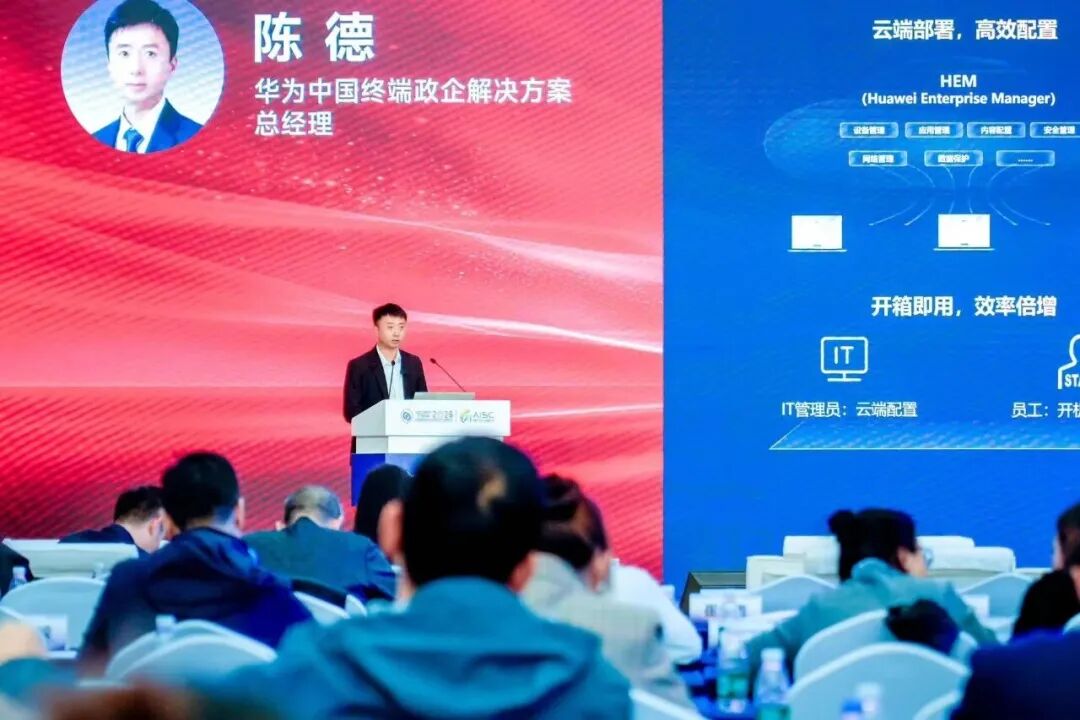 Image source: Weibo
I walked the floor twice, and what finally made me stop was neither a camera nor a large display screen—it was a car.
Qingyun, the commercial brand under Huawei Terminal, occupied a corner booth, also displaying eight characters: "Together with HarmonyOS, Building Government Security Together."
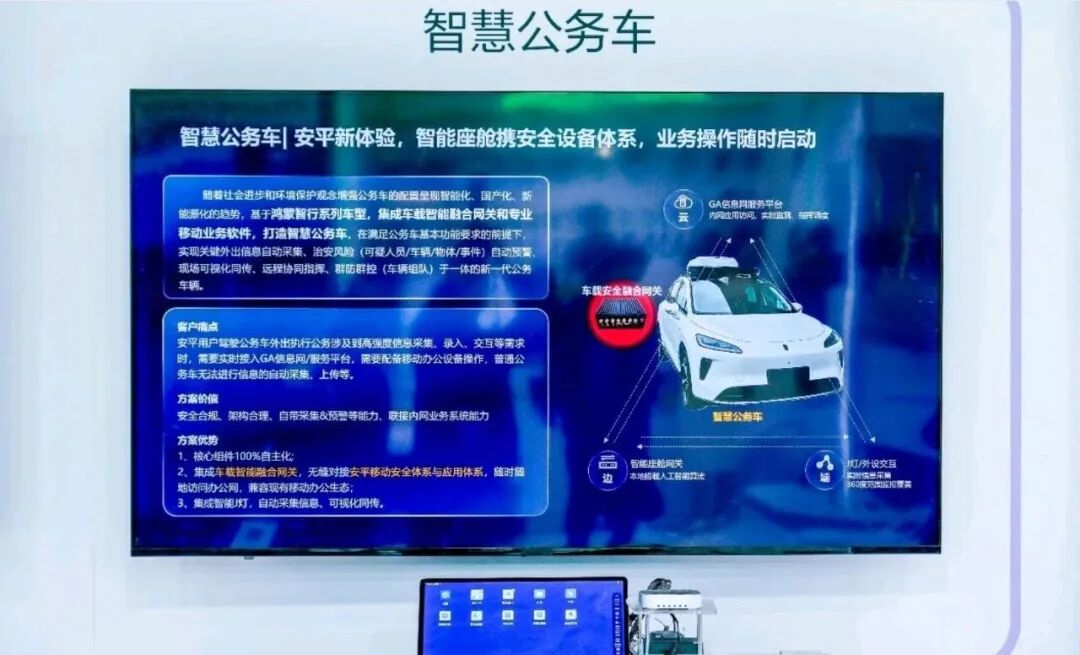 Image source: Weibo
The vehicle on stage was a HarmonyOS Intelligent Mobility AITO.
Parked downstairs at your home, it is a family car for picking up the kids, cruising the highways, and competing for charging piles. Driven onto the exhibition stage, with a tap on the central control screen, it takes on another identity—a mobile government affairs hub capable of holding meetings, checking archives, connecting to private networks, and dispatching equipment.
One shell, two souls. The name is remarkably plain: smart official vehicle.
Many brands can supply official vehicles. But the one that writes the word "smart" into official vehicles—and dares to put a real car at the Security Expo and into the government procurement catalog—is currently only Huawei.
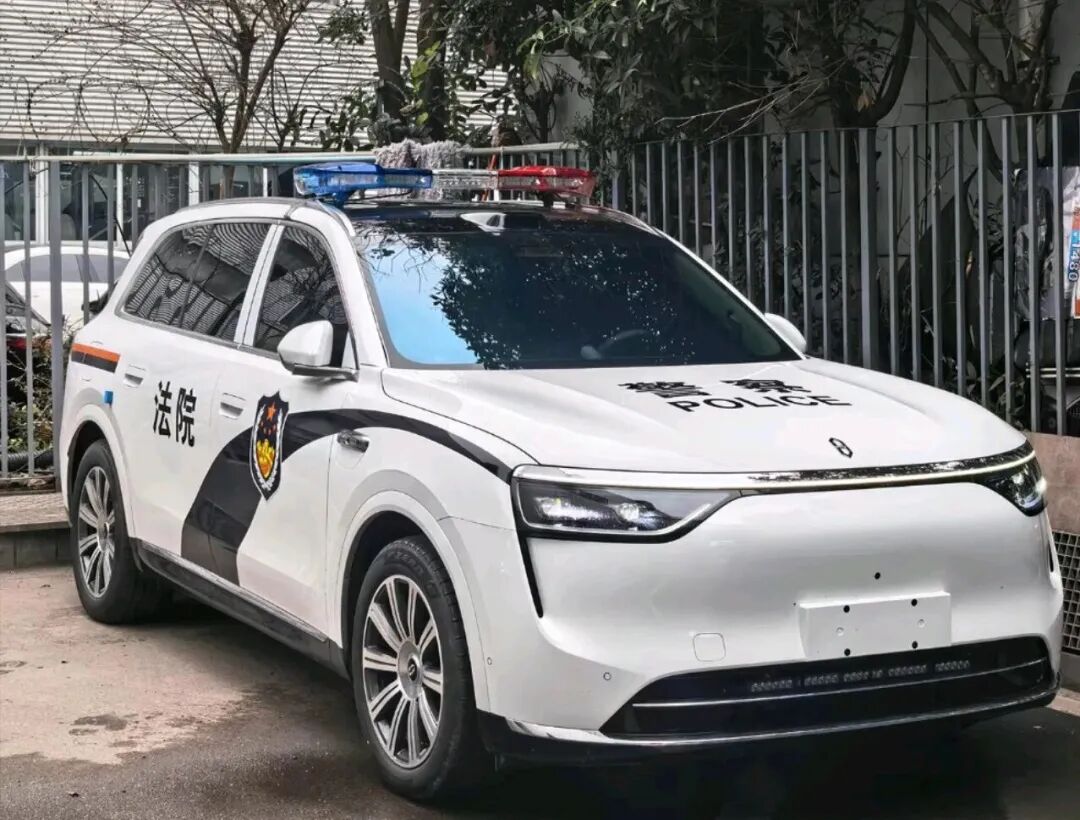 Image source: Weibo
Why does a car need "two sets of hardware"?
Anyone who works in this field knows that awkward feeling.
Wanting to get things done on the road, you add a tablet to the center console, prop up a stand, wires tangle into a mess, and navigation has to give way.
What is really uncomfortable is not the crowding, but the network.
Government intranets cannot be connected at will. An ordinary car head unit connects to the public network. If a case file that has not been closed, or a piece of personnel information, travels through the public network even once, the nature of the matter changes.
In recent years, the industry's mainstream solution has been "software isolation"—dividing two spaces within the same system, using sandboxes and permissions to separate internal and external networks.
It makes sense on paper, but not in physics. The fatal flaw of software isolation is that it bets on that layer of software not making mistakes. One vulnerability, one privilege escalation, and the walls on both sides collapse.
What Huawei brought out this time is a bit harder: dual-system hardware physical isolation.
In plain terms—two independent sets of hardware are stuffed into the car, one runs the car head unit, the other runs government affairs. Physically they do not shake hands or share a bus. One-key switching, and after switching it is another machine.
Isolation alone is not enough. The solution also packs three things: national cryptographic security chips, dedicated communication modules, and single BeiDou modules.
Confidentiality where needed, signal where needed, positioning where needed. According to the solution provider, the relevant capabilities have passed testing and certification by the competent ministries and commissions.
It can also grow outward. The car can be optionally equipped with IoT smart equipment cabinets and integrated smart lights, allowing onboard police equipment, gear, and emergency supplies to be connected in real time, putting people, vehicles, and equipment all into one visualized interface. Further up is the trinity: security terminals, government mobile work terminals, and health training—dispatching, collection, callback, approval, and assessment, the entire field work loop closed inside the car.
This is no longer adding configurations to a car. It is equipping the car with a desk.
This question, car companies cannot answer
What are car companies good at? Chassis, powertrain, cockpit, intelligent driving. This is the logic of consumer electronics: fast iteration, get it on the car first and talk later.
The logic of government affairs is the opposite. Compliance first, then talk about getting it on the car.
For a car to connect to a government private network, what has always blocked it is not how big the screen is, but these things: whether the equipment is independent, whether encryption is national cryptographic, whether positioning uses its own system, whether internal and external networks can be physically separated, and whether the whole machine can pass the multi-level protection and the several tests of the competent authorities.
If any one item fails to meet the standard, no matter how luxurious the car is, it cannot get in the door.
Reality is quite cruel: in recent years, brands talking about "smart cockpits" are a dime a dozen, but when it really comes to "government versions," few can present a complete solution.
What is lacking is not product strength, but the qualification chain.
Huawei happens to be one of the few that holds several chains in its own hands: the system has HarmonyOS, chips are its own, communication modules are its own, positioning has BeiDou, and security has national cryptographic algorithms. It can rewrite a car from the bottom up, rather than slapping a "government version" label on the shell and calling it done.
This is also why Qingyun dares to directly use HarmonyOS Intelligent Mobility as the carrier: the car is AITO's, the base is HarmonyOS's, the solution is Qingyun's, and there is no need for translation in between.
The "police version" line was buried even earlier. According to public reports, police departments in Shenzhen and other places bought AITO vehicles, and the head units have already been customized with police systems and police applications, capable of connecting to police systems and supporting in-car facial recognition. This has been done since 2022, but has not been much publicized.
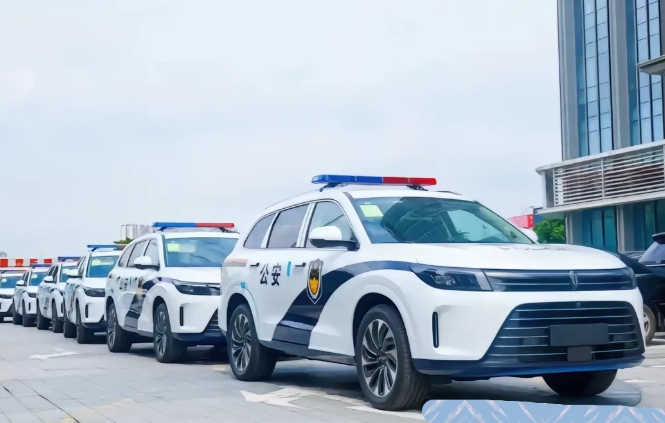
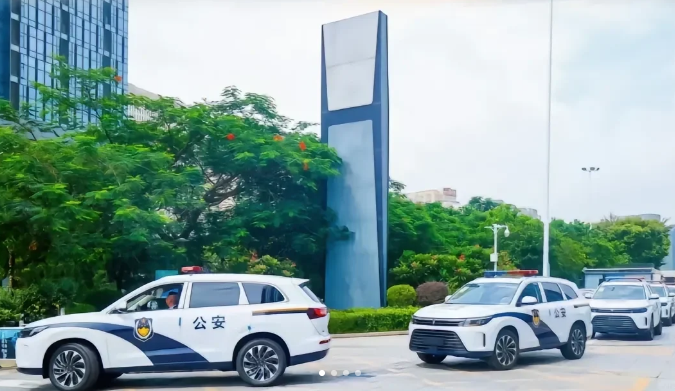 Image source: Weibo
At the Security Expo, Huawei laid out the foundation of its approach: an independent innovation base plus an open co-creation ecosystem.
AITO entering the official vehicle list did not start this year
Spread out the timeline, and this road has been walked for four years.
According to public reports, in 2022, the AITO M5 extended-range version entered the official vehicle procurement of the Shenzhen procuratorate system, becoming a vehicle for public security, procuratorate, and court projects.
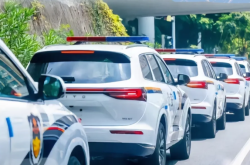
Around 2024, police departments in Chongqing and Shenzhen began to buy AITO M7 in batches, using them as police cars and law enforcement duty vehicles.
In 2025, the frequency of "AITO" appearing on government procurement websites increased noticeably. A few orders can be found at random:
In September 2025, the Chongqing Public Security Bureau's law enforcement duty vehicle transaction was the AITO M7 PRO rear-wheel-drive five-seat version; in the same month, Chongqing Bank updated its official vehicles, buying the AITO M7 Pro government procurement version, one five-seat and two six-seat. One month earlier, the Chongqing Public Security Bureau Water Branch bought the AITO M5 pure electric Ultra rear-wheel-drive version.
Further up is the M9. A 500,000-class SUV with a starting price close to 470,000, many enterprises and institutions buy it as an official vehicle. In January 2026, the 1,000,000th complete vehicle of AITO rolled off the line, and it was an M9—this model has sat firmly as the sales champion in the 500,000 class for 21 months, with cumulative deliveries of 270,000. According to previous disclosures from AITO, some customers ordered 600 units in one go.
Here a fair statement must be made.
The M7 and M5 entering the list is a story of "volume": around 250,000, extended range without anxiety, large enough space, exactly matching the appetite of law enforcement duty vehicles. The M9 entering the list is a story of "benchmark," with limited numbers, mostly appearing in reception and command scenarios.
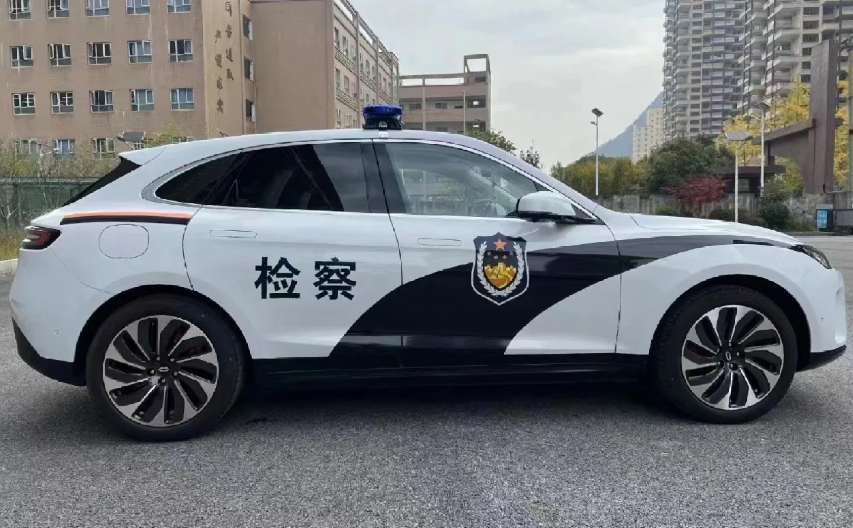
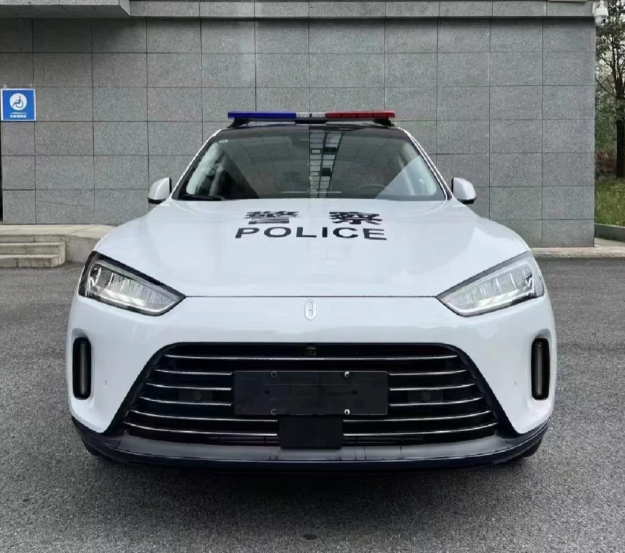 Image source: Weibo
Mixing these two stories together easily leads to the illusion that "official vehicles are all buying 500,000 luxury cars." This is neither fact nor the policy direction.
The "Guidelines on Performance Related to Equipping New Energy Vehicles for Central Administrative Institutions" clearly states: priority should be given to purchasing products of good quality and low price, and the pursuit of high-end configurations or luxury interiors is strictly prohibited. The first principle of official vehicle procurement has never been grandeur, but sufficiency, compliance, and not exceeding standards.
What is truly valuable is not how many M9s were sold. It is that HarmonyOS Intelligent Mobility, for the first time, entered the procurement vision of this system as a "complete solution."
The curve obscured by monthly sales figures
On November 1, HarmonyOS Intelligent Mobility announced October deliveries: 33,537 units. Last year in the same period it was 68,216, down about 50.8% year-on-year; September was 37,500, down 10.5% month-on-month. Among them, AITO accounted for 22,105, two-thirds of the total.
The numbers are here, no excuse. Last October was the delivery peak for the M9 and M7, with a high base; this year's "Silver October" lacked luster, and several new forces went down together.
But focusing only on this report card will miss another line.
This line is written in the Ministry of Finance documents.
On December 30, 2024, the General Office of the Ministry of Finance issued the "Notice on Further Clarifying the Proportion Requirements for Government Procurement of New Energy Vehicles," with two sentences drawing two lines—in the total procurement of official vehicles, the proportion of new energy vehicles should in principle be no less than 30%; for confidential communication and other official vehicles mainly running in urban areas, in principle 100% should be new energy.
Earlier notices from the National Government Offices Administration and the Central Government Offices Administration also state: central and state organs, when equipping and renewing official vehicles, should take the lead in using domestically produced new energy vehicles.
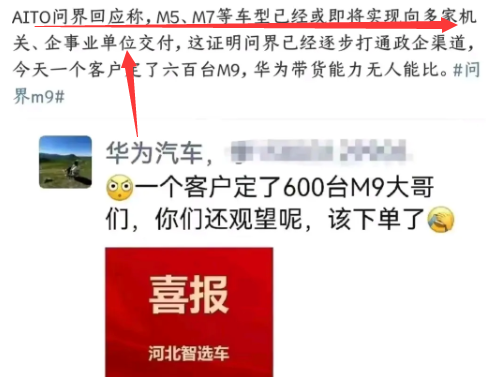 Image source: WeChat Moments
Looking forward, the "Work Plan for Energy Conservation and Carbon Reduction in Public Institutions during the 15th Five-Year Plan" issued in July 2026 pushed another step: newly added and renewed official vehicles should "use whenever applicable."
30% is the bottom line, 100% is the hard threshold, and "use whenever applicable" is the direction. Stacked together, the three point to one conclusion: the new energy transformation of official vehicles is not a multiple-choice question, but a timetable.
The C-end is like a vegetable market, where the outcome is known in one morning; the G-end is like a workplace cafeteria, decided once a year, and once decided it lasts several years, and if you lose the bid you wait for the next round.
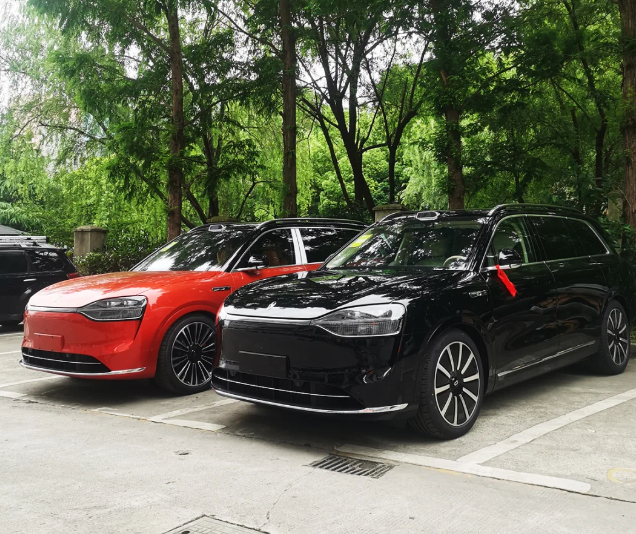 Image source: Weibo
The temper of this market is exactly opposite to the C-end. The C-end looks at discounts and reputation; the G-end looks at establishment, budget, catalog, and qualifications.
G-end procurement prices follow the budget. Once an order is signed, it is often a replacement cycle of four to eight years, accompanied by maintenance and system upgrades.
What blocks people even more is the procurement catalog. Official vehicles are not whatever you want to buy; you have to first enter the catalog, enter agreement supply, and enter framework procurement. A model being able to enter a provincial or industry catalog means its price, configuration, after-sales, and supply capacity have been reviewed from beginning to end. This ticket is harder to obtain than holding ten launch events.
A brand dropping a few points on the C-end and getting an admission ticket on the G-end are simply not things of the same magnitude.
Do not use the C-end ruler to measure the G-end door
Of course, the G-end is not a universal cure.
First, establishment. Official vehicles have establishment, standards, and price ceilings, and that 30% "in principle" is implemented at very different paces across regions.
Then the decision chain. The G-end is much longer than the C-end. From entering the vision to batch implementation, a model often takes years.
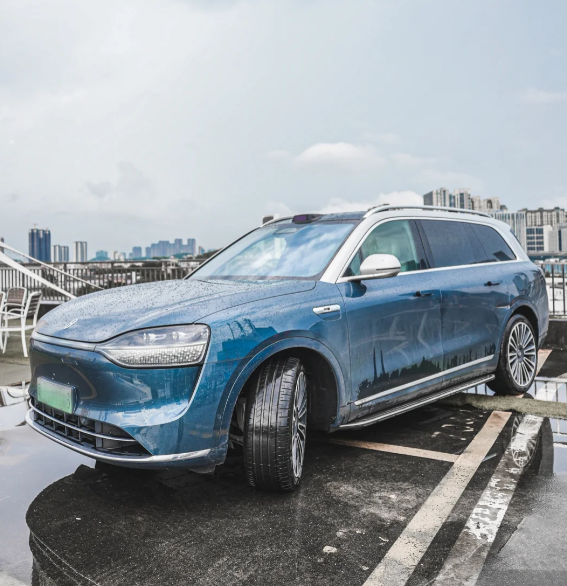
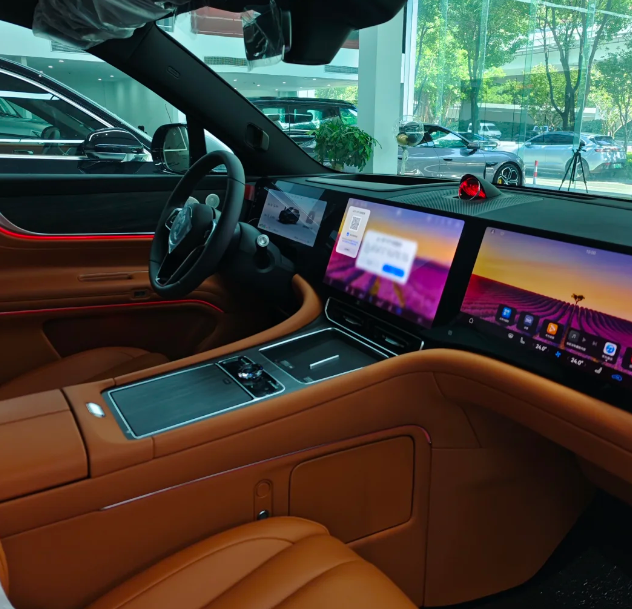
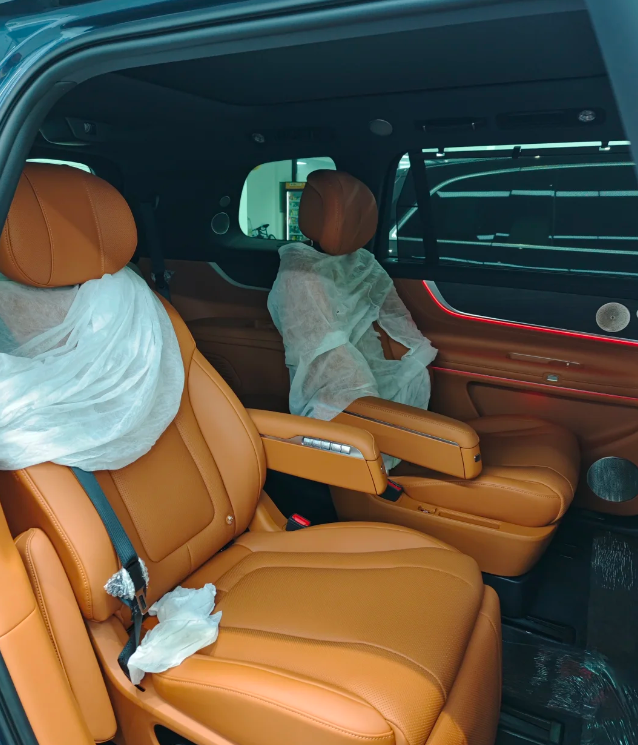 Image source: Weibo
There is another point most easily overlooked: the government affairs market wants "stability," not "flashiness." Features installed today still need someone to maintain, upgrade, and guarantee them five years from now.
So the saying "once the G-end door opens, the volume is unimaginable" is half right. The right half is that this is indeed a certainty market supported by policy, following budgets, and unaffected by terminal price wars. The wrong half is that it is not a flood surging overnight, but a road of signing one order and spreading out over a year.
HarmonyOS Intelligent Mobility has been on this journey for four years: from the first batch of M5s delivered to the Shenzhen Procuratorate in 2022, to the M7 law enforcement vehicles patrolling the streets of Chongqing in 2025, and now to this mature solution showcased at the Security Expo. The trajectory is clear: first, prove that it can serve as an official vehicle; then, prove that it can turn an official vehicle into a mobile office.
The former is a contest of product and price; the latter is a contest of base and credentials. Anyone can compete in the former, but few can master the latter.
This is the real significance of this Security Expo. What it offers is not merely a car, but vehicle-grade government IT infrastructure—except that this infrastructure happens to have four wheels.
As for sales, the November figures will still be subject to outside judgment. That does not matter. The consumer end is a monthly scorecard; the government end is a multi-year contract. The two accounts should not be lumped together.
Next time you see an AITO marked "Official Vehicle" on the street, do not rush to pull out your phone and snap a photo. It may be hurrying to handle matters you will never know about.
Disclaimer: This article is solely a big-tech financial commentary and does not constitute any investment advice. The enterprise data and regulatory events mentioned in the article are all drawn from public information and are for reference only; official releases shall prevail. Image sources are from the internet; if there is any copyright issue, please contact us for removal.
-
![]()
Is Toyota Cutting Ties with the Rest of the World for China?
-
![]()
"China's Buffett" Goes All-In on AI and Crashes Hard! Turns Into a "0.6 Yuan Fund" in Just 4 Months
-
![]()
The Pain Points of Lingguang as a Personal Agent: Xiaohongshu and Rokid Join Forces to Fill the Gaps
-
![]()
Yu Chengdong "Takes Advice": the "Crown Prince" Returns as the New AITO M8 Rolls Back into Huawei Stores
-
![]()
Hongguo Short Dramas Takes on Doubao—Even Jack Ma Can't Sit Still?
-
![]()
Breaking! AITO Secures Major Orders for Smart Policing and Official Vehicles
-
In the AI Era, the Real Competition Is Not Just AI Itself
-
![]()
Toyota's Half-Year Report: New Cars and Robotics as New Business Lines underpin "Stabilization" and "Survival" Transformation