Chips Are Scarce, Yet TSMC Has Started "Vetting Customers' Finances"?
 11/18 2026
 550
The company whose chips are among the easiest in the world to sell has started paying closer attention to how much money its customers actually have.
On November 16, Taiwan's Commercial Times, citing industry sources, reported that TSMC sets credit limits based on customers' financial conditions. If orders exceed the limit, customers must put up additional cash, and some are also required to pay in advance to secure capacity.
TSMC Chairman C.C. Wei also revealed at the October earnings call that the company has sent teams to the United States to inspect data center construction and power supply conditions. He added that AI chip demand still exceeds supply.
Chips are in short supply, yet the manufacturer has begun carefully scrutinizing customers' financial strength. When the entire AI industry is scrambling for chips, why does TSMC instead need to confirm whether customers can actually afford to pay?
01 The Money Behind the Orders
US$46.72 billion was TSMC's revenue in the third quarter of this year, up 41.2% year on year, with high-performance computing contributing 68% of revenue. As of the end of September, customer advances reached NT$359.481 billion, up about 89% from the end of last year.
These funds are mainly prepayments made by customers to reserve capacity, and can be refunded or offset against future payments for goods in accordance with agreements.
Why are prepayments so important? Because investment in wafer manufacturing comes far earlier than product delivery.
An advanced wafer fab often takes years from construction to production. TSMC plans capital expenditure of US$60 billion to US$64 billion this year and must build in advance based on customers' future demand. Once equipment is put into production, depreciation does not stop even if customers cancel purchases, and excess capacity may not easily find buyers in the short term.

For custom AI chip (ASIC) design companies, funding pressure also emerges earlier. They order wafers from TSMC, and chips can only be delivered after packaging; if downstream customers pay in stages, the design companies must first advance manufacturing costs. As orders increase, if customer payment progress cannot keep pace with funding expenditures on the manufacturing side, the funds that design companies need to advance will also grow accordingly. Some Taiwanese ASIC companies have recently raised funds through bond issuance or bank loans precisely to meet the funding needs brought by business expansion.
For TSMC, customers' willingness to purchase is certainly important, but whether their balance sheets can support order fulfillment is also tied to capacity arrangements.
The more chips are in short supply, the more leverage manufacturers have to require customers to put up real money to prove the reliability of their purchasing commitments.
But the problem does not end there. Chip design companies are only an intermediate link in the capital chain. What supports the purchase decisions of those data centers that invest billions of dollars at every turn?
02 Who Is Paying for Whom
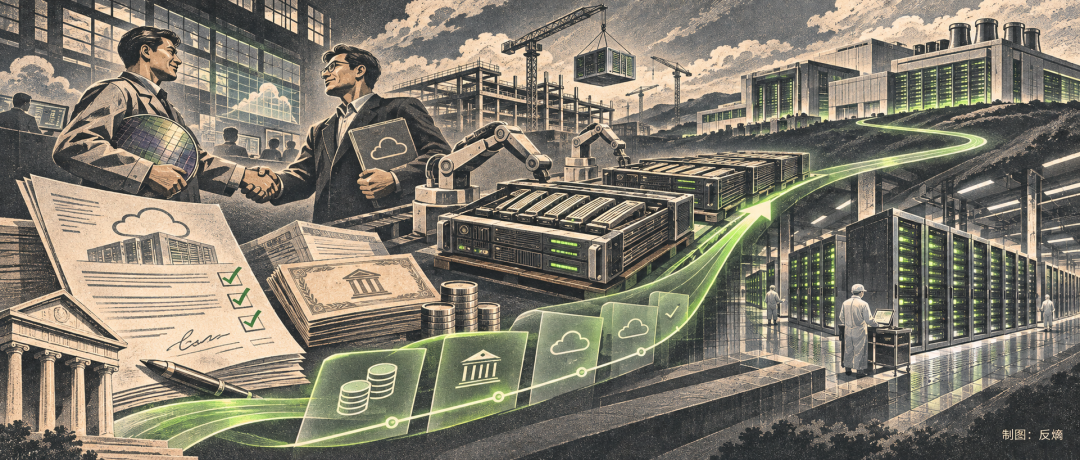
NVIDIA, which sells chips, is also helping those who buy chips obtain financing.
Under agreements disclosed by NVIDIA, some AI cloud service providers purchase its equipment, while NVIDIA commits to buying future computing power services. As of July 26, the total amount of such cloud service purchase commitments reached US$36 billion, usually fulfilled over six years.
Such cooperative arrangements can help emerging cloud service providers obtain financing.
A company preparing to build a large GPU cluster needs to buy expensive chips and servers in advance. When financial institutions assess loans, they focus on whether the project can generate stable revenue in the future. If NVIDIA commits to purchasing part of the computing power, the project obtains a relatively certain future source of revenue and is therefore better able to secure external funding.
Cloud service providers use the funds raised to buy NVIDIA equipment, and NVIDIA obtains hardware orders while committing to purchase part of the computing power services under agreed conditions. This arrangement helps customers expand construction scale and also allows suppliers to establish closer financial ties with downstream operators.
There are historical precedents for this approach. In 2000, telecom equipment giant Lucent provided customers with credit commitments and debt guarantees totaling about US$8.1 billion to help carriers buy equipment. After the dot-com bubble burst, some carriers were unable to repay their debts, and Lucent not only lost equipment orders but also suffered losses from the customer financing risks.
CoreWeave's financial reports show the current funding pressure. This cloud service provider, which has received investment from NVIDIA, had third-quarter revenue of US$3.661 billion, up about 168% year on year, and future contracted revenue backlog reached US$132.5 billion; in the same period, net interest expense was US$846 million and net loss was US$709 million. It expects full-year capital expenditure of US$37 billion to US$39 billion, far above expected revenue of US$13 billion to US$13.3 billion.
Financing can convert future computing power demand into chip orders in advance, but it cannot create final investment returns in advance.
For TSMC, customers' ability to pay on time now does not guarantee that future purchasing plans will be carried out smoothly. The construction progress and operating conditions of downstream data centers also affect the reliability of subsequent orders.
If downstream projects encounter difficulties in collecting payments, how will the pressure be transmitted upstream?
03 China's Collection Difficulties
China's AI chip industry chain has also begun to show pressure between order growth and cash collection.
The listing application materials of domestic AI chip company Enflame Technology show that as of the end of 2025, its accounts receivable balance was 290 million yuan, of which about 241 million yuan was overdue, accounting for 82.96%; the provision ratio for bad debts rose from 8.73% at the end of the previous year to 24.76%.
At the same time, Enflame Technology's accounts receivable balance declined significantly from the previous year. Some historical projects remained unsettled for a long time, significantly raising the proportion of overdue payments and also increasing the pressure for bad debt provisions.
An important reason for this situation lies in the obvious differences in payment terms among different customers.
Enflame Technology disclosed that internet customers usually enjoy credit periods of 45 to 90 days and have good payment collection; some intelligent computing center projects need to be settled in stages according to construction and acceptance progress. System integrators that directly purchase chips may also be affected by the funding arrangements of the ultimate owners. Upstream has already delivered goods, yet cash remains stuck in subsequent settlement stages.
For domestic AI chip companies that are expanding business scale, if receivables generated by sales cannot be collected for a long time, they will need to rely more on their own funds or external financing to maintain operations.
Compared with TSMC requiring customers to prove payment ability in advance, Enflame Technology faces payment collection pressure after product delivery. Located at different positions in the industry chain, both need to prevent customers' funding arrangements from affecting their own operations.
When orders may tie up large amounts of funds, customers' credit conditions will directly affect chip companies' next round of procurement and expansion.
04 Who Can Keep Expanding
When chip supply is tight, financial strength is becoming an important condition for companies competing for capacity. Even with a long-term purchase contract, a company may not necessarily obtain chip capacity of the corresponding scale.
Large cloud service providers can rely on cash flow from existing businesses to pay for goods in advance; emerging operators usually need to use future computing power contracts to obtain loans. If construction is delayed and revenue is postponed, interest still has to be paid; the launch of a new generation of GPUs may also affect the rental prices and financing valuations of old equipment. If upstream requires more prepayments, differences in financial strength will directly translate into differences in purchasing power.
This will give customers with good credit an advantage in competing for scarce capacity, and also make it harder for companies that rely on continuous financing to expand scale. Therefore, when the market measures an order, it cannot look only at the amount, but also at the source of payment, construction progress, and the spending power of end users.
TSMC's credit assessment is not enough to prove that AI demand has generally run into a payment crisis, but it reminds the market to pay attention to an expanding variable: some chip purchases rely on financing from future computing power revenue, and that future revenue has yet to materialize.
When those who sell chips also help customers obtain purchasing power, order growth alone cannot prove how strong final demand is.
Chips are in short supply, and TSMC still has to check customers' books—because what ultimately determines how far this round of AI investment can go is how much real revenue those growing orders can generate.
* If you have different views on the content of this article, you are welcome to contact us.
-
![]()
OpenAI Unveils GPT-6.2 Astra and Sol, Outperforming Claude Fable 5.2 at Just 5% of the Cost
-
![]()
Baidu's Q3 Report: Advertising Stalls as AI Takes the Wheel
-
![]()
JD.com: Retail Stops the Bleeding While Overseas Burns Cash — When Will the "Thrashing" End?
-
![]()
Great report! But without Jensen Huang, Nvidia just doesn't feel the same!
-
![]()
LCoS and the Screen Door Effect: Why Do Our Eyes "Catch" the Pixel Gaps?
-
![]()
Cybertruck Failed to Keep Musk, the Car Builder
-
![]()
Chips Are Scarce, Yet TSMC Has Started "Vetting Customers' Finances"?
-
After "Taking Down" Jensen Huang, the United States Officially Shows Its Hand: A Comprehensive Blockade on China's AI Computing Power