Great report! But without Jensen Huang, Nvidia just doesn't feel the same!
 11/18 2026
 343
Nvidia (NVDA.O) released its fiscal 2027 third-quarter earnings report (for the quarter ended October 2026) after the U.S. market closed in the early hours of November 18, 2026 Beijing time. This was also the first earnings report since Jensen Huang resigned on November 12, presided over by interim CEO Colette Kress. The details are as follows:
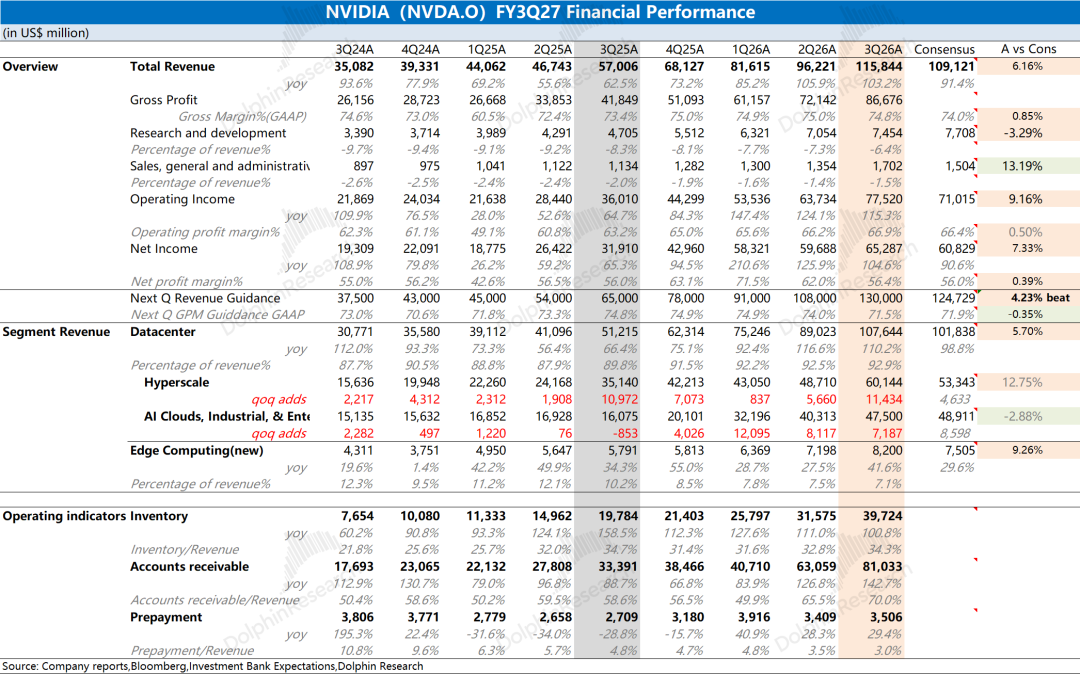
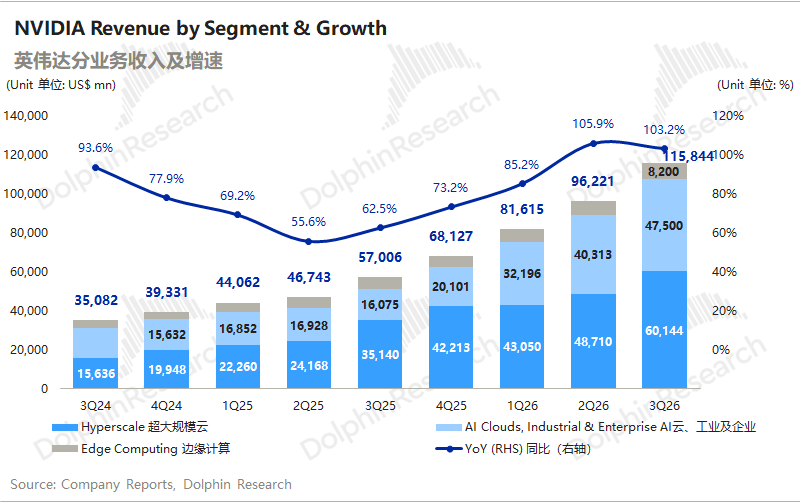
1. Data Center: Revenue for the quarter was $107.6 billion, up $18.6 billion quarter-over-quarter and 110% year-over-year, beating market expectations of $101.8 billion. Growth was mainly driven by the first-quarter volume production and shipment of Vera Rubin and continued shipments of Blackwell Ultra (GB300): Rubin contributed nearly $20 billion in revenue in its first quarter of volume production (about 18% of data center revenue).
Networking revenue for the quarter exceeded $21 billion, accounting for about 20% of data center revenue. In addition, during the quarter the company shipped $2.4 billion of licensed Hopper data center products to China (direct sales of H200).
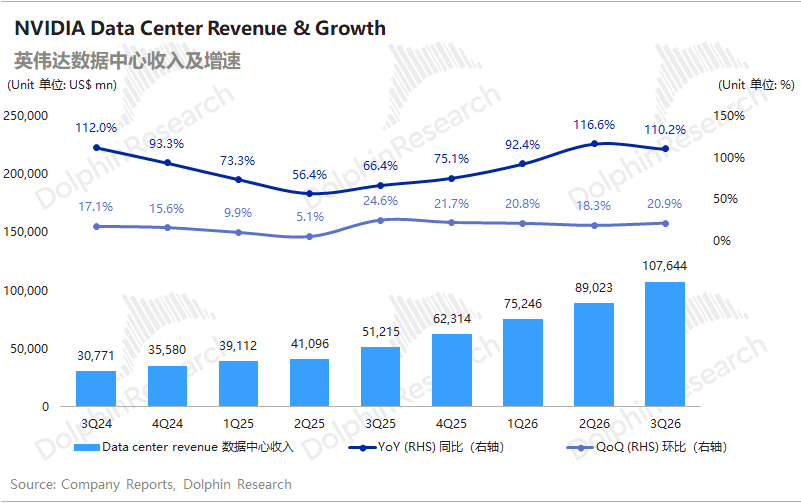
Starting this fiscal year, the company adjusted its disclosure methodology, splitting data center into "Hyperscale" and "ACIE (AI cloud, industrial and enterprise, including sovereign customers)."
Specifically, hyperscale customer revenue this quarter was $60.1 billion, up $11.4 billion quarter-over-quarter (+23%), significantly above consensus expectations of $53.3 billion; ACIE customer business revenue was $47.5 billion, up $7.2 billion quarter-over-quarter (+18%), slightly below consensus expectations of $48.9 billion.
After two quarters, hyperscale customers once again became the largest source of revenue growth. Cloud industry backlog increased from $2 trillion three months ago to $2.5 trillion; ACIE's quarter-over-quarter growth came from Vera Rubin shipments to leading new clouds and frontier labs beginning to build their own data centers.
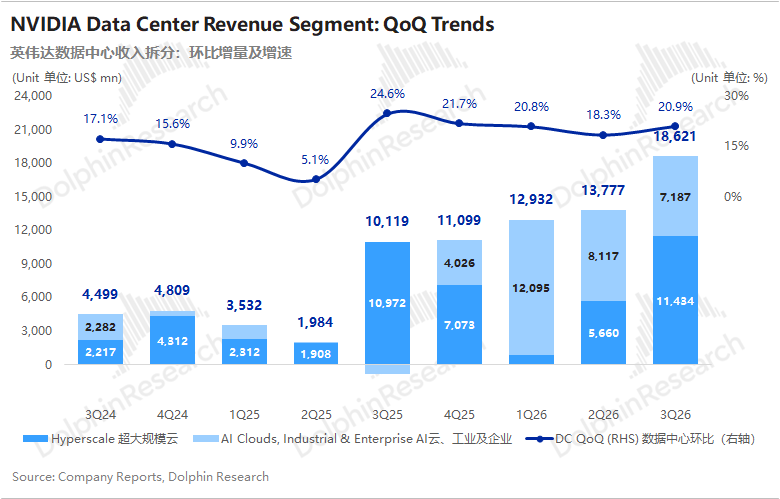
With major CSPs developing their own chips, Nvidia over the past year opened up the ACIE market through "supporting small and medium-sized customers + backstopping with its balance sheet" (new clouds account for more than half of ACIE). But this path showed signs of contraction this quarter: ACIE quarter-over-quarter growth slowed from 25% last quarter to 18%, and came in below consensus expectations.
On the earnings call, Kress said the company would "remain disciplined and support new clouds selectively," and that future financing support would prioritize land, power, and shell, while acknowledging that "a lot has changed over the past quarter."
2. Key incremental information: Starting last quarter, the company began disclosing three sets of data: Commitments, Additional Commitments, and Guarantees. These three items put Nvidia's role as the "central bank of computing power" on full display. This quarter is the first disclosure after Jensen Huang's departure, and the changes can be summarized as: continuing to lock up upstream capacity, while downstream backstopping is selective.
1) Commitments: Supply and capacity commitments reached $390 billion this quarter, up $111 billion quarter-over-quarter (from $279 billion last quarter). The company said this was mainly multi-year memory purchases.
By year distribution, the newly added supply commitments almost all fall in fiscal 2028 (corresponding to calendar 2027): FY28 supply and capacity commitments jumped from $87 billion last quarter to $203 billion, FY29 rose slightly from $88 billion to $92 billion, and FY30 and beyond totaled only $26 billion.
A rough comparison: based on FY28 revenue growth guidance of 75% and gross margin guidance of 72%–73%, FY28 cost of revenue would be about $200–208 billion, broadly in line with the FY28 supply commitment of $203 billion—the upstream supply supporting "75% growth" is basically already locked in.
2) Additional Commitments and Guarantees: Commitments and backstops for downstream customers
① Additional Commitments: This quarter only one item remained, the "new cloud agreements" (renamed from the original "AI cloud agreements"), amounting to $32 billion, down $4 billion quarter-over-quarter.
The company also added an explanation: such commitments only take effect after the new cloud independently completes financing, the relevant computing power deployment goes live, and Nvidia accepts it.
Kress said "nothing has changed," and that the terms were simply written more clearly because of numerous inquiries. Dolphin views that, regardless of the explanation, with the balance falling from $36 billion to $32 billion, the expansion of L2 (additional commitments) has effectively stopped.
② Guarantees: The maximum guarantee exposure this quarter was $118 billion (vs. $108.5 billion last quarter), with the $9.5 billion increase entirely from newly appearing "power and systems credit support guarantees." The company's description of guarantees also expanded from "land, power, shell" to "land, power, shell, and hardware financing arrangements," meaning it has begun backstopping hardware financing for some customers.
The new cloud land, power, and shell guarantee ($3.5 billion) and the SB Energy/PORTS-Pike campus ($105 billion) remained unchanged. The PORTS-Pike campus guarantee takes effect as each of the nine buildings is completed in stages, with the first phase expected in FY29; Nvidia also has an option for about 3.8GW of additional expansion guarantees. To date, the company has not made any payments under these guarantees.
The $500 billion computing power financing platform announced in August (Apollo, BlackRock, Blackstone, Brookfield, Goldman Sachs, KKR) is still being set up. Kress said the company "continues to work closely with infrastructure capital partners to advance the financing platform," and no projects were disclosed as finalized this quarter.
3) First statements after management transition: This earnings call was opened by Jones (the new chairman, a newly created position) and led by interim CEO Kress. Key statements are as follows:
① Personnel: The board unanimously accepted Jensen Huang's resignation and "has no intention of asking him to return as CEO." A headhunting firm has been engaged to lead the search for a permanent CEO, considering both internal and external candidates.
The new CEO must be able to navigate an environment where advanced chips and national security are intertwined. The company hopes to appoint someone as soon as possible, but "will not lower standards for the sake of speed," and gave no timetable. It declined to comment on the specific circumstances of the resignation or the ongoing investigation.
② Compliance: The board announced that day the establishment of a "National Security and Export Controls Oversight Committee," composed of some independent directors, senior external advisors, and legal counsel, to strengthen communication with relevant U.S. government departments.
③ Operations: Kress repeatedly emphasized that "business is as usual," the roadmap is unchanged (Vera Rubin Ultra to launch next year, Feynman in 2028), and customers, suppliers, and partners are "100% supportive." TSMC management visited Nvidia this week, and the company has additionally locked in memory and advanced packaging capacity.
④ Capital returns: In the future, the company will return to shareholders all excess free cash flow after deducting strategic uses, and plans to use up the remaining $227.3 billion buyback authorization within FY28.
Kress listed shareholder returns as one of the top priorities, while saying the primary deployment is to suppliers (supporting capacity expansion through prepayments and other means), followed by already committed investments, and then financing or guarantees for a small number of high-quality customers, each to be rigorously evaluated case by case.
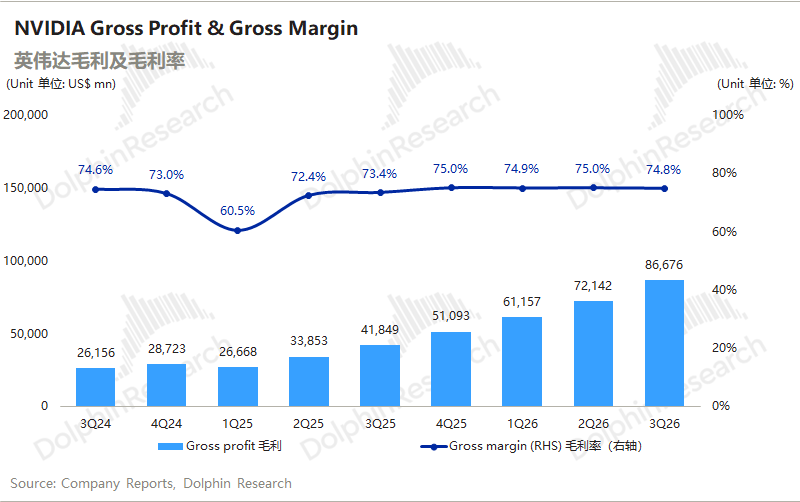
3. Guidance: The company expects fiscal 2027 fourth-quarter revenue (i.e., 4Q26, a 14-week quarter) of $130 billion (±3%), up $14.2 billion quarter-over-quarter, above market expectations of $124.7 billion; next-quarter gross margin (GAAP) of 71.0%–72.0%, down about 3 percentage points quarter-over-quarter, in line with market expectations of 71.9%.
The guidance does not include any China data center computing revenue. Management also explicitly stated that it has stopped shipping licensed Hopper data center products (H200) to China, and that the $2.4 billion in the third quarter will drop to zero in the fourth quarter.
Excluding China Hopper products, the company's next-quarter revenue on a 13-week basis would still grow about 6% quarter-over-quarter on a comparable basis. Management reiterated that FQ4 gross margin is the bottom; the fourth quarter is still fulfilling orders already taken at old prices, new prices take effect from the new fiscal year, and the FY28 gross margin framework of returning to 72%–73% remains unchanged.
In subsequent discussions, management raised its fiscal 2028 revenue growth outlook from about 70% to about 75%. Kress said "demand far exceeds supply, and we expect performance to remain strong." The FY28 growth outlook has already taken into account an assessment of current export controls, but the company "still needs time to study the more difficult parts," and did not provide a quantified impact.
Dolphin's overall view: Performance holds up, but the pullback is not simply a "mispricing"
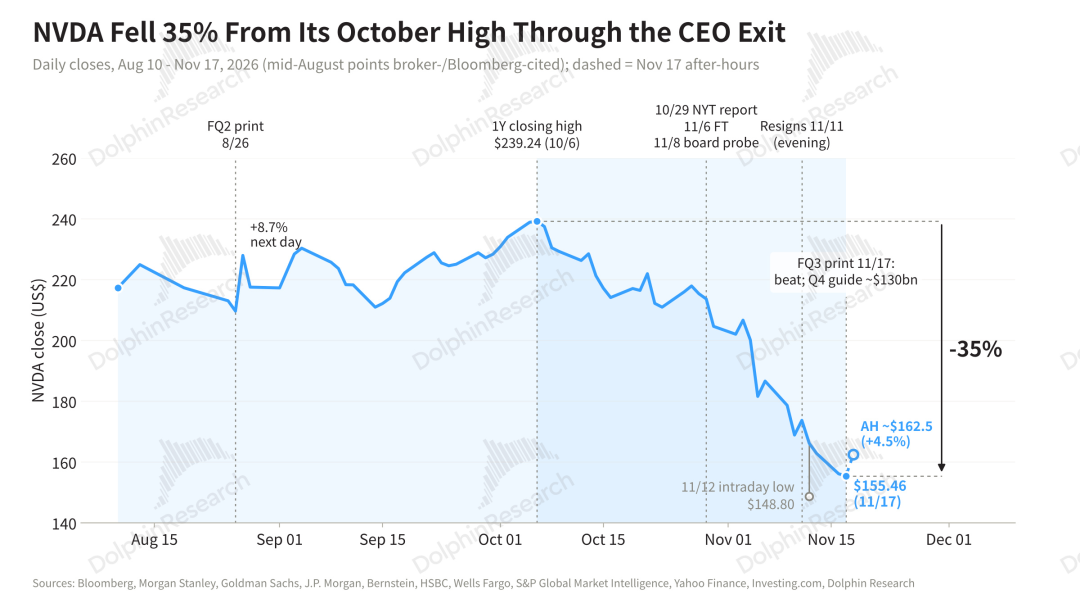
Last quarter, Jensen Huang laid out the clear FY28 "about +70%" target, and the stock price once recovered to a high of $239. But afterward, Nvidia suffered a double blow of "personnel + compliance." The significance of this earnings report goes beyond a single quarter's performance; what the market really wants to verify is whether "Nvidia without Jensen Huang" can hold through 2027 (FY28).
In subsequent discussions, management raised its FY28 (i.e., 2027) revenue growth outlook from about 70% to about 75%, with gross margin guidance of 72%–73%, intending to use this as a response to show that "with or without Jensen Huang, Nvidia can still grow."
Through detailed disclosure of upstream and downstream procurement and guarantee commitments, a "disciplined, selective support" attitude toward new clouds, the establishment of a committee, larger dividends and buybacks, and H200-related revenue dropping to zero... all of this shows that Nvidia's new team is relying on the deep foundation built by Jensen Huang, while distancing itself from him, demonstrating loyalty to the country, and using a financial management mindset to reassure Wall Street's current demands.
But behind these choices, there is still no answer to the most critical question: in the post-Jensen Huang era, who exactly is steering the company's long-term strategy and execution?
The U.S. Department of Commerce issued new export control rules on November 16, bringing "remote provision of computing power to Chinese entities" under global licensing management and adding new export licensing thresholds for five Southeast Asian countries and Brazil; the company also disclosed in its earnings report that it has stopped shipping licensed Hopper data center products to China, and the FQ4 guidance does not include any China data center computing revenue.
Beyond this earnings report, the market is also concerned about the following:
1) Jensen Huang's departure and CEO succession
Chairman Harvey Jones, speaking for the board, said: Jensen Huang resigned after disclosure of "personal conduct inconsistent with the company's code of conduct, standards, and cultural norms," and the board unanimously accepted and has no intention of asking him to return as CEO.
Dolphin views that within the 12–24 months in which orders and supply are already locked in, the direct operational impact of a CEO change is limited, and the FY28 raise to 75% confirms this.
What is truly affected is two things: first, customer backstopping and financing expansion will become more cautious, with new cloud agreements already down from $36 billion to $32 billion this quarter; second, the company's export control risk has risen, and licensed Hopper data center product shipments to China have stopped.
The board has ruled out the possibility of Jensen Huang's return, and there is no timetable for selecting a permanent CEO. Before the new CEO sets the strategic direction, governance risk has not been cleared.
2) New export control rules: offshore computing channels are blocked
Rule content: The U.S. Department of Commerce's Bureau of Industry and Security (BIS) issued an interim final rule on November 16 aimed at preventing existing export controls from being "circumvented through remote computing arrangements involving third-country data centers." It mainly consists of five parts:
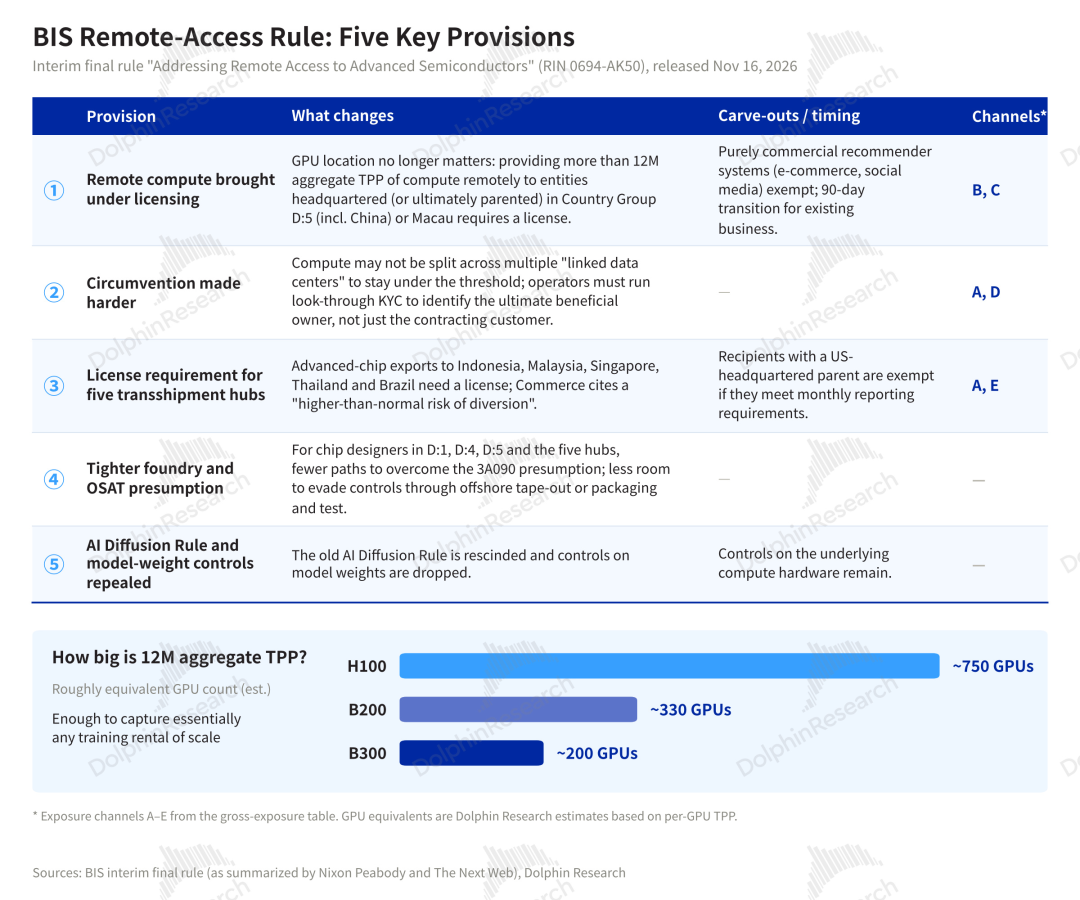
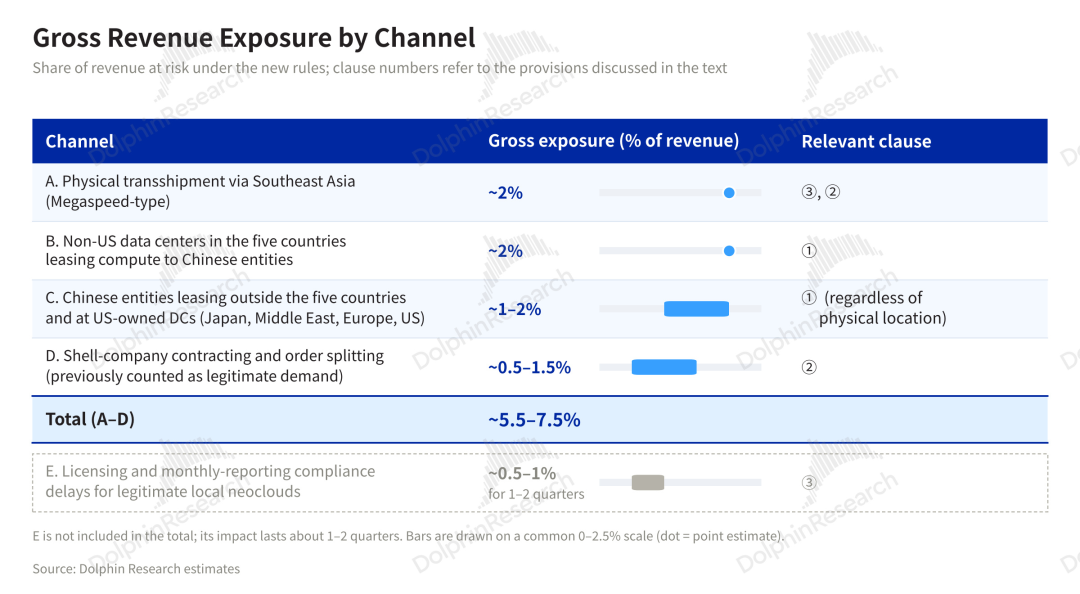
Dolphin's view: For Nvidia, this new rule means "limited revenue damage, but greater valuation pressure." Items ①② are the main shocks—the path for Chinese entities to rent chips globally for training is cut off, and the leakage space from shell companies signing on behalf of others and splitting small orders is also plugged; ③ creates delivery friction for non-U.S. local new clouds, while U.S. cloud providers merely face additional monthly reporting compliance costs.
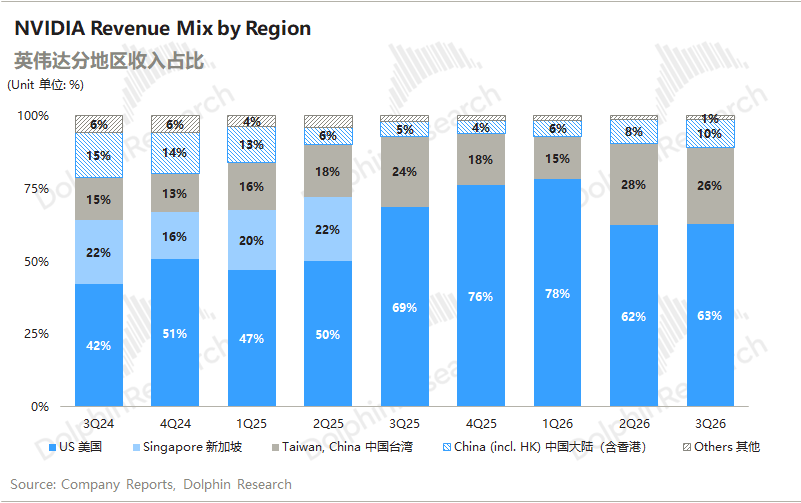
First, let's clarify a metric: In FY25, by billing location, Singapore revenue was about $23.7 billion (18%) and China (including Hong Kong) about $17.1 billion (13%), totaling about 30%, but this is not the exposure under the new rules.
Restated by customer headquarters, FY25 China increased by about $7.9 billion to about $25 billion (about 19%), with the rest mainly U.S.-headquartered customers billed in Singapore, which are exempt. China-headquartered customer revenue subsequently fell from about 19% to 8.2% in FQ2 FY27, due to prior China controls such as the H20 sales ban; the new rules currently do not touch direct sales to China or H200 licensing.
However, the company disclosed in its earnings report that it shipped $2.4 billion of licensed Hopper data center products to China in the third quarter, and China (including Hong Kong) revenue rebounded to $11.05 billion, or 9.5%. Management also stated, however, that it has stopped shipping such products to China, and its fourth-quarter guidance does not include any China data center computing revenue; the reason for the halt was not explained.
What the new rules directly hit is the "offshore channel"—non-U.S. data centers renting computing power to Chinese entities—as well as physical transshipment. In the earnings report's regional breakdown, this is mostly recorded under "Taiwan" (ODM shipments) or "United States" (OEM), and cannot be seen directly under any metric.
Assume the net exposure is approximately 5.5%–7.5% of revenue (see chart below). Not all of the displaced quota will disappear; Dolphin assumes that 50%–60% of it can be absorbed by North American cloud providers, AI labs, and sovereign clouds, so the actual impact is around 2–3%.
More noteworthy is the second-order impact: after Chinese tenants withdraw, whether the vacancy rates and rental prices of overseas new clouds come under pressure, thereby weakening their capacity expansion and financing capabilities, and affecting Nvidia's buyout and guarantee arrangements.
For the Chinese market, restricted offshore training paths will force domestic compute procurement. The original hedge of "turning to H200 license-based procurement from China" has also temporarily fallen through as Nvidia stops shipments to China—Q3 China revenue of $2.4 billion dropped to zero in Q4—and in the long run the Chinese data center market will further shift toward domestic products.
3) Rubin's ramp-up pace
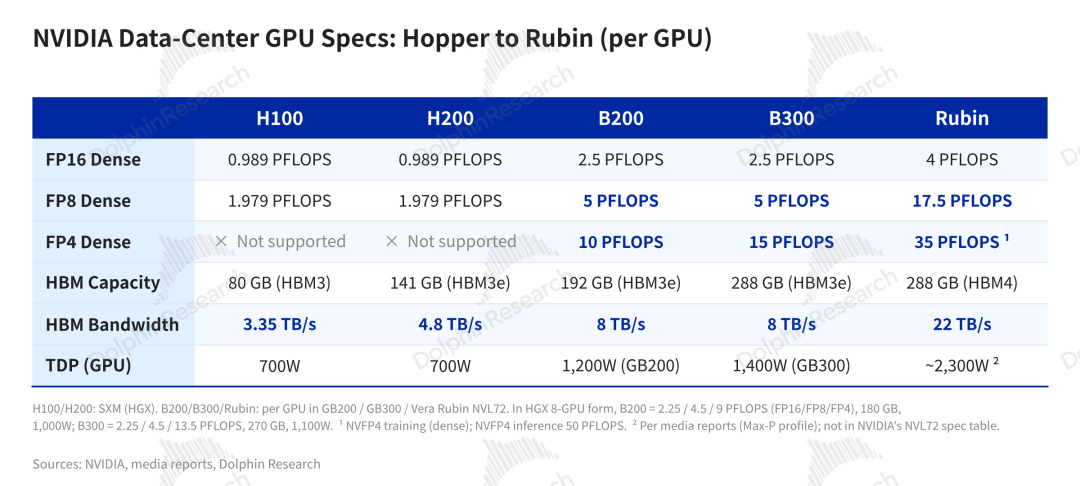
Vera Rubin began mass production and shipments in August, contributing nearly $20 billion in revenue in its first quarter (about 18% of data center revenue, slightly below the 20% mentioned last quarter).
The full rack VR200 NVL72 uses 72 Rubin GPUs (2 dies per GPU) + 36 Vera CPUs. Revenue per GW rises from about $18 billion for Hopper and about $25 billion for Grace Blackwell to more than $40 billion for Vera Rubin, and Feynman (2028 architecture) will further rise to "significantly above $50 billion."
In addition to GPUs, CPU and networking are the other two growth drivers this quarter: the standalone Vera CPU has been adopted by CoreWeave, Meta, Nscale, and OpenAI (previously AWS, OCI, and SpaceX), and management expects FY28 total CPU revenue to more than double. Networking revenue exceeded $21 billion this quarter, the co-packaged optics (CPO) roadmap is progressing as planned, and Lambda completed the first mass deployment of Nvidia's CPO switches (connecting more than 10,000 GB300s).
Management reiterated this time that Vera Rubin Ultra will launch next year and Feynman in 2028, with the roadmap progressing as planned; it also launched the DSX POD modular AI factory reference design, with the first batch planned for delivery to customers in the United States and Central Europe early next year.
4) Market expectations and competitive landscape
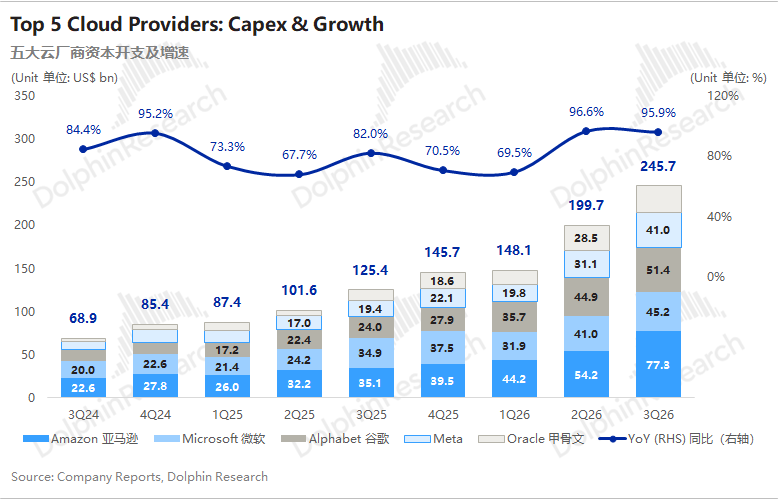
SemiAnalysis recently comprehensively cut AI chip shipment and spending forecasts, especially sharply lowering Nvidia, due to the dual screening of "performance/TCO + financing capability":
① Nvidia's priority in frontier labs' compute portfolios has declined—Anthropic uses four types of platforms: TPU, Trainium, AMD GPUs, and Nvidia GPUs, with Nvidia being the most marginal in cost-effectiveness; on OpenAI's side, the AMD warrant transaction makes AMD GPUs very attractive, and OpenAI will prioritize deploying its own ASICs (Jalapeno, Serrano);
② Nvidia has the highest customer exposure to new clouds, while the execution and financing risks of new clouds are rising.
Regarding long-term pricing power under ASIC competition, Kress only said pricing is "well considered" and the FY28 gross margin framework remains unchanged.
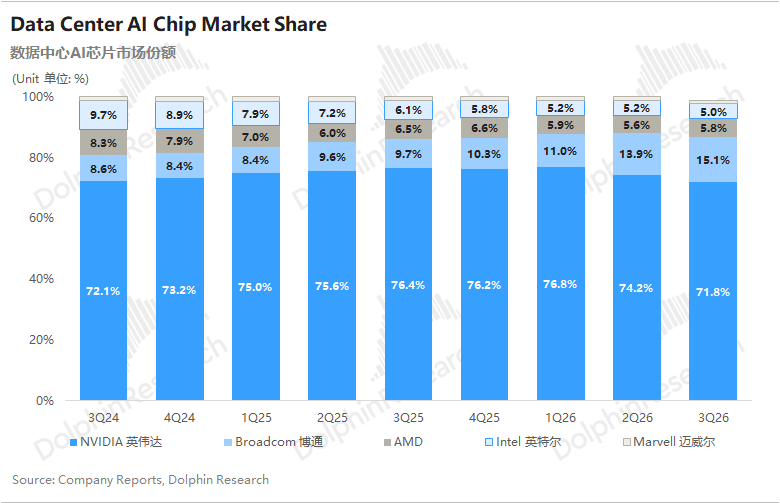
Market concerns about Nvidia's valuation have extended from "whether big tech capex will decline, whether market position/gross margin can be maintained, and whether performance has peaked" to "governance (CEO vacancy), compliance (export control investigation), and financing ecosystem (shrinkage of backstops)."
This earnings report temporarily eased concerns on the performance side, but the three issues of governance, compliance, and financing ecosystem remain unresolved—there is no timetable for a permanent CEO; the company is still studying the impact of new export control rules, and shipments of Hopper products to China have stopped; new cloud agreements are shrinking, while new hardware financing guarantees are increasing. If subsequent policies deteriorate further, the company's performance and valuation will still come under pressure.
Overall, this is an earnings report of "operating results beating expectations, risks not yet cleared." After the stock price fell back to its current level, support on the performance side has actually become stronger, but Dolphin does not believe this is simply a "mispricing": the valuation discount comes from three uncleared risks—governance, compliance, and financing ecosystem—rather than performance itself.
Before clear clearing signals appear (a permanent CEO in place, conclusions of an independent investigation, and export control legislation finalized), Dolphin believes the room for recovery is limited.
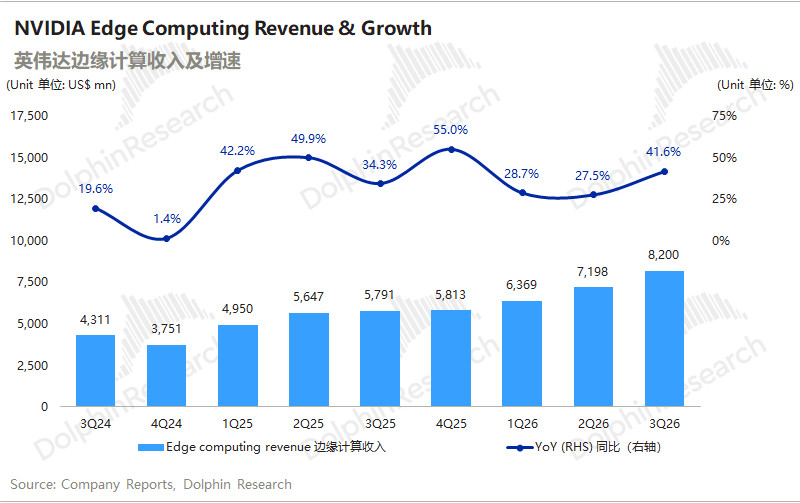
Dolphin's Nvidia earnings data and related charts:
- END -
// Reprint authorization
This article is an original article by Dolphin Research. For reprinting, authorization must be obtained.
// Disclaimer and general disclosure notice
This report is for general comprehensive data purposes only, intended for general reading and data reference by users of Dolphin Research and its affiliates, and does not take into account the specific investment objectives, investment product preferences, risk tolerance, financial situation, and special needs of any person who receives this report. Investors who make investments based on this report must consult an independent professional adviser before doing so. Anyone who makes investment decisions based on the use of or reference to the content or information mentioned in this report shall bear the risks themselves. Dolphin Research shall not be liable for any liability or loss that may be directly or indirectly caused by the use of the data contained in this report. The information and data contained in this report are based on publicly available materials and are for reference only. Dolphin Research strives for but does not guarantee the reliability, accuracy, and completeness of the relevant information and data.
The information mentioned or views expressed in this report shall not, in any jurisdiction, be regarded as or deemed an offer to sell securities or an invitation to buy or sell securities, nor do they constitute advice, inquiry, or recommendation regarding relevant securities or related financial instruments. The information, tools, and materials contained in this report are not intended or intended for distribution to citizens or residents of any jurisdiction where the distribution, publication, provision, or use of such information, tools, and materials would conflict with applicable laws or regulations or would cause Dolphin Research and/or its subsidiaries or affiliates to be subject to any registration or licensing requirements in that jurisdiction.
This report only reflects the personal views, opinions, and analytical methods of the relevant creators and does not represent the position of Dolphin Research and/or its affiliates.
This report is produced by Dolphin Research, and the copyright belongs solely to Dolphin Research. Without the prior written consent of Dolphin Research, no institution or individual may (i) produce, copy, reproduce, reprint, or forward in any form any copies or reproductions in any manner, and/or (ii) directly or indirectly redistribute or transfer them to other unauthorized persons. Dolphin Research reserves all related rights.
-
![]()
OpenAI Unveils GPT-6.2 Astra and Sol, Outperforming Claude Fable 5.2 at Just 5% of the Cost
-
![]()
Baidu's Q3 Report: Advertising Stalls as AI Takes the Wheel
-
![]()
JD.com: Retail Stops the Bleeding While Overseas Burns Cash — When Will the "Thrashing" End?
-
![]()
Great report! But without Jensen Huang, Nvidia just doesn't feel the same!
-
![]()
LCoS and the Screen Door Effect: Why Do Our Eyes "Catch" the Pixel Gaps?
-
![]()
Cybertruck Failed to Keep Musk, the Car Builder
-
![]()
Chips Are Scarce, Yet TSMC Has Started "Vetting Customers' Finances"?
-
After "Taking Down" Jensen Huang, the United States Officially Shows Its Hand: A Comprehensive Blockade on China's AI Computing Power